
科创板

Search documents
西安奕斯伟材料科技股份有限公司首次公开发行股票科创板上市公告书提示性公告
Shang Hai Zheng Quan Bao· 2025-10-27 23:10
Listing Overview - Xi'an Yiswei Materials Technology Co., Ltd. will list its ordinary shares on the Shanghai Stock Exchange's Sci-Tech Innovation Board on October 28, 2025 [1] - The total share capital after the initial public offering (IPO) will be 4,037,800,000 shares, with 537,800,000 shares being newly issued [4] Investment Risks - The company has not yet achieved profitability and will be classified under the Sci-Tech Growth Tier upon listing [2] - Investors must comply with suitability management requirements and sign a risk disclosure document before participating in trading [2] - The stock will have a price fluctuation limit of 20%, but there will be no limit on price changes for the first five trading days [2] Liquidity Concerns - The initial circulating shares will be 164,617,586 shares, representing 4.08% of the total share capital, indicating potential liquidity issues [3] Valuation Metrics - The IPO price corresponds to a price-to-sales (P/S) ratio of 16.41 times based on diluted earnings for 2024, which is lower than comparable companies in the A-share market [8] - The company has chosen to disclose the P/S ratio as it is not yet profitable, in accordance with regulatory requirements [7] Financing and Margin Trading - The stock will be eligible for margin trading from the first day of listing, which may introduce additional price volatility and liquidity risks [9]
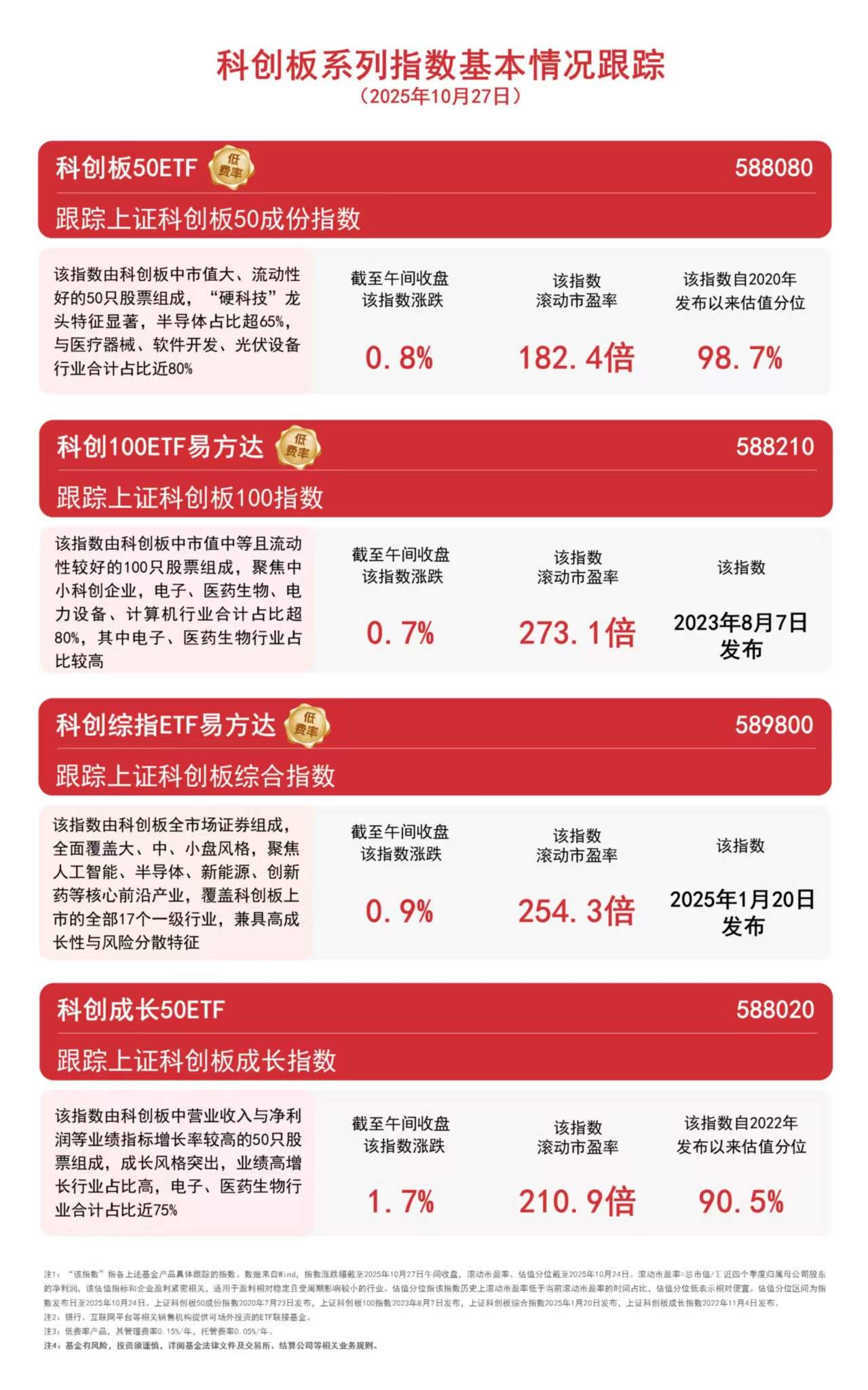
科创板系列指数集体走强,科创板50ETF(588080)等产品受市场关注
Mei Ri Jing Ji Xin Wen· 2025-10-27 05:16
Group 1 - The article presents a neutral stance on the opinions expressed by the author, indicating that the content does not reflect the views of Hexun and that the website does not guarantee the accuracy or completeness of the information [1][1][1]

养老金三季度现身4只科创板股
Zheng Quan Shi Bao Wang· 2025-10-27 02:48
Core Insights - Pension accounts have appeared in the top ten circulating shareholder lists of HaiTai New Light, DingTong Technology, Rejing Biology, and KaiYin Technology by the end of the third quarter [1] Group 1: Pension Holdings - The Basic Pension Insurance Fund 802 Combination is the fourth largest circulating shareholder of HaiTai New Light, holding 5.0346 million shares, accounting for 4.20% of circulating shares [1] - The Basic Pension Insurance Fund 1906 Combination and 16052 Combination are the seventh and ninth largest shareholders of DingTong Technology, with a total holding of 1.5174 million shares, representing 1.09% of circulating shares [1] - The Basic Pension Insurance Fund 16022 Combination is the ninth largest shareholder of Rejing Biology, holding 1.5001 million shares, which is 1.62% of circulating shares [1] - The Basic Pension Insurance Fund 2009 Combination is the eighth largest shareholder of KaiYin Technology, with a holding of 872.6 thousand shares, accounting for 0.51% of circulating shares [1] Group 2: Market Value of Holdings - The market value of HaiTai New Light's pension holdings is approximately 250.22 million [1] - The market value of DingTong Technology's pension holdings is approximately 144.02 million [1] - The market value of Rejing Biology's pension holdings is approximately 254.90 million [1] - The market value of KaiYin Technology's pension holdings is approximately 2.44 million [1]




广州必贝特医药股份有限公司首次公开发行股票科创板上市公告书提示性公告
Shang Hai Zheng Quan Bao· 2025-10-26 18:11
Listing Overview - The company, Guangzhou Bibete Pharmaceutical Co., Ltd., will list its common stock on the Shanghai Stock Exchange's Sci-Tech Innovation Board on October 28, 2025, with the stock code 688759 [1][2] - The total share capital after this issuance will be 450.036657 million shares, with 90 million shares being publicly offered, accounting for 20% of the total share capital post-issuance [2] Financial Metrics - The offering price is set at 17.78 CNY per share, which corresponds to a diluted 2024 price-to-research ratio of 66.52 times, lower than the average level of comparable companies in the pharmaceutical manufacturing industry, which has a recent average static price-to-earnings ratio of 31.83 times [5] Share Liquidity - The initial number of freely tradable shares will be 46.461981 million, representing 10.32% of the total share capital post-issuance, indicating a potential liquidity risk due to a relatively low number of circulating shares [4][3] Market Conditions - The company has not yet achieved profitability and will be classified under the Sci-Tech Growth Layer upon listing, which may affect investor participation and trading dynamics [2][3]
科创板平均股价41.67元,73股股价超百元
Zheng Quan Shi Bao Wang· 2025-10-24 10:04
Core Viewpoint - The average stock price of the STAR Market is 41.67 yuan, with 73 stocks priced over 100 yuan, indicating a strong performance in the market [1][2]. Group 1: Stock Performance - A total of 501 stocks on the STAR Market rose today, while 86 declined, reflecting overall positive market sentiment [1]. - The highest closing price was recorded by Cambrian-U at 1525.00 yuan, which increased by 9.01% [1]. - Among the stocks priced over 100 yuan, the average increase was 3.94%, with 66 stocks rising and 7 falling [1][2]. Group 2: Price Premiums - The average premium of stocks priced over 100 yuan relative to their issue price is 484.87%, with the highest premiums seen in companies like Shiwai New Materials (4311.48%), Cambrian-U (2268.38%), and Anji Technology (1653.77%) [1][2]. Group 3: Industry Concentration - The majority of stocks priced over 100 yuan are concentrated in the electronics, pharmaceutical, and computer industries, with 36, 11, and 10 stocks respectively [2]. Group 4: Capital Flow - There was a net inflow of 4.607 billion yuan into the stocks priced over 100 yuan today, with notable inflows into companies like SMIC (784.06 million yuan) and Tuojing Technology (564.74 million yuan) [2]. - The total margin financing balance for stocks priced over 100 yuan is 95.582 billion yuan, with Cambrian-U leading at 15.249 billion yuan [2].


科创板收盘播报:科创50指数涨4.35% 半导体股表现强势
Xin Hua Cai Jing· 2025-10-24 07:31
Core Points - The Sci-Tech Innovation 50 Index opened slightly higher on October 24 and experienced a significant increase, closing at 1462.22 points with a rise of 4.35% and a trading range of 3.6% [1] - The Sci-Tech Comprehensive Index rose by 3.55% to close at 1661.66 points, with a total trading volume of 233.5 billion yuan, a substantial increase compared to the previous trading day [2] - A total of 589 stocks on the Sci-Tech Board generally saw an increase, with high-priced stocks mostly rising and low-priced stocks showing mixed performance [2] Trading Performance - The average increase for the 589 stocks on the Sci-Tech Board was 2.49%, with an average turnover rate of 2.89% and a total trading volume of 233.5 billion yuan, with an average fluctuation of 4.19% [2] - Individual stock performance included Puran Co. and Shengyi Technology reaching the daily limit, while Sanofi Biologics saw a decline of 8.62%, the largest drop [3] Transaction Volume - The stock with the highest trading volume was Cambrian Technology, with a turnover of 23.4 billion yuan, while ST Guandian had the lowest trading volume at 1.06 million yuan [4] Turnover Rate - The stock with the highest turnover rate was Aerospace Huanyu at 25.71%, while the lowest was Bairen Medical at 0.21% [5]
科创板收盘播报:科创综指涨0.89% 电气设备股涨幅靠前
Xin Hua Cai Jing· 2025-10-20 07:38
Core Points - The Sci-Tech Innovation 50 Index opened significantly higher on October 20, initially rising over 2.5% before experiencing fluctuations, ultimately closing at 1367.90 points with a gain of 0.35% [1] - The overall Sci-Tech Innovation Index also opened strong, reaching a peak increase of nearly 2.7% during the morning session, closing at 1577.92 points with a gain of 0.89% and a total trading volume of approximately 1774 billion [1] - Approximately three-quarters of stocks on the Sci-Tech board saw gains, with notable increases in the electrical equipment sector and broad gains across software, specialized machinery, and transportation equipment [1] Trading Performance - On October 20, excluding suspended stocks, the average gain for the remaining 588 stocks on the Sci-Tech board was 1.28%, with an average turnover rate of 2.40% and a total trading volume of 1773.96 billion [1] - Individual stock performance highlighted that Yuanjie Technology surged by 14.49%, while Fuke Environmental Protection fell by 12.14% [1] - In terms of trading volume, Cambrian's trading volume reached 165.19 billion, leading the market, while Nearshore Protein had a trading volume of 710.22 million, the lowest [1] Turnover Rates - Zhongke Lanyun had the highest turnover rate at 15.33%, while Longteng Optoelectronics recorded the lowest at 0.20% [2]
创新药出海黄金时代,科创板抢占弹性先机
Quan Jing Wang· 2025-10-17 13:37
Core Insights - The article discusses the growth and potential of China's innovative drug industry, highlighting its transition from generic to innovative drug development, particularly in the context of the global market and competition with the U.S. [1][9] Group 1: Definition and Market Position of Innovative Drugs - Innovative drugs are defined as medications that are first to be launched globally, requiring novel efficacy and mechanisms of action [1][2] - The distinction between innovative drugs and generic drugs lies in the former's proprietary intellectual property and unique therapeutic functions [2][3] - China's innovative drug companies have made significant advancements, particularly in CAR-T therapies and bispecific antibodies, positioning themselves competitively on the global stage [1][8] Group 2: Pipeline Importance and Development Challenges - The pipeline is considered a major asset for innovative drug companies, with multiple projects running concurrently to mitigate risks associated with individual project failures [4][5] - The success rate for drug development from discovery to market is less than 7%, with the highest failure rates occurring in early stages [4][6] - China's innovative drug companies are noted for their rapid development and efficiency in their pipelines, which are diversified across various therapeutic targets [5][6] Group 3: Payment System and Policy Support - Recent policy changes have integrated innovative drugs into national healthcare strategies, enhancing the support for their development and market access [9][10] - The collaboration between public insurance and commercial insurance is crucial for the financial viability of innovative drugs, with current commercial insurance coverage being significantly lower than in developed markets [10][11] - The government has allocated substantial funds to support innovative drug development, with a notable shift towards commercial insurance to alleviate financial pressures on public healthcare systems [10][11] Group 4: Globalization and Collaboration Models - The article outlines the evolution of collaboration models for Chinese innovative drug companies, shifting from outright buyouts to co-development agreements with multinational corporations [12][13] - New collaborative structures, such as joint ventures, are emerging, reflecting the growing recognition of Chinese innovative assets on the global stage [12][13] - The increasing global acceptance of Chinese innovative drugs is expected to enhance their market presence and revenue potential [12][14] Group 5: Role of the STAR Market - The STAR Market is highlighted as a critical platform for innovative drug companies, providing access to capital and emphasizing their technological attributes [15][16] - The STAR Market's index includes a concentrated number of high-growth innovative drug companies, which are expected to perform well in the context of increasing global demand for innovative therapies [15][17] - The index's structure allows for significant investment opportunities, particularly in companies with strong research and development capabilities [16][17] Group 6: Future Growth Potential - The long-term outlook for China's innovative drug sector remains positive, with substantial growth opportunities anticipated over the next 3-5 years [19][20] - The domestic market for innovative drugs is still underdeveloped compared to global standards, indicating significant room for expansion [21][22] - The potential for large-scale contracts and partnerships with multinational companies is increasing, reflecting the competitive strength of Chinese innovative drug firms [22]
创新药出海黄金时代,科创板抢占弹性先机|2025招商证券“招财杯”ETF实盘大赛
Sou Hu Cai Jing· 2025-10-17 11:18
Core Insights - The article discusses the growth and potential of China's innovative drug industry, highlighting its transition from generic to innovative drug development, particularly in the context of global competition and market dynamics [1][2][3] Group 1: Innovative Drug Definition and Market Position - Innovative drugs are defined as medications that are first to be launched globally, requiring novel efficacy and mechanisms of action [2] - The distinction between innovative drugs and generic drugs lies in the former's unique patents and superior therapeutic effects [2][3] - China's innovative drug sector has made significant advancements, particularly in CAR-T therapies and bispecific antibodies, positioning itself competitively against the US [1][3] Group 2: Pipeline Importance and Development Challenges - The pipeline of innovative drug companies is a critical asset, with multiple projects often pursued simultaneously to mitigate risks [4][5] - The development cycle for innovative drugs can span 10 to 20 years, with a global success rate of less than 7% from discovery to market [4][6] - China's innovative drug companies are noted for their efficiency and progress in pipeline development, often leading globally [5][6] Group 3: Market Environment and Policy Support - Recent policy changes have improved the R&D and market environment for innovative drug companies in China, including better collaboration between medical insurance and commercial insurance [9][10] - The government has allocated significant funds to support innovative drugs, with 360 billion yuan redirected from generic drug payments to support innovative drug development [10] - The introduction of commercial insurance for innovative drugs is expected to enhance market access and payment structures [10][11] Group 4: Globalization and Collaboration Models - The collaboration model for Chinese innovative drug companies has evolved from outright buyouts to co-development partnerships with multinational corporations [12][13] - New models, such as joint ventures, are emerging, reflecting the increasing global recognition of Chinese innovative assets [13][14] - Successful examples, like the drug Zebutinib, demonstrate the potential for significant revenue generation from international markets [15] Group 5: Role of the Science and Technology Innovation Board - The Science and Technology Innovation Board (STAR Market) plays a crucial role in supporting innovative drug companies by providing access to capital for R&D [16][17] - The STAR Market's index includes a concentrated number of high-potential innovative drug companies, enhancing investment opportunities [17][18] - The index's structure allows for better risk management and investment in the innovative drug sector [18][19] Group 6: Future Growth Potential - The innovative drug sector in China is expected to experience substantial growth over the next 3 to 5 years, driven by increasing domestic demand and improved payment mechanisms [20][21] - The current market dynamics suggest a shift towards more innovative products, with a growing number of first-in-class drugs anticipated [22][23] - The potential for large contracts and partnerships indicates a robust future for the innovative drug industry in China [23][24]

科创板收盘播报:科创50指数跌3.77% 上涨个股仅39只
Xin Hua Cai Jing· 2025-10-17 07:55
Market Performance - The Sci-Tech 50 Index experienced a decline of nearly 4% on October 17, closing at 1363.17 points, with a drop of 3.77% and a fluctuation of 3.90% [1] - The total trading volume reached approximately 72.84 billion yuan, with 588 stocks on the Sci-Tech board averaging a decline of 3.49% and an average turnover rate of 2.78% [1] Stock Performance - Among individual stocks, Shenlian Bio led the gainers with an increase of 10.65%, while Shijia Photon recorded the largest drop at 18.58% [2] - In terms of trading volume, Cambrian Technology topped the list with a transaction volume of 10.61 billion yuan, while ST Guandian had the lowest at 863.2 thousand yuan [3] Turnover Rate - Saifen Technology achieved the highest turnover rate at 24.67%, whereas Longteng Optoelectronics had the lowest turnover rate at 0.25% [4]