职业教育

Search documents
天源迪科涨2.16%,成交额2.51亿元,主力资金净流出2036.62万元
Xin Lang Cai Jing· 2025-10-30 06:00
Core Viewpoint - Tianyuan Dike's stock price has shown a significant increase of 36.86% year-to-date, despite recent fluctuations in trading performance [2] Group 1: Stock Performance - As of October 30, Tianyuan Dike's stock price rose by 2.16% to 16.06 CNY per share, with a trading volume of 2.51 billion CNY and a turnover rate of 2.94%, resulting in a total market capitalization of 10.242 billion CNY [1] - Year-to-date, the stock has increased by 36.86%, with a 3.68% rise in the last five trading days, a 2.78% decline over the last 20 days, and a slight 0.12% drop over the last 60 days [2] Group 2: Financial Performance - For the period from January to September 2025, Tianyuan Dike reported a revenue of 6.3 billion CNY, reflecting a year-on-year growth of 12.44%, and a net profit attributable to shareholders of 38.603 million CNY, which is a 19.75% increase compared to the previous year [3] Group 3: Shareholder and Dividend Information - Since its A-share listing, Tianyuan Dike has distributed a total of 285 million CNY in dividends, with 28.699 million CNY distributed over the past three years [4] - As of October 20, 2025, the number of shareholders decreased to 94,200, with an average of 5,795 circulating shares per shareholder, which is an increase of 3.30% from the previous period [3]

科德教育跌2.05%,成交额1.28亿元,主力资金净流出1800.20万元
Xin Lang Cai Jing· 2025-10-30 05:20
Core Viewpoint - Kede Education's stock price has shown mixed performance in 2023, with a year-to-date increase of 12.42% but a recent decline in the last 20 days by 10.81% [2] Financial Performance - For the period from January to September 2025, Kede Education reported a revenue of 557 million yuan, representing a year-on-year decrease of 3.64% [3] - The net profit attributable to the parent company for the same period was approximately 92.45 million yuan, down 12.98% year-on-year [3] Stock Market Activity - As of October 30, Kede Education's stock price was 17.65 yuan per share, with a market capitalization of 5.809 billion yuan [1] - The stock experienced a net outflow of 18.002 million yuan from main funds, with significant selling activity [1] - Kede Education has appeared on the stock market's "Dragon and Tiger List" twice this year, with the most recent instance on August 26, where it recorded a net buy of -69.1483 million yuan [2] Shareholder Information - As of September 30, 2025, Kede Education had 45,100 shareholders, a decrease of 0.60% from the previous period [3] - The average number of circulating shares per shareholder increased by 0.60% to 7,192 shares [3] - The company has distributed a total of 356 million yuan in dividends since its A-share listing, with 204 million yuan distributed in the last three years [4] Business Overview - Kede Education, established on January 14, 2003, and listed on March 22, 2011, is based in Suzhou, Jiangsu Province [2] - The company's main business includes the research, production, and sales of environmentally friendly printing inks and education training services [2] - The revenue composition includes 48.77% from vocational and full-time schools, 20.04% from quick-drying glossy printing inks, 17.13% from high-gloss printing inks, and 13.64% from high-wear printing inks [2]

就业市场“求稳”催热面试辅导 首个国央企面试AI备考工具即将上线
智通财经网· 2025-10-30 03:14
Core Insights - The company Fenbi (02469) is launching a new AI product for interview preparation aimed at candidates preparing for state-owned enterprises and central enterprises, enhancing its career education ecosystem from exam preparation to job interview coaching [1][3] Group 1: Market Context - The number of college graduates in China is projected to reach 12.22 million by 2025, an increase of 430,000 year-on-year, marking a historical high [3] - State-owned enterprises have become the preferred employment direction for fresh graduates, with approximately 1 million job openings annually, 80% of which are targeted at new graduates, indicating a potential user base exceeding 4 million [3] - There is a noticeable increase in demand for structured and professional coaching services, extending from exam preparation to interview preparation [3] Group 2: Product Features - The new AI product leverages a vast database of past interview questions from state-owned enterprises, creating an online interactive system that simulates real interview scenarios [4] - It aims to address the pain points of traditional interview coaching, such as high costs and low practice frequency, by providing a 1:1 simulation of the interview process [4] - The product offers in-depth analysis based on key assessment dimensions for state-owned enterprise interviews, such as political stance and logical expression, while providing tailored suggestions based on individual responses [4] Group 3: Business Expansion - The state-owned enterprise interview AI product is the sixth intelligent preparation product launched by Fenbi in 2025, following other successful AI systems [5] - Since 2020, Fenbi's AI applications have served over 15 million users, demonstrating the company's ability to effectively reduce marginal development costs and enhance product implementation efficiency [5] - The continuous expansion of AI interview scenarios suggests that Fenbi is advancing in the career development sector, with plans to launch additional AI products for social recruitment and interactive foreign language learning [5]


产教融合“破题”人才瓶颈 山东职教赋能区域经济提质增效
Zhong Guo Xin Wen Wang· 2025-10-28 05:25
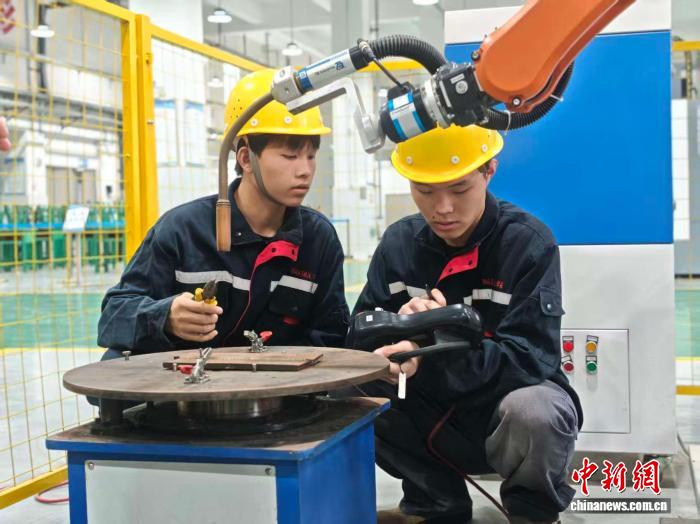
Core Insights - The integration of vocational education and local industries in Shandong is addressing talent shortages and enhancing regional economic development through specialized training programs [1][4]. Group 1: Industry Integration - Shandong's vocational education is closely aligned with local industries, exemplified by the establishment of the "Chatou Gourd Industry Education Alliance" to merge education with the gourd industry and rural revitalization [1]. - The gourd industry in Dongchangfu District has a planting area of over 30,000 acres, accounting for 75% of the national market share, generating an annual comprehensive benefit of 1.6 billion RMB [1]. - The "order-based training" model in Linyi City ensures that vocational schools tailor their programs to meet specific enterprise needs, resulting in over 500 skilled graduates annually [2]. Group 2: Educational Innovations - The Jining City vocational school has developed a professional system that aligns with the local economy, focusing on smart manufacturing and related fields [3]. - Partnerships with major companies like Lush Robot and Haier allow for practical training opportunities, enhancing students' hands-on skills and reducing the talent development cycle [3]. - The Huanzhou County Advanced Technical School has become a provincial-level artisan academy, expanding its enrollment in skilled trades and enhancing the flexibility of continuing education for workers [4]. Group 3: Employment Outcomes - Shandong has 547 vocational schools with 2.744 million students, maintaining a graduate employment rate of over 95% [4]. - More than 70% of new employees in key industries come from vocational schools, contributing to the emergence of skilled craftsmen and experts [4].
中文在线涨2.03%,成交额6.56亿元,主力资金净流入5163.80万元
Xin Lang Cai Jing· 2025-10-28 03:27
Core Viewpoint - The stock of Zhongwen Online has shown a positive trend with a year-to-date increase of 12.52%, reflecting strong market interest and trading activity [1][2]. Financial Performance - For the period from January to September 2025, Zhongwen Online achieved a revenue of 1.011 billion yuan, representing a year-on-year growth of 25.12% [2]. - The company reported a net profit attributable to shareholders of -520 million yuan, a significant decline of 176.64% compared to the previous year [2]. Stock Market Activity - As of October 28, Zhongwen Online's stock price was 27.60 yuan per share, with a trading volume of 656 million yuan and a turnover rate of 3.64%, leading to a total market capitalization of 20.107 billion yuan [1]. - The stock has seen a net inflow of 51.638 million yuan from main funds, with large orders contributing significantly to the buying activity [1]. Shareholder Information - As of September 30, 2025, the number of shareholders increased to 112,400, up by 7.20% from the previous period, while the average circulating shares per person decreased by 6.72% to 5,877 shares [2]. - The top ten circulating shareholders include Hong Kong Central Clearing Limited as the fifth largest shareholder, with 8.9865 million shares, marking a new entry [3].

2025年北京市普通中等专业学校招生规模公布
Bei Jing Shang Bao· 2025-10-27 05:21
北京商报讯(记者 吴其芸)10月27日,北京市教委官方微信公众号"首都教育"发布的消息显示,日 前,北京市教委发布《关于下达2025年北京市普通中等专业学校招生规模的通知》(以下简称《通 知》)。《通知》公布了2025年本市普通中等专业学校、五年制高等职业教育试点和高端技术技能人才 贯通培养试验项目招生规模。 各校要进一步整合融通各级各类优质教育资源,探索优质高效育人的发展新模式。紧密围绕首都经济社 会发展和产业转型升级需要,优化调整专业设置,全面加强校企合作,提升职业学校办学水平和教育质 量,增强职业教育对首都经济社会发展的贡献力和影响力。要统筹好招生、培养和就业工作,提高人才 培养的适应性。 《通知》提出,各普通中等专业学校、五年制高职试点学校和高端技术技能人才贯通培养学校要牢固树 立服务首都的意识,围绕首都经济建设与社会发展对职业技术人才的需要和市民对职业教育多样化的需 求,进一步明确办学定位,突出职业教育特色。 ...
前瞻“十五五”:我国职业教育发展五大趋势
Zhong Guo Qing Nian Bao· 2025-10-26 22:42
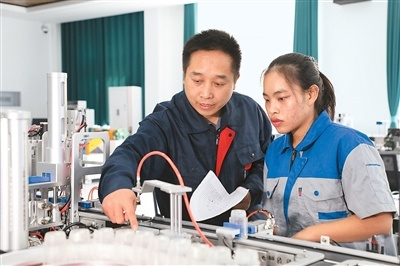
Group 1 - The core viewpoint emphasizes the importance of vocational education in supporting China's modernization goals and adapting to the evolving economic landscape, particularly in the context of the 14th and 15th Five-Year Plans [1][2][3] - The vocational education system has become the largest in the world, with over 70% of new skilled talents being trained through this system, significantly contributing to the manufacturing sector and the overall economy [1][3] - The focus is shifting from quantity to quality in vocational education, aiming to enhance the educational ecosystem and align with national strategic needs, particularly in advanced manufacturing and emerging industries [2][4] Group 2 - The strategic task of cultivating high-skilled talents has been elevated, with a clear directive from national leadership to innovate vocational education and increase the output of skilled workers [3][4] - Current statistics indicate that vocational schools produce over 10 million graduates annually, with a significant portion entering key industries, highlighting the critical role of vocational education in workforce development [3][5] - The educational structure is undergoing transformation, with a need to adjust professional categories to better meet the demands of high-end industries and technological advancements [5][6] Group 3 - The integration of education and industry (产教融合) is becoming increasingly important, with a focus on creating a symbiotic relationship between vocational institutions and enterprises to enhance talent development [7] - The digital transformation of vocational education is reshaping the educational landscape, promoting innovative teaching methods and addressing challenges such as resource shortages [8] - The trend of "going global" in vocational education is gaining momentum, with efforts to expand China's vocational training services internationally, particularly in alignment with the Belt and Road Initiative [9]
机器人前三季度营收22.18亿元同比降8.73%,归母净利润-1.60亿元同比降59.96%,毛利率下降0.61个百分点
Xin Lang Cai Jing· 2025-10-26 09:09
Core Insights - The company reported a decline in revenue and net profit for the first three quarters of 2025, with total revenue at 2.218 billion yuan, down 8.73% year-on-year, and a net loss of 160 million yuan, down 59.96% year-on-year [1][2] Financial Performance - Basic earnings per share for the reporting period were -0.10 yuan, with a weighted average return on equity of -3.66% [2] - The company's gross margin for the first three quarters was 13.79%, a decrease of 0.61 percentage points year-on-year, while the net margin was -6.98%, down 2.60 percentage points year-on-year [2] - In Q3 2025, the gross margin was 11.31%, a decline of 2.52 percentage points year-on-year and 3.30 percentage points quarter-on-quarter, with a net margin of -12.07%, down 6.89 percentage points year-on-year and 8.16 percentage points quarter-on-quarter [2] Expense Analysis - Total operating expenses for Q3 2025 were 486 million yuan, an increase of 5.5646 million yuan year-on-year, with an expense ratio of 21.90%, up 2.14 percentage points year-on-year [2] - Sales expenses decreased by 3.62% year-on-year, management expenses decreased by 1.45% year-on-year, while R&D expenses increased by 11.90% year-on-year, and financial expenses decreased by 12.63% year-on-year [2] Shareholder Information - As of the end of Q3 2025, the total number of shareholders was 181,200, a decrease of 12,100 or 6.24% from the end of the first half of the year, while the average market value per shareholder increased by 21.06% from 139,200 yuan to 168,500 yuan [2] Company Overview - The company, Shenyang Siasun Robot Automation Co., Ltd., was established on April 30, 2000, and listed on October 30, 2009. Its main business includes the design, manufacturing, and sales of industrial robots, logistics and warehousing automation equipment, automated assembly and testing production lines, and traffic automation systems [3] - The revenue composition includes 44.52% from automated assembly and testing production lines, 19.68% from logistics and warehousing automation equipment, 16.24% from industrial robots, 16.21% from semiconductor equipment, 3.07% from traffic automation systems, and 0.28% from other sources [3]

我在中国学技能(我在中国·行耕记)
Ren Min Wang· 2025-10-24 22:17
Core Insights - The rapid development of vocational education in China is attracting foreign students, who are gaining skills and witnessing the growth of Chinese industries [5][9][13] Group 1: Vocational Education Growth - China's vocational education system is expanding, drawing international students to learn skills and Chinese language [5] - The collaboration between Chinese vocational institutions and foreign schools enhances the learning experience for international students [6][9] Group 2: Student Experiences - Thai student Wang Xiaowen highlights the importance of practical training and cultural adaptation in his journey at Laiwu Vocational Technical College [6][7] - South African student Luo Wanjie expresses pride in designing a "Douban vegetable harvester," showcasing the application of theoretical knowledge to real-world problems [10][12] - Argentine student Lucas emphasizes the significance of practical skills in e-commerce, noting the unique ecosystem of Chinese online shopping platforms [13][16] Group 3: Cultural Integration - International students are engaging in various cultural activities, which help them adapt and feel a sense of belonging in China [11] - The exposure to Chinese culture enriches the students' experiences and broadens their perspectives [8][11]
10月24日珠江钢琴(002678)涨停分析:三季报预期、教育政策及托育概念驱动
Sou Hu Cai Jing· 2025-10-24 07:44
Group 1 - The stock of Zhujiang Piano reached a closing price of 6.81 yuan on October 24, with a limit-up performance and a closing market capitalization of 4.67% from the total circulation value [1] - The potential factors for the stock's limit-up include strong market expectations for improved company performance ahead of the Q3 report, positive overall performance in the musical instrument manufacturing industry, and favorable policies in arts education [1][3] - The company benefits from the active multi-child policy sector, enhancing its position as a multi-child concept stock, alongside deepening cultural tourism industry layouts through its subsidiary Zhujiang Ruifeng [1] Group 2 - On October 24, the net inflow of main funds was 40.51 million yuan, accounting for 7.44% of the total transaction amount, while retail investors experienced a net outflow of 298.93 million yuan, representing 0.55% of the total [1] - Over the past five days, the stock has shown significant fluctuations in net fund flows, with notable inflows and outflows reflecting changing investor sentiment [1]