
Scaling Law

Search documents
Thinking Machines Lab获20亿美元种子轮融资,人才成为AI行业最重要的要素
3 6 Ke· 2025-07-17 23:56
Core Insights - Thinking Machines Lab, founded by former OpenAI CTO Mira Murati, has raised $2 billion in seed funding led by a16z, achieving a valuation of $12 billion, marking it as the largest seed funding round in tech history [1][2] - The initial funding target was $1 billion with a valuation of $9 billion, but the final amount increased significantly over a few months [1] - The company currently lacks specific product offerings and revenue, with only a high-profile founding team and vague technological direction publicly available [1] Company Overview - Mira Murati has been with OpenAI since 2016, serving as CTO and leading the development of groundbreaking technologies like GPT-3, GPT-4, DALL-E, and ChatGPT [2] - The founding team includes notable AI experts such as John Schulman, Barret Zoph, Bob McGrew, Alec Radford, Alexander Kirillov, Jonathan Lachman, and Lilian Weng, all of whom have significant contributions to AI advancements [4][5][7][9][12][13][15] Talent Acquisition in AI Industry - The competition for top AI talent has intensified, with companies like Anthropic, Safe Superintelligence, and Thinking Machines Lab emerging as key players, all led by elite AI researchers [17] - The trend indicates that talent is becoming the most critical factor in the AI industry, surpassing computational power and data [17] - Major tech companies are aggressively acquiring talent, as seen in Meta's recruitment efforts, which include significant investments and hiring from various AI firms [18][19][20] Future Product Development - Thinking Machines Lab plans to release its first product within months, focusing on open-source components and AI solutions tailored to business KPIs, referred to as "reinforcement learning for businesses" [16] - The company emphasizes multimodal capabilities and effective safety measures for AI systems, aligning with industry trends towards responsible AI development [16]


Grok4、KIMIK2发布,算力板块业绩预告亮眼
Shanxi Securities· 2025-07-17 10:43
Investment Rating - The report maintains an "Outperform" rating for the communication industry, indicating an expected performance exceeding the benchmark index by over 10% [1][36]. Core Insights - The communication industry has seen significant advancements with the release of Grok4 and Kimi K2, which are expected to enhance capabilities in various applications such as programming and robotics [3][15]. - The earnings forecasts for major players in the server, optical module, and copper connection sectors are promising, with notable year-on-year growth expected [5][16]. - The ongoing global competition in computing power is shifting from model training to service quality and competitive advantages, suggesting a robust outlook for investments in the sector [7][18]. Summary by Sections Industry Investment Rating - The communication industry is rated as "Outperform," with expectations of exceeding the benchmark index by over 10% [1][36]. Industry Trends - Grok4, launched by xAI, boasts a tenfold improvement in reasoning capabilities compared to its predecessor, with applications in complex task execution and programming [3][14]. - Kimi K2, a new MoE model, has achieved state-of-the-art results in several foundational tests, indicating significant advancements in AI capabilities [4][15]. Earnings Forecasts - Industrial Fulian anticipates a net profit of 11.96-12.16 billion yuan for the first half of 2025, reflecting a year-on-year increase of 36.8%-39.1% [5][16]. - Other companies like Guangxun Technology and Huagong Technology also project substantial profit growth, with increases ranging from 30% to 95% year-on-year [5][16]. Investment Recommendations - The report suggests focusing on both overseas and domestic computing power chains, highlighting companies such as Industrial Fulian and Huagong Technology as key players [8][19]. - The ongoing arms race in computing power is expected to yield numerous investment opportunities in the coming years, particularly in the context of domestic algorithm optimization [17][18]. Market Overview - The overall market showed positive performance during the week of July 7-11, 2025, with notable increases in various indices, including a 2.36% rise in the ChiNext Index [8][19]. - Specific sectors such as equipment manufacturers and IoT led the weekly gains, indicating strong investor interest [8][19].



一文看懂:Grok 4到底强在哪里?
Hu Xiu· 2025-07-14 13:08
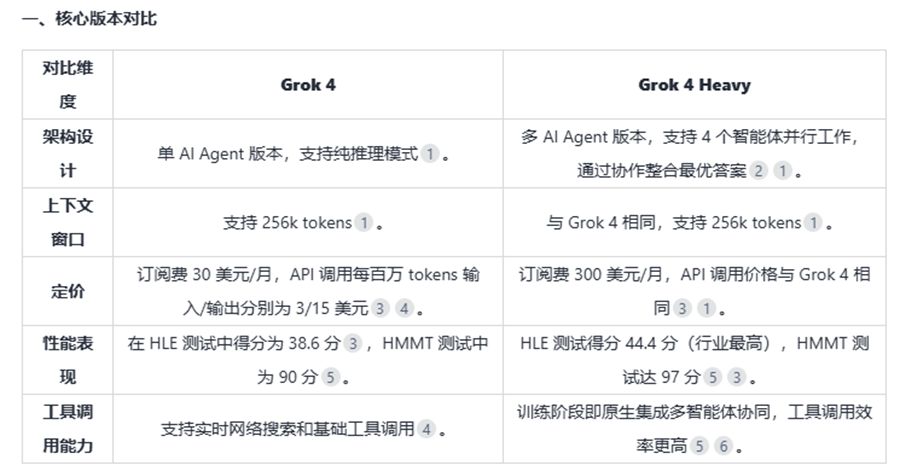
Core Insights - xAI has launched Grok 4, claiming it to be the world's strongest AI model, trained on the Colossus supercomputer with significantly increased computational resources compared to its predecessors [1][4][6] Group 1: Performance and Features - Grok 4 is trained on xAI's Colossus supercomputer, utilizing 100 times the computational resources of Grok-2 and 10 times that of Grok-3, leading to substantial improvements in inference performance and multi-modal capabilities [4][76] - Grok 4 is available in two versions: Grok 4 (monthly fee of $30) and Grok 4 Heavy (monthly fee of $300), with the latter supporting multiple agents working in parallel [5][6] - Grok 4 has demonstrated outstanding performance in various benchmarks, achieving scores of 38.6 in HLE and 90 in HMMT, while Grok 4 Heavy scored 44.4 in HLE, outperforming competitors like Gemini 2.5 Pro [7][9] Group 2: Innovations and Trends - The core innovation of Grok 4 is the introduction of multi-agent collaboration during the training phase, termed "multi-agent endogenous," which enhances the model's performance [6][28] - The emergence of HLE (Human Last Exam) as a benchmark aims to evaluate models' capabilities in a comprehensive manner, with Grok 4 Heavy achieving a significant score compared to previous models [11][12] - The trend of integrating agent capabilities into training processes is expected to drive a new arms race in AI model development, with significant scaling potential [81][83] Group 3: Market Implications - The global demand for computational power is anticipated to grow geometrically due to the multi-agent endogenous approach, as seen with Grok 4's training on the Colossus supercomputer, which is set to expand its GPU capacity [80][81] - The competitive landscape in AI coding capabilities is evolving, with Grok 4's current limitations in coding generation prompting expectations for future specialized coding models [63][65][72] - The success of startups like Base44, which focuses on practical coding solutions, highlights the market's demand for AI that can integrate various resources to create comprehensive applications [69][71]
对话千寻高阳:端到端是具身未来,分层模型只是短期过渡
晚点LatePost· 2025-07-10 12:30
Core Viewpoint - The breakthrough in embodied intelligence will not occur in laboratories but in practical applications, indicating a shift from academic research to entrepreneurial ventures in the field [1][5]. Company Overview - Qianxun Intelligent was founded by Gao Yang, a chief scientist and assistant professor at Tsinghua University, and Han Fengtao, a veteran in the domestic robotics industry, to explore the potential of embodied intelligence [2][3]. - The company recently demonstrated its new Moz1 robot, capable of performing intricate tasks such as organizing office supplies [4][3]. Industry Trends - The development of embodied intelligence is currently at a critical scaling moment, similar to the advancements seen with large models like GPT-4, but it may take an additional four to five years for significant breakthroughs [2][29]. - There is a notable difference in the development of embodied intelligence between China and the U.S., with China having advantages in hardware manufacturing and faster repair times for robots [6][7]. Research and Development - Gao Yang transitioned from autonomous driving to robotics, believing that robotics offers more versatility and challenges compared to specialized applications like self-driving cars [10][12]. - The field of embodied intelligence is experiencing a convergence of ideas, with many previously explored paths being deemed unfeasible, leading to a more focused research agenda [12][13]. Technological Framework - Gao Yang defines the stages of embodied intelligence, with the industry currently approaching Level 2, where robots can perform a limited range of tasks in office settings [17][18]. - The preferred approach in the industry is end-to-end systems, particularly the vision-language-action (VLA) model, which integrates visual, linguistic, and action components into a unified framework [19][20]. Data and Training - The training of VLA models involves extensive data collection from the internet, followed by fine-tuning with real-world operation data and reinforcement learning to enhance performance [23][24]. - The scaling law observed in the field indicates that increasing data volume significantly improves model performance, with a ratio of 10-fold data increase leading to substantial performance gains [27][28]. Market Dynamics - The demand for humanoid robots stems from the need to operate in environments designed for humans, although non-humanoid designs may also be effective depending on the application [33][34]. - The industry is moving towards a model where both the "brain" (AI) and the "body" (robotic hardware) are developed in tandem, similar to the automotive industry, allowing for specialization in various components [39][41].

为什么 AI 搞不定体力活——对话清华大学刘嘉:这才是生物智能最难攻克的“万里长征” | 万有引力
AI科技大本营· 2025-07-09 07:59
Core Viewpoint - The article discusses the evolution of artificial intelligence (AI) and its intersection with brain science, emphasizing the importance of large models and the historical context of AI development, particularly during its "winters" and the lessons learned from past mistakes [5][18][27]. Group 1: Historical Context of AI - AI experienced significant downturns, known as "AI winters," particularly from the late 1990s to the early 2000s, which led to a lack of interest and investment in the field [2][3]. - Key figures in AI, such as Marvin Minsky, expressed skepticism about the future of AI during these downturns, influencing others like Liu Jia to pivot towards brain science instead [3][14]. - The resurgence of AI began around 2016 with breakthroughs like AlphaGo, prompting a renewed interest in the intersection of brain science and AI [3][14]. Group 2: Lessons from AI Development - Liu Jia reflects on his two-decade absence from AI, realizing that significant advancements in neural networks occurred during this time, which he missed [14][15]. - The article highlights the importance of understanding the "first principles" of AI, particularly the necessity of large models for achieving intelligence [22][27]. - Liu Jia emphasizes that the evolution of AI should not only focus on increasing model size but also on enhancing the complexity of neural networks, drawing parallels with biological evolution [24][25]. Group 3: Current Trends and Future Directions - The article discusses the current landscape of AI, where large models dominate, and the importance of scaling laws in AI development [27][30]. - It notes the competitive nature of the AI industry, where advancements can lead to rapid obsolescence of existing models and companies [36][39]. - The article suggests that future AI development should integrate insights from brain science to create more sophisticated neural networks, moving beyond traditional models [25][50].

原来Scaling Law还能被优化?Meta这招省token又提效
机器之心· 2025-07-06 03:49
Core Insights - The article discusses the advancements in AI, particularly focusing on the evolution of the Transformer model and the introduction of the 2-simplicial Transformer, which enhances the efficiency of token utilization and model scalability [1][4][10]. Group 1: Transformer and AI Development - The paper "Attention Is All You Need" marked a significant turning point in AI development, establishing the Transformer as the foundational paradigm for current language models [1]. - The citation count for this paper is approaching 190,000, indicating its profound impact on the field [2]. - The ongoing challenge in AI is acquiring a sufficient quantity of high-quality tokens and efficiently utilizing them, necessitating further upgrades to the Transformer model [3]. Group 2: 2-Simplicial Transformer - Meta's recent research introduced a rotationally invariant trilinear attention mechanism, demonstrating comparable representational capacity to the 2-simplicial Transformer and potentially altering the coefficients in the Scaling Law [4][10]. - The 2-simplicial Transformer, derived from Clift et al. (2019), generalizes the dot-product attention mechanism to a trilinear form, enhancing its scalability under token constraints [19][11]. - Experimental results indicate that the 2-simplicial Transformer can more effectively approximate the irreducible entropy of natural language compared to traditional dot-product attention Transformers [11]. Group 3: Scaling Law and Model Performance - The Scaling Law describes how loss decreases with the total number of model parameters and token count, suggesting that larger models should approach the irreducible loss of natural text distribution as both parameters and tokens increase [13][15]. - Hoffmann et al. (2022) found that the optimal number of parameters and dataset size should scale proportionally with the computational budget, with estimated scaling exponents around 0.49 for parameters and 0.5 for tokens [17][18]. - The 2-simplicial Transformer exhibits a steeper scaling slope compared to the dot-product attention Transformer, indicating a higher exponent in its Scaling Law [50]. Group 4: Experimental Results - The team conducted experiments with various models, revealing that the 2-simplicial attention mechanism did not provide benefits in models with fewer than 2 billion active parameters [45]. - The performance metrics across different model sizes showed slight improvements or declines when comparing the 2-simplicial Transformer to traditional Transformers, with variations in performance percentages noted [43][44]. - The study estimated the differences in scaling coefficients between the 2-simplicial and dot-product attention mechanisms, highlighting the potential for improved efficiency in larger models [46][49].


华泰证券:算力链高景气延续,下半年AI眼镜有望迎来拐点
news flash· 2025-07-02 00:01
Group 1 - The report from Huatai Securities suggests that the electronic sector is expected to maintain high prosperity due to the continuous iteration of large model architectures and the potential acceleration of inference demand driven by Scaling Law [1] - In terms of self-controllability, the domestic manufacturing sector is advancing in terms of advanced process capacity, presenting opportunities for domestic equipment manufacturers as new capacities continue to emerge, leading to an increase in localization rates [1] - On the AI front, AI glasses are anticipated to reach a turning point in the second half of the year, while the smart driving sector is expected to accelerate its industrial trend due to continuous price reductions [1]

公布最新研究!这次1XWorldModel如何颠覆人形机器人领域?
机器人大讲堂· 2025-06-29 03:53
Core Insights - 1X Technologies has launched the world's first humanoid robot world model, 1X World Model, which demonstrates significant advancements in technology and application scenarios [1][2] - The model utilizes video generation technology and end-to-end autonomous driving world models to simulate how the real world evolves under the influence of intelligent agents [2][3] Group 1: Model Capabilities - The 1X World Model showcases controllable actions, allowing it to generate different outcomes based on various action commands, demonstrating diverse generation characteristics from the same initial frame [3][7] - It accurately simulates interactions between objects, enabling the robot to lift and move objects while keeping others stationary under specified conditions [5][10] - The model can predict the consequences of executing precise actions in various scenarios, such as opening doors and wiping surfaces, showcasing its ability to generate physically plausible future states [8][10] Group 2: Evaluation and Performance - The evaluation of the model's performance has been enhanced through the collection of over 3000 hours of real operational data, allowing it to learn from diverse tasks in home and office environments [16][18] - The model's ability to predict future states and task success rates has been validated against real-world performance, establishing a robust feedback mechanism for model optimization [18][20] - Empirical evidence shows that checkpoints with higher performance in the 1X World Model evaluation tend to perform better in real assessments, indicating a strong correlation between predicted success rates and actual task scores [20][21] Group 3: Data Scaling and Transfer Learning - The research indicates a positive correlation between data volume and prediction accuracy, confirming that increasing data size improves the model's performance across various tasks [25][32] - Experiments demonstrate that the model can effectively transfer knowledge from one task to another, enhancing its ability to generalize from accumulated experiences [35][40] - The model's performance is significantly improved when trained with specific task data, allowing it to adapt to unfamiliar tasks and environments more effectively [40][41] Group 4: Future Implications - The advancements in the 1X World Model suggest a potential "data singularity" in robotics, where AI-generated data becomes indistinguishable from real data, revolutionizing training methodologies [41][42] - The model's success could accelerate the commercialization of household service robots and reshape the competitive landscape of the AI industry [42]

通往 AGI 之路的苦涩教训
AI科技大本营· 2025-06-26 11:10
Core Viewpoint - The article discusses the rapid advancement of AI and the potential for achieving Artificial General Intelligence (AGI) within the next 5 to 10 years, as predicted by Google DeepMind CEO Demis Hassabis, who estimates a 50% probability of this achievement [1] Group 1: AI Development and Challenges - The AI wave is accelerating at an unprecedented pace, but there have been numerous missteps along the way, as highlighted by Richard Sutton's 2019 article "The Bitter Lesson," which emphasizes the pitfalls of relying too heavily on human knowledge and intuition [2][4] - Sutton argues that computational power and data are the fundamental engines driving AI forward, rather than human intelligence [3] - The article suggests that many previously held beliefs about the paths to intelligence are becoming obstacles in this new era [4] Group 2: Paths to AGI - The article introduces a discussion on the "bitter lessons" learned on the road to AGI, featuring a dialogue with Liu Jia, a professor at Tsinghua University, who has explored the intersection of AI, brain science, and cognitive science [5][11] - Liu Jia identifies three paths to AGI: reinforcement learning, brain simulation, and natural language processing (NLP), but warns that each path has its own hidden risks [9] - The article emphasizes that language does not equate to cognition, and models do not represent true thought, indicating that while NLP is progressing rapidly, it is not the ultimate destination [9][14] Group 3: Technical Insights - The article discusses the Scaling Law and the illusion of intelligence associated with large models, questioning whether the success of these models is genuine evolution or merely an illusion [15] - It raises concerns about the limitations of brain simulation due to computational bottlenecks and theoretical blind spots, as well as the boundaries of language in relation to understanding the world [14]

Kimi还能找到月之亮面吗?
3 6 Ke· 2025-06-25 08:08
Core Insights - Kimi, once a prominent player in the AI space, has seen a decline in attention as newer models from companies like Quark, Tencent, and Alibaba gain traction [1][2] - The initial hype around Kimi was driven by its technological scarcity, particularly its long-text processing capabilities, which were unmatched at the time [2][3] - Kimi's early valuation of $3 billion was supported by its unique technology, the founder's impressive background, and the capital's anxiety to find a domestic alternative to leading AI models [4][5] Technology and Market Position - Kimi's long-text processing ability, which expanded from 200,000 to 2 million words, was a significant technological breakthrough that positioned it as a leader in the AI field [2][3] - The founder, Yang Zhilin, had a strong academic and entrepreneurial background, which enhanced investor confidence in Kimi's potential [3][4] - The competitive landscape was characterized by a rush to find alternatives to ChatGPT, leading to Kimi's rapid user acquisition through aggressive marketing strategies [4][5] Financial Strategy and User Acquisition - Kimi faced challenges in managing its newfound capital, leading to excessive spending on user acquisition, with monthly advertising costs peaking at 220 million RMB [6][7] - Despite a significant increase in daily active users (DAU) from 508,300 to 5,897,000, this growth was primarily driven by financial investment rather than product quality [8][9] - The pressure from investors to demonstrate commercial viability led Kimi to prioritize user numbers over technological development, resulting in a loss of strategic direction [8][9] Challenges and Strategic Missteps - Kimi's marketing strategy shifted focus from its core user base in academia and professional fields to entertainment sectors, diluting its brand identity [11][12] - The company struggled with maintaining its technological edge as competitors began to catch up, particularly with the emergence of open-source models [12][13] - Kimi's reliance on user growth without a solid feedback loop or data quality management led to a false sense of security regarding its market position [13] Future Opportunities - Kimi has potential avenues for recovery, including enhancing the value density of its products and focusing on deep search capabilities for specific industries [15][17] - The company could benefit from developing comprehensive tools for developers, improving its API offerings to facilitate easier integration for enterprise clients [18][19] - Emphasizing quality over quantity in user engagement and product offerings could help Kimi regain trust and market relevance [20][21] Strategic Recommendations - Kimi needs to establish a clear commercial strategy from the outset, ensuring that its products meet genuine market demands and have viable monetization paths [29][30] - The focus should shift towards building a sustainable revenue model based on user payments rather than relying on external funding for growth [31] - A strategic approach that prioritizes understanding and fulfilling real user needs will be crucial for Kimi's long-term success in the competitive AI landscape [31][32]