价值投资

Search documents
沪深300没沸腾,还谈不上牛市
雪球· 2025-08-19 08:43
Group 1 - The market is currently experiencing a bifurcation, with small-cap stocks performing well while blue-chip stocks remain stagnant [5] - Bank stocks are an exception but are showing signs of weakness recently [6] - The prevailing sentiment among some market participants is that being conservative is a sign of laziness, which can mislead new investors [7] Group 2 - The absence of a significant rise in the CSI 300 index indicates that a true bull market cannot be declared; the current situation is merely a structural market [8] - Small-cap stocks are perceived as performing well, but this is misleading as they have also faced significant declines in the past [10] - Comparing historical peaks, the CSI 2000 index has dropped 29.18% and the CSI 300 has dropped 21.21% since their 2015 highs, indicating that small-cap stocks have underperformed more severely [12] Group 3 - New investors are encouraged to engage in extensive reading and learning about investment principles, market history, and financial analysis [13] - The notion that stocks related to popular themes can sustain high valuations indefinitely is criticized as a form of indoctrination rather than genuine learning [13] - The primary reason for retail investors' losses is buying at high prices, which can be avoided by not chasing hot stocks [13]


北上广深杭私募最新业绩揭晓!同犇投资、复胜资产、阿巴马投资等上榜!微方基金、富延资本、北京禧悦等夺冠!
私募排排网· 2025-08-19 08:16
Core Viewpoint - The article discusses the performance and ranking of private equity firms in major Chinese cities, highlighting the concentration of firms in first-tier cities and their average returns for the first seven months of the year [1][3]. Group 1: Overview of Private Equity Firms - A total of 571 private equity firms with three or more performance-displaying products are listed on the platform, with over 70% located in "Beijing, Shanghai, Guangzhou, Shenzhen, and Hangzhou" [1]. - The average returns for private equity products from January to July in these cities are as follows: Shanghai 13.63%, Shenzhen 16.41%, Beijing 14.69%, Hangzhou 17.60%, and Guangzhou 22.70% [3]. Group 2: Shanghai Private Equity Rankings - In Shanghai, 174 private equity firms are recorded, with an average return of 13.63% for the year [4]. - The top three firms in Shanghai by return are 微方基金, 同犇投资, and 龙航资产, with their respective returns being undisclosed due to regulatory requirements [4][5]. Group 3: Shenzhen Private Equity Rankings - Shenzhen has 97 private equity firms, with an average return of 16.41% [11]. - The top three firms in Shenzhen are 富延资本, 能敬投资控股, and 榕树投资, with their returns also undisclosed [11][12]. Group 4: Beijing Private Equity Rankings - Beijing has 78 private equity firms, with an average return of 14.69% [17]. - The top three firms in Beijing are 北京禧悦私募, 北恒基金, and 盛天投资, with their returns undisclosed [17][20]. Group 5: Hangzhou Private Equity Rankings - Hangzhou has 42 private equity firms, with an average return of 17.60% [24]. - The top three firms in Hangzhou are 浩坤昇发资产, 杭州博衍私募, and 云起量化, with their returns undisclosed [24][29]. Group 6: Guangzhou Private Equity Rankings - Guangzhou has 33 private equity firms, with an average return of 22.70% [30]. - The top three firms in Guangzhou are 沁昇基金, 三和创赢, and 泽元投资, with their returns undisclosed [30][35]. Group 7: Other Regions Private Equity Rankings - Other regions have 147 private equity firms, with an average return of 15.31% [36]. - The top three firms in these regions are 滨利投资, 路远私募, and 持赢私募, with their returns undisclosed [36][40].
目前中国股市远达不到泡沫化的状态!中泰姜诚最新发声:我们要时刻瞄准,但不需要频繁开枪
聪明投资者· 2025-08-19 07:03
Core Viewpoint - The A-share market is suitable for value investing, where stock prices serve as an external variable to assess potential returns rather than a variable to predict [2][25][26]. Group 1: Market Performance and Investment Strategy - As of August 18, the Shanghai Composite Index reached a nearly ten-year high, closing at 3728.03 points, with the A-share market capitalization surpassing 100 trillion yuan, marking a historical peak [2]. - The current stock prices are not as cheap as they were ten months ago, and some stocks have seen a decline in implied returns. However, the Chinese stock market is not in a bubble state when viewed alongside the Hong Kong market [2][55][56]. - The investment strategy emphasizes patience and a different perspective, focusing on long-term value rather than short-term market fluctuations [8][16][39]. Group 2: Fund Performance and Manager Insights - The fund managed by Jiang Cheng has shown a year-to-date return of 6.03%, with a three-year return of 23.77% and a five-year return of 74.68%, indicating stable performance [3]. - Jiang Cheng maintains a conservative approach, focusing on traditional sectors such as banking, chemicals, construction, and real estate, with a long-term investment horizon [3][5]. - The investment philosophy includes a significant emphasis on understanding the underlying value of assets and avoiding value traps, dedicating 20% of research efforts to identifying potential pitfalls in existing holdings [20][22]. Group 3: Value Investment Principles - Value investing is defined as an investment behavior aimed at acquiring asset value, with cash returns being the primary measure of value creation [23]. - The market's price volatility can create more opportunities for value investing, as it allows investors to buy undervalued assets [25][26]. - Safety margin is viewed as a conservative attitude, acknowledging the unpredictability of future market conditions and focusing on protecting against adverse scenarios [18][19]. Group 4: Market Dynamics and Long-term Outlook - The current market environment presents both pressures and opportunities, with a need for caution at the micro level while maintaining optimism at the macro level [58][59]. - Continuous learning and adaptation to new market dynamics are essential for identifying long-term investment opportunities, especially in emerging sectors like AI and innovative pharmaceuticals [40][43][45]. - The investment approach encourages a focus on long-term goals and the ability to tolerate short-term market fluctuations without being overly influenced by them [52][63].
历史新高!突破4.8万亿
中国基金报· 2025-08-19 06:37
Core Viewpoint - The article highlights the significant growth of the ETF market in China, with total ETF assets surpassing 4.8 trillion yuan, reflecting increased confidence and willingness of institutional and individual investors to enter the market [2] Group 1: Long-term Investment Strategy - The "long money, long investment" strategy aligns with the "three investment" philosophy, emphasizing the need for stability in the market and promoting a virtuous cycle between the capital market and the real economy [4] - Regulatory support through policies like the "National Nine Articles" and the "High-Quality Development Action Plan for Index Investment" aims to guide long-term capital into the market [4][5] - Investor education initiatives have been crucial in promoting long-term investment concepts, with significant outreach efforts reaching millions of clients [4] Group 2: ETF Market Dynamics - Broad-based ETFs tracking major indices like the CSI 300 and the STAR Market have become primary tools for long-term capital allocation, showing resilience during market adjustments [6] - The share of institutional investment in broad-based ETFs has increased significantly, indicating a shift towards long-term strategies [6] - The rise of thematic and sector-specific ETFs is driving capital towards strategic emerging industries, aligning with national priorities [7] Group 3: Bond ETFs and Market Stability - Bond ETFs have seen explosive growth, exceeding 500 billion yuan, serving as a stabilizing force in investor portfolios amid declining interest rates [8] - The demand for bond ETFs reflects strong long-term capital allocation needs among investors [8] Group 4: Institutional Investor Influence - Institutional investors have become a cornerstone of the ETF ecosystem, with their holdings in equity ETFs exceeding 40% by the end of 2024 [10] - The penetration rates of institutional investors in stock and bond ETFs have reached 62.14% and 84.9%, respectively, indicating a robust shift towards long-term investment [10] Group 5: Future Outlook - The deepening of personal pension systems and expansion of the third pillar of pensions will continue to broaden the supply of long-term capital [13] - ETFs are expected to play a crucial role in aligning capital with national innovation strategies, particularly in hard technology sectors [13] - The article envisions a resilient and vibrant capital market driven by patient capital flowing into strategic areas like hard technology and green initiatives [13]

历史新高!突破4.8万亿
Zhong Guo Ji Jin Bao· 2025-08-19 06:37
Group 1 - The core viewpoint of the articles highlights the significant growth of the ETF market, which has surpassed 4.8 trillion yuan, reflecting increased confidence and willingness of institutional and individual investors to enter the market [1][2][7] - The "long money long investment" strategy is gaining traction, aligning with the "three investment" philosophy, which emphasizes stable market conditions and a positive cycle between capital markets and the real economy [2][9] - Regulatory support through policies such as the "National Nine Articles" and the "High-Quality Development Action Plan for Index Investment" is facilitating the entry of long-term capital into the market [2][3] Group 2 - Broad-based ETFs tracking major indices like the CSI 300 and the STAR Market are becoming primary tools for long-term capital allocation, demonstrating resilience during market adjustments [3][4] - The rise of thematic and sector-specific ETFs is directing funds towards strategic emerging industries, such as hard technology and new energy, thereby enhancing the development of new productive forces [4][5] - Bond ETFs have seen explosive growth, exceeding 500 billion yuan, serving as a stabilizing force in investors' asset allocation amidst a declining interest rate environment [5][6] Group 3 - Institutional investors are increasingly becoming the backbone of the ETF ecosystem, with their holdings in stock ETFs surpassing 40% by the end of 2024, indicating a shift towards long-term investment strategies [7][8] - The low-cost nature of ETFs reduces friction in long-term investments, while their transparency enhances investors' understanding of value logic, effectively connecting long-term capital with quality assets [8][10] - The future of the ETF market is expected to expand with the deepening of personal pension systems and the integration of capital with technological innovation, promoting sustainable growth in strategic sectors [9][10]
会员金选丨巴菲特直播课限免权益
第一财经· 2025-08-19 03:31
Group 1 - The article emphasizes the core logic of value investing, highlighting insights from Warren Buffett's 70 years of shareholder letters and the management philosophy of his successor, Abel [2][11] - It discusses the importance of developing skills to navigate market cycles, focusing on a three-dimensional system of "theory - tools - practice" to help investors make informed decisions and identify long-term growth opportunities [4][11] - The content is designed for both novice investors and those looking to enhance their returns, featuring real investment scenarios backed by two authoritative institutions [4][6] Group 2 - The course includes four sessions, each lasting 1 to 1.5 hours, presented in high-definition video format, aimed at deepening understanding of investment strategies [6] - It addresses the challenges of cognitive biases in investing, particularly how ordinary investors can combat cognitive anxiety in the face of global policy shifts and technological revolutions [11] - The article promotes a limited-time free access to the "Value Investment System Course" for members, encouraging immediate registration to secure a learning spot [3][8]
证监会再放“利好”!8月19日,凌晨的三大重要消息冲击市场!
Sou Hu Cai Jing· 2025-08-19 03:03
A股市场尚未给出明确的见顶信号,市场仍有上涨空间。一方面,市场的做多力量依然非常强劲,尽管盘中出现了明显的震荡,但上证指数涨幅达到了中阳 线级别,超过30个指数点;另一方面,证监会多次利好消息,深成指给出了接近2%的中大阳线;创业板指涨幅接近3%。这些数据表明,市场做多力量依然 充足,只要这种做多力量没有明显减弱,市场就仍有继续上涨的动力。 二、警惕!上证指数刷新了过去十年的新高。 一、证监会再放"利好"!大盘全天呈现出一片喜气洋洋的景象,放量大涨,并且刷新了10年以来的高点。从市场的整体表现来看,牛市的特征已经非常明 显,两市成交量达到了2.7万亿以上,如此之高的成交量,不禁让人联想到是否应该在长高放量时选择离场。 沪深两市的三大指数都创出新高表现,市场牛气冲天、让人震撼!但在放量拔高的过程中,分歧和浮盈盘兑现也随之而来,冲高带动情绪加速、就快速迎来 了一波抛压。 近2.8万亿的成交量也表现出获利盘兑现的动作,短期是继续上攻,还是回档休息?从沪指月线的表现来看,突破十年最高点则彰显了强势态度,但技术上 的分歧抛压该释放还需要释放,经典技术走势"突破→回踩→反包"的预期则更高。 四、涨停复盘:创业板指高开高走 ...
二十年只管一只基金,朱少醒的“马拉松”为何突然掉队?
Sou Hu Cai Jing· 2025-08-19 01:13
Core Viewpoint - Zhu Shaoxing, a prominent fund manager, has faced significant challenges in recent years, with his fund, Fuqun Tianhui, experiencing a substantial decline in net value and underperforming its benchmark since 2021 [2][4]. Group 1: Fund Performance - Zhu Shaoxing has managed Fuqun Tianhui since 2005, achieving an annualized return of 15.14% over nearly 20 years, significantly outperforming the benchmark [2][3]. - Since 2021, the fund's net value has seen a maximum drawdown of nearly 50%, leading to a reduction in assets under management from a peak of 44.5 billion yuan to 23.5 billion yuan [4][6]. - The fund's top ten holdings have decreased in concentration from 50% to 34.98% of the fund's net value in recent years, indicating a shift in strategy to mitigate risk [6][8]. Group 2: Investment Philosophy - Zhu's investment philosophy centers on "selecting individual stocks and holding them long-term," with a focus on finding companies with strong growth potential [3][9]. - The fund maintains a high stock position, typically around 90%, and diversifies across sectors, ensuring no single industry exceeds 30% of the portfolio [3][9]. Group 3: Key Holdings and Adjustments - Zhu has consistently held a significant position in Kweichow Moutai since 2006, viewing it as a company with a strong brand and pricing power, despite its recent underperformance [8][9]. - In 2025, the fund re-entered a position in Guangdong Hongda, a company involved in military and civilian explosives, which has shown strong revenue and profit growth [10][11]. - The fund's strategy has evolved from aggressive accumulation of Kweichow Moutai to a more cautious approach, reflecting changing market conditions and pressures on the liquor sector [9][10].



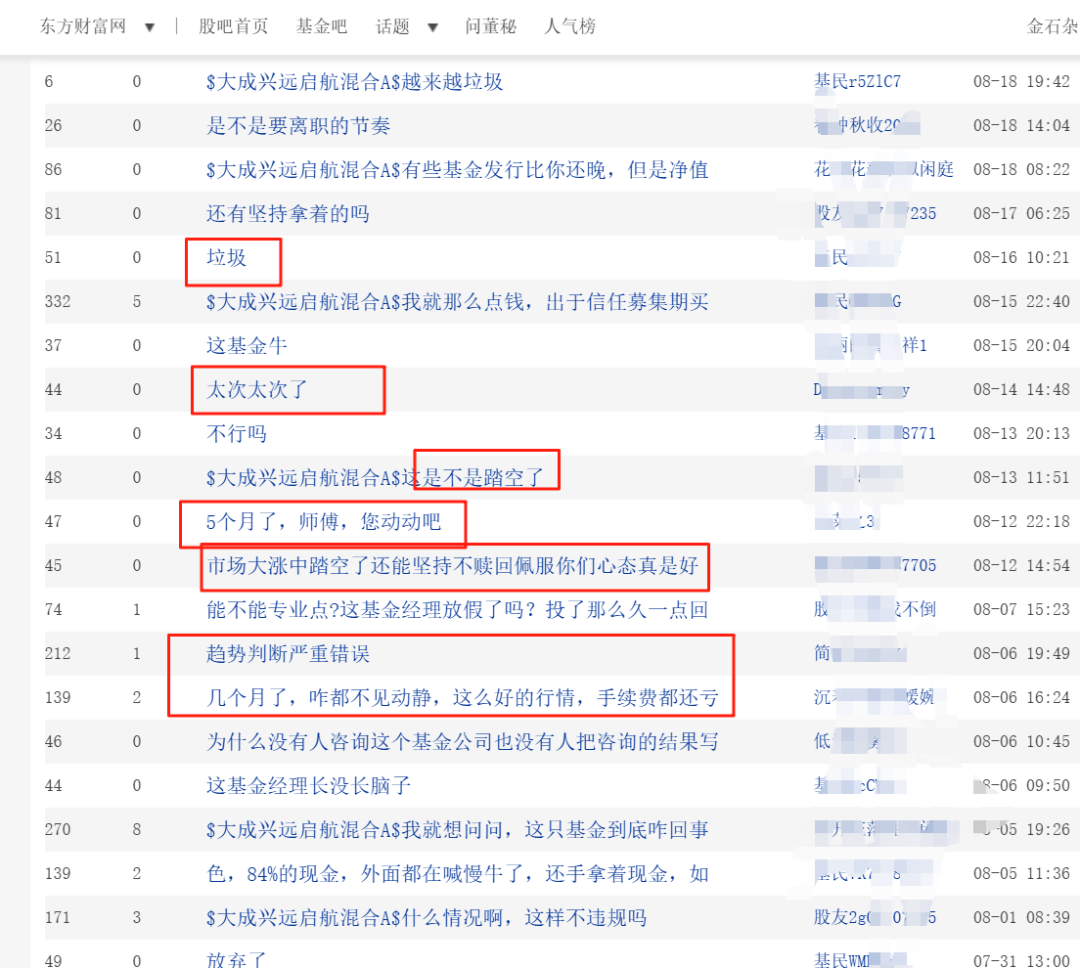
公募权重级基金经理被骂了!徐彦新基,成立半年,仍在水下...
Sou Hu Cai Jing· 2025-08-19 00:22
Core Viewpoint - The article highlights the struggles of Xu Yan, a prominent fund manager at Dacheng Fund, whose recent performance has drawn criticism from investors due to a lack of significant returns and a high cash allocation in his fund [2][11][15]. Fund Performance - Xu Yan manages the Dacheng Xingyuan Qihang Mixed Fund, which has a current net value of 0.9995, indicating it is barely above break-even after six months since its establishment on March 11, 2025 [2][10]. - The fund's initial fundraising was 757 million, but it has since shrunk to 627 million, reflecting a 17% decrease in size primarily due to investor redemptions rather than direct losses [2][10]. - Investors have expressed dissatisfaction, with comments indicating frustration over missed opportunities in a rising market, as the fund has not made significant moves to invest [2][3][15]. Investment Strategy - Xu Yan has not initiated large-scale investments, stating that the fund is still in the accumulation phase and has maintained 84% of its assets in cash, with only 0.72% allocated to equities [11][14]. - The rationale behind this strategy is attributed to the current market conditions, where many stocks are perceived as overvalued, making it challenging to find undervalued opportunities [11][15]. - Xu Yan's cautious approach contrasts sharply with the broader market, which has seen significant gains, leading to perceptions of him as missing out on the bull market [15][16]. Historical Context - Prior to the recent downturn, Xu Yan was recognized for his strong performance, achieving an annualized return of 12.66% and positive returns over three years [6][8]. - His management of other funds has yielded returns of around 20% for those launched in 2023 or 2024, but his current fund's performance has lagged behind peers that have seen returns of 30% in the same period [8][9]. Investor Sentiment - Investor sentiment has turned negative, with many expressing doubts about Xu Yan's decision-making and the fund's lack of action in a favorable market environment [3][4][15]. - Comments from investors reflect a desire for more proactive management, questioning why the fund has not begun to build positions despite the favorable market conditions [3][4][15].
百万亿时代开启!帮主深扒:慢牛行情下必须死磕的三大“黄金赛道”!
Sou Hu Cai Jing· 2025-08-19 00:21
Market Overview - The A-share market has officially reached a market capitalization of 100 trillion yuan, marking a historical shift from a "policy market" to a "value market" [1] - The Shanghai Composite Index is firmly positioned at 3728 points, indicating stability in the market [1] Market Activity - Trading volume has exceeded 2 trillion yuan over four days, averaging approximately 1500 yuan per person entering the market [3] - The margin financing balance has surged past 2.06 trillion yuan, reflecting increased leverage in the market [3] Market Drivers - The "slow bull" market is driven by three main factors: 1. Policy support: New policies such as the "National Nine Articles" and an increase in insurance capital investment ratios to 70% are expected to inject long-term capital into the market [3] 2. Strong capital inflow: Both domestic and foreign capital are working together to provide liquidity and long-term investment [3] 3. Industrial innovation: AI computing power is likened to "oil" in the new era, while innovative pharmaceuticals and consumer sectors are showing resilience and growth [3] Investment Strategies - Long-term investment strategies should focus on three main themes: 1. Hard technology breakthroughs: Companies like Cambrian are making strides in GPU compatibility, while Zhongji Xuchuang has seen a 45% increase in 800G optical module shipments [3] 2. Consumer resilience: Observations on inventory cycles of brands like Moutai and user growth on platforms like Pinduoduo indicate strong consumer demand [3] 3. Policy benefits: Subsidies for semiconductor equipment and tax exemptions for new energy vehicles are fostering growth in targeted industries [3] Cautionary Notes - There is a warning regarding the increasing proportion of margin financing, which has exceeded 10% for seven consecutive days, nearing a cautionary threshold of 12% [3] - The potential volatility from external factors, such as the Federal Reserve's interest rate decisions, should be monitored closely [3] - Investors are advised to be wary of "pseudo-leaders" in the market that may not sustain their value [3]