
大模型

Search documents
字节跳动挥师AI手机:和多家手机厂商推进合作
2 1 Shi Ji Jing Ji Bao Dao· 2025-12-19 06:55
Core Viewpoint - ByteDance is advancing into the smartphone operating system sector with its Doubao AI model, marking a shift from traditional hardware development to a collaborative ecosystem with major smartphone manufacturers [1][2]. Group 1: Strategic Partnerships - ByteDance is accelerating its partnerships with leading smartphone manufacturers such as Vivo, Lenovo, and Transsion, following its collaboration with ZTE [1][6]. - The Doubao assistant is being integrated deeply into the operating systems of partner manufacturers, aiming to create a new ecosystem that combines internet giants with hardware firms [2][3]. Group 2: Product Development and Features - The Doubao assistant has been designed to operate at a system level, allowing it to perform tasks across applications, unlike traditional AI plugins [3][4]. - The first partner, ZTE, showcased the Nubia M153, which features a dedicated AI button and the latest Doubao model capabilities, enabling users to perform complex tasks with simple voice commands [4]. Group 3: Market Response and Challenges - The announcement of the partnership led to significant stock price increases for ZTE, indicating strong market confidence in the "large model + hardware" collaboration [4]. - However, the Doubao assistant faced challenges related to app permissions and user experience, particularly with major apps like WeChat and Taobao, raising concerns about data privacy and security [5][6]. Group 4: Future Outlook - ByteDance aims to establish a large "AI terminal matrix" that appeals to smaller smartphone manufacturers lacking in-house AI capabilities, providing them with a competitive edge [6]. - The company is exploring ways to balance user experience with platform security and data privacy, indicating a commitment to refining its technology for broader adoption [5][6].

谷歌版两门「小钢炮」开源,2.7亿参数干翻SOTA
3 6 Ke· 2025-12-19 06:17
Core Insights - Google has made significant advancements in the field of AI with the release of T5Gemma 2 and FunctionGemma, focusing on small models that can operate efficiently on edge devices [1][3][37] Group 1: T5Gemma 2 Overview - T5Gemma 2 is part of the Gemma 3 family and emphasizes architectural efficiency and multimodal capabilities, distinguishing itself from larger models like Gemini [3][4] - The model is available in three sizes: 270M, 1B, and 4B parameters, showcasing its versatility [5] - T5Gemma 2 outperforms corresponding models in the Gemma 3 series across various benchmarks, particularly in code, reasoning, and multilingual tasks [9][11] Group 2: FunctionGemma Overview - FunctionGemma is designed for function calling optimization, allowing it to run on mobile devices and browsers, making it suitable for applications like voice assistants and home automation [7][40] - The model has 270M parameters and is optimized for specific tasks, demonstrating that smaller models can achieve high performance in targeted areas [44][46] - FunctionGemma aims to transition AI from a conversational interface to an active agent capable of executing tasks and interacting with software interfaces [43][56] Group 3: Architectural Innovations - T5Gemma 2 represents a return to the encoder-decoder architecture, which is seen as a modernized revival of classical Transformer models, contrasting with the dominant decoder-only models like GPT [14][30] - The model's architecture allows for better handling of "hallucination" issues and provides inherent advantages in multimodal tasks [32][34] - Google employs a technique called "model adaptation" to efficiently train T5Gemma 2, leveraging existing models to reduce computational costs [36] Group 4: Strategic Implications - The release of these models reflects Google's strategic positioning in the AI landscape, particularly in mobile computing and edge AI, as it seeks to maintain control over the Android ecosystem [52][64] - FunctionGemma's design philosophy aims to democratize AI capabilities across various applications, making advanced functionalities accessible to developers without significant infrastructure costs [64] - By establishing a standard protocol for AI interactions with applications, Google is enhancing its competitive edge in the mobile AI market [57][58]



3位武大00后,融资数千万,要做智能体的“3D打印机”
3 6 Ke· 2025-12-19 04:22
Core Insights - The article discusses the establishment and growth of MercAllure, a tech startup founded by three alumni from Wuhan University, focusing on creating a comprehensive technology platform for large-scale AI applications, referred to as the "Jump Base" [1][6]. Company Overview - MercAllure has completed two rounds of financing totaling several tens of millions of yuan, with investors including Shenzhen High-tech Investment, Lihe Science and Technology Innovation, and others [1]. - The company was registered in August 2023 and aims to develop a "3D printer for intelligent agents" [1]. - The team has grown rapidly to about 40 members, with over 80% holding master's or doctoral degrees, emphasizing a culture of youth, openness, and flat hierarchy [4]. Product Development - The "Jump Base" integrates various components such as multi-modal models, intelligent agent frameworks, and local inference acceleration technologies, aimed at facilitating enterprise-level AI applications [1][8]. - MercAllure has already provided services to several large domestic and international enterprises and renowned academic institutions [3]. Market Strategy - The company deliberately avoids highly competitive sectors, focusing instead on industries with significant market potential but less visibility, such as engineering consulting, hydrology, and education [12]. - The strategy includes establishing benchmark clients in these sectors to demonstrate the effectiveness of their solutions [12]. Product Offerings - MercAllure has developed two main products: "DingHuiTong" for engineering consulting, which aims to significantly reduce the time required to compile feasibility reports, and "MoYueQiZhi" for the education sector [13]. - The pricing model for these products is based on the cost savings or efficiency improvements they provide, rather than traditional per-project or per-person billing [13]. Future Outlook - The company plans to release version 1.5 of the Jump Base by August 2024, which will include six core components and over 30 modules to enhance the scalability of their delivery capabilities [11]. - The focus is on creating a replicable business model that can integrate intelligent agents into existing business processes effectively [8][14].

万兴科技(300624.SZ)获近40家机构调研 AIGC布局与大模型进展获关注
智通财经网· 2025-12-19 03:41
Core Viewpoint - The company, Wanxing Technology, is actively engaging with investors to showcase its advancements in AI-driven digital creative software and its strategic focus on large model development and product innovation [1][3]. Group 1: Company Overview - Wanxing Technology, established in 2003 and listed on the Shenzhen Stock Exchange in 2018, specializes in digital creative software, covering over 200 countries and regions with more than 2 billion active users [3]. - The company has developed a range of products including video, drawing, and document software, and is committed to enhancing mobile and AI capabilities [1][3]. Group 2: AI Model Development - The company employs a "dual model drive" strategy, investing in its proprietary Wanxing Tianmu large model while also integrating high-quality third-party models such as Google Veo3 and OpenAI Sora2 [2]. - As of the first three quarters of 2025, the cumulative call volume of the company's AI servers exceeded 800 million, indicating a growing user willingness to utilize AI features [2]. Group 3: Business Strategy - Wanxing Technology is focusing on three main areas: leveraging AIGC (AI Generated Content) opportunities, promoting multi-end collaborative development, and enhancing internal efficiency through AI tools [3]. - The company has received multiple awards for its governance and innovation, reflecting its commitment to transparency and investor communication [3].

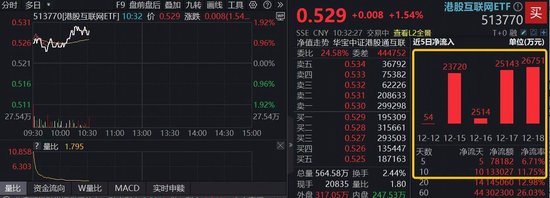
ETF盘中资讯|美联储“松口”:明年利率或大幅下降!港股AI应声走强,百亿港股互联网ETF(513770)上探1.7%
Sou Hu Cai Jing· 2025-12-19 03:14
随着海外流动性预期重新恢复,叠加政策利好,港股有望重启升势,尤其是此前回调较深的科技方向。兴业证券表示,2026年港股牛市将继续,盈利和估值 双提升的潜力依然较大,特别是大盘成长和红利资产。 中信建投证券表示,前期因风格切换而深度调整的成长板块,或伴随市场情绪回暖与宏观不确定性消退,将凭借高盈利弹性成为引领市场的核心主线。重点 关注互联网等板块。 值得一提的是,此前回调区间,港股互联网ETF(513770)获资金密集涌入,上交所数据显示,港股互联网ETF(513770)近10日连续吸金,合计获资金净 流入13.3亿元。 港股互联网ETF(513770)及其联接基金(A类017125;C类017126)被动跟踪中证港股通互联网指数,重仓阿里巴巴-W、腾讯控股、小米集团-W等互联网 龙头,前10大持仓汇聚AI云计算、大模型+各领域AI应用公司,合计占比超73%,龙头优势显著。港股互联网ETF(513770)最新规模超百亿,年内日均成 交额超6亿元,支持日内T+0交易,不受QDII额度限制,流动性佳! 12月19日,港股迎来全线反弹,科网龙头涨势不俗,截至发稿,腾讯控股、快手-W涨逾1%,小米集团-W、阿里巴巴-W ...
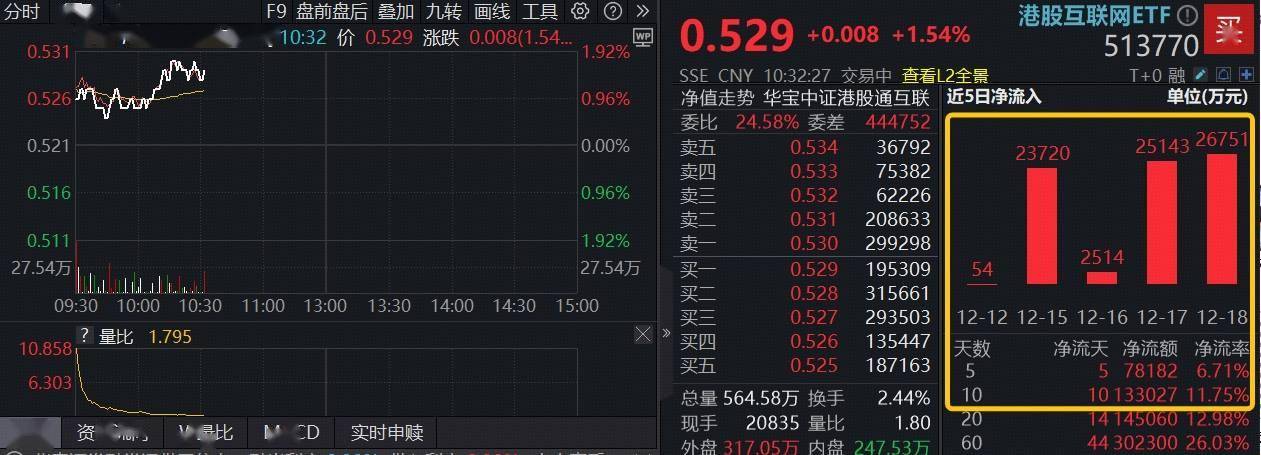
美联储“松口”:明年利率或大幅下降!港股AI应声走强,百亿港股互联网ETF(513770)上探1.7%
Xin Lang Cai Jing· 2025-12-19 02:50
Core Viewpoint - The Hong Kong stock market experienced a broad rebound on December 19, with significant gains in technology stocks, particularly in internet giants like Tencent and Alibaba, indicating a potential recovery in the sector [1][5]. Group 1: Market Performance - The Hong Kong stock market saw a notable rebound, with Tencent Holdings and Kuaishou rising over 1%, while Xiaomi, Alibaba, and Meituan also followed suit [1][5]. - The Hong Kong Internet ETF (513770) saw its price increase by 1.73% at one point, currently up by 1.54% [1][5]. - The ETF has attracted significant capital inflow, with a total of 1.33 billion yuan net inflow over the past 10 days [3][7]. Group 2: Economic Indicators - The U.S. Labor Department reported a year-on-year CPI of 2.7% for November, lower than the expected 3.1%, which may lead to potential interest rate cuts in the future [7]. - Analysts from Industrial Securities predict that the Hong Kong stock market will continue its bull run into 2026, with significant potential for both earnings and valuation improvements, particularly in large-cap growth and dividend assets [7]. Group 3: Investment Opportunities - The Hong Kong Internet ETF (513770) and its linked funds passively track the CSI Hong Kong Internet Index, heavily investing in leading internet companies like Alibaba and Tencent, with over 73% of its top holdings focused on AI and cloud computing [3][8]. - The ETF has a current scale exceeding 10 billion yuan, with an average daily trading volume of over 600 million yuan, providing good liquidity and supporting T+0 trading [8]. - For investors looking to reduce volatility while still focusing on technology, the Hong Kong Large Cap 30 ETF (520560) is recommended, which combines high-growth tech stocks with stable dividend-paying companies [8].
ETF盘中资讯|机构:港股迎来年内最后一次交易窗口!港股AI企稳,百亿港股互联网ETF(513770)涨逾1%,近10日狂揽13亿元
Sou Hu Cai Jing· 2025-12-19 02:17
12月19日,港股早盘高开,互联网龙头集体上涨,截至发稿,美团-W涨超1%,腾讯控股、阿里巴巴-W、哔哩哔哩-W、快手-W等跟涨。重仓互联网龙头的 港股互联网ETF(513770)场内价格现涨逾1%。 此前回调区间,港股互联网ETF(513770)持续受资金关注,上交所数据显示,港股互联网ETF(513770)近10日连续吸金,合计获资金净流入13.3亿元。 配置方向上,前期因风格切换而深度调整的成长板块,或伴随市场情绪回暖与宏观不确定性消退,将凭借高盈利弹性成为引领市场的核心主线。重点关注互 联网等板块。 港股互联网ETF(513770)及其联接基金(A类017125;C类017126)被动跟踪中证港股通互联网指数,重仓阿里巴巴-W、腾讯控股、小米集团-W等互联网 龙头,前10大持仓汇聚AI云计算、大模型+各领域AI应用公司,合计占比超73%,龙头优势显著。港股互联网ETF(513770)最新规模超百亿,年内日均成 交额超6亿元,支持日内T+0交易,不受QDII额度限制,流动性佳! 看好港股科技但又希望降低波动?也可以关注全市场首只——香港大盘30ETF(520560),自带"科技+红利"哑铃策略,重仓股既 ...
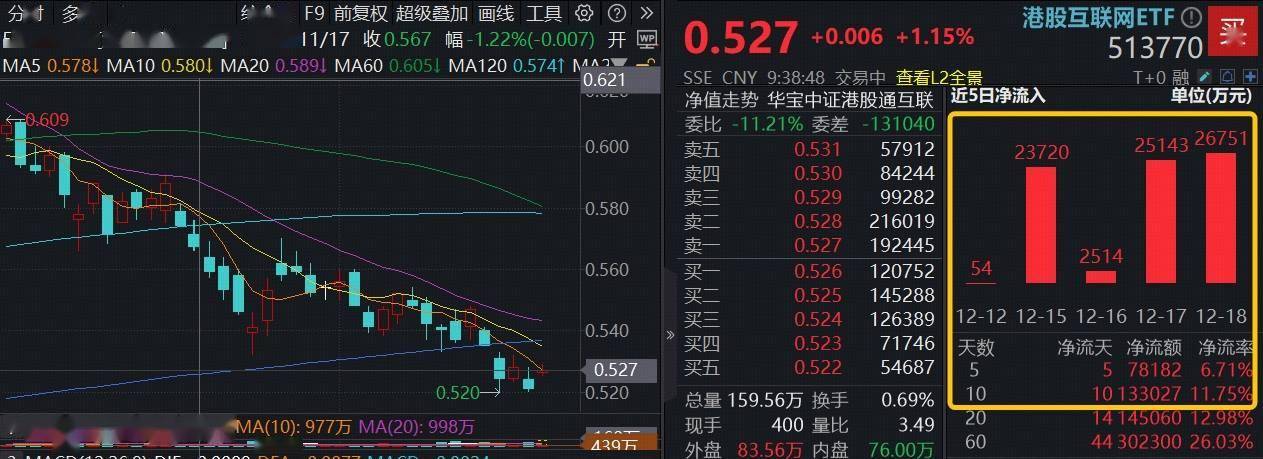
机构:港股迎来年内最后一次交易窗口!港股AI企稳,百亿港股互联网ETF(513770)涨逾1%,近10日狂揽13亿元
Xin Lang Cai Jing· 2025-12-19 01:55
Group 1 - The core viewpoint of the articles indicates that the Hong Kong stock market, particularly the internet sector, is experiencing a rebound with significant inflows of capital into internet ETFs, suggesting a positive outlook for the sector [1][7]. - The Hong Kong internet ETF (513770) has seen a net inflow of 1.33 billion yuan over the past 10 days, reflecting strong investor interest [1][7]. - The market is currently viewed as being in the mid-stage of a bull market, with multiple factors contributing to a favorable trading window, including improved macroeconomic conditions and continued net inflows from southbound capital [3][9]. Group 2 - The Hong Kong internet ETF (513770) tracks the CSI Hong Kong Internet Index and has a significant concentration in leading internet companies such as Alibaba, Tencent, and Xiaomi, with over 73% of its top holdings focused on AI and cloud computing [4][10]. - The ETF has a market size exceeding 10 billion yuan and an average daily trading volume of over 600 million yuan, indicating strong liquidity and support for intraday trading [4][10]. - For investors looking to balance technology exposure with lower volatility, the Hong Kong Large Cap 30 ETF (520560) is recommended, which combines high-growth tech stocks with stable dividend-paying companies [4][10]. Group 3 - The CSI Hong Kong Internet Index has shown varied performance over the past five years, with significant fluctuations, including a peak increase of 109.31% in 2020 and a decline of 24.74% in 2023 [5][11]. - The index's historical performance does not predict future results, and its composition is adjusted according to specific rules [5][11].
L3级试点,为什么是北京、重庆?
Xin Hua Wang· 2025-12-19 01:55
Core Viewpoint - The Ministry of Industry and Information Technology has officially announced the first batch of L3 conditional autonomous driving vehicle permits in China, with two models set to pilot in designated areas of Beijing and Chongqing, marking a significant step in the development of autonomous driving technology in the country [1]. Group 1: Pilot Locations - Beijing and Chongqing were chosen for the pilot due to their advantages in data accumulation and diverse traffic scenarios, allowing for effective testing of the systems in different environments [7]. - The pilot in Chongqing involves the Changan SC7000AARBEV model, which can operate in congested traffic and on highways, limited to specific routes with a maximum speed of 50 km/h [7]. - The pilot in Beijing features the Arcfox BJ7001A61NBEV model, capable of similar functions but with a maximum speed of 80 km/h on designated highways [7]. Group 2: Vehicle Approval Process - The Ministry, in collaboration with relevant departments, conducted comprehensive assessments of the pilot production companies' R&D, testing, and emergency response capabilities [11]. - Third-party testing organizations and experts were involved to evaluate the expected functional safety and cybersecurity risks of the pilot models [11]. - The L3 level allows the system to act as a "temporary driver" under specific conditions, requiring the driver to be ready to take control when requested by the system [11][12]. Group 3: Implications for the Industry - The introduction of L3 level autonomous driving signifies a shift from technical validation to mass application, indicating that intelligent features are now essential for automotive companies [17]. - The advancement of intelligent connected vehicles will inject strong momentum into technological innovation and upgrades in the automotive sector, providing valuable practical experience for standard formulation [19]. - The commercial application of L3 autonomous driving models is expected to strengthen the position of domestic new energy vehicles in the market and accelerate their global expansion, positioning them as leaders in the intelligent connected vehicle sector [19].
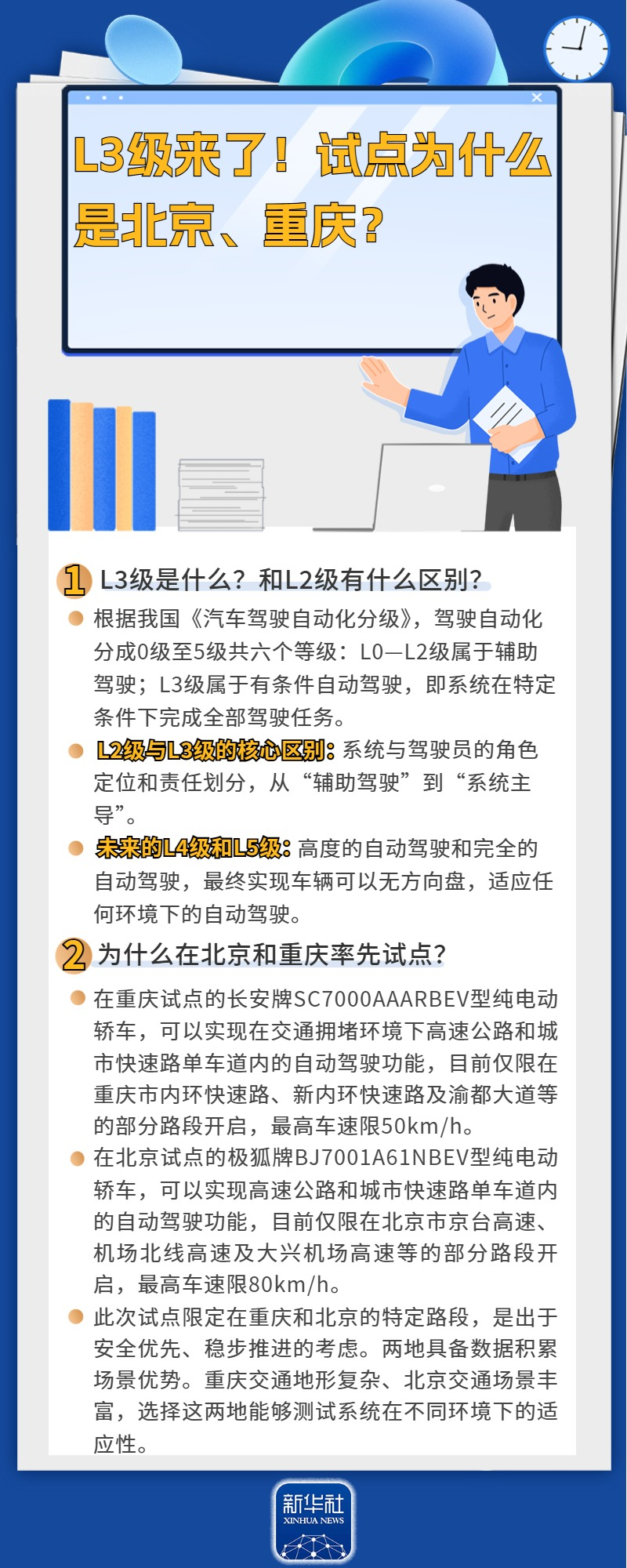
L3级来了!试点为什么是北京、重庆?
Xin Hua Cai Jing· 2025-12-19 01:43
Core Viewpoint - The Ministry of Industry and Information Technology has officially announced the first batch of L3 conditional autonomous driving vehicle permits in China, with two models set to pilot in designated areas of Beijing and Chongqing, marking a significant step in the development of autonomous driving technology in the country [1]. Group 1: Pilot Locations - The L3 autonomous driving models are being piloted in Beijing and Chongqing due to their unique traffic conditions and data accumulation advantages. Chongqing's complex traffic terrain and Beijing's rich traffic scenarios provide a diverse testing environment for the systems [7]. - The pilot in Chongqing involves the Changan SC7000AARBEV model, which can operate in congested traffic and on single lanes of highways, limited to specific routes with a maximum speed of 50 km/h [7]. - The pilot in Beijing features the Arcfox BJ7001A61NBEV model, capable of similar functions but with a higher speed limit of 80 km/h on designated routes [7]. Group 2: Vehicle Approval Process - The Ministry, in collaboration with relevant departments, conducted comprehensive assessments of the research, testing, and emergency response capabilities of the pilot production companies [11]. - Third-party testing organizations and experts were involved in systematic testing of the expected functional safety and cybersecurity risks associated with the pilot models [11]. - The approval process emphasized the management capabilities of the pilot cities and their emergency response capabilities, leading to the selection of two joint ventures for the pilot program [11]. Group 3: Implications of L3 Level - L3 conditional autonomous driving allows the system to act as a "temporary driver" under specific conditions and scenarios, although drivers must remain responsible for the vehicle [11][12]. - The pilot program is limited to specific low-risk scenarios to ensure safety and orderly advancement of autonomous driving technology [15]. - As the pilot progresses and the industry gains a better understanding of safety risks, restrictions may gradually be relaxed, allowing for broader public access to autonomous driving features [15]. Group 4: Industry Opportunities - The pilot signifies a shift from technical validation to mass production application in China's autonomous driving sector, presenting new opportunities for the industry [17].