房地产市场调整

Search documents
经典重温 | “谁”在超额储蓄?(申万宏观·赵伟团队)
申万宏源宏观· 2025-09-25 16:03
Group 1: Core Insights - The article discusses the structure of excess savings, indicating that regions with lower savings rates and lower incomes are the primary contributors to excess savings [1][2][3] - It highlights that the increase in excess savings is not primarily due to typical precautionary savings behavior but rather a reduction in housing expenditures [3][28] - The article emphasizes that the release of excess savings in China is likely to flow into real estate rather than consumption, contrasting with trends observed in the US and EU [5][36] Group 2: Savings Structure - The analysis of savings by region shows that areas with lower savings rates, such as Henan and Sichuan, have seen significant increases in their savings rates [9][12] - Income levels correlate with savings rates, where lower-income regions tend to have higher savings rates, while high-income areas like Shanghai and Jiangsu exhibit lower savings rates [12][30] - The age structure of savers indicates that excess savings are not dominated by older populations, as both high and low aging rate regions show similar increases in savings rates [16][30] Group 3: Formation of Excess Savings - The article argues that the increase in excess savings is more influenced by the adjustment in the real estate market rather than a direct response to income declines or consumption reductions [21][28] - It notes that the reduction in housing expenditures has significantly contributed to the increase in excess savings, with annualized consumption from housing dropping from 8 trillion to 3.3 trillion [28][36] - The impact of social security and aging pressures on savings rates is deemed minimal, as both high and low dependency ratio regions exhibit excess savings [30] Group 4: Release Pathways of Excess Savings - The article posits that the stabilization of the real estate market is crucial for the release of excess savings, requiring policies that address both supply and demand sides [40][44] - It suggests that the "保交楼" (ensure delivery of buildings) policy could play a significant role in stabilizing the market and facilitating the release of excess savings [48] - The current environment shows a significant gap in funding for unsold properties, which could be addressed through targeted fiscal policies to stimulate investment and sales [48]


网友热议!卖不掉也租不出去,赣州的房子真这么惨?
Sou Hu Cai Jing· 2025-09-25 11:28
Core Viewpoint - The current real estate market in Ganzhou is facing significant challenges, with properties failing to sell or rent, reflecting a broader trend in the housing market of third and fourth-tier cities in China [1][11]. Market Conditions - A user shared their experience of purchasing a 138㎡ stairwell apartment in 2010 for over 700,000 yuan, only to find it valued at around 600,000 yuan after 15 years, indicating a depreciation in property value [2]. - The user attempted to rent the property at 1,600 yuan per month but had to lower the price to 1,200 yuan after two months without interest, highlighting a lack of demand for older stairwell apartments [2][4]. Price Trends - Many commenters noted that housing prices in third and fourth-tier cities are declining, with some areas reverting to prices seen a decade ago. There are reports of second-hand homes being difficult to sell, even at significant losses [4][5]. - Predictions suggest that prices may continue to fall, with some estimates indicating a potential drop to 300,000 yuan in six years, and a recovery could take 20-30 years [4]. Buyer Preferences - The younger generation shows a low willingness to buy homes, with demand shifting towards elevator apartments and new products, while older stairwell apartments struggle due to their lack of accessibility [4][7]. - Properties over 100 square meters and older homes face challenges in selling due to banks tightening loan approvals and a preference for smaller units among first-time buyers [5]. Market Segmentation - The real estate market is experiencing a clear divide, with high-quality properties in prime locations maintaining better value, while those in less desirable areas face significant selling pressure [7][11]. - The perception of real estate as a reliable investment has weakened, with some individuals humorously suggesting extreme measures like free demolition due to the lack of value retention [7]. Strategic Recommendations - Property owners are advised to accept that real estate is no longer a guaranteed investment and to adjust their selling and renting strategies accordingly to mitigate losses [13]. - Buyers should focus on their housing needs and financial capabilities rather than following market trends blindly, emphasizing the importance of rational decision-making in the current market [13].

对话楼市大咖:哪些城市跌出机会,企稳的城市有何特征
2025-09-24 09:35
Summary of Conference Call on Real Estate Market Trends Industry Overview - The conference call discusses the current state of the national real estate market in China, highlighting a downward trend since August 2025, with core cities experiencing significant price declines [1][2][3]. Key Points and Arguments 1. **Market Downturn**: The national real estate market has returned to levels seen in 2016, with a notable increase in price declines since August 2025. Core cities are showing signs of a "补跌" (catch-up decline) [2][3]. 2. **Optimistic Signals**: Despite the overall negative trend, there are positive indicators such as improving M1 and M2 monetary metrics, active A-share market participation, and Hong Kong's early rebound from price declines [1][2]. 3. **City Performance**: - **First-tier Cities**: Hong Kong has rebounded, Shenzhen remains stable, while Guangzhou, Beijing, and Shanghai have seen increased declines [1][8]. - **Regional Variations**: Cities like Harbin and Urumqi show strong resistance to price declines due to high rental yields, while the Yangtze River Delta and Greater Bay Area are experiencing severe adjustments [3][8]. 4. **Rental Yields**: Rental yields vary significantly across cities, with first-tier cities averaging around 1.6%, second-tier cities at approximately 2.0%, and some third-tier cities like Urumqi and Harbin reaching up to 3.5% [7][9]. 5. **Investment Appeal**: Equity assets are yielding better returns than real estate, with many cities' rental yields failing to cover mortgage rates, diminishing real estate's attractiveness as an investment [9][10]. 6. **Policy Changes**: The government has implemented measures to ease purchasing restrictions and lower interest rates in major cities, indicating a shift towards a more accommodative policy environment [4][5]. 7. **Future Risks and Opportunities**: The market may face further downward adjustments, but there is potential for rebounds in certain regions, particularly in the West and Northeast, as well as in tourism-related real estate [2][16]. Additional Important Insights - **High-Quality Assets**: Low-density residential properties and high-quality apartments are showing resilience, with some areas experiencing price increases despite the overall market downturn [10][12]. - **Market Dynamics**: The relationship between monetary cycles and real estate cycles is crucial, with monetary indicators leading real estate trends by 6-8 months [4][18]. - **Investment Focus**: Future investment opportunities may lie in high-yield assets and properties that align with demographic trends, such as retirement communities and digital nomad-friendly developments [15][16]. - **Price Stabilization**: Price stabilization in cities like Urumqi and Harbin is attributed to both active market conditions and external economic factors, including the Belt and Road Initiative [17][19]. This summary encapsulates the key discussions and insights from the conference call, providing a comprehensive overview of the current real estate market landscape in China.
专题 | 2025年上半年房企盈利能力报告——毛利率修复至10.87%,净利润维持亏损
克而瑞地产研究· 2025-09-24 09:08
Core Viewpoint - The real estate industry in China continues to face significant challenges, with a decline in both revenue and profit, leading to a net profit loss for four consecutive years. The industry is undergoing deep adjustments, and companies must adapt their operational strategies to ensure profitability and navigate through the current cycle [3][6][18]. Group 1: Revenue and Profit Decline - The overall revenue of typical listed real estate companies decreased by 15% to 12,868 billion, while gross profit fell by 9% [4][6]. - The gross profit margin for the industry was recorded at 10.87%, with a net profit margin of -7.45%, indicating a sustained loss [8][6]. - The net profit loss reached 902 billion, with attributable net profit loss at 954 billion, marking a continuous decline in profitability since 2022 [6][8]. Group 2: Industry Trends - 66% of real estate companies reported net profit losses, with four companies experiencing losses exceeding 10 billion [12][15]. - The industry’s return on equity (ROE) has further declined, remaining at historically low levels [15]. - Nearly 60% of companies saw a decrease in gross profit, while operational business recovery is essential for improving profitability [15][12]. Group 3: Inventory and Asset Valuation - The period saw inventory impairment losses amounting to 49.4 billion, with over 70% of companies recognizing such losses [13][16]. - The fair value of investment properties suffered a loss of 3.3 billion due to declining demand in commercial properties [16][13]. - The overall income from investment properties decreased by 3%, accounting for 5% of total revenue [11][23]. Group 4: Strategic Shifts - Companies are shifting focus from scale expansion to quality competition, with asset operations becoming a stabilizing factor during the cycle [17][19]. - Major firms are planning to enhance their operational capabilities and asset management through public REITs and other innovative financing methods [21][19]. - The industry outlook suggests that the second half of 2025 or 2026 could be pivotal for market stabilization, emphasizing the need for precise investment and product upgrades [19][18].


哈尔滨8月楼市:新房价格环比降0.4%,高端盘逆势热销
Xin Lang Cai Jing· 2025-09-18 04:29
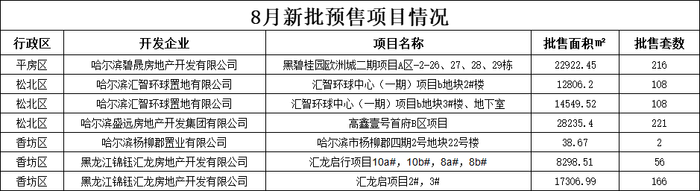
Core Viewpoint - The new housing market in Harbin is experiencing a complex scenario of volume and price differentiation, with a notable decline in sales prices amidst a general downtrend in the national housing market [1][8]. Market Performance - In August 2025, Harbin's new residential sales prices decreased by 0.4% month-on-month, contrasting with rising prices in Shenyang and Jilin [1]. - The market is transitioning into a quality-oriented phase, as some high-end projects are performing well despite the overall price decline [1]. Supply and Demand Dynamics - In August, six new residential projects were approved, totaling approximately 10.4 million square meters and 877 units sold, indicating a steady supply rhythm from developers [1][2]. - From January to August 2025, over 60 new residential projects were approved, with a total sale area exceeding 690,000 square meters and 5,531 units sold [1]. Transaction Highlights - The market showed significant differentiation in transactions, with high-end projects in the Xiangfang and Daoli districts leading in sales volume and value [2][3]. - The "Huilong Hesong Yinhao" project in Xiangfang district achieved the highest sales area of 18,709.11 square meters and sales revenue of 25.76 million yuan [4][5]. Inventory and Market Pressure - As of the end of August, the total unsold residential area in Harbin was 6.69 million square meters, with a depletion cycle of approximately 27 months, indicating persistent inventory pressure [6][7]. - The inventory level has remained stable between 630,000 and 669,000 square meters throughout 2025, reflecting a market primarily focused on digesting existing stock [6][7]. Future Outlook - The Harbin new housing market is expected to maintain a weak balance, relying on regional highlight projects and marginal policy easing to navigate through high inventory and prolonged depletion cycles [8].
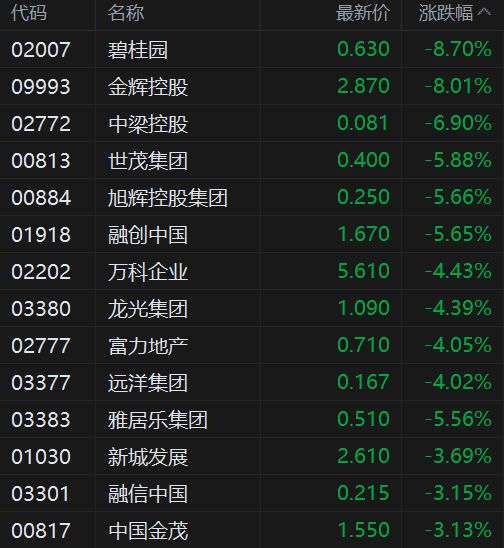
港股异动丨内房股跌势扩大 碧桂园跌8.7% 金辉控股跌8%
Ge Long Hui· 2025-09-18 03:33
Group 1 - The Hong Kong real estate stocks continue to decline, with Country Garden down 8.7%, Jin Hui Holdings down 8%, and Zhongliang Holdings down 7% [1] - The National Bureau of Statistics reported that from January to August, national real estate development investment reached 60,309 billion yuan, a year-on-year decrease of 12.9%, with residential investment at 46,382 billion yuan, down 11.9% [1] - The funding for real estate development enterprises decreased by 8% year-on-year, with personal mortgage loans dropping by 10.5% [1] Group 2 - Analysts indicate that the current real estate data shows a comprehensive weakening, with both development investment and personal mortgage loans declining, confirming that the market is still in a deep adjustment period [1] - Recently, several key cities have introduced favorable policies to promote the stable and healthy development of the real estate market, particularly in terms of easing purchase restrictions, with notable adjustments in Beijing, Shanghai, and Shenzhen [1]

房地产与下游消费韧性及投资逻辑
GUOTAI HAITONG SECURITIES· 2025-09-16 12:23
Investment Rating - The report provides a cautious increase rating for the real estate sector, indicating a potential recovery in the market due to supportive policies and structural adjustments [61]. Core Insights - Since 2022, the real estate market in China has entered a multi-faceted adjustment phase, with significant declines in sales, development, and investment activities [7][14]. - Continuous policy support from central and local governments aims to stabilize the market, with measures focusing on risk mitigation and market confidence restoration [15][17]. - The smart home system market within the decorated housing sector has shown resilience, with increasing penetration rates despite overall market contraction [19][30]. - Downstream industries such as home appliances, light industry, and renovation credit have demonstrated strong resilience through proactive transformations and policy support [33][54]. Summary by Sections 1. Current Status of the Real Estate Market and Stabilization Policies - The sales area of commercial housing has significantly declined, with a 45.73% drop from 2021 to 2024 [7]. - The total sales value of commercial housing has also decreased by 46.82% during the same period [7]. - New construction and construction scale have seen a notable decline, with new housing starts down by 62.85% and construction area down by 24.82% by 2024 [9][11]. 2. Analysis of the Trend in Decorated Housing - The penetration rate of decorated housing peaked in 2022 but has since decreased by 16.92% by 2024, indicating a phase of adjustment [19]. - New decorated housing projects have decreased by 64.98% and the number of units has dropped by 76.79% by 2024 [26]. - The penetration of smart home systems has increased, with a growth of 12.29% from 2021 to 2024 [29]. 3. Resilience of Downstream Industries - The home appliance industry has shifted from dependence on new housing to benefiting from policies like the old-for-new program, leading to a retail value of 1,030.75 billion yuan in 2024, a year-on-year increase of 18.22% [36]. - The light industry has transitioned from a channel-driven model to a service-driven approach, resulting in an 11.11% increase in furniture production from 2021 to 2024 [48]. - The renovation credit industry has seen a 20% growth since 2022, with expectations to exceed 1.3 trillion yuan in market size by 2025 [53].
2025年不买房,5年后会庆幸,还是后悔?现在有了答案
Sou Hu Cai Jing· 2025-09-15 21:40
Core Viewpoint - The Chinese real estate market is undergoing a prolonged adjustment period, with a continuous decline in housing prices expected to persist into 2025, leading to a potential regret for those who choose to buy now rather than wait [1][3]. Group 1: Market Trends - National second-hand housing prices have been declining for over 30 months, with an average year-on-year drop of 7.34% in August alone, and an overall decline exceeding 30% [1][3]. - In certain areas like Zhuozhou and Yanjiao, housing prices have plummeted nearly 60%, indicating severe market distress [1][3]. - Various stimulus policies have been introduced, including the relaxation of purchase restrictions in most cities, increased housing provident fund loan limits, and a reduction in first-home loan interest rates to a historic low of 3.2% [3][4]. Group 2: Supply and Demand Dynamics - There are approximately 600 million residential buildings in China, sufficient to accommodate a population of 6 billion if each building houses 10 people, with millions of new properties expected to enter the market annually [4][6]. - A staggering 96% of households already own at least one property, with 41.5% owning two or more, indicating a saturation of demand for new housing [6][7]. - The aging population is expected to further diminish the demand for new housing, as many elderly individuals already own homes and younger generations face challenges such as inheritance and declining birth rates [7][10]. Group 3: Price Adjustments - The real estate market is entering a long-term deep adjustment phase after over 20 years of rapid growth, with persistent price bubbles remaining in major cities [9][12]. - In cities like Shanghai and Shenzhen, the price-to-income ratio is as high as 40 times, meaning residents would need to save for 40 years without spending to afford a home [9][12]. - Future housing prices are expected to align more closely with residents' income levels, suggesting that those who wait to purchase may benefit from more favorable pricing in the future [12].

8月中国70城房价环比下降 同比降幅收窄
Zhong Guo Xin Wen Wang· 2025-09-15 07:44
Group 1 - In August, housing prices in 70 major cities in China showed a month-on-month decline, but the year-on-year decline continued to narrow [1][2] - First-tier cities saw new residential prices decrease by 0.1% month-on-month, with Shanghai increasing by 0.4% while Beijing, Guangzhou, and Shenzhen experienced declines of 0.4%, 0.2%, and 0.4% respectively [1] - Second-tier cities' new residential prices fell by 0.3% month-on-month, and third-tier cities saw a 0.4% decline, with the latter's decline expanding by 0.1 percentage points [1] Group 2 - Year-on-year, first-tier cities' new residential prices decreased by 0.9%, with the decline narrowing by 0.2 percentage points compared to the previous month [1] - Second and third-tier cities experienced year-on-year declines of 2.4% and 3.7% respectively, with both declines also narrowing [1] - The real estate market is showing signs of recovery, with an increase in the real estate agency industry index by 2.8 to 47.26, marking the largest monthly increase this year [2]
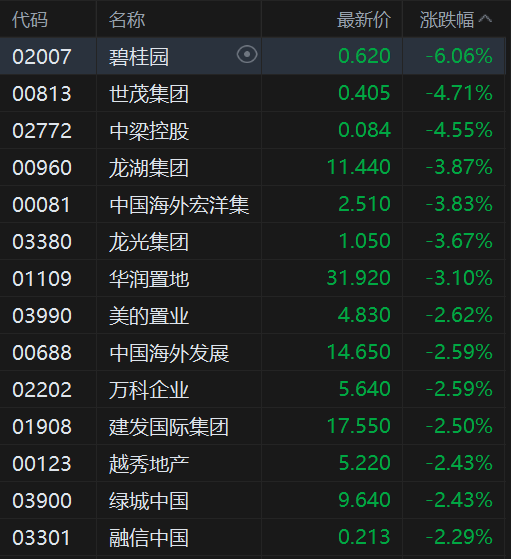
港股异动丨内房股普跌 首8月全国房地产开发投资同比降12.9% 个人按揭贷款降10.5%
Ge Long Hui· 2025-09-15 03:48
Group 1 - The core viewpoint indicates a significant decline in Hong Kong property stocks, with major companies like Country Garden and Shimao Group experiencing drops of 6% and 4.7% respectively [1] - National Bureau of Statistics data shows that from January to August, national real estate development investment reached 60,309 billion yuan, a year-on-year decrease of 12.9%, with residential investment at 46,382 billion yuan, down 11.9% [1] - The analysis suggests that the current real estate data reflects a comprehensive downturn, with both development investment and personal mortgage loans declining, indicating the market is still in a deep adjustment phase [1] Group 2 - The report highlights that the decline in developer investment reflects a severe lack of confidence in the industry, while the shrinkage in mortgage loans indicates continued weak demand for housing [1] - The negative cycle formed by the weakness on both supply and demand sides suggests that market recovery requires more substantial policy support and confidence restoration [1] - Specific stock performance shows that several major property companies, including Longfor Group and China Overseas Development, also faced declines of over 2% [2]