
低空经济

Search documents
金帝股份:eVTOL电机总成已交付样品并通过客户整机测试
Zheng Quan Ri Bao Wang· 2026-01-06 11:09
Core Viewpoint - The company emphasizes its commitment to innovation in the electric vertical takeoff and landing aircraft (eVTOL) sector, which is seen as a key component of future urban air mobility due to its zero emissions, low noise, and flexible takeoff and landing capabilities [1] Group 1: Company Innovations - The company is focused on bottom-layer technological innovation across various dimensions, including raw material development, structural design, process routes, and independent equipment development [1] - The company leverages core technologies from the electric drive components of new energy vehicles to enhance its eVTOL motor assembly development [1] - The company has successfully expanded its drive motor rotor production technology from the new energy vehicle sector to the low-altitude economy sector, strengthening its foundation for sustainable future development [1] Group 2: Market Applications - eVTOL technology is applicable in multiple scenarios such as commuting, logistics, and emergency medical services [1] - The company has developed and delivered samples of eVTOL motors that meet high power density, high reliability, and lightweight requirements, although these products have only generated a small amount of sample revenue and do not significantly impact the company's overall performance [1]

2025固态电池融资潮背后,资本在赌什么?
高工锂电· 2026-01-06 10:47
Core Viewpoint - The solid-state battery sector in China is expected to experience a financing boom in 2025, driven by technological breakthroughs and policy support, transitioning from the "laboratory stage" to "industrialization" [2] Financing Cases Summary - A total of 17 typical financing cases in the solid-state battery field have been identified, showcasing significant capital influx and diverse investment strategies [2][3][4] Group 1: Financing Characteristics - The current capital layout is primarily focused on semi-solid state batteries, with a relatively lower proportion of financing directed towards all-solid state projects, indicating a pragmatic investment approach [5] - A diversified investment matrix has formed, combining industrial capital, government funds, and VC/PE, with each type of investor focusing on different aspects of the industry [5] - The focus on specific technological routes is evident, with sulfide electrolyte routes becoming a financing hotspot among both leading companies and startups [6] - Most financing is directed towards production line construction and mass production validation, reflecting a shift from R&D to engineering delivery in the industry [6] Group 2: Reasons for Capital Interest - Performance advantages and technological maturity of solid-state batteries drive investment interest, as they significantly enhance energy density and safety, addressing consumer concerns about range anxiety [7] - Policy incentives provide confidence for capital investment, with government support including subsidies for vehicles equipped with semi-solid state batteries and the establishment of standards for solid-state batteries [7] - Growing market demand for high-performance batteries, particularly in the electric vehicle sector, is expected to support the growth of solid-state batteries as a mainstream technology [8] Group 3: Future Development Trends - The solid-state battery sector is anticipated to see semi-solid state batteries dominate the market in the near term, with energy density potentially reaching 450 Wh/kg and cycle life exceeding 6000 cycles within 3-5 years [9] - The industry will witness a concentrated effort in the construction of pilot lines for all-solid state batteries, with some leading companies expected to achieve small-scale production by 2027 [9] - The industry landscape will continue to evolve, with a focus on collaboration across the supply chain and the emergence of specialized companies in high-nickel cathodes and new solid-state electrolytes [9] - Applications for solid-state batteries will diversify beyond electric vehicles, expanding into sectors such as energy storage, humanoid robots, and low-altitude flying vehicles [9] Conclusion - The concentrated capital investment is accelerating the industrialization of the solid-state battery sector, with semi-solid state battery commercialization and all-solid state battery technological advancements progressing in parallel [10]


新股前瞻|新思考电机闯关港交所 光学防抖占比下降下的转型困境与突围方向
Zhi Tong Cai Jing· 2026-01-06 10:36
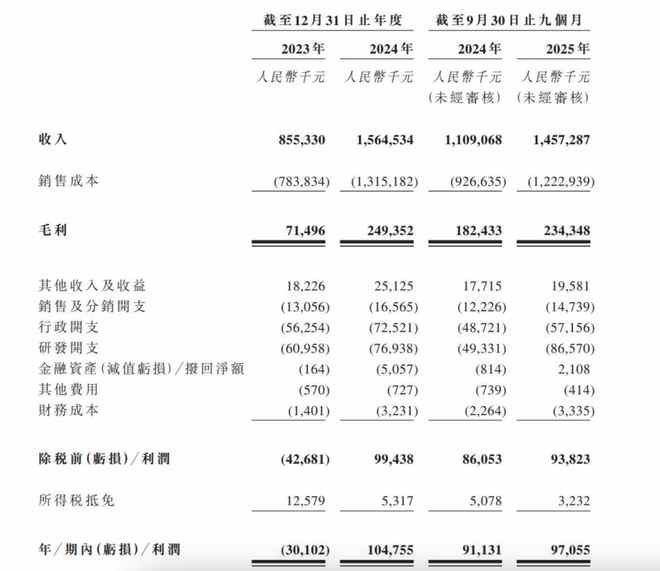
Core Viewpoint - New Thinking Motor Co., Ltd. has submitted its listing application to the Hong Kong Stock Exchange, indicating its growth potential and strategic direction in the micro precision motor industry [1]. Financial Performance - The company reported revenues of approximately 855 million RMB in 2023, which increased to 1.566 billion RMB in 2024, reflecting a growth rate of about 82.9% [3][4]. - The net profit transitioned from a loss of 30.1 million RMB in 2023 to a profit of 105 million RMB in 2024, indicating a significant turnaround [3][5]. - Gross profit margin improved from 8.36% in 2023 to 15.93% in 2024, showcasing enhanced profitability [4][5]. Market Position - As of 2024, New Thinking Motor ranks sixth globally and third in China in the imaging motor market, holding a 9.1% market share in China [2]. - In the optical image stabilization (OIS) imaging motor sector, the company ranks fourth globally and first in China, with a market share of 20.1% [2]. Product Segmentation - The company's revenue is primarily derived from three product categories: optical stabilization and periscope motors, open-loop motors, and closed-loop motors [5][8]. - Optical stabilization and periscope motors accounted for 72.1% of revenue in 2023, increasing to 81.5% in 2024, but dropped to 67.7% in the first nine months of 2025 [5][8]. Strategic Expansion - New Thinking Motor is expanding its production capacity with new facilities in Nanchang and Dongguan, expected to be operational by 2026, which will enhance long-term growth potential [5][9]. - The company aims to diversify into emerging fields such as robotics and low-altitude economy, indicating a proactive approach to industry trends [7][9]. Industry Trends - The micro precision motor industry is undergoing structural changes, with growth shifting from mobile phone optical module demand to multi-terminal and multi-scenario applications [7]. - The global non-mobile micro motor market is projected to grow at a compound annual growth rate of over 20% by 2028, highlighting the need for strategic positioning in this sector [7]. Challenges - Despite its achievements, the company faces challenges such as high business concentration, significant related-party transactions, and a fragmented global market share [9].
制造业PMI持续修复仍需政策支持|宏观晚6点
Xin Lang Cai Jing· 2026-01-06 10:13
Macro News - Zheng Zhajie emphasized the need to build a modern industrial system during the "14th Five-Year Plan" period, focusing on optimizing and enhancing traditional industries such as chemicals, machinery, and shipbuilding to strengthen their global competitiveness [1] - The development of strategic emerging industry clusters, including new energy, new materials, aerospace, and low-altitude economy, is prioritized, with a push for quantum technology, biomanufacturing, hydrogen energy, nuclear fusion energy, brain-computer interfaces, embodied intelligence, and sixth-generation mobile communication to become new economic growth points [1] Shanghai Investment Encouragement - The Shanghai Municipal Development and Reform Commission and other departments issued measures to encourage foreign-invested enterprises to reinvest domestically, comprising 15 initiatives [1] - Key measures include supporting various reinvestment methods, enhancing project coordination services, optimizing land resource allocation, encouraging technological upgrades, and supporting domestic production and R&D innovation [1] - Additional initiatives involve simplifying medical device production processes, facilitating multi-warehouse coordination for drug wholesale, easing food chain operations, implementing profit reinvestment tax policies, and broadening financing channels for reinvestment [1]
洋河做LP,参设一支母基金
FOFWEEKLY· 2026-01-06 10:05
Core Viewpoint - The article highlights the active participation of industrial Limited Partners (LPs) in the investment market, particularly focusing on the establishment of a new mother fund by a major liquor company, which signals a broader trend of revitalization in the investment landscape [2][3][4]. Group 1: Fund Establishment and Investment Strategy - The newly registered mother fund in Suqian City has a total scale of 1.5 billion yuan, with significant contributions from Suqian Industrial Development Group and Yanghe Distillery [5]. - The fund's investment focus includes intelligent manufacturing sectors such as robotics, artificial intelligence, and data industries, with a commitment to early, small, long-term, and hard technology investments [6]. - The fund has a lifespan of 15 years, with an investment period of 8 years and an exit period of 7 years, and it will not hold more than 30% of shares in any single investment [6]. Group 2: Market Trends and LP Activity - Since 2025, the primary market has shown signs of recovery, with institutional LP contributions reaching approximately 1.24 trillion yuan in the first three quarters, a 9% year-on-year increase [8]. - The number of newly registered funds has increased by 15.18% year-on-year, indicating a growing interest from LPs, particularly industrial LPs, who are leading in investment frequency [8]. - The investment landscape is characterized by a busy schedule for investors and fundraising teams, reflecting a significant uptick in activity across both investment and fundraising sectors [9][10]. Group 3: National Policy and Market Structure - The entry of "national team" funds into the venture capital market marks a significant shift, with increased government support for industrial investments [14]. - The establishment of the National Venture Capital Guidance Fund and regional mother funds aims to inject substantial capital into the market, focusing on future industries like artificial intelligence and advanced manufacturing [15]. - The ongoing support from national-level funds is expected to address market funding gaps and foster a more sustainable investment environment, with projections for continued market recovery into 2026 [15][17].


商业航天异动拉升!航天环宇、航天电子等多股涨停,航空ETF基金(159257)大涨4.59%创新高,商业航天行业迎奇点时刻!
Xin Lang Cai Jing· 2026-01-06 10:01
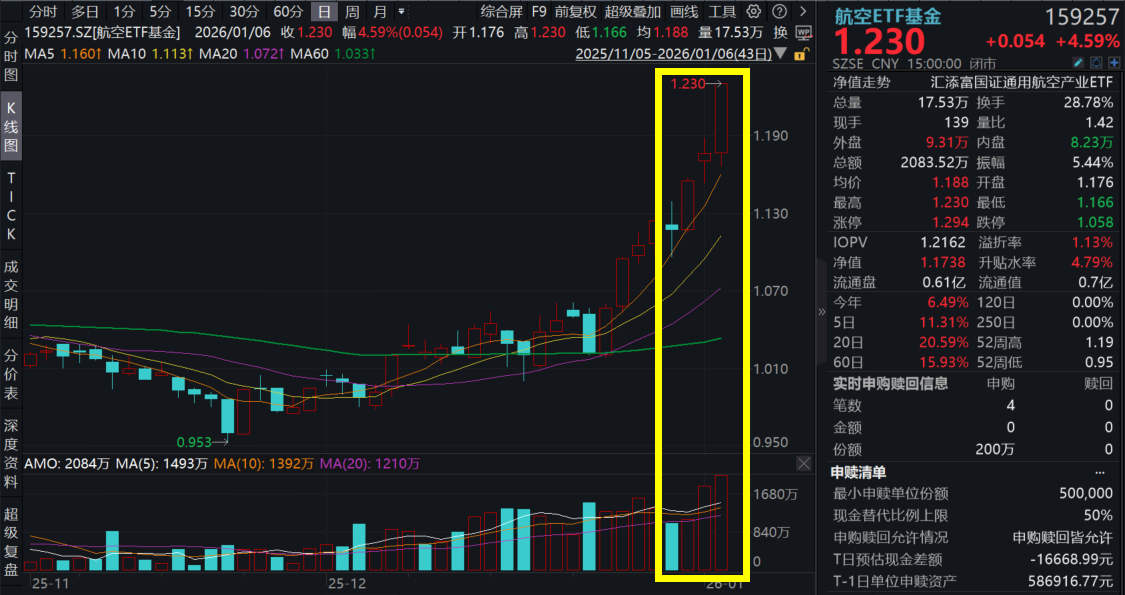
Core Viewpoint - The A-share market continues its upward trend with over 4,100 stocks rising, and the Shanghai Composite Index has increased by over 1%, marking a 13-day winning streak and reaching a new high [1] Group 1: Market Performance - The Aviation ETF (159257) has surged by 4.59%, setting a new historical high and achieving three consecutive days of gains [1] - The Aviation ETF has attracted over 2.37 million yuan in investments, indicating strong market interest in the aviation sector [1] Group 2: Stock Performance - Most component stocks of the Aviation ETF index have seen significant gains, with Aerospace Huan Yu hitting the daily limit, and other stocks like Huace Navigation and Aerospace Electronics also experiencing substantial increases [3] - Notable stock performances include China Satellite up by 7.6% and Hongdu Aviation up by over 6% [3] Group 3: Industry Insights - The commercial aerospace sector is experiencing a sustained rally, driven by favorable policies and the listing guidance for commercial rocket companies, which has increased market attention [5] - The rise of the commercial aerospace sector is attributed to three core factors: policy benefits, technological breakthroughs, and rigid industrial demand [5] - According to Guojin Securities, the global aerospace industry is undergoing structural changes similar to the Age of Exploration, with China's commercial aerospace sector transitioning from a policy incubation phase to an industrial explosion phase [5] Group 4: Sector Composition - The Aviation ETF index is primarily concentrated in the defense and military industry (56.3%), followed by computer (7.5%) and automotive (7.4%) sectors [5] - The defense and military sector is the largest weighted industry within the Aviation ETF, with component stocks distributed across various sub-sectors such as aviation equipment and military electronics [5] Group 5: Economic Themes - The low-altitude economy concept stocks account for 51% of the Aviation ETF index, with six of the top ten component stocks being low-altitude economy concept stocks [8] - The commercial aerospace sector represents 24% of the index, covering satellite navigation and satellite internet, which positions it well to capture opportunities in the trillion-dollar satellite industry [9]

因大联科“京津冀企业加速计划”启动,产业“新生态”模式获多方认可
Jin Tou Wang· 2026-01-06 09:57
Group 1 - The summit highlighted the importance of platform-based development models as a key approach to drive regional innovation and high-quality development in the Beijing-Tianjin-Hebei area [1][2] - The Beijing-Tianjin-Hebei Enterprise Headquarters Science and Technology Innovation City is recognized for providing comprehensive support for enterprise growth through a platform that integrates space, capital, technology, and talent [2][4] - Experts noted that platformization effectively addresses the challenges of resource fragmentation faced by small and medium-sized enterprises, offering one-stop solutions from technology transformation to market expansion [2][6] Group 2 - The summit featured discussions on low-altitude economy and AI-driven industrial transformation, with insights from Chinese Academy of Engineering academicians on their potential as new growth engines [3] - A strategic cooperation award ceremony was held, signifying authoritative recognition of the Science and Technology Innovation City in building an industrial ecosystem that integrates production, education, research, and application [4] - The launch of the "Beijing-Tianjin-Hebei Enterprise Acceleration Plan" aims to provide full-cycle empowerment for resident enterprises by integrating resources such as patient capital and global market access [5][6] Group 3 - Media commentary emphasized that the platform-based development model represents a transformative direction for China's industrial parks, shifting from a landlord to a shareholder approach and from management to empowerment [6] - The platform model is seen as a means to enhance resource allocation efficiency and foster a culture of continuous innovation, providing a replicable practice for building a world-class urban agglomeration in Beijing-Tianjin-Hebei [6]
光影绘就“十五五”新图景,上海静安市北高新500架无人机点亮园区夜空
Zhong Guo Jin Rong Xin Xi Wang· 2026-01-06 09:54
转自:新华财经 1月5日晚,上海静安市北高新园区500架无人机以夜空为幕、光影作笔,呈现了一场名为"天马行空・智链新元"的无人机编队秀。这场融合前沿科技、产业 符号与人文关怀的视觉表演,生动勾勒出科技、人文与生活在此交融共生的发展图景。 "去年没抢到好位置,今年特意提前半小时来!看着每天工作的园区以这样震撼的方式亮相,太自豪了!"在数通链谷一家区块链企业工作的杨先生激动地 说,夜空中的哈希桥、共识大道等元素,让日常通勤的场景成了光影焦点。"此次表演将低空经济技术与视觉艺术融合,展示市北高新特色产业,希望科技 美学成为连接产业与生活的桥梁。"园区相关负责人表示。 此次表演巧妙地将园区地标融入画卷。无人机的光影掠过"合约桥",桥下便是潺潺流水的城市地标健身步道。观众们在"赛博烟花"的璀璨中,同步感受着四 季皆景的生态之美。哈希桥、共识大道……这些承载着区块链技术内核的命名地标,在光影点化下,成为市民可亲近、可驻足的浪漫景致。 科技为笔,绘就高质量发展新气象 作为上海"创新驱动、转型发展"的示范窗口,近年来,市北高新以"数通链谷""视听静界"为支点,撬动面向未来的高质量发展新动能。此次无人机表演是两 大产业品牌科技 ...


上海剑指“世界eVTOL之都”
3 6 Ke· 2026-01-06 09:40
Core Viewpoint - Shanghai is transitioning from planning to industrialization in the low-altitude economy, aiming for a core industry scale of approximately 80 billion yuan by 2028, establishing a complete industrial chain for new low-altitude aircraft, and positioning itself as a "world eVTOL capital" [1] Group 1: Policy Development - The recent policy document, "Several Measures," supplements the previously released "Action Plan for High-Quality Development of Low-Altitude Economy (2024-2027)," focusing on manufacturing capabilities, enterprise hierarchy, application scenarios, and regional collaboration [2] - The new policy is seen as a significant boost for low-altitude enterprises in Shanghai, providing concrete support for the action plan and clarifying the goal of becoming an eVTOL hub [2][4] Group 2: Manufacturing and Capability - The "Several Measures" outlines three key tasks for building the low-altitude advanced manufacturing industry cluster, emphasizing the need for quantifiable manufacturing capabilities [3][4] - Shanghai aims to cultivate and attract 10 leading manufacturers in eVTOL, industrial-grade drones, and new energy aviation aircraft, achieving a production capacity of over 500 new aircraft and generating an additional investment of over 20 billion yuan [4] Group 3: Regional Collaboration - The policy emphasizes enhancing regional collaboration, aiming to establish a national-level testing platform for new low-altitude aircraft and promoting applications in smart logistics, public governance, and production operations [5] - The integration of resources and optimization of layouts across the Yangtze River Delta region is expected to provide substantial benefits for low-altitude enterprises [5][6] Group 4: Financial Support and Innovation - The new policy clarifies financial support for research and certification processes, reducing cash flow pressures for innovative SMEs during technology development and market validation phases [7] - Local government intervention in the testing and certification stages is intended to share risks with enterprises, accelerating the transition of technology from laboratories to market [7] Group 5: Market and Investment Trends - The low-altitude economy has been included in significant national policy documents for two consecutive years, with local governments accelerating their actions [7] - The capital market's interest is rising, with the China Securities Regulatory Commission expanding the application of the fifth set of listing standards to support enterprises in frontier technology fields, including low-altitude economy [7]
链接长三角加快建设低空经济先进制造业集群,上海发布若干措施
Di Yi Cai Jing· 2026-01-06 09:39
Core Objectives - By 2028, the core industry scale of Shanghai's low-altitude economy is expected to reach approximately 80 billion yuan, forming a complete industrial chain for new low-altitude aircraft and establishing a national advanced manufacturing cluster for the low-altitude economy, aiming to become the "world eVTOL capital" [1][3] Major Measures - Establish a high ground for low-altitude equipment research and manufacturing, focusing on building specialized industrial parks and providing comprehensive support for key projects, with a maximum support of 100 million yuan for high-innovation projects [4][5] - Support key core technology breakthroughs in eVTOL and industrial-grade drones, with a maximum support of 50 million yuan for technological advancements [4][5] - Accelerate the development of new technology testing and verification platforms, with a maximum support of 20 million yuan for testing services [4][5] - Enhance the capabilities for airworthiness certification of new aircraft, providing one-time rewards for companies obtaining type certificates and production licenses [5] Industry Ecosystem Development - Improve airworthiness technology capabilities by collaborating with national airworthiness certification agencies and establishing a "one-stop" airworthiness service platform [5][6] - Accelerate the formulation of standards and norms, with rewards for leading enterprises and research institutions involved in standard-setting [6] - Increase financial support for low-altitude enterprises, including innovative insurance products and bank loans, with a maximum subsidy of 20 million yuan for financing projects [6] Regional Collaboration - Strengthen interconnectivity of low-altitude facilities in the Yangtze River Delta region, promoting shared infrastructure and collaborative planning for low-altitude public air routes [6][7] - Encourage the application of low-altitude equipment in various scenarios, such as logistics and emergency rescue, while fostering cross-regional cooperation [6][7] Infrastructure and Safety - Develop a scientific layout for low-altitude infrastructure, ensuring land and funding support for the construction of specialized take-off and landing sites [7] - Promote safe low-altitude transportation, focusing on urban delivery and logistics, while ensuring the safety of new aircraft demonstration routes [7] - Encourage the use of low-altitude aircraft for public governance applications, such as urban management and environmental monitoring [7]