开源模型

Search documents
宇树科技王兴兴谈人形机器人最大挑战
2 1 Shi Ji Jing Ji Bao Dao· 2025-09-24 15:13
Core Insights - The development of humanoid robots is heavily reliant on innovations in communication connectivity, which necessitates stringent requirements for chip computing power and energy consumption [1] - The company aims to enable humanoid robots to perform real-time actions based on arbitrary commands by mid-2024, with a longer-term goal of allowing robots to operate autonomously in unfamiliar environments by the end of 2025 [1][2] - The company emphasizes the importance of reducing cable usage in robots, as 60%-70% of industrial robot failures are related to cable issues, and aims to connect the main control unit and limbs with a single cable in the future [2] - The development of large models is crucial for enhancing the general capabilities of robots, and the company advocates for an open-source approach to accelerate industry advancement, having recently open-sourced its UnifoLM-WMA-0 model [3]

宇树科技王兴兴谈人形机器人最大挑战
21世纪经济报道· 2025-09-24 15:12
Core Viewpoint - The development of humanoid robots is heavily reliant on innovations in communication connectivity, which necessitates stringent requirements for chip computing power and energy consumption [1][2]. Group 1: Development Roadmap - The company aims to enable humanoid robots to learn and perform various human movements, such as dance and martial arts, with improved fluidity and effectiveness compared to previous attempts [1]. - The next phase involves allowing robots to execute any command in real-time, moving closer to a state where robots can autonomously perform tasks [1]. - The company anticipates achieving the capability for real-time action generation by the end of this year or early next year, with further advancements expected by the end of next year to allow robots to operate in unfamiliar environments [1][2]. Group 2: Challenges in the Industry - A significant challenge in the robotics industry is related to cable management, with 60%-70% of industrial robot failures attributed to cable issues [2]. - The company emphasizes the importance of reducing the number of cables to enhance robot performance and reliability, aiming for a future where only one cable connects the main control unit to the limbs [2]. Group 3: Open Source Initiatives - The company has announced the open-sourcing of UnifoLM-WMA-0, a world model-action framework designed for general robot learning, which includes datasets and training source codes [3]. - The call for open-source model development is seen as a way to accelerate industry progress, similar to early strategies employed by OpenAI [3].


宇树科技王兴兴谈机器人现状:最大挑战在哪里?为什么坚持开源?
2 1 Shi Ji Jing Ji Bao Dao· 2025-09-24 14:13
Core Viewpoint - The development of humanoid robots is heavily reliant on innovations in communication connectivity, which necessitates unique requirements for chip computing power and energy consumption [1][3] Group 1: Development Roadmap - The company aims to enable humanoid robots to perform real-time actions based on arbitrary commands, with expectations to achieve this by mid-next year [1] - By the end of next year, the goal is for humanoid robots to autonomously operate in unfamiliar environments, such as retrieving a bottle of water for a guest [1] Group 2: Challenges in the Industry - A significant challenge in the robotics industry is related to cabling, with 60% to 70% of industrial robot failures attributed to cable issues [3] - The company is focused on reducing the number of cables connecting the main control unit and limbs to enhance robot performance and reliability [3] Group 3: Open Source Initiatives - The company advocates for an open attitude in the industry, similar to OpenAI's early approach, to accelerate the development of large models and the robotics sector [4] - The company has announced the open-sourcing of UnifoLM-WMA-0, a world model designed for general robot learning, including datasets and training source codes [4] Group 4: Importance of Large Models - Developing corresponding large model capabilities is crucial for enhancing the general capabilities of robots [5]
吴泳铭的两个新判断,和加倍激进投入的阿里云
3 6 Ke· 2025-09-24 13:11
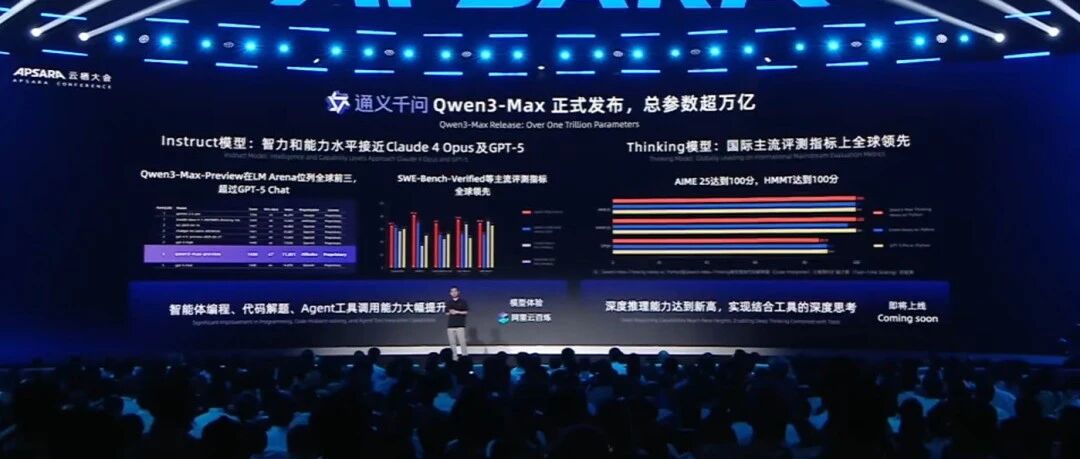
Core Insights - The core message of the article revolves around Alibaba Cloud's aggressive push into the AI sector, particularly through the launch of new models and the establishment of a strategic vision for the future of artificial intelligence, termed ASI (Artificial Superintelligence) [1][4][12]. Group 1: AI Models and Innovations - Alibaba Cloud introduced several new AI models at the Yunqi Conference, including the flagship model Qwen3-Max, which outperforms competitors like GPT-5 and Claude Opus 4, ranking among the top three globally on LMArena [1][6]. - The new models include Qwen3-Next, Qwen3-Coder, Qwen3-VL, Qwen3-Omni, Wan2.5-preview, and Tongyi Bailing, each with significant advancements in capabilities such as visual understanding, coding, and multi-modal interactions [1][6][12]. - The Qwen3-Max model has a pre-training data volume of 36 trillion tokens and over one trillion parameters, showcasing a substantial increase in performance and efficiency [6][12]. Group 2: Strategic Vision and Goals - Alibaba Cloud's CEO, Wu Yongming, articulated a vision where large models will serve as the next generation of operating systems, fundamentally transforming software development and interaction [3][4]. - The company aims to build a "Super AI Cloud" to provide a global intelligent computing network, with a three-year plan involving an investment of 380 billion yuan in AI infrastructure [3][4]. - The transition from AGI (Artificial General Intelligence) to ASI is outlined in three stages: "intelligent emergence," "autonomous action," and "self-iteration," with the ultimate goal of surpassing human intelligence [4][12]. Group 3: Market Response and Financial Performance - Following the announcement of its new AI strategy, Alibaba's stock surged over 9%, reaching its highest level since October 2021, indicating strong market confidence in the company's direction [5][12]. - Alibaba Cloud reported a 26% year-on-year increase in quarterly revenue, with AI-related income growing for eight consecutive quarters at triple-digit rates [12][18]. - The Chinese AI cloud market is projected to reach 22.3 billion yuan by mid-2025, with Alibaba Cloud holding a 35.8% market share, surpassing the combined share of its next three competitors [12].

阿里一口气发了N款新模型,让我们向源神致敬。
数字生命卡兹克· 2025-09-24 05:28
Core Viewpoint - Alibaba's recent cloud conference showcased a comprehensive range of new AI models, indicating a significant investment in AI technology and a commitment to building a robust AI ecosystem [1][64]. Group 1: New Model Releases - The Qwen3-Max model was introduced as a direct competitor to top models like GPT-5 and Claude Opus 4, featuring over 1 trillion parameters and trained on 36 trillion tokens [3][6]. - Qwen3-Max has two versions: the Instruct version for general use and a more advanced Thinking version, which is not yet publicly available [8][15]. - The Wan2.5 model was launched, enhancing capabilities for audio-visual synchronization, allowing users to generate videos from images and audio [20][32]. - Qwen3-VL, a powerful visual language model, supports a context of 256K tokens and can be extended to 1 million tokens, outperforming some competitors in specific tasks [33][37]. - Qwen3-Omni, an end-to-end multimodal model, supports various input types and languages, showcasing Alibaba's extensive capabilities in AI [45][48]. Group 2: Performance and Capabilities - Qwen3-Max achieved top scores in various AI benchmarks, including a perfect score in challenging math reasoning competitions [11][15]. - The models demonstrate advanced reasoning and agent capabilities, allowing them to perform complex tasks and interact with tools effectively [40][41]. - The new models are designed to enhance user experience in applications such as digital content creation and real-time translation, with low latency and high accuracy [49][59]. Group 3: Additional Innovations - Alibaba introduced several other models, including Qwen3-Coder-Plus for improved coding efficiency and Fun-ASR for advanced speech recognition [54][57]. - The company is also focusing on safety with models like Qwen3Guard, aimed at ensuring AI security in real-time applications [60]. - The overall strategy reflects Alibaba's ambition to create a comprehensive AI ecosystem that spans various modalities and applications [68][70].
谈超级人工智能之路,吴泳铭称阿里目标是打造AI时代的操作系统
Di Yi Cai Jing· 2025-09-24 03:29
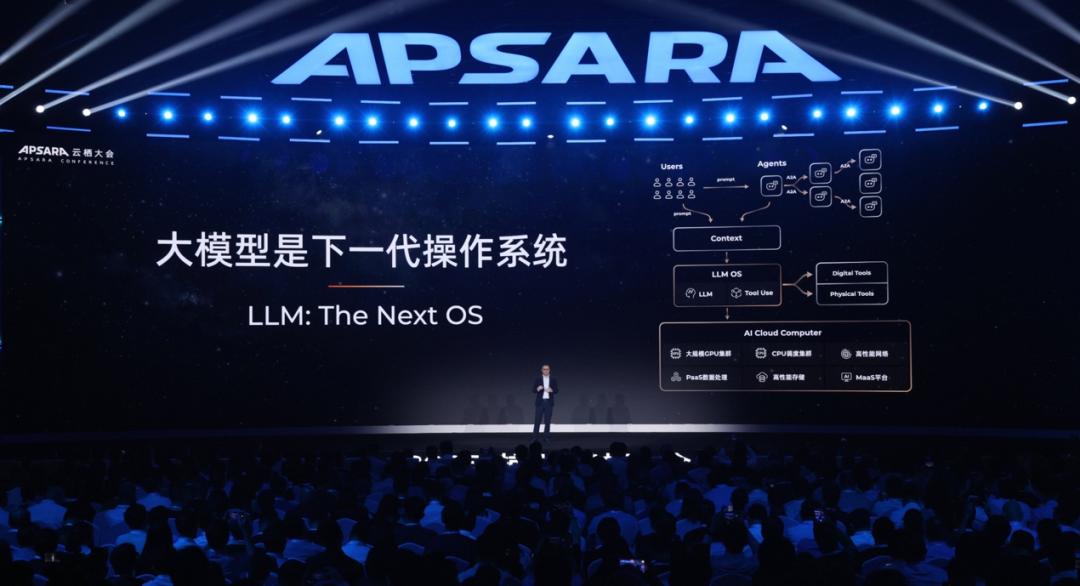
其次,他判断,AI Cloud是下一代计算机。算力正在从以CPU为核心的计算加速转变为GPU为核心、以 大模型驱动的AI计算,新的计算范式需要更稠密的算力、更高效的网络和更大的集群规模,需要超大 规模的基础设施和全栈基础积累才能承载这样的需求。他认为,未来全世界也许只会有5到6个超级云计 算平台。 AGI并不是终点,吴泳铭认为,AI会经历三个阶段最终成长为超级人工智能。第一阶段是智能涌现,AI 学习人;第二阶段是AI自主行动,辅助人,我们刚刚处在这个阶段的开端,未来也许会有超过世界人 口的智能体和机器人和人类一起工作;第三个阶段是自我迭代,超越人,跨越到这个阶段需要两个要 素,AI将逐步连接几乎物理世界的所有场景和数据,模型能够自我学习、通过与真实世界的持续交互 获得新的数据实现自我迭代与智能升级。 在通往这个变革的路上,吴泳铭作出了一些预测。首先,他认为大模型将是下一代操作系统,在未来物 理世界与数字世界的交互中,大模型扮演今天操作系统的地位。各行各业、所有用户都会通过大模型相 关的工具执行任务,自然语言可能就是未来AI时代的编程语言。 吴泳铭相信,未来大模型将运行在所有计算设备中,基于此,阿里巴巴坚持开源 ...
阿里云CTO周靖人:通义千问已开源300+模型,累计下载量超6亿
Xin Lang Ke Ji· 2025-09-24 02:59
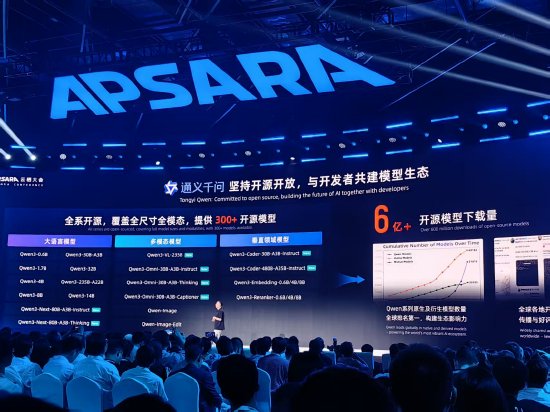
Core Insights - Alibaba Cloud has opened over 300 open-source models under the Tongyi Qianwen initiative, with downloads exceeding 600 million [1] - New models, including Qwen3-VL, were announced at the 2025 Yunqi Conference [1] - The Tongyi Wanxiang initiative has generated over 390 million images and more than 70 million videos [1]
为 OpenAI 秘密提供模型测试, OpenRouter 给 LLMs 做了套“网关系统”
海外独角兽· 2025-09-23 07:52
Core Insights - The article discusses the differentiation of large model companies in Silicon Valley, highlighting OpenRouter as a key player in model routing, which has seen significant growth in token usage [2][3][6]. Group 1: OpenRouter Overview - OpenRouter was established in early 2023, providing a unified API Key for users to access various models, including mainstream and open-source models [6]. - The platform's token usage surged from 405 billion tokens at the beginning of the year to 4.9 trillion tokens by September, marking an increase of over 12 times [2][6]. - OpenRouter addresses three major pain points in API calls: lack of a unified market and interface, API instability, and balancing cost with performance [7][9]. Group 2: Model Usage Insights - OpenRouter's model usage reports have sparked widespread discussion in the developer and investor communities, becoming essential reading [3][10]. - The platform provides insights into user data across different models, helping users understand model popularity and performance [10]. Group 3: Founder Insights - Alex Atallah, the founder of OpenRouter, believes that the large model market is not a winner-takes-all scenario, emphasizing the need for developers to control model routing based on their requests [3][18]. - Atallah draws parallels between OpenRouter and his previous venture, OpenSea, highlighting the importance of integrating disparate resources into a cohesive platform [19][20]. Group 4: OpenRouter Functionality - OpenRouter functions as a model aggregator and marketplace, allowing users to manage over 470 models through a single interface [31]. - The platform employs intelligent load balancing to route requests to the most suitable providers, enhancing reliability and performance [37]. - OpenRouter aims to empower developers by providing a unified view of model access, allowing them to choose the best models based on their specific needs [34][35]. Group 5: Future Directions - OpenRouter is exploring the potential of personalized models based on user prompts while ensuring user data remains private unless opted in for recording [52][55]. - The platform aims to become the best reasoning layer for agents, providing developers with the tools to create intelligent agents without being locked into specific suppliers [58][60].

朱啸虎:搬离中国,假装不是中国AI创业公司,是没有用的
Hu Xiu· 2025-09-20 14:15
Group 1 - The discussion highlights the impact of DeepSeek and Manus on the AI industry, emphasizing the importance of open-source models in China and their potential to rival closed-source models in the US [3][4][5] - The conversation indicates that the open-source model trend is gaining momentum, with Chinese models already surpassing US models in download numbers on platforms like Hugging Face [4][5] - The competitive landscape is shifting towards "China's open-source vs. America's closed-source," with the establishment of an open-source ecosystem being beneficial for China's long-term AI development [6][7] Group 2 - Manus is presented as a case study for Go-to-Market strategies, illustrating that while Chinese entrepreneurs have strong product capabilities, they often lack effective market entry strategies [10][11] - Speed is identified as a critical barrier for AI application companies, with the need to achieve rapid growth to outpace competitors [11][12] - Token consumption is discussed as a significant cost indicator, with Chinese companies focusing on this metric due to lower willingness to pay among domestic users [12][13][14] Group 3 - The AI coding sector is characterized as a game dominated by large companies, with high token costs making it challenging for startups to compete effectively [15][16] - The conversation suggests that AI coding is not a viable area for startups due to the lack of customer loyalty among programmers and the high costs associated with token consumption [16][18] - Investment in vertical applications rather than general-purpose agents is preferred, as the latter may be developed by model manufacturers themselves [20] Group 4 - The discussion on robotics emphasizes investment in practical, value-creating robots rather than aesthetically pleasing ones, with examples of successful projects like a boat-cleaning robot [21][22] - The importance of combining functionality with sales capabilities in robotic applications is highlighted, as this can lead to a more favorable ROI [22][23] Group 5 - The conversation stresses the need for AI hardware companies to focus on simplicity and mass production rather than complex features, as successful hardware must be deliverable at scale [28][29] - The potential for new hardware innovations in the AI era is questioned, with a belief that significant breakthroughs may still be years away [30][31] Group 6 - The dialogue addresses the challenges of globalization for Chinese companies, noting that successful market entry in the US requires a deep understanding of local dynamics and compliance [36][37] - The importance of having a local sales team for B2B applications in the US is emphasized, as relationships play a crucial role in sales success [38][39] Group 7 - The conversation highlights the risks associated with high valuations, which can limit a company's flexibility and increase pressure for performance [42][43] - The discussion suggests that IPOs for Chinese companies may increasingly occur in Hong Kong rather than the US, as liquidity issues persist in the market [46][48] Group 8 - The need for startups to operate outside the influence of large companies is emphasized, with a call for rapid growth and innovation in the AI sector [49][53] - The potential for AI startups to achieve significant scale quickly is acknowledged, but the conversation warns that the speed of evolution in the AI space may outpace traditional exit strategies [52][53]

超强开源模型Qwen3、DeepSeek-V3.1,都被云计算一哥「收」了
机器之心· 2025-09-19 10:43
Core Insights - Amazon Web Services (AWS) is enhancing its AI capabilities by integrating new models into its Amazon Bedrock and Amazon SageMaker platforms, allowing users to choose from a diverse range of AI models [2][5][39] - The recent addition of two significant domestic models, Qwen3 and DeepSeek-V3.1, showcases AWS's commitment to providing a comprehensive ecosystem for AI development [3][7][11] - AWS emphasizes the importance of model choice, asserting that no single model can address all challenges, and advocates for a multi-model approach to meet complex real-world demands [5][39] Summary by Sections Model Integration - AWS has recently integrated OpenAI's new open-source models into its AI platforms, alongside the domestic models Qwen3 and DeepSeek-V3.1, which are now available globally on Amazon Bedrock [2][3][4] - The integration of these models reflects AWS's agility in the global AI competition and its strategy of offering diverse options to developers and enterprises [5][7] Qwen3 Model - Qwen3, developed by Alibaba, is a new generation model that excels in reasoning, instruction following, multilingual support, and tool invocation, significantly reducing deployment costs and hardware requirements [9][10] - The model features a hybrid architecture, supporting both MoE and dense configurations, which enhances its performance across various applications [10][13] - Qwen3 supports a context window of 256K tokens, expandable to 1 million tokens, allowing it to handle extensive codebases and long conversations effectively [10] DeepSeek-V3.1 Model - DeepSeek-V3.1 is recognized for its efficient reasoning capabilities and competitive pricing, making it a popular choice for enterprises [11][12] - AWS is the first overseas cloud provider to offer a fully managed version of DeepSeek, enhancing its service offerings [12][16] - The model supports both thinking and non-thinking modes, improving adaptability and efficiency in various applications [14] Performance and User Experience - Both Qwen3 and DeepSeek models have demonstrated strong performance in practical tests, showcasing their capabilities in code generation and complex reasoning tasks [19][23][31] - The Amazon Bedrock platform currently hosts 249 models, providing users with a wide array of options for different applications, from general dialogue to code assistance [16] Strategic Vision - AWS's strategy, encapsulated in the "Choice Matters" philosophy, aims to empower customers with the freedom to select and customize models according to their specific needs [39][40] - This approach not only enhances innovation potential but also positions AWS as a neutral and reliable infrastructure provider in the AI landscape [40][41]