
日本央行加息

Search documents
日本央行加息预期升温 美元/日元自低位反弹
Jin Tou Wang· 2025-08-25 03:34
Group 1 - The USD/JPY exchange rate has rebounded from a low of 146.58 to trade between 146.80 and 147.52, currently at 147.4200, reflecting a 0.33% increase [1] - Japan's inflation data for July slightly exceeded expectations, with the national CPI rising 3.1% year-on-year, leading to speculation about a potential interest rate hike by the Bank of Japan (BOJ) as early as October [1] - Economists increasingly support a 25 basis point rate hike by the BOJ in Q4, with October seen as the most likely time for policy tightening, driven by strong GDP growth and a renewed trade agreement with the US [1] Group 2 - BOJ Governor Kazuo Ueda indicated that a tight labor market will continue to exert upward pressure on wages, suggesting that stable inflation is imminent [2] - Ueda's comments may fuel speculation about another rate hike this year, although he did not directly address monetary policy during his speech [2] - The BOJ has identified labor shortages as a key factor driving inflation through wage growth [2] Group 3 - The USD is experiencing a slow upward correction, with the USD/JPY gradually adjusting to the mid-range [3] - Short-term pressure levels are near the mid-axis around 147.9, with technical indicators showing a bearish trend despite a strong rebound [3] - The overall market is currently in a consolidation phase within the range of 146 to 149.5, with key resistance at 147.7 [3]
野村:美联储主席鲍威尔的偏宽松讲话可能加大美元/日元的下行空间
Sou Hu Cai Jing· 2025-08-25 00:59
Core Viewpoint - The remarks made by Federal Reserve Chairman Jerome Powell last Friday may provide more downward pressure on the USD/JPY exchange rate, indicating a potential for further weakening of the dollar in the short term [1] Group 1: Federal Reserve and Monetary Policy - Powell's comments have increased the likelihood of a rate cut by the Federal Reserve in the September meeting [1] - The market sentiment is leaning towards a more dovish stance from the Fed, which could lead to a weaker dollar [1] Group 2: Currency Exchange and Trading Strategy - Nomura's global market research team expresses increased confidence in their short position on USD/JPY, targeting a level of 142.00 yen per dollar by the end of October [1] - Recent discussions among Bank of Japan officials, including member Nakagawa Junko, regarding the possibility of a rate hike before the end of the year are also a focal point [1]
日本政要警告央行加息需谨慎 警惕经济降温风险
Jin Tou Wang· 2025-08-19 03:43
Group 1 - The USD/JPY exchange rate is currently trading around 147, showing a slight decline of 0.07% from the previous close of 147.86 [1] - Japanese political figure Saito Ken emphasized the need for caution in the Bank of Japan's interest rate hikes due to potential economic cooling from increased US tariffs [1] - Saito Ken's comments indicate that the Bank of Japan may face political pressure if it resumes interest rate hikes, as rising US tariffs could weaken corporate profits and wage growth in Japan [1] Group 2 - The USD/JPY is in a corrective channel since the low of 147.05 on August 5, with a potential bearish flag pattern forming [2] - A break below the August 7 and 8 lows of 146.75 would confirm the bearish pattern, with the next target being the July 25 low of 145.85 [2] - Immediate resistance is noted at the intraday high of 148.10, with further resistance at 148.50 and the upper boundary of the bullish channel currently at 148.60 [2]
每日机构分析:8月15日
Xin Hua Cai Jing· 2025-08-15 13:55
Group 1 - French Agricultural Credit Bank analysts indicate that Japan's corporate capital expenditure is expected to become cautious due to U.S. tariffs and concerns over global economic slowdown, potentially leading to a quarter-on-quarter contraction in Japan's economy in Q3 2025 [2] - Barclays Bank reports a surge in European high-yield bond issuance driven by refinancing needs and increased dividend payments, with issuance surpassing €80 billion since 2025, marking the second-highest level for the period [2] - ING analysts suggest that if geopolitical risks ease, the dollar may face downward pressure due to reduced safe-haven demand, while strong U.S. inflation data has led to a reassessment of Federal Reserve rate cut expectations, supporting the dollar [3] Group 2 - Analysts believe the Bank of England may maintain a cautious interest rate stance for the remainder of 2025, with expectations to pause rate cuts in September and December, providing key support for the pound [4]



法农银行:日本经济可能在第三季度萎缩
Xin Hua Cai Jing· 2025-08-15 08:13
Core Viewpoint - Japanese companies are expected to be more cautious about capital expenditures due to the impact of US tariffs and concerns over a global economic slowdown, potentially leading to a contraction in the Japanese economy in the third quarter [1] Economic Outlook - Analysts predict that the Bank of Japan may raise interest rates as early as January 2026, contingent on the belief that the global economy will not decline and that economic policies will be effective enough to restore real GDP to positive growth starting in the fourth quarter [1] Consumer Behavior - The extreme heat during the summer may cause hesitation among consumers to go out, which could limit the recovery of consumer spending [1]
关税阴云下日本Q2经济超预期扩张 强化日央行加息预期
智通财经网· 2025-08-15 02:33
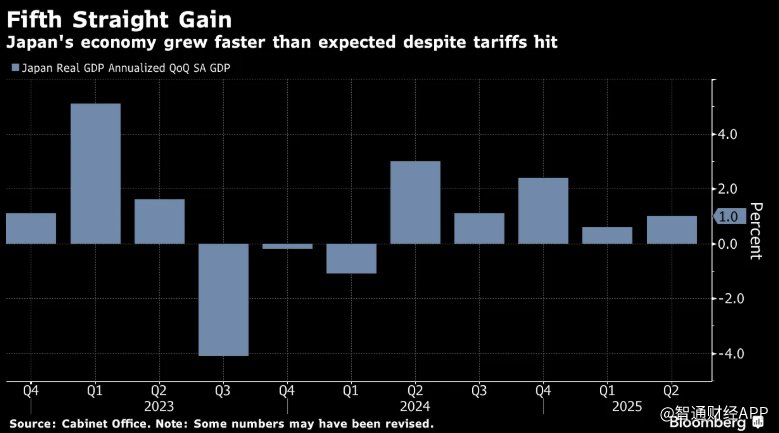
Economic Growth - Japan's GDP for the second quarter grew at an annualized rate of 1.0%, surpassing the forecast of 0.4% and showing a revision from the previous quarter's growth of 0.6% [1][4] - Business investment increased by 1.3% quarter-on-quarter, exceeding the market expectation of 0.7%, while private consumption saw a slight growth of 0.2% [3][4] Central Bank Implications - The strong economic performance may reinforce market expectations for the Bank of Japan to raise interest rates again this year, with 42% of economists surveyed anticipating a rate hike in October [4][5] - The Bank of Japan's Governor has indicated that if domestic demand remains stable, the central bank will continue to raise borrowing costs [4] Trade and Investment - Despite the uncertainties posed by U.S. tariffs, Japanese corporate investment has shown steady growth, with large companies planning to increase investment by 11.5% this fiscal year, significantly higher than the previous estimate of 3.1% [6] - Net exports contributed 0.3 percentage points to economic growth, with actual exports increasing by 2% despite U.S. tariffs, as companies lowered sales prices to maintain market share [7] Consumer Spending - Private consumption accounts for nearly 60% of Japan's GDP, and despite ongoing inflation, its growth rate remains slightly above expectations, supported by robust wage growth from this year's salary negotiations [7][8] - Strong inbound tourism has also bolstered net exports, with foreign tourist spending increasing by 18% in the second quarter [7] Future Outlook - The third quarter data may better reflect the impact of tariff policies as initial shock effects dissipate, with ongoing risks including persistent inflation [7] - Companies have committed to wage increases exceeding 5%, which may support consumer spending in the coming months [8]

多国利率调整步调不一 全球资产格局酝酿重塑
Shang Hai Zheng Quan Bao· 2025-08-14 18:23
Group 1 - The core viewpoint of the articles highlights the divergence in monetary policy paths among major global economies, with a growing expectation for the Federal Reserve to initiate interest rate cuts in September, influenced by recent economic data and political statements [1][3][6] - The Australian central bank has lowered its benchmark interest rate by 25 basis points to 3.6%, marking its third cut this year, with expectations of further reductions in the coming year [2][3] - The Bank of Japan is maintaining its policy rate at around 0.5%, with a complex situation as it prepares to normalize its monetary policy, contrasting with the easing measures taken by other developed nations [2][3] Group 2 - The Federal Reserve's potential rate cut is anticipated to reshape global asset pricing, with discussions shifting from whether to cut rates to the extent and nature of the cuts [3][5][6] - The divergence in monetary policies, particularly the suggestion of a "U.S. rate cut and Japan rate hike" scenario, is expected to alter the global interest rate structure and influence capital flows and market sentiments [6][7] - If the Federal Reserve proceeds with rate cuts, it is projected to lead to increased liquidity in global financial markets, benefiting sectors such as high-growth technology stocks and potentially lowering U.S. Treasury yields [7]
国元证券实时热点
Guoyuan Securities2· 2025-08-11 02:28
Monetary Policy and Economic Indicators - Federal Reserve Governor Bowman supports starting interest rate cuts in September, with three cuts expected by year-end[4] - U.S. June imports saw a significant decline, exceeding expectations[4] - Japan's central bank may resume interest rate hikes by year-end if U.S. tariffs have limited impact[4] - The UN Food and Agriculture Organization reported that global food prices reached a two-year high in July[4] Market Performance - 2-year U.S. Treasury yield increased by 3.45 basis points to 3.762%[4] - 5-year U.S. Treasury yield rose by 4.15 basis points to 3.833%[4] - 10-year U.S. Treasury yield climbed by 3.49 basis points to 4.287%[4] Economic Data - China's Q2 current account surplus was 971.5 billion yuan[4] - China's July CPI rose by 0.4% month-on-month, while PPI's decline narrowed[4] - China's robot industry revenue grew by 27.8% year-on-year in the first half of the year[4] Stock Market Indices - Nasdaq index closed at 21,450.02, up 0.98%[6] - Dow Jones Industrial Average closed at 44,175.61, up 0.47%[6] - Hang Seng Index closed at 24,858.82, down 0.89%[6]
美财长:正牵头物色鲍威尔的继任人选
21世纪经济报道· 2025-08-10 23:49
Core Viewpoint - The U.S. Treasury Secretary is leading the search for the successor to the current Federal Reserve Chairman Powell, emphasizing the need for a candidate who can analyze complex economic data and gain market trust [1][2]. Group 1 - The new Federal Reserve Chairman should possess the ability to assess the entire institution and focus on forward-thinking rather than relying solely on historical data [2]. - President Trump has been pressuring the Federal Reserve to lower interest rates and has linked the discussion of the next chairman to the current chairman Powell [2]. - Powell's term is set to end in May 2026, and it is customary for the President to announce the next nominee in the final months of the current chairman's term [2].
日本央行坎坷的加息之路
2 1 Shi Ji Jing Ji Bao Dao· 2025-08-08 22:32
Group 1 - The Bank of Japan decided to maintain the current interest rate at 0.5% despite rising inflation, with no indication of a near-term rate hike [1][2] - Japan's consumer price index (excluding fresh food) rose by 3.3% year-on-year in June, exceeding the Bank of Japan's inflation target of 2% for over three years [1][2] - Major financial institutions in Japan are calling for a rate hike in September or October, citing the need to address the widening interest rate differential with the US and Eurozone [1][2] Group 2 - Despite high inflation, the Bank of Japan believes the underlying inflation rate has not reached 2%, and consumer activity has been declining since March [2][3] - Japan's GDP growth was -0.2% in Q1 and stagnant in Q2, indicating that inflation is not a sign of economic strength but rather a result of yen depreciation and labor shortages [3][4] - Political instability following the recent upper house elections complicates the situation, making it difficult for the Bank of Japan to raise interest rates [4][5] Group 3 - The US economy grew by 3.0% in Q2, but this growth is seen as temporary, and potential rate cuts by the Federal Reserve could impact Japan's interest rate decisions [5][6] - If the US economy remains strong, it could lead to further yen depreciation and increased domestic prices in Japan, potentially creating an opportunity for the Bank of Japan to raise rates [5][6]