
汽车出口

Search documents
崔东树:2025年1-9月中国汽车实现出口571万辆 同比增长21%
Di Yi Cai Jing· 2025-10-24 11:10
Core Insights - In the first nine months of 2025, China's automobile exports reached 5.71 million units, representing a year-on-year growth rate of 21% compared to the same period in 2024 [1] - In September 2025, China exported 763,000 vehicles, showing a year-on-year increase of 26% and a month-on-month growth of 0%, indicating strong overall performance [1] - The export of new energy vehicles (NEVs) in September 2025 was 300,000 units, marking a significant increase of 66% [1] - For the first nine months of 2025, NEV exports totaled 2.32 million units, reflecting a year-on-year growth of 52%, which is substantially higher than the 22% growth rate observed in the same period of 2024 [1]
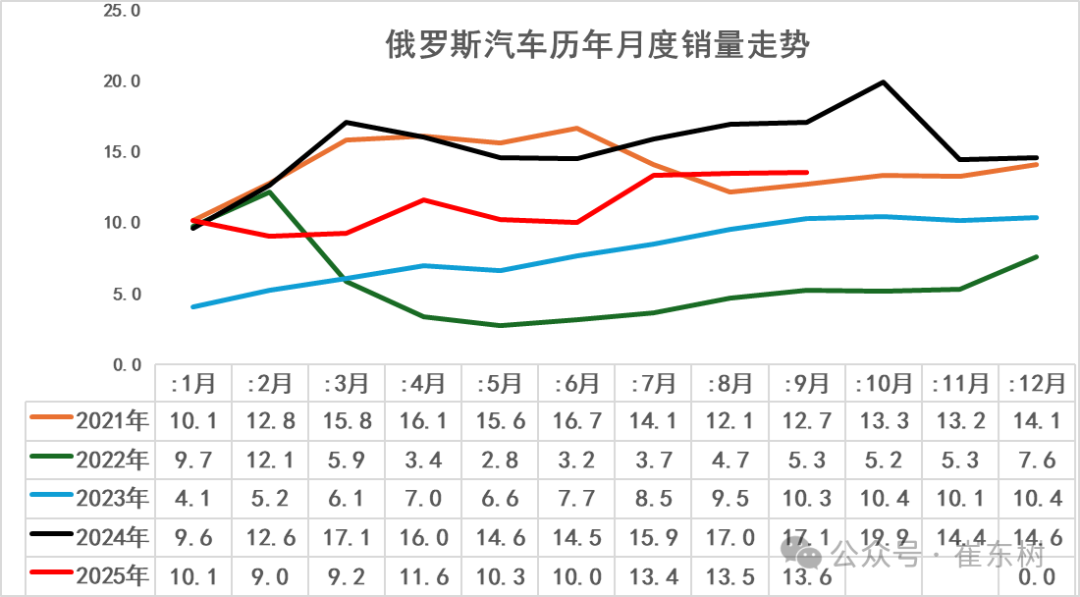
崔东树:9月俄罗斯汽车销量达到13.6万辆 同比下降21% 环比增1%
智通财经网· 2025-10-23 11:49
Core Insights - The overall sales of the Russian automotive market are projected to reach 1.83 million units in 2024, marking a 91% year-on-year increase, the highest annual sales in recent years [1][8] - In 2025, sales are expected to decline to 136,000 units in September, a 21% year-on-year decrease, while cumulative sales from January to September 2025 are projected at 1.01 million units, down 25% year-on-year [1][9] Market Trends - The Russian automotive market has experienced significant fluctuations, with sales dropping to around 30,000 units per month during the peak of the Ukraine crisis in 2022, but recovering to approximately 100,000 units per month in 2023 [6][8] - The market is expected to stabilize at around 150,000 units per month in 2024, although it may weaken towards the end of the year due to new vehicle purchase policies [6][8] Chinese Automotive Presence - Chinese automotive companies have significantly increased their market share in Russia, achieving over 50% in 2023 and surpassing 60% in monthly market share from June to September 2024 [1][16] - By 2025, the market share of Chinese brands is expected to rebound to 57% in the first nine months, with a slight increase to 59% in September [1][16] Export and Local Sales - In 2023, China exported 1 million vehicles to Russia, with local sales of 480,000 units, representing 48% of the export volume [2][11] - By 2024, exports are projected to rise to 1.28 million units, with local sales reaching 1.07 million units, accounting for 84% of the export volume [2][11] Localization Strategies - Chinese automakers are accelerating localization efforts in Russia, including establishing regional production bases and enhancing local supply chains to mitigate tariff impacts and delivery times [3][12] - Strategies include increasing local component sourcing to over 60%, improving service networks, and adapting products for extreme weather conditions [3][12] Challenges and Risks - The Russian automotive market faces challenges such as increased import taxes, economic recession, high interest rates, and consumer hesitance due to potential returns of international brands [9][12] - The introduction of a significant increase in vehicle scrappage taxes and other protective measures may hinder the competitiveness of Chinese automakers in the Russian market [9][16] Brand Performance - In 2024, the top-performing brands in Russia include AvtoVAZ, Chery, and Geely, while traditional international brands like Toyota and Volkswagen are also present but facing challenges [18][19] - The overall market dynamics are shifting, with local brands gaining ground due to the exit of many international competitors [14][19]





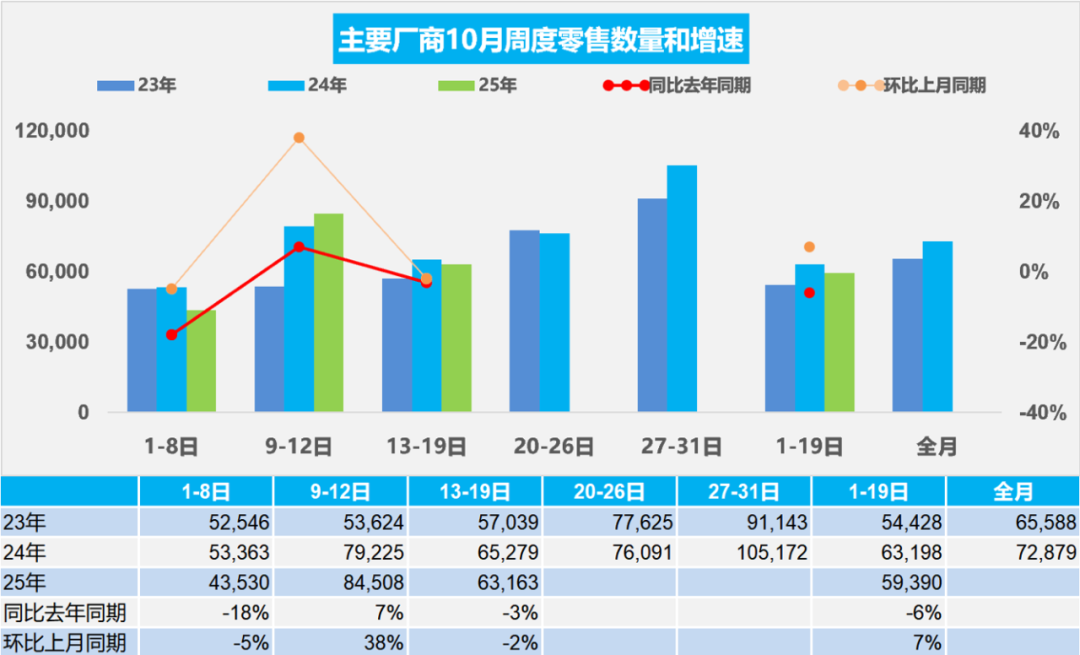
乘联分会:10月1-19日全国乘用车市场零售112.8万辆 同比下降6%
智通财经网· 2025-10-22 09:01
Core Insights - The retail sales of passenger cars in China from October 1 to 19 reached 1.128 million units, representing a year-on-year decline of 6% but a month-on-month increase of 7% [1][2] - Cumulative retail sales for the year reached 18.136 million units, showing a year-on-year growth of 8% [1][2] - The retail sales of new energy vehicles (NEVs) during the same period were 632,000 units, marking a year-on-year increase of 5% and a month-on-month increase of 2%, with a penetration rate of 56.1% [1][2] Passenger Car Market Overview - Retail sales from October 1 to 19 totaled 1.128 million units, down 6% year-on-year but up 7% month-on-month; cumulative sales for the year reached 18.136 million units, up 8% year-on-year [2][5] - Wholesale figures for the same period were 1.155 million units, down 5% year-on-year but unchanged from the previous month; cumulative wholesale for the year reached 22.002 million units, up 12% year-on-year [2][9] New Energy Vehicle (NEV) Insights - NEV retail sales from October 1 to 19 were 632,000 units, up 5% year-on-year and 2% month-on-month, with a cumulative total of 9.502 million units for the year, reflecting a 23% year-on-year increase [2][5] - NEV wholesale during the same period was 676,000 units, up 6% year-on-year and 5% month-on-month, with a cumulative total of 11.123 million units for the year, showing a 30% year-on-year growth [2][9] Market Trends and Influences - The market experienced a slow start in October due to holiday effects and a previous surge in September driven by government incentives [5] - The traditional peak season of "Golden September and Silver October" is expected to boost sales, although tightening subsidy standards and the impending expiration of tax incentives may affect consumer enthusiasm [5][11] - The export market for Chinese automobiles has shown positive growth, particularly in the NEV segment, with increasing competitiveness against international brands [9][11]
在全球最大滚装码头,看汽车出口“汽”势如虹
Zhong Guo Jing Ji Wang· 2025-10-22 08:55
Core Insights - The article highlights the significant growth and transformation of the automotive export operations at the Haitong International Automobile Terminal in Shanghai, emphasizing the increase in both volume and efficiency in recent years [1][2][3][4] Group 1: Export Volume and Growth - Since the beginning of the 14th Five-Year Plan, the Haitong Terminal has exported over 5.32 million domestic vehicles by September 2023, with an annual growth rate of 10.6% [1] - The proportion of new energy vehicles in exports has increased from 34% to 59% over the past five years [1] Group 2: Efficiency Improvements - The terminal has implemented a fully enclosed automated multi-story parking garage, which can accommodate up to 6,160 vehicles, significantly enhancing storage capacity and reducing the required space to less than one-sixth of traditional flat storage [2] - The integration of smart technology and remote monitoring has streamlined the entire process of vehicle management, greatly reducing customs clearance times [2] Group 3: Cost-Effective Logistics - The adoption of the "river-sea combined transport" model has become increasingly popular, allowing for more efficient logistics compared to traditional road transport, with a significant reduction in vehicle damage rates [3] - The new transport model has been estimated to save approximately 1,500 yuan in comprehensive costs per vehicle compared to traditional customs declaration methods [3] Group 4: Self-Sufficiency in Shipping - There is a growing trend of domestic automotive companies investing in their own shipping capabilities, transitioning from relying on foreign vessels to building their own fleets [4] - The first domestically built clean energy roll-on/roll-off vessel, capable of carrying the largest number of vehicles globally, is set to begin operations in early 2024, marking a significant shift towards self-reliance in shipping [4]
【周度分析】车市扫描(2025年10月13日-10月19日)
乘联分会· 2025-10-22 08:42
Group 1: Market Overview - From October 1 to 19, the national passenger car retail market sold 1.128 million units, a year-on-year decrease of 6%, but a month-on-month increase of 7%. Cumulative retail sales for the year reached 18.136 million units, up 8% year-on-year [2][5] - During the same period, wholesale of passenger cars reached 1.155 million units, down 5% year-on-year but flat compared to the previous month. Year-to-date wholesale totaled 22.002 million units, an increase of 12% year-on-year [2][8] - The penetration rate of new energy vehicles (NEVs) in the passenger car market reached 56.1% with retail sales of 632,000 units, a year-on-year increase of 5% [2][5] Group 2: Monthly Sales Trends - Daily average retail sales in the first week of October were 44,000 units, down 18% year-on-year, while the second week saw an increase to 85,000 units, up 7% year-on-year [4][5] - The third week recorded a daily average of 63,000 units, a slight decrease of 3% year-on-year [5] Group 3: Wholesale Trends - Daily average wholesale in the first week of October was 30,000 units, down 21% year-on-year, while the second week saw a slight decrease to 76,000 units, down 1% year-on-year [7][8] - The third week recorded a daily average of 87,000 units, showing a year-on-year increase of 1% [7] Group 4: Investment and Production - In the first nine months of 2025, automotive investment grew by 19%, production increased by 11%, and consumption rose by 1% [9] - The production of automobiles in September reached 3.23 million units, a year-on-year increase of 14%, with NEVs accounting for 1.58 million units, up 20% [9] Group 5: Battery Market Insights - In September, the production of power batteries reached 151 GWh, a year-on-year increase of 50%, with a cumulative production of 1,122 GWh for the first nine months, up 44% [10][11] - The market share of lithium iron phosphate batteries has increased, with CATL surpassing BYD in market share for these batteries [11] Group 6: Pickup Truck Market Analysis - In September 2025, the pickup truck market sold 46,000 units, a year-on-year decrease of 1.9% but a month-on-month increase of 14.6% [12] - Cumulative sales for the first nine months reached 432,000 units, a year-on-year increase of 11.2% [12][13]

深汕小漠港单月汽车出口冲刺1.4万辆新纪录 比亚迪“出海舰队”年运力超百万辆
Shen Zhen Shang Bao· 2025-10-21 23:08
Core Viewpoint - BYD is significantly expanding its international presence, with a record number of vehicles being exported through Xiaomo Port, which is becoming a key hub for the company's global strategy [1][2]. Group 1: Export Activities - On October 19, 1380 BYD electric vehicles were loaded onto the "Changzhou" roll-on/roll-off ship for export to Brazil, contributing to increased port operations [1]. - Xiaomo Port is expected to exceed 14,000 vehicles in exports for October, setting a new monthly record for the port [1]. - In the first three quarters of this year, Xiaomo Port exported a total of 23,000 vehicles, with over 90% of the cargo sourced from BYD's nearby Shen-Shan base [1]. Group 2: Global Sales Performance - From January to September, BYD's global sales reached 3.26 million units, a year-on-year increase of 18.64%, with total historical sales surpassing 13.8 million units [2]. - Overseas sales for BYD reached 701,500 units in the first nine months, exceeding the total overseas sales for the entire year of 2024 [2]. - In September alone, BYD's overseas sales of passenger cars and pickups amounted to 70,851 units, accounting for approximately 17.9% of total sales for the month, reflecting a 107% year-on-year growth [2]. Group 3: Strategic Developments - BYD's chairman emphasized that the overseas market is entering a growth phase similar to the domestic market's explosive growth in 2020, making international expansion a core strategy for the next three years [2]. - Xiaomo Port is part of Shenzhen's future growth strategy, with ongoing infrastructure developments to enhance its capacity for vehicle exports [3]. - The port's new facilities will allow for simultaneous loading and unloading of two 9,200-car capacity roll-on/roll-off ships, aiming for an annual transportation capacity of 1 million vehicles [3].
中汽协:9月汽车出口65.2万辆 同比增长21%
Zhong Guo Xin Wen Wang· 2025-10-21 05:44
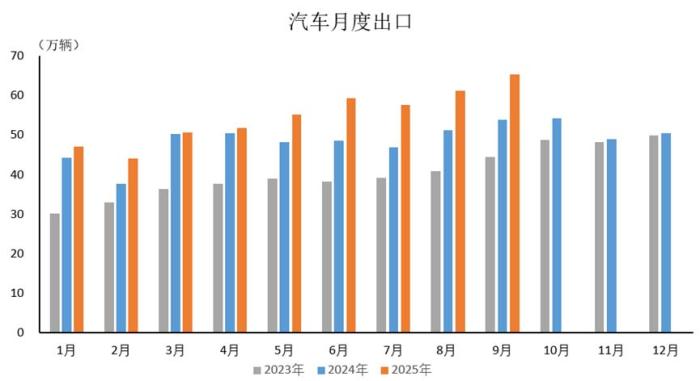
Group 1 - In September 2025, automobile exports reached 652,000 units, representing a year-on-year increase of 21% and a month-on-month increase of 6.7% [3] - From January to September 2025, total automobile exports amounted to 4.95 million units, showing a year-on-year growth of 14.8% [3] - Passenger car exports in September 2025 were 560,000 units, with a month-on-month increase of 5% and a year-on-year increase of 22.4% [4] Group 2 - Commercial vehicle exports for the first nine months of 2025 totaled 748,000 units, reflecting a year-on-year increase of 10.2% [5] - In September 2025, commercial vehicle exports were 93,000 units, with a month-on-month increase of 18% and a year-on-year increase of 13.3% [6] Group 3 - Traditional fuel vehicle exports in September 2025 were 430,000 units, with a month-on-month increase of 11.1% and a year-on-year increase of 0.5% [7] - From January to September 2025, traditional fuel vehicle exports totaled 3.192 million units, indicating a year-on-year decline of 5.6% [7] Group 4 - New energy vehicle exports in September 2025 reached 222,000 units, showing a month-on-month decrease of 0.9% but a year-on-year increase of 100% [9] - From January to September 2025, new energy vehicle exports totaled 1.758 million units, reflecting a significant year-on-year growth of 89.4% [10]
中汽协:9月汽车出口超60万辆 新能源汽车出口保持快速增长态势
Ge Long Hui· 2025-10-21 02:22
Core Insights - In September, China's automobile exports exceeded 600,000 units, with a rapid growth in new energy vehicle exports [1] Passenger Vehicle Exports - In September, passenger vehicle exports reached 560,000 units, representing a month-on-month increase of 5% and a year-on-year increase of 22.4% [1] - From January to September 2025, passenger vehicle exports totaled 4.201 million units, showing a year-on-year growth of 15.6% [1] Commercial Vehicle Exports - In September, commercial vehicle exports amounted to 93,000 units, with a month-on-month increase of 18% and a year-on-year increase of 13.3% [1] - From January to September 2025, commercial vehicle exports reached 748,000 units, reflecting a year-on-year growth of 10.2% [1] Traditional Fuel Vehicle Exports - In September, traditional fuel vehicle exports were 430,000 units, with a month-on-month increase of 11.1% and a year-on-year increase of 0.5% [1] - From January to September 2025, traditional fuel vehicle exports totaled 3.192 million units, indicating a year-on-year decline of 5.6% [1] New Energy Vehicle Exports - In September, new energy vehicle exports were 222,000 units, showing a month-on-month decrease of 0.9% but a year-on-year increase of 100% [1] - From January to September 2025, new energy vehicle exports reached 1.758 million units, marking a year-on-year growth of 89.4% [1]
新华指数丨中国乘用车在欧盟东盟等地出口高速增长 新华出海指数随市回调
Xin Hua Cai Jing· 2025-10-17 09:52
Core Insights - Chinese passenger cars, especially new energy vehicles (NEVs), are rapidly expanding into global markets, with a cumulative export of 3.64 million units in the first eight months of the year, representing a year-on-year increase of 14.5% [1] - NEVs have become the main driver of export growth, with their export share rising by 15 percentage points to 41% in the same period, marking the entry of Chinese passenger cars into the "new energy" era [1] Export Performance - BYD's exports surged by 130% year-on-year to 601,000 units, leading the export rankings among Chinese car manufacturers [1] - Traditional automakers like Chery and SAIC maintained steady export growth due to established overseas operations, while new entrants like Xpeng and Leapmotor achieved significant breakthroughs with exports of 25,000 and 31,000 units respectively [1] - In contrast, Tesla's exports fell by 23% during the same period, highlighting the rise of Chinese automakers in the global export landscape [1] Regional Market Growth - Chinese passenger cars have seen rapid growth in key markets such as the EU, ASEAN, West Asia, and Africa, with NEVs showing particularly strong performance [2] - In the EU, NEV exports from China increased by 32% year-on-year, indicating strong adaptability and competitiveness in various global markets [2] - The EU is projected to experience a rebound in NEV penetration rates in 2025, providing significant opportunities for Chinese automakers [2][3] ASEAN Market Dynamics - The ASEAN market is characterized by a diverse landscape of local and Chinese brands, with NEV sales expected to reach 229,000 units in 2024, a 55% increase year-on-year [4] - By mid-2025, NEV penetration rates in Vietnam, Thailand, and Indonesia are projected to reach 37%, 28%, and 14% respectively, with Chinese brands gaining significant market share [4] Latin America Market Position - In the relatively low-base Latin American market, Chinese passenger cars have achieved remarkable growth, particularly in the NEV segment [5] - BYD's market share in the Latin American NEV sector increased from 60% to 77% between 2023 and mid-2025, with models like Song Plus and Dolphin driving this growth [5] Strategic Responses to Trade Barriers - Despite strong export momentum, trade barriers pose challenges, including tariffs and anti-subsidy measures [5] - Chinese automakers are adopting strategies such as "capacity going abroad + localized operations" to mitigate the impact of trade policies, including establishing overseas factories and joint ventures [5]

乘联分会:1-9月皮卡出口22.8万辆,同比增长28%
Xin Lang Cai Jing· 2025-10-17 09:00
Core Insights - The national pickup truck market in China is projected to export 244,000 units in 2024, reflecting an impressive growth rate of 85% [1] - The overall industry export performance, led by Great Wall Motors, has been exceptionally strong, with a total of 228,000 pickup trucks exported from January to September 2023, marking a year-on-year increase of 28% [1] - In September 2025, pickup truck exports reached 26,000 units, showing a year-on-year growth of 3% and a month-on-month increase of 22% [1] Industry Performance - The pickup truck export market continues to maintain a high export share, indicating robust demand and competitive positioning in the global market [1] - The strong export figures suggest a positive outlook for the pickup truck segment, particularly for leading manufacturers like Great Wall Motors [1]