
流动性管理

Search documents
三部门联合发文!涉及1170家境外机构,4万亿债券市场迎来巨变!
Sou Hu Cai Jing· 2025-10-02 09:03
Core Viewpoint - The recent announcement by the central bank, the China Securities Regulatory Commission, and the State Administration of Foreign Exchange allows foreign institutional investors to fully participate in the bond repurchase market, marking a significant policy shift in China's financial landscape [1][8]. Group 1: Impact on Foreign Investors - The new policy effectively provides foreign investors with a "liquidity button" for their RMB-denominated bonds, enhancing their ability to manage cash flow [2]. - Historically, foreign investors faced challenges during market volatility, often forced to sell Chinese government bonds to meet margin calls, disrupting their investment strategies [3]. - The inability to efficiently manage liquidity led to increased trading costs and amplified investment risks, with estimates suggesting that transaction costs could consume 30%-50% of investment returns [4]. Group 2: Historical Context and Policy Evolution - The bond repurchase business for foreign institutions has been a decade-long journey, with initial participation limited to sovereign institutions and certain clearing entities, excluding major investment players [8]. - The recent policy change opens the door for a broader range of foreign investment institutions, allowing them to engage in repurchase agreements, which are essential for liquidity management [8]. Group 3: Operational Differences and Future Prospects - The new repurchase framework introduces a buyout-style repurchase model, aligning more closely with international practices, while the existing pledge-style repurchase remains in place for the time being [11]. - The policy is expected to enhance the attractiveness of Chinese bonds, with foreign institutions likely to increase their holdings significantly, as evidenced by a net increase of over 300 billion RMB in the first eight months of the year [13]. - The central bank's efforts to position Chinese bonds as widely accepted collateral in global markets could further boost their appeal and liquidity [13].

央行10月9日买断式逆回购将操作1.1万亿元
Jing Ji Guan Cha Bao· 2025-10-01 02:59
Core Viewpoint - The People's Bank of China (PBOC) is set to conduct a buyout reverse repurchase operation of 1.1 trillion yuan to maintain ample liquidity in the banking system on October 9, 2025 [1] Group 1 - The operation will be conducted using a fixed amount, interest rate bidding, and multiple price level bidding methods [1] - The term of the reverse repurchase operation will be 3 months (91 days) [1]
11000亿元!央行出手
券商中国· 2025-09-30 09:46
Group 1 - The People's Bank of China announced a buyout reverse repurchase operation of 1.1 trillion yuan, set to take place on October 9, 2025, with a term of 3 months (91 days) to maintain ample liquidity in the banking system [1] - The operation will be conducted through a fixed quantity, interest rate bidding, and multiple price level bidding method [1] Group 2 - The announcement is part of the central bank's strategy to ensure sufficient liquidity in the financial system [1] - The operation reflects ongoing efforts to manage monetary policy effectively amid changing economic conditions [1]
央行10月9日将开展11000亿元买断式逆回购操作
Zheng Quan Shi Bao Wang· 2025-09-30 09:11
Core Viewpoint - To maintain ample liquidity in the banking system, the People's Bank of China will conduct a 1.1 trillion yuan (approximately 110 billion) reverse repurchase operation on October 9, 2025, with a term of 3 months (91 days) using a fixed quantity, interest rate bidding, and multiple price bidding method [1] Group 1 - The People's Bank of China aims to ensure sufficient liquidity in the banking system [1] - The reverse repurchase operation will amount to 1.1 trillion yuan [1] - The operation will have a duration of 3 months (91 days) [1]
2025年9月30日国债期货行情异动原因分析
Sou Hu Cai Jing· 2025-09-30 04:24
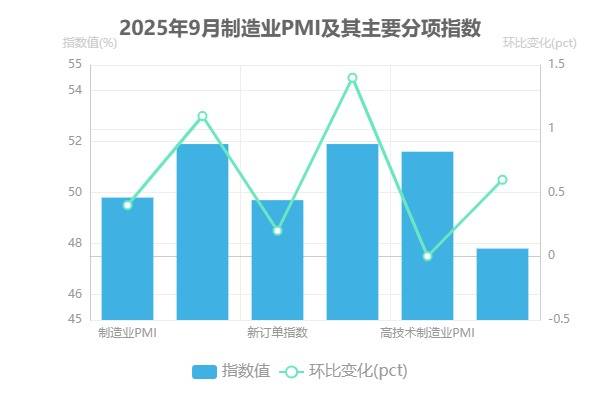
Market Overview - On September 30, 2025, significant intraday fluctuations were observed in the government bond futures market, with all contract maturities rebounding sharply by midday after a cautious opening [1][3] - The 30-year main contract experienced notable volatility, initially dropping by 0.30% before closing up 0.07%, indicating intense long-short competition in the long-end segment [3] Policy Drivers - The fluctuations in government bond futures were primarily driven by multiple positive signals from the policy front, with the People's Bank of China (PBOC) injecting stability into market expectations through precise liquidity provision [4] - On September 30, the PBOC conducted a 7-day reverse repurchase operation at a fixed rate of 1.40%, injecting 242.2 billion yuan into the market, which alleviated seasonal funding pressures [4][5] - The PBOC's third-quarter monetary policy meeting emphasized "promoting stable economic growth" and maintaining ample liquidity, indicating a shift in policy tone from "maintaining" to "promoting" [5][7] Economic Data Impact - The release of the manufacturing PMI data for September, which rose to 49.8%, played a crucial role in influencing market sentiment, reflecting a "weak recovery" in the economy [9][11] - The production index increased to 51.9%, indicating expansion, while the new orders index remained below the threshold, highlighting persistent demand weakness [12][13] Fund Allocation Demand - The concentrated entry of allocation-type funds, particularly from insurance capital, was a key driver behind the price increase in government bonds [14][15] - The 30-year government bond ETF saw significant inflows, with its scale reaching 18.608 billion yuan, reflecting strong demand for long-duration assets [16][19] International Market Transmission Effects - The Federal Reserve's decision to lower interest rates by 25 basis points on September 17, 2025, has influenced global financial markets, leading to a narrowing of the interest rate differential between China and the U.S. [18][20] - The weakening of the U.S. dollar and stabilization of the Chinese yuan have created a favorable environment for foreign capital to flow back into Chinese assets [20][21] Future Outlook and Investment Strategy - The current government bond futures market is in a balancing phase, with a likelihood of 10-year bond yields remaining within the 1.7%-1.9% range, supported by weak economic fundamentals and expectations of liquidity easing [24][26] - Investors are advised to adopt a defensive and diversified strategy, closely monitoring signals from the Federal Reserve and domestic government bond issuance [27][28]
央行加码流动性投放 呵护跨季资金面
Zheng Quan Ri Bao· 2025-09-29 16:11
Group 1 - The People's Bank of China (PBOC) has increased liquidity injections since late September, indicating a clear intention to support the funding environment across the quarter [1] - On September 22, the PBOC restarted 14-day reverse repos with a scale of 300 billion yuan, followed by an increase to 600 billion yuan on September 26, and a total of 29,377 billion yuan injected from September 22 to September 29 [1] - The PBOC also conducted a 6,000 billion yuan Medium-term Lending Facility (MLF) operation on September 25, resulting in a net injection of 3,000 billion yuan for the month [1] Group 2 - Tianfeng Securities reports that the PBOC's increased liquidity measures have led to a stable funding environment, with expectations for continued stability into October despite potential liquidity disturbances [2] - October is anticipated to be a month of high fiscal revenue and low expenditure, with significant government bond issuance potentially tightening liquidity, although the amount of interbank certificates maturing is expected to be lower than in September [2] - The PBOC is likely to continue using various liquidity management tools in October to maintain ample market liquidity, suggesting limited upward pressure on major money market rates [2] Group 3 - There is a growing expectation in the market for the PBOC to resume government bond trading operations, which had been paused earlier this year to avoid impacting investor needs [3] - Regardless of whether government bond trading resumes, Tianfeng Securities believes that liquidity concerns are manageable due to the diverse range of monetary policy tools available to the PBOC [3] - The PBOC can effectively stabilize funding fluctuations by flexibly utilizing short, medium, and long-term liquidity injection tools such as reverse repos and MLF [3]
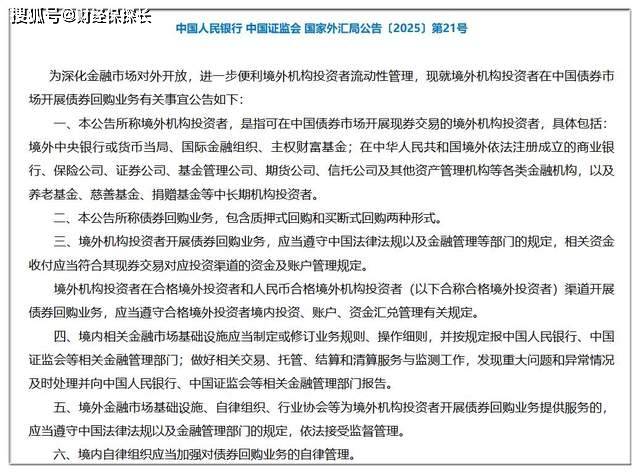
支持境外机构投资者开展债券回购业务
Ren Min Ri Bao Hai Wai Ban· 2025-09-29 02:02
Core Viewpoint - The announcement by the People's Bank of China, the China Securities Regulatory Commission, and the State Administration of Foreign Exchange supports foreign institutional investors in conducting bond repurchase transactions in the Chinese bond market [2] Group 1: Policy Support - The joint announcement allows foreign institutional investors who can engage in cash bond trading in China to also participate in bond repurchase transactions [2] - Bond repurchase is a widely used liquidity management tool internationally, facilitating short-term financing among financial institutions [2] Group 2: Market Participation - All foreign institutional investors, including those entering the market directly and through the "Bond Connect" channel, are eligible to engage in bond repurchase transactions [2] - The implementation of bond repurchase will follow international practices, allowing for the transfer and utilization of the underlying bonds [2] Group 3: Historical Context - Since 2015, the People's Bank of China has progressively opened the bond repurchase market to foreign entities, initially supporting sovereign institutions and offshore clearing banks [2] - By August 2025, a total of 1,170 foreign institutions from 80 countries and regions had entered the Chinese bond market, holding approximately 4 trillion RMB in bonds [2]
进一步支持各类境外机构投资者开展债券回购
Sou Hu Cai Jing· 2025-09-26 22:18
Core Points - The People's Bank of China, the China Securities Regulatory Commission, and the State Administration of Foreign Exchange jointly issued an announcement to support foreign institutional investors in conducting bond repurchase transactions in the Chinese bond market [1] - The announcement further opens up the bond repurchase business, allowing all types of foreign institutional investors to participate, including those entering through direct market access and the "Bond Connect" channel [1] - Bond repurchase is a widely used liquidity management tool internationally, and the announcement aims to meet the liquidity management needs of foreign institutional investors and promote connectivity between onshore and offshore financial markets [1] Group 1 - The announcement strengthens the bond repurchase mechanism in the interbank market and aligns it with international practices, providing greater convenience for foreign institutional investors [2] - The bond repurchase business includes both pledged and buyout repurchase forms, with current differences in operational practices compared to international markets [2] - The mechanism design of transferring the ownership of the underlying bonds aligns with international mainstream repurchase practices, enhancing the attractiveness of the Chinese bond market to foreign institutional investors [2]
人民银行将开展6000亿元MLF操作
Bei Jing Shang Bao· 2025-09-24 11:45
北京商报讯(记者 刘四红)9月24日,据人民银行官网消息,为保持银行体系流动性充裕,2025年9月 25日(周四),中国人民银行将以固定数量、利率招标、多重价位中标方式开展6000亿元MLF操作, 期限为1年期。 ...
银河君信混合I单日暴跌23%引热议,持有人仅1户,规模435万元,同系列净值正常
Xin Lang Ji Jin· 2025-09-24 10:37
Core Viewpoint - The significant drop of 23.33% in the net value of Galaxy Junxin Mixed Fund I on September 22 has raised concerns among investors, highlighting the volatility and liquidity management issues within the fund industry [1][6]. Fund Performance - Galaxy Junxin Mixed Fund I, established on September 7, 2016, reported a year-to-date return of -15.19%, a one-year return of -7.05%, and a three-year return of -7.87% as of September 24 [4][6]. - The fund's latest net value is 1.0000 yuan, with a notable single-day decline of 23.33% on September 22 [4][6]. Fund Structure and Holdings - The fund primarily holds a small percentage in Sany Heavy Industry, accounting for only 0.93% of the fund's net asset value, indicating that the drop cannot be attributed to individual stock volatility [5][6]. - Galaxy Junxin Mixed Fund I is a special share class within the Galaxy Junxin series, targeting large investors with a minimum subscription amount of 10 million yuan and a lower service fee compared to other classes [5][6]. Investor Behavior and Market Impact - The fund reportedly has only one holder, with its shares decreasing from 205 million at the end of 2022 to 3.6208 million currently, resulting in a total scale of only 4.35 million yuan [6]. - The sharp decline in net value due to large redemptions has raised concerns about market confidence and the fund's stability, despite the fact that it primarily affects large investors [6].
