
消费者权益保护

Search documents
购物被打疑似歧视“标签” 斐乐惹众怒
Jing Ji Guan Cha Bao· 2025-11-25 04:42
Core Viewpoint - The incident involving FILA has sparked outrage due to perceived discriminatory remarks made by staff towards a customer, highlighting issues of consumer respect and privacy in retail settings [1][4]. Group 1: Incident Overview - A customer in Zhengzhou reported that a FILA KIDS store employee made a derogatory remark about her purchase, labeling her as "complaining about the price" in a group chat [1]. - The incident has led to public backlash, with many customers expressing their shock and disappointment, and some even threatening to stop shopping at FILA [1][3]. Group 2: Legal and Ethical Implications - Legal experts have indicated that labeling customers based on physical or personal characteristics may violate consumer dignity and privacy rights, potentially leading to discrimination claims [2][3]. - Previous incidents in the industry, such as those involving Haidilao and other brands, demonstrate a pattern of negative consumer labeling that has resulted in public outcry and subsequent policy changes [2][3]. Group 3: Brand Reputation and Management - The incident reflects a significant failure in customer service training at FILA, raising concerns about the brand's respect for diverse consumer needs and its overall service philosophy [4][5]. - The store manager's decision to dissolve the group chat in response to criticism indicates a lack of effective crisis management and further exacerbates the brand's reputational damage [5]. Group 4: Industry Context - FILA, as a high-end brand under Anta Group, generated revenue of 14.182 billion yuan in the first half of the year, accounting for 37% of Anta's total income, emphasizing the importance of maintaining a positive brand image [6]. - The incident serves as a warning to the retail industry about the necessity of balancing efficiency with human-centered service, as consumer data represents individuals deserving of respect [5].

扫码充电被投“百万医疗险”!扣费3个月才知道
Yang Guang Wang· 2025-11-25 03:35
Core Viewpoint - The incident highlights consumer rights violations related to unauthorized insurance charges linked to a charging station service, emphasizing the need for better consumer protection and regulatory oversight in the insurance and service industries [2][10][12]. Group 1: Incident Overview - A consumer, Mr. Ma, discovered unauthorized deductions for a medical insurance policy after using a charging station, with charges occurring over three months [2][4]. - The insurance was linked to a pop-up advertisement encountered while scanning a QR code at the charging station, which Mr. Ma was unaware of until contacted by a representative [4][5]. Group 2: Company Responses - After media intervention, the insurance company refunded Mr. Ma the full amount, despite initially stating only a partial refund was possible [7][8]. - The charging station's service hotline was found to be non-functional, prompting regulatory scrutiny and demands for corrective actions from the involved companies [6][10]. Group 3: Regulatory Actions - The local market supervision bureau confirmed the misleading advertisement practices and initiated corrective measures, including updating contact information and adding warning signs at the charging stations [10][11]. - Legal experts criticized the insurance company's practices as "implied insurance," arguing that they violate consumer rights by not providing clear information about the insurance terms and conditions [11][12].
全球都在围剿“夺命门把手”
Di Yi Cai Jing Zi Xun· 2025-11-24 06:19
Core Viewpoint - Recent lawsuits against Tesla highlight safety concerns regarding the design of hidden door handles, which have been implicated in accidents leading to fatalities and injuries [2][3][4]. Group 1: Lawsuits and Incidents - Tesla was sued in a Washington state federal court following an incident where a Model 3 lost control, crashed, and caught fire, resulting in one death and one injury due to the inability to open the door [3]. - The lawsuit claims that the "unique and defective door handle design" obstructed rescue efforts, contributing to the tragic outcome [3]. - Another lawsuit from a previous incident involved a Model S where five passengers died because they could not escape a burning vehicle due to the door being inoperable after a crash [4]. Group 2: Regulatory Actions - The National Highway Traffic Safety Administration (NHTSA) has initiated an investigation into Tesla's hidden door handles, affecting approximately 174,000 vehicles [4]. - NHTSA has received multiple complaints regarding the 2021 Model Y, specifically related to failures in the low-voltage battery system that rendered the door handles inoperative [4]. - Tesla is required to submit detailed records regarding the design and failure of the door systems by December 10, with potential fines of up to $140 million for non-compliance [5]. Group 3: Industry Responses and Legal Framework - Tesla's design team has indicated plans to change the door handle design in response to the ongoing issues [6]. - Legal experts note that the dual-track system of regulatory oversight and litigation in the U.S. creates significant pressure on companies like Tesla to address safety concerns [7]. - The U.S. product liability laws provide consumers with multiple avenues for lawsuits, including negligence and strict liability, which can lower the burden of proof for plaintiffs [8]. Group 4: Comparative Analysis of Legal Systems - The U.S. employs a model of "full compensation + punitive damages," which can lead to substantial financial repercussions for companies found liable [9][10]. - In contrast, China's legal framework focuses on statutory compensation with defined limits on punitive damages, which may result in less severe financial consequences for companies [10].


全球都在围剿“夺命门把手”
第一财经· 2025-11-24 06:10
Core Viewpoint - The article discusses the ongoing legal challenges faced by Tesla regarding its hidden door handle design, which has been implicated in several accidents leading to fatalities and injuries. The situation highlights the contrasting regulatory and legal approaches in the U.S. and China concerning automotive safety standards and consumer protection [3][4][10]. Group 1: Legal Issues and Incidents - Tesla is facing a lawsuit in Washington state after a Model 3 vehicle lost control and crashed, resulting in one death and one injury, attributed to the "unique and defective door handle design" that hindered escape [4][5]. - The National Highway Traffic Safety Administration (NHTSA) has initiated an investigation into Tesla's door handle safety, affecting approximately 174,000 vehicles, following multiple complaints about the Model Y's door handles failing due to low-voltage battery issues [5][9]. - Previous lawsuits against Tesla have highlighted similar issues, including a fatal incident involving a Model S where passengers were trapped in a burning vehicle due to the door locks malfunctioning [4][5]. Group 2: Regulatory Approaches - In the U.S., the dual-track system of regulatory oversight and litigation provides consumers with multiple avenues for recourse, including negligence, warranty, and strict liability claims [8][10]. - NHTSA's investigation aims to compel Tesla to disclose critical design and failure data, with significant financial penalties for non-compliance, showcasing a proactive regulatory approach to mitigate systemic risks [9][10]. - The article contrasts the U.S. model with China's approach, where regulatory standards are being established to preemptively address safety concerns, as seen in the recent public consultation for mandatory safety standards for automotive door handles [3][10]. Group 3: Compensation and Liability Differences - In the U.S., the compensation model includes comprehensive and punitive damages, which can significantly impact companies in product liability cases, especially when malice is proven [11]. - Conversely, China's compensation framework is primarily statutory, with punitive damages having clear limits, making the regulatory penalties and brand reputation more significant deterrents for companies [11][12].

女子奔丧退票被索要“火化证明”,去哪儿网回应
Xin Lang Ke Ji· 2025-11-22 08:13
Core Viewpoint - The article discusses consumer complaints regarding the ticket refund process on the Qunar platform, particularly in cases of bereavement, highlighting issues of transparency and fairness in the refund policies [2][4][8]. Group 1: Consumer Complaints - A user, referred to as Ms. Lin, faced difficulties in obtaining a full refund for her flight tickets after the death of a family member, despite the airline's approval for a full refund [2][4]. - Ms. Lin reported that after initially being told her refund request was approved, she was later informed that her documentation was insufficient, leading to frustration over the platform's changing requirements [3][4]. - The Qunar platform claimed that the issues arose from unclear documentation submitted by the consumer and a selection error during the refund process [3][4]. Group 2: Legal Perspectives - Legal experts noted that while there is no specific law governing ticket refunds due to a family member's death, consumers have the right to request contract changes under the Consumer Rights Protection Law and Contract Law [6][7]. - The concept of "force majeure" was discussed, indicating that while a family member's death may not fit the strict definition, it is still a valid reason for consumers to seek refunds based on moral and ethical considerations [7]. Group 3: Platform Practices - Multiple consumers reported unauthorized ticket cancellations by Qunar, where tickets were refunded without prior notification, despite the flights still operating normally [8][9]. - Complaints highlighted that the platform's actions resulted in financial losses for consumers, as ticket prices surged after the unauthorized cancellations [8][9]. - Qunar attributed these issues to airline pricing errors, which led to the unilateral cancellation of tickets without informing the consumers [9]. Group 4: Regulatory Concerns - The article mentions that Qunar has faced over 190,000 complaints, primarily related to ticket refunds and customer service issues, indicating a systemic problem within the platform [10][11]. - Regulatory bodies have previously intervened, urging Qunar to improve its service and protect consumer rights, especially regarding unreasonable booking rules [11].
女子奔丧退票被索要“火化证明”,去哪儿网回应 | BUG
新浪财经· 2025-11-22 08:05
Core Viewpoint - The article highlights consumer grievances regarding the ticket refund process on the Qunar platform, particularly in cases of bereavement, indicating potential systemic issues in customer service and compliance with consumer rights [3][5][8]. Group 1: Consumer Complaints - A user, referred to as Ms. Lin, faced difficulties in obtaining a full refund for her flight tickets after the death of a family member, despite the airline's approval for a full refund [3][7]. - Ms. Lin reported that after initially being told her refund request was approved, she was later informed that her submitted documents were insufficient, leading to frustration and confusion [4][7]. - The airline confirmed that the documents provided by Ms. Lin were adequate, raising concerns about Qunar's handling of the refund process [7]. Group 2: Legal Perspectives - Legal experts noted that while there is no specific law governing ticket refunds due to a family member's death, consumer rights laws allow for contract modifications under special circumstances [8][10]. - The concept of "force majeure" was discussed, indicating that while a family member's death may not fit the strict legal definition, it is recognized in practice as a valid reason for refund requests [9][10]. Group 3: Systemic Issues with Qunar - Multiple consumers reported that Qunar unilaterally canceled their tickets without prior notification, despite the flights still operating, leading to significant financial losses as ticket prices surged [12][13]. - Complaints against Qunar have exceeded 190,000, primarily related to refund issues and poor customer service, indicating a broader pattern of consumer dissatisfaction [15]. - The article suggests that Qunar's practices may reflect a prioritization of profit over consumer rights, particularly in the context of refund policies [15].

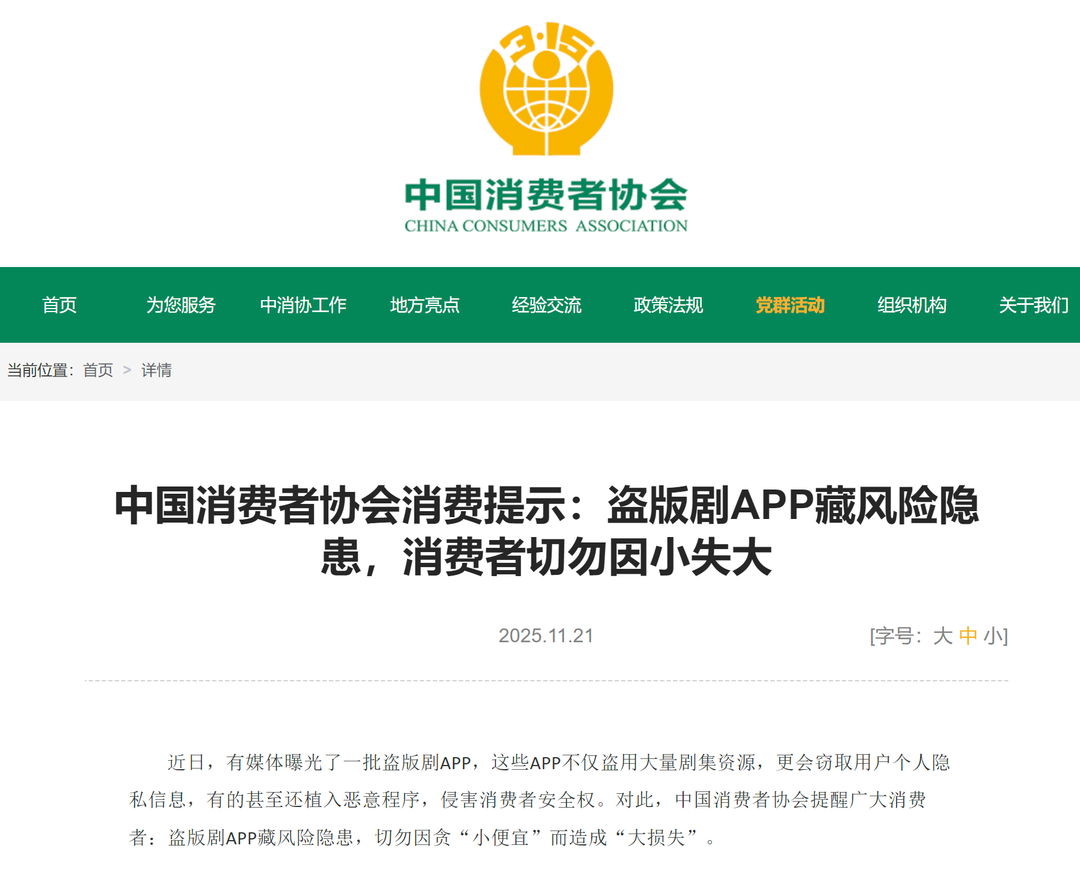
中消协提醒盗版剧APP藏风险隐患,切勿贪“小便宜”造成“大损失”
Yang Zi Wan Bao Wang· 2025-11-21 06:31
Core Insights - A recent media report has exposed a batch of pirated drama apps that not only misuse a large number of drama resources but also steal users' personal privacy information, with some even embedding malicious programs that infringe on consumer safety rights [1][4] - The China Consumer Association (CCA) has warned consumers about the risks associated with pirated drama apps, advising against the temptation of "small savings" leading to "big losses" [1][4] Group 1: Consumer Risks - Pirated drama apps may appear to offer consumers the chance to watch popular dramas at a low or no cost, but they lack guarantees in terms of picture quality, compatibility, and after-sales service, making consumers' legal rights vulnerable [4] - The behavior of these pirated apps is suspected of infringing copyright, which not only dampens the creative enthusiasm of original authors but also severely impacts the healthy development of the entire entertainment industry, ultimately harming consumers' interests [4] Group 2: Privacy and Security Concerns - Pirated drama apps typically require access to consumers' phone locations, photos, cameras, microphones, and contacts during download and operation, posing significant privacy risks [4] - Some pirated apps use various tricks to lure consumers to illegal websites containing trojans and phishing programs, leading to the theft of personal information and making consumers unwitting victims of online fraud [4] Group 3: Consumer Rights Protection - Consumers are advised to keep records of orders, payment receipts, and contracts to protect their rights during consumption [5] - In case of disputes, consumers can negotiate with operators based on the Consumer Rights Protection Law or file complaints through relevant administrative departments or platforms like the "National Consumer Association Smart 315 Platform" [5] - Consumers should report any illegal activities by operators, such as the excessive collection and use of personal information [5]
为民办实事 多维护民生 ——渤海人寿11月消保常态化宣传周活动稳健开展
Cai Fu Zai Xian· 2025-11-21 03:33
11月以来,渤海人寿各分支机构以"为民办实事"为核心导向,紧扣消保常态化教育宣传周契机,组织开 展了一系列主题鲜明、形式多样的金融消保宣传活动。通过场景化普及、专业化解读与便民化服务,多 维度筑牢金融消费安全防线,深入践行 "共治共享 构建消保大格局,从心出发 同塑消保新气象" 的消保 文化理念,展现金融机构维护消费者权益的责任担当。 11 月 14 日,天津分公司走进合作单位天保控股有限公司,开展 "为民办实事" 主题活动。活动打破传 统宣传模式,将金融知识普及与民生服务需求深度融合:通过互动问答、发放图文宣传资料等形式,靶 向提示金融领域非法中介乱象,细致拆解 "虚假宣传诱导贷款""违规代理维权" 等行为的表现形式与危 害;同步开展心理健康讲座、健康问诊及鹰瞳健康设备检测等服务,让企业员工在享受便民服务的同 时,轻松掌握金融风险防范技巧,实现 "守护钱袋子" 与 "守护身心健康" 的双重保障。 本月消保常态化教育宣传周活动,构建起 "高管领航、机构联动、专业支撑" 的三维宣传体系。活动既 通过云端直播实现广覆盖宣传,依托企业场景完成精准化服务,更以人才培育筑牢长效服务根基。 高管讲消保,云端筑防线 未来, ...
你的隐私可能已经泄露 盗版剧App暗藏这些风险
Yang Shi Xin Wen· 2025-11-21 03:04
Core Viewpoint - The exposure of a batch of pirated drama apps by media highlights significant risks to consumer privacy and security, urging consumers to avoid these apps to prevent substantial losses [1] Group 1: Consumer Awareness - Consumers are misled into thinking they can watch popular dramas for little or no cost through pirated apps, but these apps lack quality assurance and can infringe on consumer rights, making it difficult to seek redress [2] - The behavior of pirated drama apps infringes on copyright, undermining the motivation of original creators and negatively impacting the overall health of the entertainment industry, ultimately harming consumer interests [2] Group 2: Privacy Risks - Pirated drama apps often require extensive permissions from consumers, such as access to location, photos, camera, microphone, and contacts, which can lead to personal information theft [3] - These apps may also redirect consumers to illegal websites containing malware or phishing programs, putting consumers at risk of becoming victims of online fraud [3] Group 3: Legal Rights and Protections - Consumers should retain evidence such as order screenshots, payment records, and contracts to protect their rights during disputes, and can seek resolution through legal channels or consumer protection platforms [5] - The entertainment consumption sector is a vital driver of economic growth in China, and improving the consumption environment requires active participation from consumers to foster a culture of responsible consumption and legal rights protection [5]
大力提振消费 夯实发展根基
Qi Huo Ri Bao Wang· 2025-11-21 01:32
Core Viewpoint - The "14th Five-Year Plan" emphasizes boosting consumption as a key driver for sustainable economic growth and improving the quality of life for citizens, especially in the context of a complex global economic environment and domestic economic transformation [1] Group 1: Implementation of Consumption Boosting Actions - The government will implement targeted actions to stimulate consumption through a combination of policies aimed at enhancing market vitality [2] - Focus on increasing employment and income, particularly for key groups such as recent graduates and migrant workers, to enhance consumer capacity [2] - Increase public service spending in areas like education and healthcare to reduce the financial burden on residents, encouraging them to spend more [2] Group 2: Development of International Consumption Centers - The plan includes cultivating international consumption center cities to attract global quality consumption resources and enhance the national image [3] - Improvement of urban consumption infrastructure and introduction of international brands to meet consumer demand for global products [3] - Expansion of inbound consumption by optimizing the environment for international tourists, including simplifying visa processes and enhancing payment options [3] Group 3: Direct Consumer Benefits through Inclusive Policies - The government will increase funding for consumer welfare initiatives, such as issuing consumption vouchers and providing subsidies for upgrading old products [4] - Policies will target high-demand sectors like dining and tourism to stimulate market recovery [4] - Removal of unreasonable restrictions on consumption, such as easing car purchase limits, to unleash consumer potential [4] Group 4: Strengthening Consumer Rights Protection - Enhancing consumer rights protection is crucial for boosting consumption, with plans to improve legislation and market regulation [5] - Establishing efficient complaint resolution mechanisms to lower the cost of consumer rights protection [6] - Promoting consumer education to foster informed and responsible consumption behaviors [6]