
自由贸易

Search documents
王文涛部长会见德国外长瓦德富尔
Shang Wu Bu Wang Zhan· 2025-12-08 13:24
Group 1 - The core viewpoint emphasizes the importance of deepening China-Germany economic and trade relations, as indicated by the recent meeting between Chinese Commerce Minister Wang Wentao and German Foreign Minister Baerbock [2][3] - Wang Wentao highlighted the need to implement the consensus reached by the leaders of both countries, advocating for free trade and the maintenance of a multilateral trade system centered around the WTO [3] - The Chinese side welcomes German companies to seize new opportunities presented by China's 14th Five-Year Plan and aims to convert the "opportunity list" into a "results list" through strengthened cooperation in both traditional and emerging sectors [3] Group 2 - Baerbock acknowledged China as Germany's most important economic partner, expressing a desire to enhance dialogue and pragmatic cooperation, particularly in areas like WTO reform and climate change [4] - The German government appreciates China's efforts in stabilizing the global supply chain, particularly regarding the implementation of a general licensing system for rare earths [4] - Both parties are committed to addressing semiconductor supply chain issues and finding long-term solutions collaboratively [4]

成绩超预期!透过三个关键词解读前11个月外贸为何走得又“稳”又“好”
Yang Shi Wang· 2025-12-08 13:06
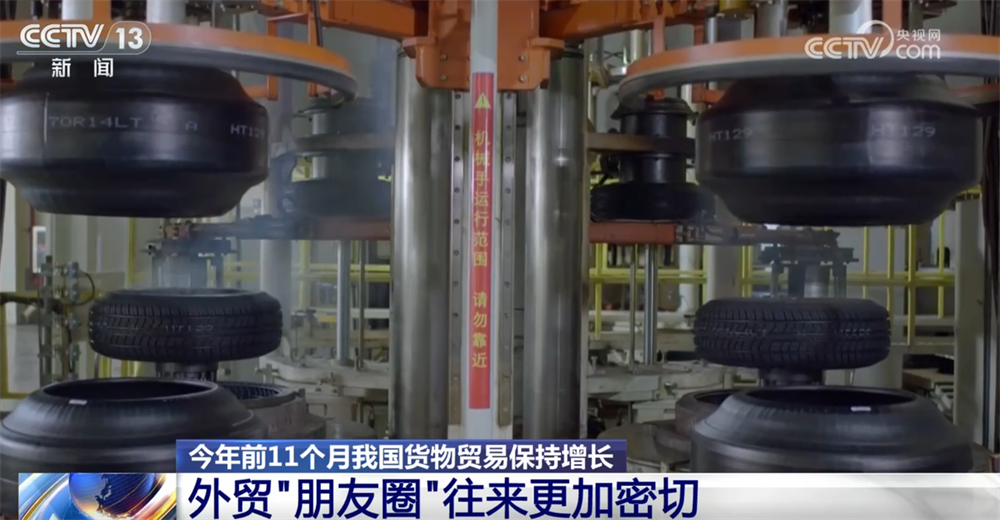
Core Viewpoint - China's goods trade has maintained growth in the first 11 months of the year, with exports reaching 24.46 trillion yuan, an increase of 6.2%, and imports at 16.75 trillion yuan, up 0.2% [1] Group 1: Trade Growth and Key Markets - In November, China's foreign trade growth rebounded, with total imports and exports amounting to 3.9 trillion yuan, a year-on-year increase of 4.1% [1] - In the first 11 months, trade with ASEAN reached 6.82 trillion yuan, growing by 8.5%; trade with the EU was 5.37 trillion yuan, up 5.4%; trade with Latin America was 3.57 trillion yuan, increasing by 5.6%; and trade with Africa was 2.25 trillion yuan, rising by 18.7% [6] Group 2: International Market Expansion - China's international market layout has been diversified, particularly under the Belt and Road Initiative, leading to significant growth in trade with Africa, where the integration of industrial and supply chains is deepening [2][4] - Companies are expanding through a dual approach of "finished product exports + raw material imports," creating a closed-loop industry model between African resources and Chinese manufacturing [4] Group 3: Free Trade Zones and Economic Impact - Free trade zones and ports are central to China's foreign trade development, accounting for about 20% of the country's trade volume despite occupying less than 0.4% of its land area [8] - In the first 11 months, imports and exports from free trade zones and Hainan Free Trade Port reached 8.07 trillion yuan, a year-on-year increase of 5.2%, contributing to a 0.3 percentage point rise in their share of total foreign trade to 19.6% [10] Group 4: Innovations in Trade and Logistics - The logistics channels have seen continuous innovation, with the launch of scheduled operations for the Jinan to Budapest China-Europe Railway Express, improving overall transit times by over 30% [12][14] - Customs innovations include remote video inspections for certain goods, allowing for quicker customs checks, exemplified by a rapid inspection process for traditional Chinese medicine exports [14][16] - The export of "new three types" products, such as lithium batteries, has been on the rise, with Fujian province seeing an average growth rate of 83.1% in lithium battery exports over the past five years [16][18]
外交部:中欧合作有利于双方,也有利于世界
Xin Hua She· 2025-12-08 12:11
Core Viewpoint - The current international situation is increasingly turbulent, and strengthening strategic communication and deepening dialogue and cooperation between China and Europe is beneficial for both parties and the world [1] Group 1: Strategic Communication - High-level exchanges between China and European countries have been frequent this year, with leaders reaching important consensus on further developing strategic partnerships and deepening mutually beneficial cooperation [1] - China is willing to work with Europe to implement the consensus reached by both sides' leaders, enhancing unity and cooperation to promote healthy and stable development of China-Europe relations [1] Group 2: Global Challenges and Governance - Both sides should jointly uphold multilateralism, support free trade, defend the post-war international order and international rules, and oppose unilateralism and bullying actions [1] - There is a call for collaboration to address global challenges such as climate change, improve global governance, and benefit the peoples of China and Europe, thereby injecting more stability and certainty into a turbulent world [1]
中国外交部:中欧加强战略沟通有利于双方也有利于世界
Zhong Guo Xin Wen Wang· 2025-12-08 08:32
中国外交部:中欧加强战略沟通有利于双方也有利于世界 中新经纬版权所有,未经书面授权,任何单位及个人不得转载、摘编或以其它方式使用。 关注中新经纬微信公众号(微信搜索"中新经纬"或"jwview"),看更多精彩财经资讯。 来源:中国新闻网 编辑:郭晋嘉 广告等商务合作,请点击这里 本文为转载内容,授权事宜请联系原著作权人 中新网北京12月8日电 (记者 黄钰钦)中国外交部发言人郭嘉昆8日主持例行记者会。 有记者问:西班牙国王、法国总统近期刚访问中国,德国外长也来中国访问。中方对此有何评价? 郭嘉昆:今年以来,中国同欧洲国家高层交往频密,双方领导人就进一步发展战略伙伴关系、深化互利 合作达成重要共识,提供了战略指引。当前国际局势动荡加剧,中欧加强战略沟通,深化对话合作,有 利于双方也有利于世界。 中方愿同欧方一道落实好双方领导人达成的共识,加强团结协作,推动中欧关系健康稳定发展。双方要 共同维护多边主义,支持自由贸易,捍卫战后国际秩序和国际规则,反对单边主义和霸凌行径,共同应 对气候变化等全球性挑战,完善全球治理,造福中欧人民,为动荡世界注入更多的稳定性和确定性。 (完) ...
专访崔洪建:中法“新甲子”伊始,马克龙访华别具深意
2 1 Shi Ji Jing Ji Bao Dao· 2025-12-07 10:50
(原标题:专访崔洪建:中法"新甲子"伊始,马克龙访华别具深意) 南方财经21世纪经济报道记者郑青亭、实习生陈俊康 北京报道 法国总统马克龙12月5日晚离开成都,结束了对中国为期3天的国事访问。这是马克龙任内的第四次访 华,也是对去年中法建交60周年之际中国领导人对法国进行历史性国事访问的回访。在国际形势风云变 幻之际,此访被视为一次具有深远意义的外交互动,为中欧关系乃至更广泛的大国合作提供了重要范 式。 据新华社报道,马克龙表示,法方欢迎中国企业更多赴法投资,愿提供公平、非歧视营商环境。法方致 力于推动欧中关系健康稳定发展,认为欧中应坚持对话合作,欧洲应实现战略自主。面对世界地缘形势 不稳、多边秩序受到冲击,法中合作更显重要,不可或缺。 据中国外交部消息,访问期间,两国元首共同见证签署核能、农食、教育、生态环境等领域多项合作文 件。双方就加强全球治理、合作应对全球气候和环境挑战、持续推进和平利用核能领域合作、农业和食 品交流与合作、乌克兰局势和巴勒斯坦局势发表了联合声明。 今年是中法关系"新甲子"开局之年,马克龙此时访华无疑具有重要意义。北京外国语大学欧盟与区域发 展研究中心主任崔洪建在接受21世纪经济报道记 ...
【环球财经】第四届链博会荷兰推介会在阿姆斯特丹举行
Xin Hua She· 2025-12-05 08:38
Core Viewpoint - The fourth China International Supply Chain Promotion Expo was held in Amsterdam, emphasizing the need for enhanced international cooperation in supply chains amidst rising political and security concerns globally [1] Group 1: Global Supply Chain Cooperation - The current trend of politicization and security concerns in global supply chains poses significant challenges to free trade and multilateralism [1] - Strengthening international supply chain cooperation is seen as essential for addressing global challenges and is a pressing need for all parties involved [1] Group 2: Event Overview - The event was attended by over a hundred representatives from Chinese and Dutch business communities and industry associations, focusing on topics such as smart logistics, green agriculture, and supply chain finance [1] - The overall arrangements and details of the fourth expo were presented by Zhao Feng, Deputy Representative of the China Council for the Promotion of International Trade in the EU [1]
李强会见法国总统
Yang Guang Wang· 2025-12-05 04:46
Core Viewpoint - The meeting between Chinese Premier Li Qiang and French President Macron emphasizes the commitment to deepen bilateral relations and enhance cooperation in various sectors amidst increasing international economic and trade tensions [1] Group 1: Bilateral Relations - Li Qiang highlighted the direction set by the meeting between President Xi Jinping and President Macron for further developing China-France relations [1] - The Chinese side expressed willingness to continue traditional friendship, strengthen political mutual trust, and expand two-way openness [1] Group 2: Economic Cooperation - Both leaders discussed the need for timely communication and understanding to address economic and trade frictions, advocating for cooperation and proper resolution of mutual concerns [1] - Macron expressed France's intention to enhance dialogue and cooperation in areas such as trade, agriculture, and renewable energy [1] Group 3: Global Trade and Governance - The meeting underscored the importance of maintaining free trade and a multilateral trading system, as well as reforming and improving the global governance system [1]
第四届链博会荷兰推介会在阿姆斯特丹举行
Xin Hua She· 2025-12-05 00:39
Core Viewpoint - The fourth China International Supply Chain Promotion Expo was held in Amsterdam, emphasizing the need for enhanced international cooperation in supply chains amidst rising political and security concerns affecting global trade [1] Group 1: Global Supply Chain Cooperation - The current trend of politicization and security concerns in global supply chains poses significant challenges to free trade and multilateralism, highlighting the urgent need for strengthened international collaboration [1] - The Chairman of the China-Netherlands Business Council, Hakma, stated that enhancing global supply chain cooperation is essential to address global challenges, advocating for deeper cooperation between Europe and China across various fields [1] Group 2: Event Participation and Focus Areas - The event saw participation from over a hundred representatives from Chinese and Dutch business communities and industry associations, focusing on topics such as smart logistics, green agriculture, and supply chain finance [1] - Zhao Feng, Deputy Representative of the China Council for the Promotion of International Trade in the EU, provided an overview of the arrangements and details for the fourth Supply Chain Expo [1]
李强赵乐际分别会见法国总统马克龙
Ren Min Wang· 2025-12-04 22:20
新华社北京12月4日电 12月4日下午,国务院总理李强在北京人民大会堂会见来华进行国事访问的法国 总统马克龙。 新华社北京12月4日电 全国人大常委会委员长赵乐际4日下午在北京会见法国总统马克龙。 赵乐际表示,习近平主席今天上午同总统先生举行会谈,为中法关系下阶段发展指明了方向。中方愿同 法方一道,落实好两国元首重要共识,弘扬中法建交精神,密切友好往来,深化互利合作,扩大人文交 流,加强多边领域对话协作,推动两国关系稳健、积极发展。中国全国人大愿同法国议会两院密切各层 级交流交往,分享立法、监督等工作经验,为两国务实合作提供法律保障。 马克龙表示,法中保持坦诚直接、内涵丰富的对话,达成许多共识。法方钦佩中国在经济、科技等领域 取得的成就,愿同中方深化务实合作,加强立法机构交往,共同应对全球性挑战,不断推动法中关系平 衡发展。 李鸿忠参加会见。 《 人民日报 》( 2025年12月05日 01 版) 李强表示,近年来,在两国元首战略引领下,中法关系与合作取得很多新的进展和成果。今天上午,习 近平主席同总统先生举行会晤,为进一步深化两国关系指明了方向。中法同为全球主要经济体和联合国 安理会常任理事国,保持密切战略 ...
李强会见法国总统马克龙
Xin Hua She· 2025-12-04 11:40
12月4日下午,国务院总理李强在北京人民大会堂会见来华进行国事访问的法国总统马克龙。 李强表示,近年来,在两国元首战略引领下,中法关系与合作取得很多新的进展和成果。今天上午,习 近平主席同总统先生举行会晤,为进一步深化两国关系指明了方向。中法同为全球主要经济体和联合国 安理会常任理事国,保持密切战略沟通,开展协调有力行动,不仅有利于双方携手发展,也能为当今变 乱交织的世界注入更多稳定性、确定性。中方愿同法方一道继续努力,赓续传统友谊,巩固政治互信, 加强全方位合作,推动中法全面战略伙伴关系迈上新台阶。 马克龙表示,今天上午,我同习近平主席举行了富有成果的会晤,共同擘画了法中全面战略伙伴关系持 续深入发展的愿景。祝贺中国近年来经济社会发展取得显著成就,乐见中国经济持续增长。中国科技创 新迅速发展,在诸多领域位居世界前列。法方愿同中方加强各层级交往对话,扩大双向开放和相互投 资,深化经贸、农业、航天、航空、民用核能、可再生能源等领域合作,共同开拓第三方市场。法方愿 同中方加强协作,维护自由贸易和多边贸易体制,推动改革完善全球治理体系。 吴政隆参加会见。 (文章来源:新华社) 李强指出,中法作为长期重要经贸伙伴,经 ...