被动投资

Search documents
贝莱德与先锋领衔,美国资管巨头靠ETF横扫欧洲,十年规模翻倍!
Hua Er Jie Jian Wen· 2025-08-11 06:46
Core Insights - A "super alliance" of American asset management giants is rapidly expanding in the European market, driven by the rise of low-cost passive investment strategies [1][2] - The total assets under management (AUM) of American fund groups in Europe surged from $2.2 trillion a decade ago to $4.9 trillion as of May this year, with BlackRock and Vanguard being the dominant players [1][2] - In contrast, European asset management growth has been sluggish, with the UK AUM increasing from $1.2 trillion to $2 trillion, and France from $870 billion to $1.5 trillion during the same period [1] Group 1: Growth of Passive Investment - The explosive growth of ETFs and index-tracking funds is closely linked to the rapid expansion of American asset management companies in Europe [2] - BlackRock alone manages $1.4 trillion in ETFs and index-tracking funds in Europe and the UK, while Vanguard manages $442 billion [2] - The top three American companies account for 50% of the market share of all American companies operating in Europe [2] Group 2: Competitive Landscape - European asset management firms are under increasing pressure from American giants, necessitating consolidation and differentiation strategies [4][5] - Established European institutions like UBS and Deutsche Asset Management still hold significant market shares in domestic mutual funds and ETFs, but they face urgent challenges to catch up [4] Group 3: Opportunities in Active Management - Despite the dominance of passive investment, there are still opportunities for active management strategies [6] - The rise of index funds may create new opportunities for fund managers focused on selective strategies, as fewer well-resourced competitors exist in the active management space [6] - There is a belief that the active management landscape will ultimately yield a limited number of "winners" [6]

资金进出节奏加快 龙头宽基ETF减持中芯国际
Zhong Guo Zheng Quan Bao· 2025-08-10 21:15
Core Viewpoint - The A-share market is experiencing active trading, particularly in leading broad-based ETFs, with significant fluctuations in holdings of major stocks like SMIC, reflecting the impact of fund inflows and outflows [1][2][3]. Group 1: ETF Holdings and Performance - The Huaxia SSE STAR 50 ETF increased its holdings in SMIC by 399,200 shares on July 11, but subsequently reduced its holdings by 651,800 shares on August 1 [1][2]. - From July 12 to August 1, the Huaxia SSE STAR 50 ETF rose by 4.20%, while experiencing a net outflow of over 3.1 billion yuan, ranking third among all ETFs in terms of outflows [3]. - As of July 31, SMIC was the largest weighted stock in the STAR 50 Index, with a weight of 10.09%, and the ETF held a market value of 8.44 billion yuan in SMIC shares, the highest in the market [3]. Group 2: SMIC's Financial Performance - SMIC reported a revenue of 2.209 billion USD for Q2 2025, a 1.7% decrease quarter-on-quarter but a 16.2% increase year-on-year, with a gross margin of 20.4% [4]. - The company expects a revenue growth of 5% to 7% for Q3 2025, with a projected gross margin between 18% and 20% [4]. - SMIC's capacity utilization rate was 92.5% in Q2 2025, with an 8-inch standard logic monthly capacity of 991,000 wafers, indicating strong demand that exceeds supply [4]. Group 3: Semiconductor Industry Outlook - The semiconductor cycle is currently in an upward trend, driven by strong growth in AI and a recovery in the industrial sector [5][6]. - AI is expected to be the primary growth driver for the semiconductor industry, with increasing demand from cloud AI and accelerating terminal AI applications [6]. Group 4: Passive Investment Trends - Passive investment, particularly through ETFs, is gaining significant influence, with leading broad-based ETFs becoming major shareholders in key stocks like SMIC [7][8]. - As of Q1 2025, four of SMIC's top ten shareholders were ETFs, highlighting the growing role of passive investment in the market [7]. - The market is witnessing a shift towards passive investment strategies, which are expected to play a crucial role in enhancing corporate governance and shareholder returns [8].

资金进出节奏加快龙头宽基ETF减持中芯国际
Zhong Guo Zheng Quan Bao· 2025-08-10 21:05
Group 1 - The A-share market is currently active, with significant fund inflows and outflows in leading broad-based ETFs, particularly affecting the holdings of major stocks like SMIC [1][2] - From July 12 to August 1, the Huaxia SSE STAR 50 ETF increased its holdings in SMIC by 399,200 shares, but later reduced its holdings by 651,800 shares on August 1, indicating volatility in fund management [1][2] - As of July 31, SMIC is the largest weighted stock in the STAR 50 Index, with a weight of 10.09%, and the Huaxia ETF held a market value of 8.44 billion yuan in SMIC shares [1][3] Group 2 - SMIC reported a revenue of 2.209 billion USD for Q2 2025, a 1.7% decrease quarter-on-quarter but a 16.2% increase year-on-year, with a gross margin of 20.4% [3][4] - The company expects a revenue growth of 5% to 7% in Q3 2025, with a projected gross margin between 18% and 20% [3] - SMIC's production capacity utilization rate was 92.5% in Q2 2025, reflecting strong demand that is expected to continue at least until October [3][4] Group 3 - The semiconductor cycle is currently in an upward trend, driven by strong growth in AI and a recovery in industrial sectors [4] - The demand for 8-inch and 12-inch wafers remains robust, with 12-inch wafers accounting for 76% of revenue [4] - Passive investment strategies, particularly through ETFs, are gaining influence, with major ETFs becoming significant shareholders in companies like SMIC [4][6]
平台时代已至 “选基金就是选人”迎来新解
Zheng Quan Shi Bao· 2025-08-10 17:37
Group 1 - The public fund industry is transitioning from a "star manager" era to a "platform era," driven by the rise of passive investment products like ETFs, which have surpassed 4.5 trillion yuan as of July [1][2] - The number of fund manager changes has reached nearly 3,000 this year, indicating a trend of mass departures among fund managers, raising concerns among investors about whether to hold or sell their funds [2] - The industry is witnessing a shift towards multi-manager models, which leverage team strengths and mitigate risks associated with individual manager departures, ensuring more stable fund performance [3] Group 2 - Regulatory bodies are encouraging fund companies to enhance their research and investment systems, promoting a team-based management approach to strengthen the overall investment capabilities [2] - Companies are increasingly adopting technology and platform-based strategies to reduce reliance on individual capabilities, with examples like China Europe Fund integrating industrialized processes into their research systems [3] - The investment selection strategy for investors is evolving, focusing more on the overall strength and stability of the fund company's research team rather than individual fund managers, reflecting a broader shift in investment philosophy [4]
活动邀请 | 2025上半年全球公募基金趋势与海外基金配置中国情况解读
Morningstar晨星· 2025-08-07 01:05
Core Insights - The article discusses the significant trends in the global public fund market, highlighting a total scale of $57.6 trillion, with the top ten management firms holding 60% of the market share [2] - It emphasizes the increasing share of passive investments, while noting that in newly issued ETFs, the number of active funds has surpassed passive ones, indicating a shift in investment strategies [2] - The article also points out the inflow of funds into stock funds, particularly in European large-cap stocks, Indian stocks, and Chinese stocks, as well as the attraction of $18.3 billion into emerging digital asset ETFs [2] Global Asset Management Trends - The upcoming event will focus on the dynamics of the global asset management industry and the strategies of overseas funds in allocating resources to the Chinese market [3][4] - The event aims to empower investment research decisions by analyzing global public fund dynamics and the latest trends in overseas fund allocations to China [4] Key Highlights - The session will cover exclusive data on global public fund issuance strategies and fund flows [8] - It will provide insights into the evolution of active and passive management funds and the dominance of ETFs [8] - The discussion will reveal new asset allocation trends based on fund flows and highlight strategic hotspots in key markets like China and the US [8]



ETF丛林时代:嘉实基金的“超级”生态样本
Zheng Quan Shi Bao Wang· 2025-08-06 13:18
Core Viewpoint - The article emphasizes the evolution of passive investment, highlighting the importance of not just the breadth and depth of product offerings but also the quality of service in the ETF market. It showcases how companies like 嘉实基金 (Harvest Fund) are leveraging their strengths to create a "super ETF" ecosystem that caters to investor needs and market trends [1][14][15]. Group 1: ETF Market Growth - The ETF market in China has surpassed 4.6 trillion yuan, reflecting rapid growth, with the top 12 fund companies holding over 80% of the market share, and the top 5 companies accounting for nearly 60% [2][8]. - 嘉实基金 has achieved an ETF management scale of over 290 billion yuan, positioning itself among the top players in the industry [2][8]. Group 2: Product Development and Performance - 嘉实基金 has developed a diverse range of ETFs focusing on key themes such as AI, green energy, and biotechnology, with notable products like 科创芯片ETF (588200) and 软件ETF (159852) showing significant growth in assets [4][5][11]. - The 科创芯片ETF has grown from 367 million yuan to 31.74 billion yuan, marking an 86-fold increase since its inception [4][11]. Group 3: Investment Strategy and Insights - The company emphasizes the importance of understanding market trends and consumer needs, which has led to the successful launch of innovative products that align with emerging industries [3][7]. - 嘉实基金's strategy includes a focus on passive investment tools that allow investors to easily access core assets while minimizing individual stock volatility [3][5]. Group 4: Service and Ecosystem Development - 嘉实基金 is enhancing its service ecosystem by providing tools like the "超级嘉贝" investment app, which helps investors navigate ETF options and market trends more effectively [15][16]. - The company aims to transition from a self-service model to a more guided investment experience, focusing on comprehensive support for investors [17][18].
ETF丛林时代:嘉实基金的“超级”生态样本
券商中国· 2025-08-06 13:13
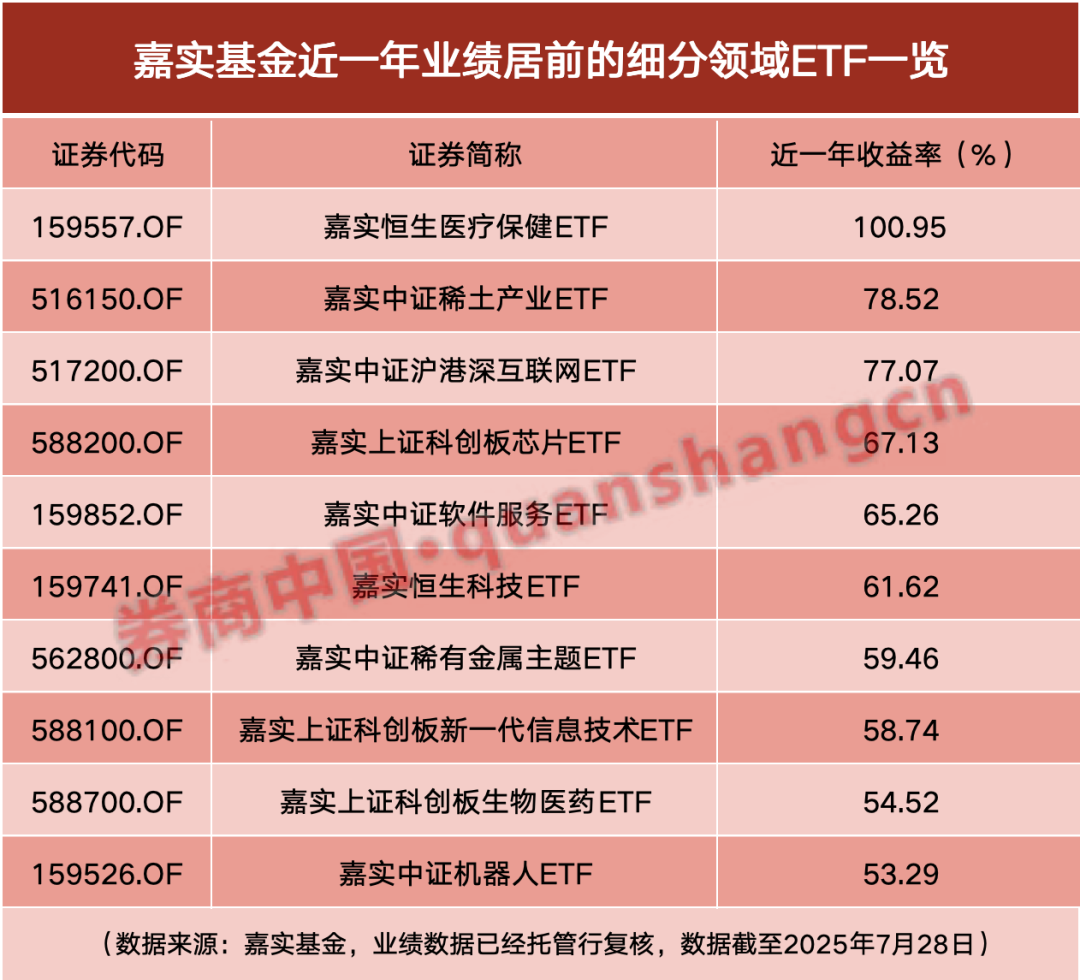
Core Viewpoint - The article emphasizes that in the second half of passive investment, the key to success lies not only in the breadth and depth of product offerings but also in the quality of service provided to investors, highlighting the importance of a "super ETF" ecosystem developed by the company [1][14]. Group 1: Market Trends and Growth - The total scale of ETFs in China has surpassed 4.6 trillion yuan, reflecting rapid growth, with the market structure showing a "winner-takes-all" trend where the top 12 fund companies hold over 80% of the market share [2][8]. - The company has achieved a management scale of over 290 billion yuan in ETFs, positioning itself among the top five in the industry [3][8]. Group 2: Investment Strategies and Product Offerings - The company focuses on passive investment tools that allow ordinary investors to participate in market trends, offering advantages such as risk diversification, cost optimization, and systematic capture of industry dividends [4][6]. - The company has launched several ETFs targeting key sectors, including AI, new energy, and biomedicine, with notable products like the Sci-Tech Chip ETF (588200) and Software ETF (159852) showing significant growth [5][6]. Group 3: Performance Metrics - The Sci-Tech Chip ETF (588200) has grown from 367 million yuan to 31.74 billion yuan, marking an 86-fold increase since its inception [5]. - The company’s ETFs have shown impressive performance, with the Hang Seng Medical ETF achieving a return of 100.95% over the past year [6][7]. Group 4: Product Development and Innovation - The company has developed a comprehensive product matrix that includes core broad-based ETFs and actively managed thematic products, ensuring alignment with investor needs [9][15]. - The introduction of the "Super ETF" brand and related investment tools aims to enhance investor experience and provide tailored solutions [14][16]. Group 5: Future Outlook - The article suggests that the future of passive investment will focus on value rather than just fee competition, with the company positioning itself to meet evolving investor demands through enhanced service offerings [18].
一年十大资管重磅事件全梳理
2 1 Shi Ji Jing Ji Bao Dao· 2025-08-05 11:46
Core Insights - The asset management industry is undergoing significant changes driven by regulatory policies and market dynamics, with a focus on compliance, consumer protection, and high-quality development [1] Group 1: Policy Changes - On September 24, 2024, a comprehensive set of financial policies was introduced, leading to a turning point in stock and bond market trends, with the Shanghai Composite Index surging by 4.2% on the same day [2][3] - The introduction of several key regulations, including the "Financial Institutions Product Appropriateness Management Measures," aims to enhance compliance and protect consumer rights in the wealth management sector [5][6] Group 2: Market Trends - The stock market experienced a significant shift, with the CSI 300 Index rising by 21% by the end of October 2024, marking a transition from a bear to a bull market [3] - The bond market saw fluctuations, with the 10-year government bond yield dropping below 2.5% following the implementation of easing policies [3][4] Group 3: Investment Strategies - The introduction of policies to promote long-term capital market investments, including increasing the investment ratio of commercial insurance funds in A-shares, is expected to shape asset allocation strategies for large asset management institutions [7][8] - The public fund industry is responding to new regulations by implementing performance-based fee structures and enhancing the assessment mechanisms for fund managers [9][10] Group 4: Industry Developments - The number of private equity firms is decreasing due to stricter regulations, with 568 private fund managers being deregistered in the first half of 2025 [15] - The popularity of passive investment strategies is rising, with passive equity fund sizes surpassing active funds, reflecting a shift in investor preferences [16][17] Group 5: Gold Investment - The gold market has seen a significant increase in investment, with the price rising from approximately $1,178 per ounce in late 2018 to around $3,280 per ounce by mid-2025, marking a cumulative increase of about 178% [18][19] Group 6: Bond ETF Growth - The bond ETF market is rapidly expanding, with the total scale surpassing 500 billion yuan, and new products like the Sci-Tech Bond ETF being introduced to cater to evolving market needs [20]
赢了业绩输了规模!绩优主动权益基金遭ETF“偷袭”,什么情况?
Zheng Quan Shi Bao Wang· 2025-08-04 01:52
Group 1 - The core viewpoint of the articles highlights a divergence in performance between actively managed equity funds and ETFs, where actively managed funds have outperformed in terms of returns, but ETFs have seen greater growth in scale [1][2][3] - The innovation drug sector has driven significant performance for both actively managed funds and ETFs, with a notable number of funds achieving double returns this year, particularly in the innovation drug theme [2][3] - Despite strong performance, actively managed funds have not attracted as much capital as ETFs, which have expanded significantly in scale, particularly in response to high-performing sectors like innovation drugs and humanoid robots [3][4] Group 2 - Data shows that 10 actively managed innovation drug funds had a total scale of only 9.4 billion yuan at the end of Q2, with a modest increase of 5.8 billion yuan during the quarter, while 7 ETFs saw an increase of 12.9 billion yuan, reaching a total scale of 28.4 billion yuan [3] - The rapid growth of ETFs is attributed to their passive tracking mechanism, which allows them to capture industry beta returns effectively, leading investors to prefer ETFs for quick exposure to high-growth sectors [4][5] - The management fees for ETFs are generally lower than those for actively managed funds, providing a cost and efficiency advantage that attracts investors, especially when returns are comparable [6][7] Group 3 - The increasing popularity of ETFs has pressured actively managed funds, as the latter struggle to attract new capital despite their strong performance, with many investors favoring the transparency and flexibility of ETFs [5][6] - The shift in focus towards passive investment strategies by fund companies further constrains the space for actively managed funds, as new ETF products are increasingly being launched in high-demand sectors [6][7] - The current trend indicates that ETFs are more appealing to investors compared to actively managed funds, prompting the latter to seek differentiated strategies for survival [7]
赢了业绩输了规模!绩优主动权益基金遭ETF“偷袭”,什么情况?
券商中国· 2025-08-04 01:40
Core Viewpoint - The article highlights a divergence in performance between actively managed equity funds and ETFs, where actively managed funds have outperformed in terms of returns, but ETFs have significantly outpaced them in terms of growth in scale [2][4]. Group 1: Performance Comparison - Actively managed equity funds have excelled in performance, particularly in sectors like innovative pharmaceuticals and humanoid robots, with a notable number of funds doubling their performance this year [3][4]. - As of July 29, 17 funds had doubled their performance, with 10 being actively managed equity funds and 7 being innovative pharmaceutical ETFs [3]. - Despite strong performance, the scale of actively managed funds has not kept pace with ETFs, which have attracted more investor interest due to their structural advantages [4][6]. Group 2: Scale and Growth - By the end of Q2, the 10 actively managed innovative pharmaceutical funds had a total scale of only 9.4 billion, with a modest increase of 5.8 billion during the quarter, while 7 ETFs saw an increase of 12.9 billion, reaching a total scale of 28.4 billion [4]. - From July onwards, these 7 ETFs have further increased their scale by nearly 10 billion [4]. - The rapid growth of ETFs is closely linked to the performance of hot sectors like innovative pharmaceuticals and humanoid robots, which have provided excellent opportunities for expansion [4][5]. Group 3: Market Dynamics - The rise of ETFs has created competitive pressure on actively managed equity funds, as investors prefer the passive tracking mechanism of ETFs that allows for quick exposure to high-growth sectors [6][8]. - ETFs are characterized by lower management fees and greater transparency, which enhances their appeal to investors compared to actively managed funds [8][9]. - The shift in focus towards passive investment strategies by fund companies further constrains the space for actively managed equity funds [8][9]. Group 4: Future Outlook - The increasing prevalence of ETFs capturing market beta raises concerns about potential market volatility due to their short-term trading characteristics [12]. - While ETFs serve as effective tools for asset allocation, the article emphasizes the importance of maintaining a balanced long-term investment strategy [11][12].