
创新驱动发展

Search documents
湖南一级市场实录
Sou Hu Cai Jing· 2025-10-03 06:43
Core Insights - Hunan province is leveraging equity investment to drive industrial transformation and innovation, creating a comprehensive support system for entrepreneurs to foster long-term high-quality development [2][3] Group 1: Macroeconomic Environment - In the first half of 2025, Hunan's GDP reached 2.62 trillion yuan, with a growth rate of 5.6%, slightly above the national average of 5.3% [2] - Changsha, the capital, contributed 764.04 billion yuan to the GDP, accounting for 29.2% of the province's total, with a year-on-year growth of 5.0% [2] - Hunan is focusing on building a "4×4" modern industrial system supported by various policy measures across multiple dimensions [2] Group 2: Fundraising Situation - In the first half of 2025, Hunan's equity investment market saw 36 funds complete new rounds of fundraising, a year-on-year increase of 12.5%, with a total fundraising amount of 12.293 billion yuan, up 11.6% [6] - Changsha remains a key player in the fundraising market, with 29 new funds raising 8.719 billion yuan, representing increases of 38.1% and 85.4% respectively [6] - The majority of new funds are venture capital funds, with 21 new funds raising 6.127 billion yuan, reflecting increases of 40.0% and 45.5% year-on-year [6] Group 3: Investment Situation - In the first half of 2025, Hunan recorded 145 equity investment cases, a significant year-on-year increase of 79.0%, surpassing the total for the entire year of 2024 [8] - The total investment amount was 5.255 billion yuan, showing a decline of 17.0% [8] - Investment cases are primarily concentrated in sectors such as semiconductors, IT, biomedicine, and traditional industries, with a notable increase in seed and early-stage investments [8] Group 4: Exit and Listing Situation - In the first half of 2025, there were 12 exits in Hunan's equity investment market, a decrease of 29.4% year-on-year [11] - The number of listed companies from Hunan has declined, with only one company going public in the first half of 2025 due to a slowdown in the A-share IPO market [11] Group 5: Government Investment Fund Situation - Hunan has been enhancing its provincial government guidance fund system, with a total of 61 government investment funds established, targeting a total scale of approximately 175.74 billion yuan [14] - In the first half of 2025, six new government investment funds were established, leading the nation in new fund creation [14] - The largest fund is the Changsha Economic Development Zone Science and Technology Innovation Fund, with a target scale of 10 billion yuan [14] Group 6: Conclusion - Overall, Hunan's equity investment market is showing steady growth, with increased fundraising and investment activity, particularly in supporting small and medium-sized enterprises in the technology innovation sector [19] - The market is focused on serving the real economy and empowering technological innovation, with the establishment of the Jin Furong Fund Matrix to support the "4x4" modernization system and entrepreneurship [19]

深刻认识中国经济长期稳定发展的内在逻辑
Xin Hua Wang· 2025-09-30 23:20
Core Insights - The article emphasizes the internal logic behind China's long-term stable economic development, highlighting the role of the Communist Party's leadership and strategic planning [2][3][4]. Group 1: Economic Achievements - Since the establishment of New China and particularly after the reform and opening-up, China's GDP has grown from 367.9 billion yuan in 1978 to an expected 134.9 trillion yuan in 2024, averaging an annual growth rate of 8.8%, significantly higher than the global average of about 3% during the same period [2]. - During the 14th Five-Year Plan period, China's GDP surpassed 100 trillion yuan in 2020 and is projected to reach 140 trillion yuan this year [2]. Group 2: Leadership and Governance - The leadership of the Communist Party provides a fundamental guarantee for economic and social development through top-level design, overall layout, and effective coordination [2][3]. - The Party's long-term governance avoids the policy shortsightedness seen in Western multi-party systems, serving as a "stability anchor" for China's economic development [2]. Group 3: Theoretical Framework - The continuous innovation of the theoretical system provides a scientific guide for economic and social development, with Xi Jinping's economic thought introducing new concepts such as "new development concepts" and "new development patterns" [3]. - The integration of traditional socialist models with contemporary practices has led to a unique economic development path [3]. Group 4: People-Centric Development - The focus on a people-centered development philosophy has led to significant improvements in living standards, with nearly 100 million people lifted out of poverty and the establishment of the world's largest social security system [4]. - The alignment of national development goals with the aspirations of the populace has strengthened public trust and support for the government [4]. Group 5: Market Economy and Innovation - The combination of socialism with a market economy has injected continuous vitality into China's economic development, with reforms focusing on the relationship between government and market [5]. - The establishment of a high-level socialist market economy has optimized resource allocation and maximized efficiency, driving high-quality economic growth [5]. Group 6: Market Size and Innovation - China's vast domestic market, with over 1.4 billion people and more than 400 million middle-income individuals, creates significant potential for innovation and economic growth [6]. - The interaction between supply and demand has lowered innovation costs and accelerated technological advancements, meeting the evolving needs of the population [6].
广东区域创新能力全国“九连冠” 企业创新、创新环境等指标均居榜首
Nan Fang Ri Bao Wang Luo Ban· 2025-09-28 07:56
Core Insights - Guangdong has retained its position as the top region in China's innovation capability, achieving a "nine consecutive championships" status according to the "China Regional Innovation Capability Evaluation Report 2025" [1][2] - The report evaluates regional innovation capabilities based on five primary indicators, with Guangdong ranking first in enterprise innovation and innovation environment, and second in innovation performance and knowledge creation [1] Group 1: Innovation Capability Rankings - Guangdong's enterprise innovation score is 68.11, significantly higher than the second-ranked region at 57.15, indicating a strong innovation capacity among local enterprises [1] - The province ranks first in key metrics such as the number of high-tech enterprises, R&D expenditure intensity, and new product sales revenue, showcasing the vibrancy and effectiveness of innovation in Guangdong [1] Group 2: Investment and Development - Guangdong's total R&D expenditure has surpassed 510 billion yuan, maintaining the highest level in the country, with an R&D intensity of 3.6% [2] - The province leads in major technology indicators, including R&D personnel and PCT international patent applications, supporting the development of the Guangdong-Hong Kong-Macao Greater Bay Area as a global innovation center [2] Group 3: Recent Technological Advancements - The "Shenzhen-Hong Kong-Guangzhou" technology cluster has ranked first in the global top 100 innovation clusters, reflecting the region's growing influence in technology innovation [2] - Significant scientific projects, such as the operation of the Jiangmen neutrino experiment and the initiation of major research facilities, further validate Guangdong's leading position in regional innovation capabilities [2]
成渝地区双城经济圈专家团走进梁平 为产业高质量发展献智赋能
Zhong Guo Xin Wen Wang· 2025-09-27 05:04
Core Viewpoint - The event aimed to enhance the development of Liangping District by connecting high-level experts with local industry projects, focusing on innovation and talent cultivation in the Chengdu-Chongqing economic circle [1] Group 1: Event Overview - The event took place from September 26 to 28, 2025, in Liangping District, Chongqing, involving a high-level expert team led by Chinese Academy of Sciences academician Hao Yue [1] - The expert team provided guidance on 10 industrial projects, contributing to the goal of establishing Liangping as a leading area for modernization in the northeastern Sichuan-Chongqing border region [1] Group 2: Development Goals - Liangping District is focusing on becoming a city characterized by distinctive industries, safety, trust, livability, and innovation [1] - The district aims to build a "new, harmonious, and beautiful" characteristic city through innovative policies and efficient mechanisms to attract and nurture talent [1] Group 3: Expert Insights - Academician Hao Yue emphasized the importance of collaboration among academia, industry, and government to address industrial development challenges and promote high-quality growth in Liangping [1] - The event featured 11 experts who provided one-on-one guidance and hands-on support in various sectors, including electronic information, low-altitude economy, food processing, education, and healthcare [1]
创新成果闪耀世界 四川建设西部创新高地迈出坚实步伐
Zhong Guo Fa Zhan Wang· 2025-09-26 09:37
Core Insights - Sichuan Province is making significant strides in establishing itself as an innovation hub in Western China during the "14th Five-Year Plan" period, focusing on innovation-driven development strategies [2] Group 1: Comprehensive Innovation Capability - R&D expenditure in Sichuan is expected to reach approximately 150 billion yuan, a growth of over 40% compared to 2020, with basic research funding accounting for an estimated 6.5% of total R&D spending [3] - The province has seen a substantial increase in high-value invention patents, with a per capita ownership rate of 7.94 patents, which is 2.7 times that of 2020 [3] - The transaction volume of technology contracts has surpassed 260 billion yuan, doubling since 2020 [3] Group 2: Growth of High-tech Industries - The revenue from high-tech industries in Sichuan has increased from 31.9% to 40.9% of the total industrial output, marking a 9 percentage point rise [4] - Emerging industries such as artificial intelligence, biotechnology, and nuclear technology applications are projected to grow by over 20% in added value in 2024 [4] Group 3: High-level Innovation Platforms - The number of national-level innovation platforms in Sichuan has increased to 205, including the only national laboratory in Western China and 28 national key laboratories [5] - Major scientific facilities are being developed, including 10 national large scientific devices, with significant breakthroughs in various research areas [5] Group 4: Breakthroughs in Key Technologies - In aerospace, Sichuan has successfully completed major national projects and launched the world's first AI large model scientific satellite [6] - In the electronic information sector, significant advancements have been made in integrated circuits and software security, including the release of the first international gallium nitride quantum light source chip [6] - The biopharmaceutical sector has seen the approval of the first domestic TROP2 antibody-drug conjugate and the world's first trivalent COVID-19 vaccine for emergency use [6] Group 5: Innovation Entity Vitality - The number of high-tech enterprises in Sichuan has reached 19,000, a 2.4-fold increase since 2020, with a significant rise in technology-based SMEs [8] - Corporate R&D spending has increased by 58.4% compared to 2020, highlighting the strengthening of enterprises' roles in innovation [8] Group 6: Talent Development - Sichuan has implemented open talent policies, with the number of academicians reaching 67 and R&D personnel exceeding 400,000 [9] - The province has established a comprehensive talent service system, making it a key area for high-level talent innovation and entrepreneurship [9] Group 7: Regional Collaborative Innovation - Sichuan and Chongqing are jointly building the Western Science City and have established 11 joint key laboratories, enhancing collaborative innovation efforts [10] - Chengdu and Mianyang are positioned as major innovation engines, with Chengdu ranking 24th globally among tech clusters [10]
创历史新高!今年江苏独角兽企业和瞪羚企业评估结果发布,扬州51家企业入选
Yang Zi Wan Bao Wang· 2025-09-25 09:35
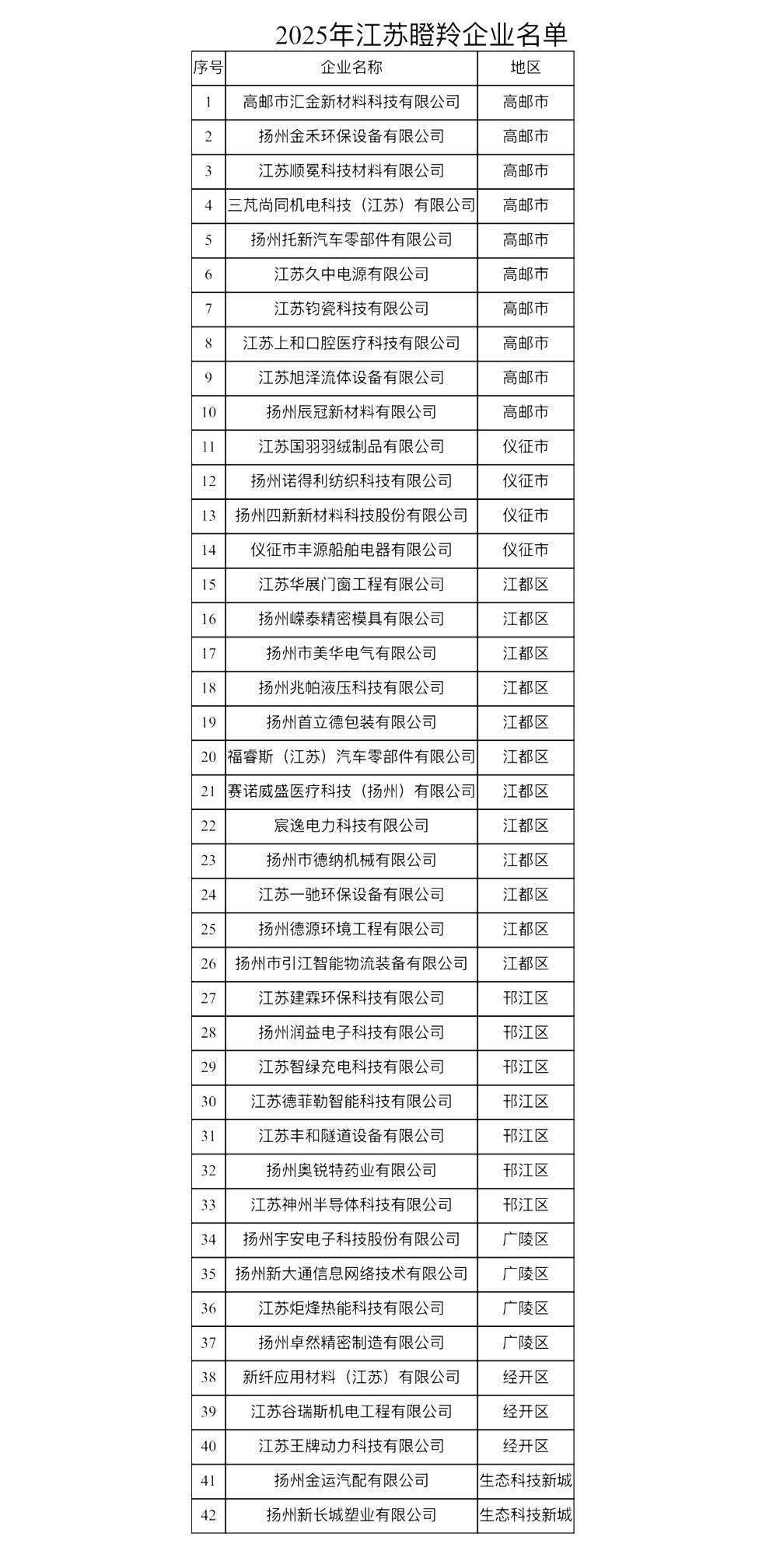
Core Insights - Yangzhou has successfully selected 51 enterprises, including 4 provincial unicorns, ranking 6th in the province, marking a new breakthrough [4] - The number of provincial potential unicorns is 5, and there are 42 provincial gazelle enterprises, showing a year-on-year growth of 20% [4] Group 1: Unicorn and Gazelle Enterprises - The unicorn enterprises in Yangzhou include Jiangsu Zejing Automotive Electronics Co., Ltd., Jiangsu Shenzhou Semiconductor Technology Co., Ltd., Libang Biopharmaceutical (Jiangsu) Co., Ltd., Jiangsu Aitaisi New Energy Technology Co., Ltd., and Keba Biopharmaceutical (Jiangsu) Co., Ltd. [7] - The gazelle enterprises are primarily focused on high-tech, high-growth, and high-value sectors, contributing to the innovation-driven development strategy [8] Group 2: Innovation and Development Strategy - Yangzhou is implementing an innovation-driven development strategy aimed at creating a competitive and influential industrial and technological innovation hub in the Yangtze River Delta [8] - The city is fostering a tiered cultivation system for innovation entities, focusing on the development matrix of "technology-based SMEs - high-tech enterprises - gazelle enterprises - unicorn enterprises" [8]
世界知识产权组织发布2025年全球创新指数报告 南京排名全球百强创新集群第15位
Nan Jing Ri Bao· 2025-09-25 02:21
Group 1 - The core viewpoint of the news is that China has improved its ranking in the Global Innovation Index to 10th place, marking its first entry into the top ten globally, reflecting significant achievements in innovation-driven development strategies [1] - The Global Innovation Index evaluates the innovation ecosystem performance of 139 economies based on innovation input and output, showing that China's ranking has risen by 25 places since 2013 [1] - Nanjing ranks 15th in the global innovation cluster ranking and 5th among domestic clusters, based on metrics such as international patent applications, scientific publications, and new venture capital transactions [1] Group 2 - Nanjing's PCT application volume is 8,241.81, accounting for 0.63% of the global total, ranking 20th among the top clusters; its scientific publication volume is 136,094, representing 1.66% of the global total, ranking 5th; and the new venture capital transaction volume is 1,266, accounting for 0.54%, ranking 35th [2] - Nanjing has been recognized as a national model city for intellectual property protection and has achieved significant results in intellectual property strategy implementation, with patent quality indicators ranking first in the province for four consecutive years [2] - As of June 2025, Nanjing has a high-value invention patent ownership of 77.99 per ten thousand people, and the effective invention patents in the digital economy industry account for 62.9% of the total effective invention patents in the region, maintaining the top position in the province [2] Group 3 - Nanjing aims to leverage high-quality development of intellectual property to support high-quality economic and social development, focusing on becoming a leading city in intellectual property creation, utilization, protection, management, and service [3] - The city is committed to enhancing its intellectual property capabilities to better serve innovation-driven development and contribute to the modernization of Nanjing [3]
21社论丨有效市场和有为政府共同成就中国创新速度
21世纪经济报道· 2025-09-24 00:28
Group 1 - The World Intellectual Property Organization (WIPO) released the 2025 Global Innovation Index report, showing China ranked 10th globally, marking its first entry into the top ten and leading among 36 upper-middle-income economies, having risen 25 places since 2013 [1] - In terms of innovation output, China ranked 5th in 2025, up 2 places from 2024, while its innovation input ranked 19th globally, an increase of 4 places from the previous year [1] - China leads in several areas, holding the top position in multiple intellectual property-related sub-indicators and ranking 2nd globally in patent applications per GDP, industrial cluster development, and corporate R&D expenditure as a percentage of GDP [1] Group 2 - Despite China's strong performance, global innovation growth is slowing, with expected R&D spending growth of 2.9% in 2024, down from 4.4% in 2023, marking the lowest level since 2010 [2] - International patent applications are projected to grow by only 0.5% in 2024, significantly lower than the 2.5% average growth rate over the past decade, while China continues to be the largest applicant, accounting for nearly 25% of global applications [2] - The report emphasizes that innovation ecosystems require thoughtful policies, meaningful investments, and cross-sector collaboration, with China's innovation achievements stemming from a strategic, long-term, and systematic national approach [2] Group 3 - China's innovation success is driven by a robust market dynamic, with enterprises as the main innovators engaging in emerging industries and technological transformations [3] - In 2024, R&D spending among 1,510 global companies reached approximately $1.3 trillion, marking the slowest nominal growth since 2010, while Chinese companies are experiencing rapid growth in R&D investments [3] - A total of 524 Chinese companies made it to the global top 2000 in industrial R&D spending, representing 26.2% of the total, with significant growth rates observed in companies like BYD and Tencent [3] Group 4 - China's notable achievements in innovation are attributed to its advantageous position in emerging industries and a vast commercial application market, including sectors like robotics, electric vehicles, and high-speed rail [4] - The rapid growth of technological innovation in China is a result of the effective combination of proactive government policies and a dynamic market, leading to accelerated integration of technological and industrial innovation [4] - With the advantages of a large-scale market and intensified competition among enterprises, China is expected to enhance industrial efficiency and technological superiority across various innovation metrics and fields [4]

创业板成创新型经济“晴雨表”
Jing Ji Ri Bao· 2025-09-19 22:18
Core Insights - The ChiNext board has reached its 16th anniversary, with 1,385 listed companies and a total market capitalization exceeding 16 trillion yuan, showcasing its evolution from a simple financing platform to a key driver of new economic momentum and high-end industrial transformation [1][4] - In the first half of the year, ChiNext companies achieved a total operating revenue of 2.05 trillion yuan, with an average revenue growth of 9.03%, and a net profit of 150.54 billion yuan, reflecting strong performance in emerging industries such as new energy, biomedicine, and high-end equipment manufacturing [1][2] Industry Performance - The overall R&D intensity of ChiNext companies reached 4.89%, significantly higher than the market average of 2.33%, indicating a strong focus on innovation [2] - Notable companies like CATL and Mindray Medical have made significant technological advancements, enhancing China's position in the global new energy and high-end medical equipment sectors [2] Global Expansion - ChiNext companies have seen a 21.26% increase in overseas revenue, outpacing domestic growth, with exports in high-end manufacturing sectors like new energy vehicles and photovoltaic components on the rise [2] Structural Challenges - Despite notable achievements, there are structural issues such as high asset-liability ratios in some companies, reliance on imported core components, and uneven innovation capabilities among firms [3] - Governance issues, including inadequate information disclosure and instances of financial misconduct, have also been highlighted as concerns affecting investor confidence [3] Future Directions - Recommendations for enhancing the ChiNext board include increasing the weight of technological innovation in evaluation criteria, simplifying refinancing processes, and improving information disclosure rules [4] - The board aims to strengthen its role as a core platform for nurturing new productive forces and facilitating a virtuous cycle among technology, industry, and finance [4]

山东能源齐翔腾达:让工作室成为创新“强引擎”
Zhong Guo Hua Gong Bao· 2025-09-19 02:49
Core Viewpoint - Innovation and talent development are central to the operational strategy of Shandong Energy Qixiang Tengda, focusing on solving practical safety production issues through technology and collaboration [1][2] Group 1: Innovation and Talent Development - The company emphasizes the establishment of innovation studios to enhance employee creativity and technical skills, integrating resources and wisdom to drive development [1] - A culture of learning and technical exchange is fostered within the innovation studios, encouraging employees to share insights and solutions to production challenges [1] - The company has implemented a structured approach to innovation through monthly meetings, semi-annual progress meetings, and annual summary meetings, transforming these into collaborative learning sessions [1] Group 2: Technical Improvements and Operational Efficiency - The innovation studio focuses on optimizing public engineering, adjusting technical parameters, and integrating various water systems for economic operation [2] - Preventive maintenance of critical equipment, such as the acrylic acid plant's shielding pump, is prioritized to ensure reliable operation and safety [2] - The company is actively enhancing the electrical system's resilience and upgrading control systems to improve management and product quality through information technology [2] Group 3: Future Development Strategy - The company plans to deepen its innovation-driven development strategy, guided by a craftsmanship culture and leveraging innovation studios to create a cycle of innovation, transformation, and efficiency [2]
