
制度型开放

Search documents
海南数字经济跑出特色赛道(大数据观察)
Ren Min Ri Bao· 2026-01-14 23:48
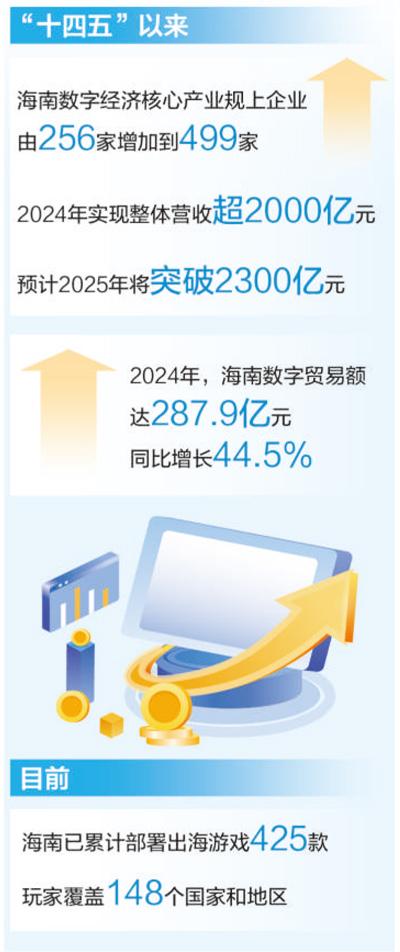
Core Viewpoint - Hainan Province is rapidly developing its digital economy, with a significant increase in the number of core industry enterprises and projected revenue growth, positioning itself as a new hub for digital culture and international data flow [4][11]. Group 1: Digital Economy Growth - The number of core digital economy enterprises in Hainan has increased from 256 to 499 since the start of the 14th Five-Year Plan, with expected overall revenue surpassing 200 billion yuan in 2024 and 230 billion yuan in 2025 [4]. - Hainan's digital trade volume is projected to reach 287.9 billion yuan in 2024, marking a year-on-year growth of 44.5% [7]. Group 2: Infrastructure Development - Hainan has established a "data highway" with the completion of several international submarine cables, significantly reducing internet latency to as low as 7.8 milliseconds, enhancing communication and operational efficiency for businesses [5]. - The world's first commercial underwater data center is operational in Hainan, improving energy efficiency by approximately 40% compared to land-based data centers [7]. Group 3: Support for Creative Industries - Hainan's game export public service platform has facilitated the entry of 63 companies and over 200 game titles into international markets, with more than 10 million overseas registered users [9][10]. - The Hainan International Film and Television Base offers comprehensive support for film production, reducing costs by about 35% compared to mainland China, and has hosted over 100 film projects [10]. Group 4: Regulatory Environment - Hainan's transparent regulatory framework and innovative policies, such as the "negative list" for data export, have attracted both domestic and foreign investments, fostering a conducive business environment [11][12]. - The establishment of a free trade port with zero tariffs and simplified tax systems is expected to enhance the flow of capital and support local research and development [12].

海南数字经济跑出特色赛道
Xin Hua Wang· 2026-01-14 23:37
Core Insights - The digital economy in Hainan has seen significant growth, with the number of core industry enterprises increasing from 256 to 499 since the start of the 14th Five-Year Plan, and projected revenues exceeding 200 billion yuan in 2024 and 230 billion yuan in 2025 [4][5] Group 1: Infrastructure Development - Hainan has established a robust digital infrastructure, including the completion of undersea cables that significantly reduce latency for international internet access, enhancing the efficiency of data transmission for businesses [5][7] - The first commercial undersea data center is operational in Hainan, utilizing natural cooling from seawater to improve energy efficiency by approximately 40% compared to land-based data centers [7] Group 2: Digital Trade and Services - The digital trade volume in Hainan is expected to reach 28.79 billion yuan in 2024, reflecting a year-on-year growth of 44.5% [7] - Hainan's game export public service platform has facilitated the launch of 201 games, with over 10 million registered users overseas, showcasing the province's growing role in the global gaming market [8][10] Group 3: Policy and Regulatory Environment - Hainan's transparent regulatory framework is a key factor attracting businesses, with recent legislative measures supporting the secure and orderly flow of data [11][12] - The establishment of a negative list for data export management has simplified compliance for companies, further enhancing the business environment [11] Group 4: Economic Impact and Future Prospects - By the end of 2025, Hainan will officially close its borders, marking a new phase of development that is expected to enhance financial policies and facilitate easier capital flow for small and medium enterprises [12] - The province is positioning itself as a hub for digital culture and trade, leveraging its unique policies and infrastructure to create new pathways for international business [10][12]
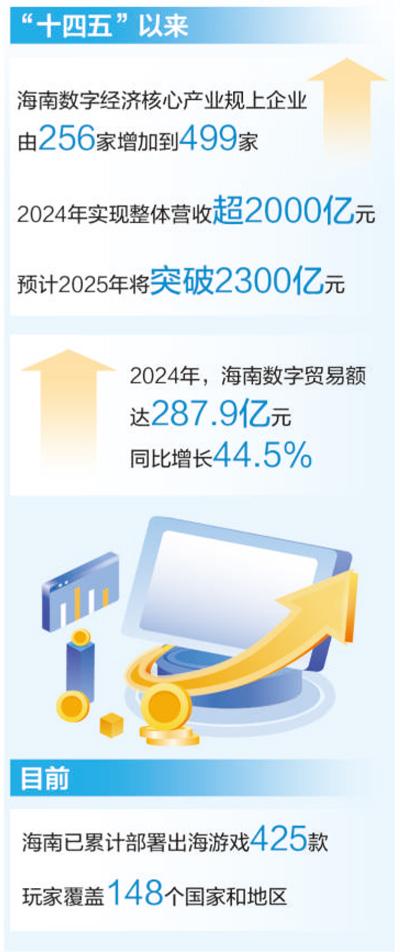
“十四五”以来,数字经济核心产业规上企业由256家增加到499家 海南数字经济跑出特色赛道(大数据观察)
Ren Min Ri Bao· 2026-01-14 22:13
Core Insights - Hainan's digital economy is rapidly developing, with the number of core industry enterprises increasing from 256 to 499 since the start of the 14th Five-Year Plan, and projected revenues exceeding 200 billion yuan in 2024 and 230 billion yuan in 2025 [1][2] Group 1: Digital Infrastructure - Hainan has established a robust digital infrastructure, including the completion of undersea cables that significantly reduce latency for international data transfer, enhancing the efficiency of businesses in the region [2][4] - The first commercial underwater data center is operational, providing a 40% increase in energy efficiency compared to land-based data centers, addressing global high-energy consumption challenges [4] Group 2: Digital Trade and Services - The digital trade volume in Hainan is expected to reach 28.79 billion yuan in 2024, marking a 44.5% year-on-year increase, driven by advancements in digital services and infrastructure [4] - Hainan's game export public service platform has facilitated the launch of 201 games, with over 10 million overseas registered users, streamlining the process for small teams to enter international markets [5][6][7] Group 3: Policy and Regulatory Environment - Hainan's transparent regulatory framework is a significant draw for businesses, with ongoing innovations in free trade policies aimed at ensuring the secure and orderly flow of data [8][9] - The establishment of a negative list for data export management has simplified compliance for companies, reducing operational costs and attracting both domestic and foreign investments [8][9] Group 4: Future Prospects - Hainan is set to officially close its borders on December 18, 2025, marking a new phase of development that will further enhance financial policies and facilitate easier capital flow for small and medium enterprises [9]
广州:谋划引进一批投资规模大、带动能力强、综合效益高的优质项目
Jin Rong Jie· 2026-01-14 14:24
1月14日,广州市委财经委员会召开会议。市委副书记、市长、市委财经委员会副主任孙志洋强调,要 坚持目标导向、问题导向、结果导向,建立健全经济运行监测体系,从行业到企业逐层精准穿透分析, 及时发现问题、调整政策,"一业一策"抓好重点行业培育,"一企一策"加强头部企业服务,提升抓经济 工作的有效性。要升级打造产业版营商环境,用足用好存量政策,加力推出增量政策,强化用地、用能 等要素保障,降低制度性交易成本,扩大制度型开放,持续增强企业获得感。要全力以赴抓投资、抓项 目、抓招商,主动对接重点企业战略布局与转型需求,谋划引进一批投资规模大、带动能力强、综合效 益高的优质项目,加快重点项目建设,为实现"开门红"、确保"全年胜"提供坚实支撑。 ...
中国记协举办新闻茶座 —— 聚焦百年变局与当前中国外交
Zhong Guo Jing Ji Wang· 2026-01-14 13:54
Core Viewpoint - The article discusses the accelerating changes in the global landscape, emphasizing China's shift from passive response to actively shaping international order through various global initiatives [1] Group 1: Global Governance Challenges - The current global governance system is ineffective in addressing major issues such as climate financing, food security, debt relief, health crises, and refugee challenges [1] - Developing countries face significant social, economic, and environmental vulnerabilities [1] Group 2: China's Role in Global Order - China is transitioning to a proactive role in international relations, proposing four major global initiatives to tackle global challenges [1] - The country is committed to institutional openness, aligning with high international standards to create multi-level institutional platforms [1] Group 3: Economic Contributions - China aims to counteract "de-globalization" through rule certainty and offers non-dependent development options for developing countries [1] - The contribution of China to global economic growth remains around 30%, positioning it as a source of certainty in a turbulent world [1]
藏在“新年第一会”中的干劲儿和机遇
Jin Rong Shi Bao· 2026-01-14 02:11
元旦假期的余温还没散尽,各地已火速切换"冲刺模式"。新年伊始,上海、辽宁、湖北、海南等多个省 份召开"新年第一会",部署新一年工作。这场开年的集体行动,藏着"十五五"时期经济发展的核心密 码,更彰显着政府转变作风、深耕产业的务实姿态。 那么,开年到底"拼"什么?新年又有哪些新亮点? 营商环境是市场经济的土壤,更是各地开年比拼的重头戏。如今的营商环境优化不再是文件里的抽象表 述,而是看得见、摸得着的"真招实策"。上海连续9年深耕这一领域,今年更是把大会提前到新年首个 工作日,用硬核举措回应企业"账款拖欠"等急难愁盼,让营商环境建设从"单点突破"迈向"系统升级"。 辽宁直接把优化营商环境推到振兴发展的"C位",以"刀刃向内"的决心列出行政效能不高、执法不规范 等整治清单,纪检监察部门牵头"发现—核查—整改—反馈"闭环机制,以严惩不贷的铁腕表态,致力于 斩断伸向企业利益的不法行为。福建则瞄准"近悦远来"的目标,以法治化给予企业稳定的发展预期,以 便利化提升获得感,同时强调突出国际化建设的独特优势,让经营主体的创新活力尽情迸发。这些举措 本质上是给制度性交易成本"做减法",给市场信心"做加法",正是对经济发展规律的精 ...
“十五五”期间海南进一步全面深化改革面临的形势和任务
Hai Nan Ri Bao· 2026-01-14 01:15
Core Viewpoint - The "15th Five-Year Plan" period is crucial for Hainan's free trade port to deepen reforms and achieve high-quality development, emphasizing the need for proactive reform to address development challenges and enhance growth momentum [2][3]. Group 1: Economic and Social Development - Economic and social development during the "15th Five-Year Plan" must be driven by reform and innovation, with a focus on achieving breakthroughs in deepening reforms and opening up [3]. - To counter external risks and challenges, Hainan needs to build a new institutional advantage through deepening reforms, transforming external challenges into opportunities for expanding openness and enhancing international competitiveness [3][4]. Group 2: Domestic and International Circulation - Hainan aims to become a strategic intersection for domestic and international dual circulation, requiring reforms to stimulate domestic demand and market vitality [4]. - The province must address the limitations of its small economic scale and enhance its self-circulation capabilities through deep reforms, effectively attracting and allocating high-quality resources [4]. Group 3: Modern Industrial System - Building a modern industrial system with Hainan's characteristics requires reforms to optimize the production capacity and enhance the resilience and competitiveness of the industrial ecosystem [8]. - The focus will be on developing key industries, promoting policy resources to critical links in the industrial chain, and establishing a robust support system for technological innovation [8]. Group 4: Talent and Innovation - Hainan will implement a talent recruitment plan and enhance its educational and technological innovation systems to attract high-level talent and foster a competitive innovation environment [9]. - The province aims to strengthen the role of enterprises in technological innovation and support collaborative innovation efforts [9]. Group 5: Business Environment - Hainan is committed to creating a market-oriented, law-based, and international business environment through administrative reforms and enhancing the efficiency of regulatory frameworks [10]. - The province will optimize market access and streamline approval processes to facilitate business operations [10]. Group 6: Resource Allocation - Reforms will focus on promoting efficient resource allocation and enhancing the flow of factors in the market, including improving investment structures and removing barriers to market entry [11]. - The province aims to establish a market-driven pricing mechanism for essential resources and promote comprehensive land governance reforms [11]. Group 7: Ecological Development - Hainan will develop a green and low-carbon development system, aligning ecological regulations with the free trade port framework and promoting sustainable practices [12]. - The province will focus on carbon neutrality goals and enhance the circular economy through resource recycling initiatives [12]. Group 8: Social Welfare and Governance - Enhancing social welfare and governance mechanisms is essential for achieving common prosperity, with reforms aimed at improving public services and addressing disparities in development [13]. - The province will focus on creating a high-level health system and improving housing supply to meet the needs of its population [13]. Group 9: Implementation of Reforms - The successful implementation of the reform blueprint requires a robust mechanism for coordinating and monitoring reform initiatives, ensuring accountability and progress [14]. - Hainan will aim to achieve significant reform outcomes in key areas such as trade and investment, while fostering a culture of innovation and responsiveness among officials [14].
深入实施海南自由贸易港法 护航政策落地实施
Xin Lang Cai Jing· 2026-01-13 19:50
Core Points - The construction of Hainan Free Trade Port has entered a new phase of closure operation, aiming to implement the Hainan Free Trade Port Law as a legal guarantee for the overall plan of the port's construction [1] - The Hainan Free Trade Port Law is characterized as the "basic law" for the port's construction, a "high-level opening law," and an "authorization law" [1] Group 1: Implementation of Core Policies - The key to implementing the Hainan Free Trade Port Law is to accelerate the landing of core policies such as "zero tariffs, low tax rates, and simplified tax systems" [2] - Currently, 74% of the imported goods in Hainan Free Trade Port are under "zero tariffs," with a goal to continuously upgrade this policy [2] - The transition from specific industry tax incentives to a universal low tax rate system is required, expanding the scope of beneficiaries [2] Group 2: Legal Arrangements for Policy Implementation - Establishing a legal framework for the core policy landing mechanism, allowing policies to be implemented after filing [3] - The law supports the innovation and specification of policies under the basic principles of higher laws, particularly regarding the "special area system" for customs supervision [3] - The Hainan Free Trade Port Law will coordinate with other existing laws, ensuring its priority in case of inconsistencies [3] Group 3: Institutional Opening and Trade - Hainan Free Trade Port aims to become a new high ground for institutional opening, focusing on service trade development to boost domestic demand and consumption [4] - By 2035, the service trade's share is expected to rise from 14.6% in 2024 to over 20%, aligning with global averages [4] - The law mandates a negative list management system for cross-border service trade, with a dynamic adjustment mechanism for the list [5] Group 4: Legislative Authority and Reform - The Hainan Free Trade Port Law grants legislative authority to Hainan, which needs to be clearly defined to enhance its legislative effectiveness [7] - A timely authorization mechanism is necessary to meet the demands of Hainan's development [9] - The law emphasizes the need for administrative and judicial reforms to create an efficient management system and enhance international credibility [9][10]
开年就“卷”起来了!这些会议里藏着今年的“重点赛道”
Jin Rong Shi Bao· 2026-01-13 08:43
Group 1 - The core focus of the new year is on optimizing the business environment, which is seen as essential for economic development and is being addressed with concrete measures across various provinces [2][3] - Shanghai has prioritized addressing urgent issues such as delayed payments to businesses, marking a shift from isolated improvements to a systematic upgrade of the business environment [2] - Liaoning has placed the optimization of the business environment at the forefront of its revitalization efforts, implementing strict measures to combat inefficiencies and illegal practices that affect enterprises [2] Group 2 - Technological innovation and manufacturing upgrades are identified as the dual engines for high-quality development, with provinces like Hubei showcasing significant innovations in various sectors [3] - Hubei aims to transform its technological innovations into economic value through a comprehensive system that fosters innovation and nurtures industrial ecosystems [3] - Henan is focusing on project construction linked to manufacturing upgrades, utilizing government support to enhance both traditional and new enterprises [3] Group 3 - Hainan is committed to becoming a significant international trade hub by advancing its free trade port initiatives, which include expanding zero-tariff policies and enhancing cross-border trade [4] - The province's efforts are positioned to provide replicable experiences for national-level open policies, contributing to a robust dual circulation economy [4] Group 4 - Local government leaders are actively engaging with businesses through innovative marketing strategies and direct interactions to resolve issues and promote local products [5] - This hands-on approach reflects a shift towards a more service-oriented government, enhancing market confidence and stability [5] Group 5 - The collective actions taken by various provinces signal a commitment to high-quality development, with a focus on improving the business environment, fostering innovation, and enhancing cooperation [6] - The ongoing efforts are expected to create a fertile ground for economic growth, ensuring that the goals set for the 14th Five-Year Plan are achieved effectively [6]
上海社科院世界经济研究所孙立行:展望“十五五”时期,人民币国际化必须与国家整体发展战略相互配合
Xin Lang Cai Jing· 2026-01-13 08:12
Core Viewpoint - The upcoming "15th Five-Year Plan" period marks a historical turning point for China's financial system, emphasizing the construction of a financial powerhouse and the development of five key financial areas to support new productive forces and enhance the real economy [1][15]. Group 1: RMB Internationalization - RMB internationalization must align with the overall national development strategy and continue to advance as a crucial component of building a financial powerhouse [3][18]. - The internationalization of RMB is not only about trade settlement but also involves investment pricing and official reserve functions, which are currently limited compared to the "petrodollar" system [3][20]. - Institutional openness will be a key driver for RMB internationalization, particularly in the commodity sector, where RMB is expected to play a larger role in pricing [4][19]. Group 2: Challenges and Opportunities - RMB internationalization faces two main constraints: the need for a stable economic foundation and the necessity to enrich the offshore financial asset system [5][20]. - The current supply of investable RMB assets abroad is limited, which restricts its use in international markets [7][21]. - The development of offshore bond markets is crucial, as they provide stable and appreciating investment options for foreign RMB holders [6][16]. Group 3: Offshore Financial System - A complete offshore financial system is essential for facilitating RMB internationalization, addressing the issue of RMB funds lacking investment opportunities post-settlement [7][21]. - The offshore bond market, particularly through instruments like dim sum bonds, needs to expand in scale and liquidity to enhance RMB's international presence [6][22]. - The design of offshore financial systems should be more open than onshore systems, serving as a "testing ground" for capital account liberalization [9][25]. Group 4: Regulatory Framework - The recent upgrades to the FT account system in the Pudong Free Trade Zone aim to enhance the offshore attributes of financial accounts, facilitating cross-border transactions [10][24]. - The focus should be on creating a robust offshore settlement platform that integrates effectively with the RMB cross-border payment system (CIPS) [12][26]. - The development of offshore reinsurance is also critical for supporting international business operations and managing risk exposure [27]. Group 5: Risk Management - There is a common misconception that offshore finance inherently increases risk; however, it can also provide important functions for risk hedging and diversification [28][29]. - The diversity of financial products in offshore markets can help market participants manage and mitigate risks effectively [28][29]. - Coordinated development between offshore and onshore financial systems is essential to avoid regulatory arbitrage and ensure effective risk management [29].