价值投资

Search documents
【私募调研记录】景林资产调研亚普股份、沪电股份
Zheng Quan Zhi Xing· 2025-07-04 00:13
Group 1: Company Insights - Yapu Co., Ltd. is expanding its overseas business leveraging its global layout and brand influence, with significant growth potential in its fuel system business, which serves major international and domestic automotive manufacturers [1] - The company is focusing on the development of IV-type hydrogen storage bottles and has successfully launched some valve products in the market, while also expanding its thermal management product line [1] - The recent acquisition of Winshang Technology enhances Yapu's capabilities in rotary transformers and special motor products, catering to various automotive and industrial clients [1] Group 2: Industry Trends - Huitian Co., Ltd. emphasizes differentiated operations and sustainable long-term benefits, with projected revenues of approximately 10.093 billion yuan from the enterprise communications market and about 2.408 billion yuan from the automotive sector in 2024 [2] - The company is accelerating customer certification and product introduction at its Thailand production base, aiming to control initial costs while responding to the growing demand for 800G switches in the data center market [2] - Huitian is increasing capital expenditure for a new high-end printed circuit board expansion project, expecting capacity improvements by the second half of 2025 [2]


Why WK Kellogg Stock Soared Higher This Week
The Motley Fool· 2025-07-03 18:12
Group 1 - W.K. Kellogg's shares increased by 10% following its addition to multiple Russell indexes, which led to significant share acquisition by these indexes [1] - The inclusion of Kellogg in these indexes suggests it may be viewed as an intriguing value stock [2] - Kellogg has transitioned into a pure-play cereal company after spinning off from Kellanova in 2023, focusing on brands like Kashi and Froot Loops [3] Group 2 - Kellogg is making progress in separating from Kellanova, allowing it to focus on marketing its cereal products [5] - The company is targeting health-conscious consumers by emphasizing cereals with simplified ingredients that provide protein and fiber [5] - Kellogg currently offers a dividend yield of 3.7%, positioning itself as a potential steady passive income investment [6] Group 3 - The company is implementing its own enterprise resource planning system and is on track to separate its distribution by mid-2025 [7] - Kellogg is stabilizing its margins as it modernizes its supply chain [7]


侃股:新股民加速入市彰显A股魅力
Bei Jing Shang Bao· 2025-07-03 12:41
上交所发布的A股新开户数据显示,今年6月A股新开户约165万户,上半年累计新开户数达到1260万 户,较2024年上半年累计新开户数949万户增长超32%。新股民加速入场,说明A股价值投资深入人 心,越来越多的非股民转变为股民,这也是A股长期向好的新基础。 新股民数量的激增,首先反映了A股市场对外围资金的吸引力。在宏观经济稳步复苏、政策面持续释放 利好的背景下,A股市场展现出较强的韧性。从估值水平看,经过前期调整,部分优质蓝筹股与成长股 的估值已处于历史低位,为新入场投资者提供了"安全垫"。与此同时,资本市场改革不断深化,注册制 全面推行、退市制度完善、投资者保护机制加强等举措,显著提升了市场透明度与公平性,增强了投资 者对市场的信任感。 新股民的涌入,亦是对中国经济长期向好基本面的积极"投票"。在全球经济不确定性增加的背景下,中 国经济的稳健增长、产业升级的持续推进以及消费市场的巨大潜力,为A股提供了坚实的业绩支撑。新 股民选择此时入场,本质上是看好中国经济的确定性,体现了市场对优质资产配置需求的上升。 新股民加速入市,更深层次的意义在于价值投资理念在中国资本市场的普及与深化。过去,A股市场曾 存在短期投机 ...
美股动荡季 价值投资迎来“高光时刻”
智通财经网· 2025-07-03 11:20
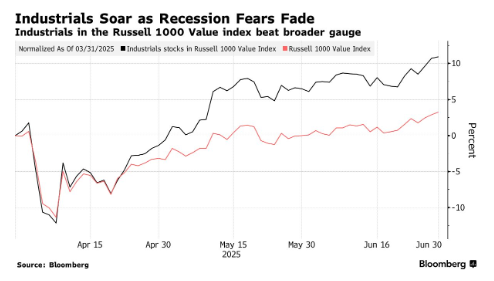
Group 1 - The value investment strategy has been overlooked in the U.S. stock market, but in the second quarter, approximately 63% of active fund managers focusing on undervalued large-cap stocks outperformed their benchmarks, marking the best performance since the pandemic's depths in 2020 [1] - Value-oriented funds have significantly increased their investments in the industrial sector, which saw an 11% rise last quarter, aligning with the performance of the S&P 500 index, while avoiding underperforming sectors like utilities, consumer goods, and real estate [1] - The industrial sector's strong performance signals a potential recovery for value stocks, with some market observers expecting broader recovery as the economy remains robust and interest rate cuts are anticipated [1] Group 2 - Jefferies' stock strategist Steven DeSanctis believes that the economy will not enter a recession, and value stocks should perform better, especially with three expected interest rate cuts in the second half of 2025, which would favor cyclical and value stocks [3] - Despite value stocks still lagging behind growth stocks in absolute terms, value stock pickers have outperformed their benchmarks by 1.7 percentage points, contrasting with growth funds that underperformed by 0.3 percentage points [3] - The S&P 500 industrial index is nearing historical peaks, driven by easing trade tensions and resilient economic data, making it the best-performing sector over the past six months [3] Group 3 - The KBW Bank Index, which tracks major U.S. banks, has surged nearly 40% since its low in April, indicating a strong recovery in the financial sector [4]
会员金选丨巴菲特直播课限免权益
第一财经· 2025-07-03 05:29
✨内容亮点: 穿越周期的能力升级:从财报解读到宏观政策分析,构建 "理论 - 工具 - 实战" 三维体系, 助你摆脱跟风投资,真正掌握 "用逻辑选股、以规则止盈" 的硬技能,在震荡市中也能锁定 长期增长机会。 无论你是刚入门的投资小白,还是想突破收益瓶颈的进阶者,这场由两大权威机构背书的 直播课,将用 "股神智慧" 拆解真实投资场景。 第一财经×星展银行 【会员金选限免权益】 从伯克希尔低调接班人阿贝尔的管理逻辑,到巴菲特 70 年致股东信中穿越牛熊的底层法 则;从破解 "认知边界" 的财富困局,到全球政策与技术革命下的投资新范式——4大内容 深度拆解价值投资核心逻辑,每一节都嵌入实战案例与趋势洞察。 ✨ 权益亮点: 独家联合:第一财经携手星展银行,专为会员用户申请【价值投资系统课】限时免费资 格。 全球政策博弈与技术革命下的投资新逻辑。 本 次 限 免 权 益 数 量 有 限 立 即 领 取 ↓↓↓ 巴菲特直播课 课程采用高清视频形式呈现,每课精心制作1-1.5小时深度内容,共四节。 揭秘低调接班人阿贝尔:巴菲特为什么说他"永远不会做蠢事"? 回顾70年致股东信,找到巴菲特穿越7次牛熊的投资密码。 巴菲特说 ...
★系统性改革拉开帷幕 头部公募响应落实
Shang Hai Zheng Quan Bao· 2025-07-03 01:56
Core Viewpoint - The release of the "Action Plan for Promoting the High-Quality Development of Public Funds" marks the beginning of systematic reforms in the public fund industry, focusing on investor returns and long-term development [1][2] Group 1: Focus on Investor Returns - The Action Plan emphasizes the importance of investor returns and long-term development, indicating a new phase for the public fund industry that prioritizes high-quality transformation [1][2] - The introduction of a floating management fee structure linked to fund performance aims to align the interests of fund managers with those of investors, enhancing the investor experience [2][3] Group 2: Long-Term Investment and Value Orientation - The Action Plan encourages long-term investment and discourages short-term behaviors, promoting a culture of value investment among fund managers [3][4] - Fund companies are adjusting their evaluation systems to focus on long-term performance, with assessment periods extending to 3-5 years [4][5] Group 3: Expansion of Equity Investment - The Action Plan aims to significantly increase the scale and proportion of equity investments in public funds, which is expected to inject fresh capital into the market [5] - Measures such as a rapid registration mechanism and encouragement of index-based investments are being implemented to empower equity investments [5]
CIO vs. OHI: Which Stock Is the Better Value Option?
ZACKS· 2025-07-02 16:41
Core Viewpoint - Investors in the REIT and Equity Trust - Other sector should consider City Office REIT (CIO) and Omega Healthcare Investors (OHI) as potential undervalued stocks [1] Valuation Metrics - Both CIO and OHI currently hold a Zacks Rank of 2 (Buy), indicating positive earnings estimate revisions and improving earnings outlooks [3] - CIO has a forward P/E ratio of 4.86, while OHI has a forward P/E of 12.14, suggesting that CIO may be more undervalued [5] - The PEG ratio for CIO is 0.81, compared to OHI's PEG ratio of 2.08, indicating that CIO has a better expected EPS growth relative to its valuation [5] - CIO's P/B ratio is 0.36, significantly lower than OHI's P/B of 2.15, further supporting the argument that CIO is undervalued [6] - Based on these valuation metrics, CIO earns a Value grade of A, while OHI receives a Value grade of C, highlighting CIO as the superior value option [6][7]



Doximity Crushes The Rule Of 40 - Try Rule Of 58
Seeking Alpha· 2025-07-02 14:36
Group 1 - Doximity (NYSE: DOCS) has moderate growth rates, with guidance indicating barely above double-digit growth [1] - The company presents strong investment potential, being part of a portfolio of undervalued stocks with rapid growth potential driven by quality management [1] - The marketplace emphasizes the importance of selecting attractive investments and highlights the work done in identifying the best stocks [2] Group 2 - The investment approach focuses on delivering strong gains and emphasizes deep value returns, indicating a commitment to high-quality stock picks [3] - The marketplace is experiencing rapid growth, suggesting increasing interest and engagement from members [3] - Member reviews indicate satisfaction with the actionable and insightful stock picks provided [3]


高毅资产邱国鹭:为什么价值投资适合中国
Sou Hu Cai Jing· 2025-07-02 09:12
Core Insights - The article emphasizes the importance of value investing in the Chinese market, highlighting that "Securities Analysis" serves as an essential guide for investors to understand both the methodology and philosophy behind value investing [3][9] - It discusses three main investment principles from Graham: margin of safety, Mr. Market, and investing with a business perspective, which are interconnected and form a logical framework for value investing [6][9] Financial Analysis - The book "Securities Analysis" uses accounting language as its foundation, focusing on financial statements to provide a practical methodology for fundamental analysis [4] - It suggests that analyzing a company's financial performance over time can help assess its intrinsic capabilities and value, similar to evaluating a student's academic performance [4][5] - The article stresses the need to look beyond surface-level profit growth and to analyze the underlying capabilities of companies through their financial reports [6][7] Market Dynamics - The article notes that price fluctuations reflect underlying value, with stock prices being influenced by both fundamental data and intrinsic capabilities [8] - It highlights the volatility of stock prices in the A-share market, which can create opportunities for investors when prices are significantly undervalued [8] - The discussion includes the importance of understanding a company's core competitiveness, industry landscape, and management quality as part of assessing its intrinsic value [8][9] Investment Philosophy - The article asserts that value investing is applicable in China, supported by historical evidence of high long-term returns for skilled value investors [9] - It emphasizes the necessity for investors to develop discipline and independent judgment, which can be enhanced by mastering the knowledge and techniques presented in "Securities Analysis" [9]

【有本好书送给你】1934年首次出版!载入史册的神书,投资传奇万字作序:这本书你读懂了吗?
重阳投资· 2025-07-02 07:25
Core Viewpoint - The article emphasizes the importance of reading and continuous learning in the investment field, highlighting the value of Benjamin Graham's "Security Analysis" as a timeless guide for investors [2][12][41]. Group 1: Importance of Reading - The article references Charlie Munger's belief that wisdom cannot be attained without reading, underscoring the significance of reading as a growth path [2][3]. - The publication aims to encourage readers to maintain their reading habits and engage in discussions about selected books [4][5]. Group 2: Overview of "Security Analysis" - "Security Analysis," co-authored by Benjamin Graham and David Dodd, is described as a foundational text for value investing, providing principles for evaluating stocks and bonds [12][41]. - The book has remained popular since its first publication in 1934, even during significant financial crises, and is referred to as the "bible of value investing" [12][41]. Group 3: Value Investing Principles - The article outlines that value investing involves purchasing securities at prices below their intrinsic value, often summarized as "buying a dollar for fifty cents" [24]. - It emphasizes the need for investors to balance multiple objectives, such as generating returns, preserving capital, and maintaining liquidity [12][19]. Group 4: Market Inefficiencies - The article discusses how market inefficiencies can lead to mispricing of securities, creating opportunities for value investors to buy undervalued stocks [19][20]. - It highlights that stock prices are often influenced by investor emotions rather than fundamental analysis, leading to volatility [19][20]. Group 5: Investment Strategy - Investors are encouraged to maintain discipline and patience, particularly during market downturns, as these periods can present buying opportunities [22][24]. - The article stresses the importance of conducting thorough research and analysis to identify undervalued securities and to avoid being swayed by market sentiment [31][32]. Group 6: Valuation Techniques - Various methods for assessing a company's value are discussed, including discounted cash flow analysis and evaluating market multiples [33][34]. - The article notes that understanding a company's future cash flow potential is crucial for accurate valuation, despite the inherent challenges in forecasting [36][37].