人民币国际化

Search documents
自贸离岸债从“两头在内”到“两头在外”,国有大行香港分行相继发债
Xin Lang Cai Jing· 2025-08-21 11:10
Core Viewpoint - The People's Bank of China (PBOC) is promoting the development of offshore bonds in Shanghai's free trade zone, transitioning from a "two ends inside" model to a "two ends outside" model, which aims to enhance the internationalization of the Renminbi and broaden financing channels for enterprises involved in the Belt and Road Initiative [1][2][4]. Group 1: Development of Offshore Bonds - The PBOC's recent meeting emphasized the need to develop offshore bonds in Shanghai, with a focus on enhancing the functionality of free trade accounts [1]. - Since June 18, 2023, major state-owned banks in Hong Kong have begun issuing offshore bonds, with the first two issuances being completed in July and August, marking a significant restart of the market [2][4]. - The first issuance by Bank of China Hong Kong was priced at 500 million RMB with an interest rate of 1.65%, while the first public issuance by Bank of Communications Hong Kong had a rate of 1.85% and a three-year term [2]. Group 2: Market Characteristics and Trends - The offshore bonds are characterized by strict adherence to the "two ends outside" principle, meaning both the issuers and investors must be from outside China, which is a shift from the previous model that relied heavily on domestic funding [5][6]. - The offshore bond market has seen a cumulative issuance of 189 bonds from 2019 to 2023, totaling over 120 billion RMB, primarily involving local government financing vehicles [4][6]. - The current trend indicates that the issuers and investors are mainly overseas branches or subsidiaries of Chinese institutions, with expectations for increased participation from foreign investors as the market matures [5][6]. Group 3: Implications for Renminbi Internationalization - The development of offshore bonds is seen as a crucial step in enhancing the Renminbi's role as a financing currency, particularly as global interest rates shift [6][7]. - The PBOC has identified the enhancement of the Renminbi's international monetary function as a key task, with a focus on improving its financing capabilities [6]. - The offshore bond market is expected to help establish Shanghai as a regional bond pricing center and attract foreign investment, thereby increasing the international influence of Renminbi-denominated bonds [5][6].


海南自贸港跨境资产管理试点业务实施细则生效,带来哪些影响?
Sou Hu Cai Jing· 2025-08-21 10:32
Group 1 - The implementation details of the cross-border asset management pilot business in Hainan Free Trade Port took effect on August 21, marking the official launch of the pilot [1] - The pilot business supports foreign investors in investing in financial products issued by financial institutions in Hainan, including wealth management products, private asset management products, publicly raised securities investment funds, and insurance asset management products [1] - The pilot aims to enrich the supply of cross-border financial products and explore new channels for foreign investors to invest in the domestic market, while attracting domestic and foreign asset management institutions to operate in Hainan [1] Group 2 - The pilot business is subject to scale management, with an initial total scale limit set at 10 billion yuan for the net inflow of funds from foreign investors purchasing pilot asset management products [1] - The pilot is expected to promote the internationalization of the Renminbi by providing new channels for offshore Renminbi to flow back into the domestic capital market [2] - The pilot opens a new window for foreign investors to allocate Chinese assets and represents a significant step forward in China's financial opening-up [2]
瑞达期货(002961):交易能力突出,资管与风险管理业绩兑现
GUOTAI HAITONG SECURITIES· 2025-08-21 08:36
Investment Rating - The report maintains an "Accumulate" rating with a target price of 28.54 CNY [6][13]. Core Insights - In H1 2025, the company achieved revenue and net profit of 1.047 billion CNY and 228 million CNY, respectively, representing year-on-year increases of 4.49% and 66.49% [13]. - The company's investment business net income increased by 69.72% to 213 million CNY, contributing 73.54% to the adjusted revenue growth [13]. - The asset management business saw a significant increase in fee income, up 278.80% to 42 million CNY, driven by growth in asset management scale [13]. - The company is expected to benefit from the expansion of the futures market under the internationalization of the RMB, leveraging its comprehensive service capabilities in risk management and asset management [13]. Financial Summary - Revenue is projected to grow from 926 million CNY in 2023 to 1.913 billion CNY by 2027, with a peak in 2024 at 1.810 billion CNY [4][14]. - Net profit attributable to shareholders is expected to rise from 244 million CNY in 2023 to 412 million CNY in 2027, with a notable increase of 56.9% in 2024 [4][14]. - Earnings per share (EPS) is forecasted to increase from 0.55 CNY in 2023 to 0.93 CNY in 2027 [4][14]. - The return on equity (ROE) is expected to remain strong, peaking at 13.0% in 2024 before gradually declining to 10.7% by 2027 [4][14].

路透社:中国正考虑推出人民币支持的稳定币
Sou Hu Cai Jing· 2025-08-21 03:53
据路透社,中国正考虑首次允许使用人民币支持的稳定币,以促进人民币在全球范围内的更广泛采用,这是其对数字资产立场的重大转变;中国可能将于 本月晚些时候审查并可能批准一项路线图,以促进全球范围内人民币的使用,包括跟上美国对稳定币的推动;该计划预计将包括人民币在全球市场上的使 用目标,并概述国内监管机构的职责,并补充说,该路线图还将包括风险预防指南;中国预计最早将于本月底举行一次学习会议,重点讨论人民币国际化 和稳定币问题,这两个问题在全球范围内正日益受到关注;会议可能会发表讲话,为稳定币定下基调,并明确其在商业中的应用和发展的界限;在与美元 挂钩的加密货币在全球金融中的影响力日益增强的背景下,北京方面认为金融创新,特别是稳定币,是人民币国际化的有希望的工具。 (来源:吴说) ...

据悉中国考虑推出人民币支持的稳定币
制裁名单· 2025-08-21 03:08
Core Viewpoint - China is considering a significant policy shift by reviewing a roadmap for the use of stablecoins linked to the renminbi, aiming to enhance the internationalization of the currency [1][2]. Group 1: Policy and Regulatory Developments - The State Council of China is expected to review and potentially approve a plan to expand the global use of the renminbi, which includes measures to address the development of stablecoins in the U.S. and guidelines for risk prevention [2]. - The potential use case for a renminbi-backed stablecoin includes facilitating cross-border trade and payments with certain countries [2]. Group 2: Market Position and Competition - The entry of China into the stablecoin market could enhance the competitiveness of the renminbi against major global reserve currencies like the U.S. dollar and the euro [3]. - As of June, the renminbi ranks as the sixth most active currency in global payments, accounting for approximately 2.9% of the total global payment volume [3]. Group 3: Stablecoin Market Dynamics - Dollar-backed stablecoins dominate the market, holding nearly 98% of the total market capitalization of stablecoins, which amounts to $288 billion [6]. - The global concern regarding the influence of dollar-backed stablecoins has prompted various jurisdictions, including China, to consider their own stablecoin initiatives [6]. - In June, officials from the People's Bank of China acknowledged the transformative potential of emerging technologies like stablecoins in the global payment system, increasing calls for regulatory approval of renminbi-backed stablecoins [6].

21评论|海南跨境资管试点今日开闸 资本项目开放向前一步
2 1 Shi Ji Jing Ji Bao Dao· 2025-08-21 02:13
Core Viewpoint - The launch of the Hainan cross-border asset management pilot program marks a significant step in financial openness, providing a new channel for foreign capital to invest in the domestic market and injecting new momentum into the internationalization of the Renminbi [1][4]. Investment Subject - The pilot program targets global foreign institutions and eligible foreign individual investors, breaking geographical and identity limitations, thus allowing a broader range of foreign investment to participate in Hainan's asset management market [1][2]. Investment Products - The range of investment products is extensive, including publicly offered securities investment funds and private asset management products across various risk levels (R1 to R4), catering to different risk preferences of foreign investors [1][2]. Currency and Settlement - The asset management products are required to be denominated in Renminbi, which not only supports the internationalization of the currency but also provides a standardized and predictable trading environment for foreign investors [2][3]. Local Impact - The pilot program is expected to enhance Hainan's role as an open gateway, attracting more foreign investors and boosting market vitality, which is crucial as the free trade port approaches its operational closure [2][4]. National Significance - The pilot program represents an important exploration of capital account openness in China, providing valuable experience for further opening up capital projects and markets across the country [3][4]. Challenges and Regulatory Framework - The implementation of the pilot may face challenges such as financial risk management and investor protection, but these can be addressed through a robust regulatory framework and enhanced monitoring of capital flows [3]. Future Outlook - The ongoing development of the pilot program is anticipated to lead to greater breakthroughs in financial openness, positioning Hainan as a key hub connecting domestic and international financial markets [4].
海南跨境资管试点今日开闸 资本项目开放向前一步
2 1 Shi Ji Jing Ji Bao Dao· 2025-08-21 02:13
Core Insights - The launch of the Hainan cross-border asset management pilot program marks a significant step in financial openness, providing a new channel for foreign capital to invest in the domestic market and injecting new momentum into the internationalization of the Renminbi [1][4] Group 1: Policy Design and Investment Scope - The pilot program targets global foreign institutions and eligible foreign individual investors, breaking geographical and identity limitations, thus allowing a broader range of foreign investment in Hainan's asset management market [1] - The investment products available are diverse, covering publicly offered securities investment funds and private asset management products across various risk levels, catering to different risk preferences of foreign investors [1] Group 2: Impact on Currency and Market - The requirement for asset management products to be denominated in Renminbi and invested in the domestic market supports the internationalization of the currency and provides a standardized trading environment for foreign investors [2] - The pilot is expected to enhance Hainan's role as an open gateway, attracting more foreign investors and asset management institutions, thereby boosting market vitality and contributing to the development of related service industries [2] Group 3: National Significance and Challenges - The pilot program is an important exploration of capital account openness in China, providing valuable experience for further opening up capital projects and markets [3] - Challenges such as financial risk management and investor protection will need to be addressed through a robust regulatory framework and monitoring systems, with the initial pilot quota of 10 billion RMB serving as a stress test [3]
X @外汇交易员
外汇交易员· 2025-08-20 12:52
路透:中国正考虑首次允许使用人民币支持的稳定币,以促进人民币在全球范围内的更广泛采用。国务院将于8月晚些时候审查并可能批准一项路线图,预计将包括人民币在全球市场上的使用目标,并概述国内监管机构的职责,以及包括风险预防指南。知情人士称,中国高层领导预计最早将于本月底举行一次学习会议,重点讨论人民币国际化和稳定币问题。高层领导可能会为稳定币定调,并明确其在商业中的应用和发展的界限。外汇交易员 (@myfxtrader):彭博:中国金融监管机构要求经纪商等机构停止发布有关稳定币的研究或举办推广稳定币的研讨会,以规避不稳定的情况。知情人士称,部分主要经纪商和智库在7月下旬及本月早些时候收到指导,敦促它们取消研讨会并停止传播关于稳定币的研究。监管机构还担心稳定币可能被用作在大陆进行欺诈活动的新工具。 https://t.co/K2g4nX1zU5 ...
港交所最新业绩公布:大增逾三成
Zheng Quan Shi Bao· 2025-08-20 09:21
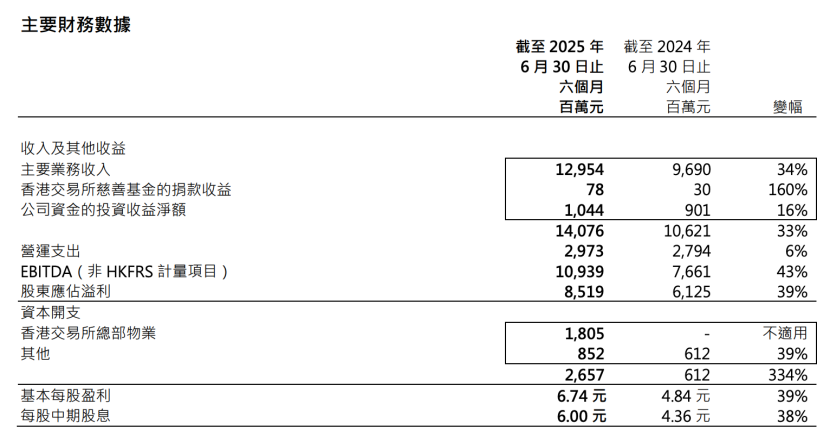
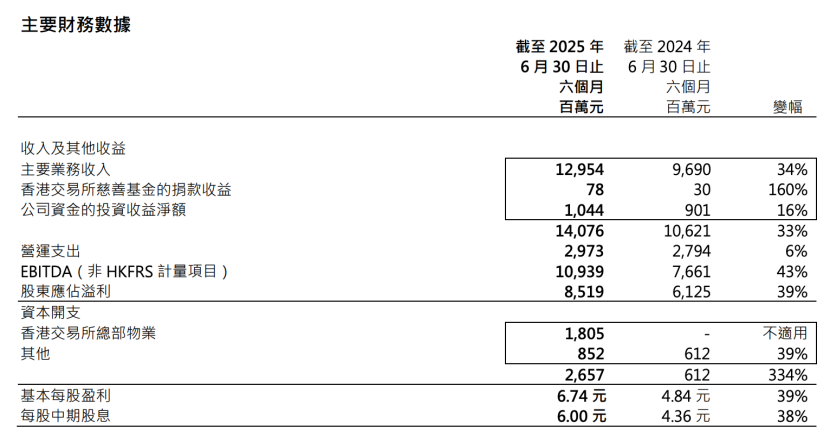
Core Viewpoint - Hong Kong Exchanges and Clearing Limited (HKEX) reported record high revenue and profit for the first half of 2025, with total revenue and other income reaching HKD 14.076 billion, a 33% increase from the same period in 2024, and shareholder profit rising by 39% to HKD 8.519 billion [1][2][12] Financial Performance - Total revenue and other income for H1 2025 was HKD 14.076 billion, up 33% from HKD 10.621 billion in H1 2024 [2] - Shareholder profit for H1 2025 was HKD 8.519 billion, compared to HKD 6.125 billion in H1 2024, marking a 39% increase [2] - Basic earnings per share increased to HKD 6.74 from HKD 4.84, a 39% rise [2] - Interim dividend declared at HKD 6.00 per share, up 38% from HKD 4.36 in the previous year [2] Market Activity - The average daily trading volume for equity securities reached HKD 222.84 billion, a 122% increase from HKD 100.3 billion in the previous year [7] - The average daily trading volume for derivatives and warrants was HKD 17.4 billion, up 72% from HKD 10.1 billion [7] - The average daily trading volume for Hong Kong Stock Connect was HKD 111.04 billion, a 196% increase from HKD 37.5 billion [7] - The number of new listings in H1 2025 was 44, raising a total of HKD 1.094 billion, a more than sevenfold increase year-on-year [8][9] Strategic Developments - HKEX is focusing on enhancing its product ecosystem, optimizing listing systems, and expanding into new commodity business directions [2][12] - A cooperation agreement was signed with the Hong Kong Monetary Authority to explore improvements in post-trade securities infrastructure, including the development of an international central securities depository [12] - HKEX plans to include Renminbi-denominated stocks in the Stock Connect program to facilitate trading for mainland investors [13] - The introduction of a "Tech Company Fast Track" aims to streamline the listing process for technology and biotech firms [13] Future Outlook - The CEO expressed optimism for the second half of 2025, emphasizing the commitment to enhancing platform infrastructure and product offerings to adapt to the changing global macroeconomic environment [2][12] - The company remains cautious about external uncertainties, including geopolitical risks and interest rate fluctuations, while maintaining a positive outlook for market performance [14]

港交所最新业绩公布:大增逾三成!
Zheng Quan Shi Bao· 2025-08-20 09:20
Core Viewpoint - Hong Kong Exchanges and Clearing Limited (HKEX) reported record high revenue and profit for the first half of 2025, driven by strong market performance and strategic initiatives [1][2][5]. Financial Performance - HKEX's revenue and other income for the first half of 2025 reached HKD 14.076 billion, a 33% increase from HKD 10.621 billion in the same period of 2024 [2]. - Shareholder profit for the first half of 2025 was HKD 8.519 billion, up 39% from HKD 6.125 billion in the previous year [2]. - The company declared an interim dividend of HKD 6.00 per share, compared to HKD 4.36 per share in 2024, marking a 38% increase [2]. Market Activity - The average daily trading volume for HKEX's stock products was HKD 222.84 billion, a 122% increase year-on-year [6]. - The average daily trading volume for derivatives, including warrants and structured products, rose to HKD 17.4 billion, up 72% from the previous year [6]. - The Hong Kong ETF market saw a significant increase, with average daily trading volume reaching HKD 338 billion, a 184% rise compared to the same period last year [7]. New Listings and Fundraising - In the first half of 2025, HKEX regained its position as the top global exchange for new listings, with 44 companies going public and raising a total of HKD 109.4 billion, a more than sevenfold increase from the previous year [7][8]. - Notable listings included CATL, which raised HKD 41 billion, marking the largest IPO in Hong Kong since February 2021 [8]. Strategic Developments - HKEX is focused on enhancing its product ecosystem, optimizing listing regulations, and expanding its commodity business [1][2]. - The company has entered into a partnership with the Hong Kong Monetary Authority to explore improvements in post-trade securities infrastructure, which is crucial for the development of the fixed income and currency product ecosystem [10][11]. - HKEX plans to introduce RMB-denominated stocks into the Stock Connect program, allowing mainland investors to trade Hong Kong-listed stocks using RMB [11]. Outlook - The CEO expressed optimism for the second half of 2025, emphasizing the commitment to improving platform infrastructure and product offerings to meet the evolving global economic landscape [2][10].