
保险资产管理产品

Search documents
新规强化全周期披露责任,吹散银行理财“信息迷雾”
Di Yi Cai Jing Zi Xun· 2025-12-29 12:48
Core Viewpoint - The recent issuance of the "Measures for the Management of Information Disclosure of Asset Management Products by Banking and Insurance Institutions" aims to address long-standing issues in the wealth management sector, such as distorted yield displays and non-transparent valuation methods, by standardizing information disclosure practices [1][2][6]. Group 1: Regulatory Framework - The new regulations establish a unified standard for information disclosure across three types of asset management products: asset management trusts, bank wealth management products, and insurance asset management products [2][6]. - The regulations emphasize the importance of protecting investors' rights to information and choice, which is a fundamental obligation of asset management institutions [2][6]. - The measures require clear disclosure of performance benchmarks, including the rationale for their selection and calculation methods, while explicitly stating that performance benchmarks are not expected yields [2][3]. Group 2: Disclosure Requirements - The regulations enhance periodic disclosure requirements, mandating accurate reporting of product net values, performance, and investment asset conditions, while introducing a mechanism for transparent disclosure of underlying asset structures [3][4]. - Specific rules for cash management products prohibit the display of annualized returns for products that have been established for less than seven days, aiming to curb misleading marketing practices [3][4]. - The regulations also require that all parties involved in the asset management process, including product managers and sales institutions, share responsibility for ensuring the accuracy and completeness of disclosed information [4][6]. Group 3: Industry Impact - The new rules are expected to elevate the quality of information disclosure, potentially becoming a key competitive differentiator for asset management institutions [4][6]. - The introduction of a "dual-channel" disclosure principle aims to simplify investor access to information, thereby enhancing transparency and consistency across different disclosure platforms [4][6]. - The regulations are anticipated to drive asset management companies towards greater professionalism and specialization by mandating the disclosure of investment strategies, portfolio structures, and performance benchmarks [5][6]. Group 4: Future Outlook - The regulations will take effect on September 1, 2026, allowing an eight-month transition period for banking and insurance institutions to adapt [6]. - The increased compliance requirements may raise operational costs for asset management firms, necessitating a comprehensive review and upgrade of their disclosure systems and product documentation [6][7]. - Long-term, the standardization of information disclosure is expected to reshape the competitive landscape of the asset management industry, with a focus on transparency and professional management becoming essential for maintaining a competitive edge [6][7].
海南自贸港封关在即,期货人需要了解这些事!
Qi Huo Ri Bao· 2025-12-17 11:15
Group 1 - The core point of the news is that the Hainan Free Trade Port will officially start its full island closure on December 18, which is expected to bring structural opportunities for the futures market, particularly in cross-border financial policies [1][3]. - After the closure, the rules and mechanisms for futures trading in Hainan will remain unchanged, allowing both individual and corporate traders to continue their activities without any adjustments [2][3]. - The new regulatory framework will facilitate cross-border capital flows and market openness, enhancing the participation of foreign investors in specific futures trading and delivery in Hainan [3][6]. Group 2 - Hainan is offering various financial incentives for futures companies, including one-time rewards based on regulatory classification evaluations, which can reach up to 3 million yuan for A-class companies [4]. - Local futures companies are focusing on deepening their domestic operations while expanding their cross-border business, particularly in sectors like tropical agriculture and oil and gas [5][6]. - The closure of the Hainan Free Trade Port is seen as a stepping stone rather than a barrier, with significant opportunities for institutions and professional traders in cross-border business and industry services [6].

34家保险资管公司管理资金超33万亿,保险业投资收益率显著提升
Sou Hu Cai Jing· 2025-12-04 05:13
Core Insights - The report titled "China Insurance Asset Management Industry Development Report (2025)" reveals significant growth in the insurance asset management sector, with total managed funds reaching 33.3 trillion yuan by the end of 2024, marking a year-on-year increase of 10.6% [1][2] Group 1: Fund Management Scale - As of the end of 2024, there are 34 insurance asset management companies managing a total of 33.3 trillion yuan, with 70.56% (23.5 trillion yuan) being internal insurance funds [2] - The proportion of third-party insurance funds has decreased for two consecutive years, while pension fund management has increased, with a growth rate of 22.93% [2] Group 2: Asset Allocation - The total investment asset scale of insurance asset management companies reached 32.68 trillion yuan in 2024, reflecting a 25% year-on-year growth [3] - Bonds constitute 46% of the asset allocation, with a total of 15.18 trillion yuan, while stocks have the fastest growth rate at 36% [3] Group 3: Revenue and Growth - The total revenue of 34 institutions reached 318.3 billion yuan in 2024, an increase of 21.68 billion yuan, with a growth rate of 7.31% [4] - The specialized account business generated 182.14 billion yuan, accounting for 57.45% of total revenue, with a growth rate of 19.21% [4] Group 4: Industry Employment - The number of employees in the insurance asset management sector increased to 7,631 by the end of 2024, representing a growth rate of 1.76% [5]
34家保险资管公司管理资金超33万亿 保险业投资收益率显著提升
Zhong Guo Jing Ji Wang· 2025-11-26 02:36
Core Insights - The report highlights the growth and performance of the insurance asset management industry in China, showcasing key data and trends from 201 companies and 34 asset management firms [1] Group 1: Industry Overview - As of the end of 2024, the total assets under management by 34 insurance asset management companies reached 33.3 trillion yuan, marking a year-on-year increase of 10.6% [2] - The report indicates that the investment return rates for the industry have significantly improved, with 21 institutions achieving a comprehensive return rate exceeding 5% [3] Group 2: Asset Management Breakdown - The total investment asset scale of insurance asset management companies reached 32.68 trillion yuan by the end of 2024, reflecting a year-on-year growth of 25% [3] - The asset allocation structure shows that bonds account for 46% (15.18 trillion yuan), financial products for 20% (6.66 trillion yuan), bank deposits for 14% (4.46 trillion yuan), stocks for 7% (2.17 trillion yuan), public funds for 4% (1.27 trillion yuan), and equity investments for 1% (429.9 billion yuan) [3] Group 3: Revenue and Growth - The total revenue of the 34 institutions reached 318.3 billion yuan in 2024, an increase of 21.68 billion yuan, with a growth rate of 7.31% [4] - The revenue from dedicated account business grew by 19.21% to 182.14 billion yuan, while the revenue from combination products increased by only 1.36% to 71.16 billion yuan [4] Group 4: Talent and Employment - The number of employees in the insurance asset management industry increased to 7,631 by the end of 2024, reflecting a growth rate of 1.76% [5]
34家保险资管公司最新成绩单:管理资金超33万亿 同比增长10.60%
Zhong Guo Jing Ying Bao· 2025-11-21 08:11
Core Insights - The China Insurance Asset Management Association released the "China Insurance Asset Management Industry Development Report (2025)" on November 21, highlighting key trends in the industry [1] Group 1: Industry Overview - As of the end of 2024, 34 insurance asset management companies managed a total of 33.30 trillion yuan, reflecting a year-on-year growth of 10.60% [1] - The total revenue for these 34 institutions in 2024 reached 31.83 billion yuan, an increase of 2.17 billion yuan compared to the previous year, with a growth rate of 7.31% [1] - Among the 33 companies with year-on-year data, the revenue growth rate was recorded at 6.75% [1] Group 2: Product Performance - By the end of 2024, the balance of insurance asset management products in the industry stood at 8.07 trillion yuan, a decrease of 461.3 billion yuan from the previous year, marking a negative growth rate of -5.41% [1] - This is the first time in five years that the growth rate has turned negative, while the compound annual growth rate over the past five years was 21.47% [1] Group 3: Report Background - The report has been compiled for nine consecutive years under the guidance of relevant departments of the National Financial Supervision Administration, aiming to provide a comprehensive and objective record of the industry's development [1]
中国人寿续展三年关联交易,涉国寿投资、安保基金
Sou Hu Cai Jing· 2025-11-07 06:51
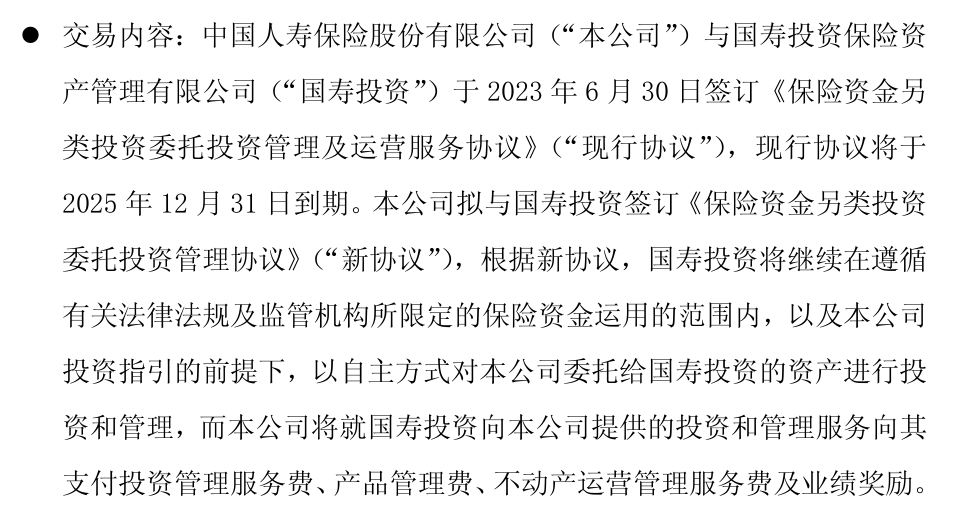
Core Viewpoint - China Life Insurance has announced the renewal of two related transactions with Guoshou Investment Insurance Asset Management Co., which will enhance its alternative investment strategy and strengthen its collaboration with Guoshou Anbao Fund Management Co. [1][3] Group 1: Transaction Details - The first announcement involves the renewal of the alternative investment management cooperation, effective from January 1, 2026, to December 31, 2028, with a maximum signing amount for new entrusted investment management assets set at 120 billion, 140 billion, and 150 billion yuan for the years 2026 to 2028 respectively [1] - The management service fees for new projects will be uniformly calculated at 0.08% annually, with total service fee caps of 1.1 billion, 1.2 billion, and 1.3 billion yuan for the same years [1][2] - The second announcement pertains to the continuation of the business cooperation with Anbao Fund, focusing on fund product subscription, redemption, and private asset management, with annual caps for subscription and redemption amounts set at 2 billion yuan and management fees at 20 million yuan for the years 2026 to 2028 [2] Group 2: Historical Data and Performance - In 2023 and 2024, the newly entrusted asset signing amounts were 76.76 billion and 64.96 billion yuan respectively, with service fees of 770 million and 730 million yuan [2] - For the first half of 2025, the signing amount reached 21.52 billion yuan, with related service fees amounting to 330 million yuan [2] - The historical data for fund subscriptions shows amounts of 140 million yuan in 2023 and 2024, and 175 million yuan in the first half of 2025, while redemptions were 140 million, 350 million, and 70 million yuan respectively [2] Group 3: Company Background - Guoshou Investment, established in 2007, is a specialized alternative investment platform under China Life, with a registered capital of 3.7 billion yuan and a cumulative signing scale exceeding 950 billion yuan as of the end of 2024 [3] - Guoshou Anbao Fund, founded in October 2013, is the first public fund management company in China with insurance background, managing over 340 billion yuan as of June 2025, but facing an asset structure imbalance with over 95% in fixed-income and money market funds [4]


海南自贸港跨境资管试点落地 首批6家机构完成证监会备案
Zhong Guo Jing Ying Bao· 2025-10-16 09:44
Core Viewpoint - The China Securities Regulatory Commission (CSRC) announced that six institutions have completed the filing for cross-border asset management pilot business in Hainan Free Trade Port, marking the first batch of pilot institutions since the implementation guidelines were released [1]. Group 1: Institutions Involved - The six institutions that have been approved include four issuing institutions: Jinyuan Securities Co., Ltd., Wanhua Securities Co., Ltd., Huibaichuan Fund Management Co., Ltd., and Peng'an Fund Management Co., Ltd. Additionally, two sales institutions are involved: Industrial Bank Co., Ltd. Haikou Branch and Shanghai Pudong Development Bank Co., Ltd. Haikou Branch [1]. Group 2: Regulatory Framework - The implementation guidelines for the cross-border asset management pilot business were jointly issued by several regulatory bodies, including the People's Bank of China Hainan Branch, the National Financial Supervision Administration Hainan Regulatory Bureau, the CSRC Hainan Regulatory Bureau, the Hainan Provincial Local Financial Management Bureau, and the State Administration of Foreign Exchange Hainan Branch on July 21 [1]. Group 3: Investment Opportunities - The guidelines support foreign investors in investing in financial products issued by financial institutions within the Hainan Free Trade Port, including wealth management products, private asset management products from securities and futures institutions, public securities investment funds, and insurance asset management products [1].


海南自贸港跨境资产管理试点启动 政策亮点揭秘
Zhong Guo Chan Ye Jing Ji Xin Xi Wang· 2025-08-27 07:29
Core Viewpoint - The implementation of the "Implementation Rules for Cross-Border Asset Management Pilot Business in Hainan Free Trade Port" aims to facilitate foreign investors' access to financial products issued by financial institutions in Hainan, enhancing investment opportunities and flexibility in asset management [1][2]. Summary by Relevant Sections Implementation Details - The rules focus on supporting foreign investors in investing in asset management products issued by financial institutions in Hainan Free Trade Port, detailing eligible investors, investment products, account types, and fund flow [1]. - The pilot program is open to global foreign institutions and qualified foreign individual investors, promoting a diversified investment base [1]. - The range of investment products includes private asset management products, publicly raised securities investment funds, and insurance asset management products with risk levels from R1 to R4 [1]. Investment Accounts - Foreign investors can open RMB bank settlement accounts and free trade accounts in Hainan, allowing them to purchase pilot asset management products, with an encouragement for transactions to be denominated and settled in RMB [1]. Investment Scale - The initial pilot program sets a net inflow limit of 10 billion RMB for foreign investors purchasing pilot asset management products, with the potential for dynamic adjustments based on economic and financial developments in Hainan and market demand [1]. Expert Insights - The pilot opens a new channel for foreign investors to invest in Chinese financial products, enriching their options for RMB asset allocation [2]. - For domestic asset management institutions, the pilot can expand their client base and business growth opportunities [2].
城市24小时 | 造价约3亿元/公里,这条高铁有多重要?
Mei Ri Jing Ji Xin Wen· 2025-08-21 16:01
Core Viewpoint - The approval of the feasibility study for the new Shanghai-Hangzhou high-speed railway marks a significant step towards its construction, with a total investment of approximately 67.1 billion yuan and a length of about 223.8 kilometers [1][2]. Group 1: Project Overview - The Shanghai-Hangzhou high-speed railway is a crucial part of the national "Eight Vertical and Eight Horizontal" high-speed rail network and is included in the 102 major railway projects for the 14th Five-Year Plan [2]. - The railway is designed for a speed of 350 kilometers per hour and will connect Shanghai East Station to Hangzhou West Station, passing through key areas such as Jiaxing and Tongxiang [2][3]. - The average construction cost of the new railway is approximately 3 billion yuan per kilometer, which is higher than the 2.33 billion yuan per kilometer cost of the existing Huzhou-Su Lake high-speed railway [2]. Group 2: Strategic Importance - The new railway aims to enhance connectivity between Shanghai and Hangzhou, two major cities in the Yangtze River Delta, which is vital for regional development and competition [2][3]. - Currently, there are multiple high-speed rail connections between Nanjing and Shanghai, but fewer direct connections between Hangzhou and Shanghai, highlighting a competitive disadvantage for Hangzhou [3]. - The new railway is expected to facilitate a more direct and efficient connection, potentially reducing travel time between the two cities to as little as 15 minutes in the future [6]. Group 3: Broader Implications - The Shanghai East Station, the eastern terminus of the new railway, will be part of a larger transportation hub that integrates air, rail, and urban transit, benefiting not only Hangzhou but also surrounding cities like Jiaxing [6]. - The project aligns with the broader goals of the "14th Five-Year" modern comprehensive transportation system development plan, which emphasizes strengthening rapid connections between core cities in major urban clusters [3].

海南自贸港跨境资产管理试点业务实施细则生效,带来哪些影响?
Sou Hu Cai Jing· 2025-08-21 10:32
Group 1 - The implementation details of the cross-border asset management pilot business in Hainan Free Trade Port took effect on August 21, marking the official launch of the pilot [1] - The pilot business supports foreign investors in investing in financial products issued by financial institutions in Hainan, including wealth management products, private asset management products, publicly raised securities investment funds, and insurance asset management products [1] - The pilot aims to enrich the supply of cross-border financial products and explore new channels for foreign investors to invest in the domestic market, while attracting domestic and foreign asset management institutions to operate in Hainan [1] Group 2 - The pilot business is subject to scale management, with an initial total scale limit set at 10 billion yuan for the net inflow of funds from foreign investors purchasing pilot asset management products [1] - The pilot is expected to promote the internationalization of the Renminbi by providing new channels for offshore Renminbi to flow back into the domestic capital market [2] - The pilot opens a new window for foreign investors to allocate Chinese assets and represents a significant step forward in China's financial opening-up [2]