
世界一流企业

Search documents
国资委主任张玉卓:深入开展新一轮中央企业数字化转型行动 推动人工智能等信息技术与传统产业全过程、全要素深度融合
Xin Hua She· 2025-12-19 13:32
Core Viewpoint - The article discusses the strategic framework outlined in the "Suggestions for Formulating the 15th Five-Year Plan for National Economic and Social Development," emphasizing the role of state-owned enterprises (SOEs) in enhancing innovation, solidifying the real economy, and deepening reforms in state-owned assets and enterprises [1]. Group 1: Strengthening Innovation - State-owned enterprises are identified as a key force in national technological innovation, with R&D investments exceeding 1 trillion yuan for three consecutive years, focusing on critical technologies [2][3]. - The plan includes increasing high-quality technological supply, particularly in areas where private enterprises lack capability, to produce more original and leading results [2]. - The transformation of technological achievements into practical applications will be accelerated, with a focus on building major pilot platforms and enhancing procurement of first sets of products [3]. Group 2: Modernizing the Industrial System - The article highlights the need for SOEs to optimize industrial layouts by upgrading traditional industries and developing strategic emerging industries, with an average annual investment growth rate of over 20% in emerging sectors during the 14th Five-Year Plan [4][5]. - Emphasis is placed on digital transformation and the integration of advanced technologies like AI, big data, and 5G into traditional industries to promote intelligent and green development [5]. Group 3: Reforming State-Owned Enterprises - The article outlines the next steps in the reform of state-owned enterprises, focusing on enhancing core functions and competitiveness while aligning with national strategic needs [6][7]. - A new regulatory framework will be established to improve the effectiveness of state asset supervision, ensuring a balance between flexibility and control [7]. Group 4: Building World-Class Enterprises - The article stresses the importance of cultivating world-class enterprises as a reflection of national economic and technological strength, with SOEs leading initiatives to enhance value creation, innovation, and governance [8][9]. - The focus will be on improving internal value, integrating innovation with industry, and enhancing resource allocation capabilities to better engage in global markets [8].
贯彻落实党的二十届四中全会精神权威访谈丨不断增强国有企业核心功能、提升核心竞争力——访国务院国资委党委书记、主任张玉卓
Xin Hua Wang· 2025-12-19 12:44
Core Viewpoint - The article discusses the strategic initiatives and reforms that state-owned enterprises (SOEs) in China will undertake to enhance their core functions and competitiveness in alignment with the 15th Five-Year Plan, focusing on innovation, industrial upgrades, and the establishment of world-class enterprises [1][7]. Group 1: Innovation and Technology - State-owned enterprises are positioned as the national team for technological innovation, with R&D investments exceeding 1 trillion yuan for three consecutive years, targeting critical technologies in areas like industrial machinery and software [2][3]. - The focus will be on increasing high-quality technological supply, particularly in areas where other enterprises lack the capability or willingness to invest, ensuring breakthroughs in foundational and key common technologies [2]. - Efforts will be made to enhance the efficiency of technology transfer and application, including the establishment of major pilot verification platforms and increasing procurement of first sets of products to promote market entry [3]. Group 2: Industrial Upgrades - The strategy emphasizes the transformation of traditional industries and the cultivation of emerging industries, with an average annual investment growth rate of over 20% in new industries during the 14th Five-Year Plan [4][5]. - SOEs will focus on digital transformation and the integration of advanced technologies like AI, big data, and 5G into traditional industries to promote smart, green, and integrated development [5]. - The cultivation of new and future industries will be prioritized, with a focus on sectors such as renewable energy, aerospace, and quantum technology, ensuring sustained growth and innovation [5][6]. Group 3: Reform and Governance - The next phase of SOE reform will focus on enhancing core functions and competitiveness, with an emphasis on aligning with national strategic needs and improving governance structures [7][8]. - A specialized regulatory framework will be developed to enhance the effectiveness of state asset supervision, ensuring a balance between flexibility and control [8]. - The goal is to foster world-class enterprises by improving value creation, innovation capabilities, and modern governance practices, while also strengthening the role of the Communist Party in corporate governance [9][10].
国资委:超前谋划量子科技、具身智能、生物制造、绿色船舶、6G等前沿赛道
Xin Hua She· 2025-12-19 12:40
Core Viewpoint - The article discusses the strategic framework and key tasks outlined in the "Suggestions for Formulating the 15th Five-Year Plan for National Economic and Social Development" approved by the 20th Central Committee, emphasizing the role of state-owned enterprises (SOEs) in achieving these goals [1] Group 1: Strengthening Innovation - State-owned enterprises are identified as a crucial part of the national strategic technology force, with a focus on enhancing independent and original innovation capabilities during the 15th Five-Year Plan [2] - R&D investment by state-owned enterprises has exceeded 1 trillion yuan for three consecutive years, targeting critical technologies in areas such as industrial mother machines and software [2] - The plan includes increasing high-quality technology supply, accelerating efficient results transformation, gathering high-level innovation elements, and building a high-level innovation ecosystem [3] Group 2: Modernizing the Industrial System - The article highlights the need to optimize industrial layout by promoting traditional industry upgrades and developing strategic emerging industries [4] - Investments in emerging industries have seen an average annual growth rate of over 20% during the 14th Five-Year Plan, with significant advancements in sectors like new information technology and high-end equipment manufacturing [4][5] - The focus will be on fostering high value-added and high-tech industries, with an emphasis on digital transformation and the integration of AI and other technologies into traditional industries [5] Group 3: Reforming State-Owned Enterprises - The article outlines the next steps for deepening the reform of state-owned enterprises, emphasizing the need for improved core functions and competitiveness [6] - The reform will focus on enhancing the strategic capabilities of state-owned enterprises, clarifying their functional positioning, and concentrating capital in key industries related to national security and public services [6][7] - A more effective regulatory framework will be established to enhance the efficiency of state-owned asset supervision, promoting a more flexible and targeted regulatory approach [7] Group 4: Building World-Class Enterprises - The article stresses the importance of cultivating world-class enterprises as a reflection of national economic and technological strength [8] - Key actions include enhancing value creation, driving innovation, improving corporate governance, and optimizing resource allocation [8][9] - The role of party leadership in ensuring high-quality development within state-owned enterprises is also emphasized, highlighting the integration of political and operational frameworks [9]
朱庆忠:锻造适应新质生产力发展要求的领导人员队伍
Bei Jing Ri Bao Ke Hu Duan· 2025-12-03 03:48
Core Viewpoint - The articles emphasize the importance of high-quality development and the cultivation of a strong leadership team within China National Petroleum Corporation (CNPC) to align with the Party's directives and enhance the company's core competitiveness [1][2][3]. Group 1: High-Quality Development - The 20th Central Committee of the Communist Party of China stresses the need for high-quality economic and social development, with a focus on self-reliance in technology and new productive forces [1]. - CNPC aims to implement the Party's directives by prioritizing talent development as one of its five strategic measures to ensure sustainable growth as a world-class energy and chemical company [1]. Group 2: Leadership Development - The Party has introduced new standards for leadership in state-owned enterprises, emphasizing the need for leaders to be politically strong, capable, and resilient [2]. - CNPC is committed to cultivating a leadership team that embodies these qualities, focusing on political loyalty and the ability to manage modern enterprises effectively [3][4]. Group 3: Innovation and Reform - The articles highlight the necessity for CNPC's leadership to embrace innovation and effective management practices to enhance the company's core competitiveness [3][4]. - There is a strong emphasis on the need for leaders to adapt to the challenges posed by global changes and to lead the company towards high-quality development [4][5]. Group 4: Strategic Planning and Future Orientation - CNPC is focused on enhancing its strategic capabilities to navigate future challenges, including the need to optimize traditional industries and foster emerging sectors [8][9]. - The company aims to develop leaders who possess strategic foresight and can effectively respond to market dynamics and technological advancements [8][9]. Group 5: Practical Experience and Capability Building - The articles stress the importance of practical experience in leadership development, advocating for leaders to engage in diverse roles and challenging environments to enhance their skills [9][10]. - CNPC is committed to providing its leaders with opportunities for hands-on experience to improve their ability to drive high-quality development [9][10]. Group 6: Creating a Supportive Environment - The articles discuss the need to foster a conducive environment for leadership within CNPC, emphasizing the importance of correct performance metrics and a supportive culture for innovation [10][11]. - The company is focused on establishing a robust assessment system that encourages leaders to prioritize value creation and long-term growth [11][12].

充分激发各类经营主体活力(学习贯彻党的二十届四中全会精神)
Ren Min Ri Bao· 2025-11-30 22:20
Core Points - The article emphasizes the importance of invigorating various business entities to enhance high-quality economic development in China, as outlined in the 20th Central Committee's Fourth Plenary Session [1] Group 1: State-Owned Enterprises (SOEs) - The article stresses the need to consolidate and develop the public ownership economy, focusing on strengthening state-owned enterprises and capital to enhance their competitiveness and innovation capabilities [2] - It highlights the importance of deepening reforms in state-owned enterprises to eliminate barriers to high-quality development and to better stimulate internal motivation and innovation [3] - The article calls for optimizing the layout and structure of state-owned capital, directing investments towards strategic and essential industries, and promoting the development of the real economy [4] Group 2: Enhancing Core Competitiveness - The article discusses the necessity for state-owned enterprises to better utilize market forces to fulfill national strategic missions, emphasizing the need for a robust evaluation system for their performance [5] - It advocates for the establishment of a modern enterprise system with improved governance structures to enhance operational efficiency and responsiveness to market changes [12] Group 3: Private Sector Development - The article underscores the critical role of the private economy in China's economic growth, noting that private enterprises account for over 90% of total enterprises and contribute significantly to employment and tax revenue [6][7] - It emphasizes the need to create a favorable environment for private enterprises, ensuring equal access to resources and fair competition [8] - The article also highlights the importance of supporting small and medium-sized enterprises (SMEs) and individual businesses, which are vital for innovation and employment [9] Group 4: Legal and Regulatory Framework - The article calls for strengthening legal protections for private property rights, ensuring that both public and private economic rights are inviolable [10] - It advocates for the establishment of a legal framework to support the development of the private economy, enhancing the predictability and stability of regulatory policies [10] Group 5: World-Class Enterprises - The article emphasizes the goal of building world-class enterprises that reflect national economic strength and competitiveness, advocating for a collaborative development of various ownership economies [11] - It discusses the need for fostering an entrepreneurial spirit and creating a supportive environment for entrepreneurs to thrive [13] - The article calls for increased investment in research and development to cultivate world-class innovation capabilities and enhance global market integration [14]
进一步全面深化改革 巩固壮大实体经济根基
Xin Hua Ri Bao· 2025-11-24 21:58
Group 1: Core Economic Development Strategies - The "15th Five-Year Plan" emphasizes the importance of focusing on the real economy, aiming to build a modern industrial system and strengthen the foundation of the real economy [1] - The plan outlines goals for a high-level modern industrial system, advocating for intelligent, green, and integrated development, with a focus on advanced manufacturing as a backbone [1] - Jiangsu province has made significant progress in advanced manufacturing during the "14th Five-Year Plan," focusing on 16 advanced manufacturing clusters and 50 industrial chains [1] Group 2: Importance of Enterprises - The development of industries is fundamentally linked to the quality of enterprises, which are driven by entrepreneurs, technical personnel, and management [2] - The "15th Five-Year Plan" calls for the acceleration of building more world-class enterprises, highlighting the need for improved enterprise development environments and quality [2] Group 3: State-Owned and Private Enterprises - Both state-owned and private enterprises are crucial to the foundation of the real economy in China, with recent reforms providing momentum for their rapid development [3] - The "15th Five-Year Plan" emphasizes the need for comprehensive reforms in both types of enterprises to achieve high-quality development [3] Group 4: State-Owned Enterprises in Jiangsu - Jiangsu's state-owned enterprises focus on key sectors such as energy, transportation, and environmental protection, playing a significant role in providing public goods [4] - The establishment of a 50 billion yuan fund aims to support strategic emerging industries, although it is relatively small compared to the province's total state-owned capital of 37 trillion yuan [4] Group 5: Private Enterprises in Jiangsu - Jiangsu is a major hub for private enterprises, with the added value of the private economy increasing from 5.1 trillion yuan in 2018 to 7.98 trillion yuan in 2024, accounting for 58.2% of the province's GDP [6] - Over 65% of the top 200 private enterprises in Jiangsu are engaged in advanced manufacturing, contributing significantly to innovation and technology [6] Group 6: Challenges and Opportunities for Private Enterprises - Despite a solid manufacturing base, Jiangsu's private economy faces challenges, including a low proportion of emerging industries and a reliance on traditional sectors [7] - The implementation of the "Private Economy Promotion Law" is seen as a significant benefit for private enterprises, providing better protection and fostering an environment conducive to innovation [7][8] Group 7: Policy Environment and Support - The sensitivity of private enterprises to policy changes necessitates a supportive government approach that goes beyond superficial assistance [8] - There is a need for deeper market-oriented reforms to release more resources to private enterprises, particularly in collaboration with educational and financial institutions [8]
榜单见证中国大企业发展态势向好(经济聚焦)
Ren Min Ri Bao· 2025-09-16 22:10
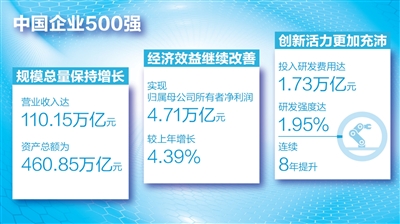
Core Insights - Since the "14th Five-Year Plan," China's top 500 enterprises have made new strides in seeking progress while maintaining stability, enhancing development momentum, and playing a significant role in industrial upgrading, innovation capability enhancement, and international competition [1][2] Group 1: Performance Metrics - The threshold for entering the "2025 China Enterprise 500" list has increased for 23 consecutive years, reaching 47.96 billion yuan, up by 579 million yuan from the previous year [1] - The total operating revenue of the top 500 enterprises reached 11.015 trillion yuan, showing an increase from the previous year; net profit attributable to shareholders was 471 billion yuan, up by 4.39% [1][3] - The number of enterprises with revenues exceeding 100 billion yuan increased from 222 in 2020 to 267 in 2024, an increase of 45 [1] Group 2: R&D and Innovation - The top 500 enterprises invested 1.73 trillion yuan in R&D, achieving a record R&D intensity of 1.95%, marking an increase for eight consecutive years [2][5] - The average R&D intensity of the "2025 China Innovation 100" increased from 5.27% to 5.61%, an increase of 0.34 percentage points [2] Group 3: Structural Optimization - The operating revenue of the top 500 enterprises grew from 8.983 trillion yuan in 2020 to 11.015 trillion yuan in 2024, a growth of 22.62% [3] - The total assets increased from 34.358 trillion yuan to 46.085 trillion yuan, a growth of 34.13% [3] - The contribution to revenue growth from manufacturing, services, and other sectors was 40.48%, 40.29%, and 19.23%, respectively [5] Group 4: Global Competitiveness - The threshold for the "2025 China Top 100 Multinational Corporations" was 22.173 billion yuan, up by 2.333 billion yuan, or 11.76% from the previous year; total overseas assets reached 11.96 trillion yuan [2] - The average multinational index was 15.56%, an increase of 0.21 percentage points from the previous year [2] Group 5: Future Directions - Chinese enterprises are encouraged to increase long-term stable investments in basic research and key common technologies, leveraging the country's vast application scenarios to overcome core technology challenges [6][7] - The importance of a market-oriented, collaborative innovation system that integrates industry, academia, and research is emphasized to enhance the competitiveness of Chinese enterprises on the global stage [7]

兖矿能源:量增本降经营显韧性,并购落地成长启新篇
Xin Lang Cai Jing· 2025-09-01 21:02
Core Viewpoint - Yanzhou Coal Mining Company reported a decline in revenue and net profit for the first half of 2025, indicating challenges in the coal sector despite some operational improvements and strategic acquisitions [1][2]. Group 1: Financial Performance - In the first half of 2025, the company achieved operating revenue of 59.349 billion yuan, a year-on-year decrease of 17.93% [1]. - The net profit attributable to shareholders was 4.652 billion yuan, down 39.38% year-on-year, while the net profit after deducting non-recurring items was 4.430 billion yuan [1]. - For Q2 2025, the company reported a single-quarter operating revenue of 29.037 billion yuan, a decline of 11.13% year-on-year, and a net profit of 1.942 billion yuan, down 49.03% year-on-year [1]. Group 2: Production and Sales - The company saw a steady increase in coal production, achieving a commodity coal output of 73.6 million tons, up 6.54% year-on-year, while coal sales were 64.81 million tons, down 4.51% [2]. - In the chemical products segment, the company produced 4.745 million tons, an increase of 13.47% year-on-year, with sales reaching 4.171 million tons, up 11.32% [2]. Group 3: Strategic Developments - The company completed the acquisition of Northwest Mining in July 2025, adding 6.352 billion tons of coal resources and 3.652 billion tons of recoverable reserves, enhancing its long-term growth potential [2]. - The board proposed a mid-term dividend of 0.18 yuan per share, totaling 1.8 billion yuan, which represents 38.7% of the net profit for the first half of the year, reflecting a commitment to shareholder returns [2]. Group 4: Future Outlook - The company is expected to continue growing towards becoming a "clean energy supplier and world-class enterprise" as production capacity is released and quality assets are injected into the group [2].

塑造以质取胜的竞争新标杆
Ren Min Ri Bao· 2025-05-26 22:07
Core Viewpoint - The necessity and urgency of improving the modern enterprise system with Chinese characteristics is emphasized, aiming to enhance innovation, governance, and resilience in the face of external risks, thereby strengthening China's economic competitiveness in the international arena [1][2][3]. Group 1: Importance of Modern Enterprise System - Accelerating the improvement of the modern enterprise system is crucial for consolidating and enhancing China's economic development momentum, especially in the context of global economic challenges and rising protectionism [2]. - The system aims to promote the complementary advantages of various ownership economies, stimulating the internal motivation and innovative vitality of enterprises [2]. - The modernization of the enterprise system is expected to drive high-quality economic development and support the green transformation of the economy and society [2]. Group 2: Characteristics of the Modern Enterprise System - The fundamental characteristic of the modern enterprise system with Chinese characteristics is the leadership of the Party, which ensures that enterprise development aligns with national policies [4]. - Strengthening the institutional mechanisms for Party leadership in state-owned enterprises and improving the Party's role in non-public enterprises are essential for guiding enterprises towards their core missions [4]. - The system includes establishing innovation-oriented incentive mechanisms and encouraging financial institutions to develop products suited for technology-driven enterprises [4]. Group 3: Risk Management and Social Responsibility - The modern enterprise system aims to enhance enterprises' awareness and capability to respond to risks, particularly for export-oriented companies facing pressures from global trade dynamics [3]. - Enterprises are encouraged to focus on intrinsic and long-term value, promoting a culture of long-termism and high standards to strengthen economic resilience [7]. - The system emphasizes the importance of social responsibility, urging enterprises to improve income distribution mechanisms and implement long-term incentive policies to enhance social value [7][8].
兖矿能源:西北矿业煤炭并购项目再落地,践行战略规划兑现成长-20250409
Xinda Securities· 2025-04-09 14:23
Investment Rating - The investment rating for Yanzhou Coal Mining Company is "Buy" [3] Core Views - The acquisition of a 51% stake in Northwest Mining Company for CNY 14.066 billion is a strategic move to enhance growth and resource base [3][4] - Northwest Mining has rich coal resource reserves with a total approved capacity of 61.05 million tons per year, and it operates in key regions such as Shaanxi, Gansu, Shanxi, and southern Inner Mongolia [3] - The company is expected to see a rebound in profitability in 2024, excluding non-recurring losses, with an adjusted net profit of approximately CNY 2.4 billion, indicating growth compared to 2023 [3] - The acquisition is projected to increase Yanzhou Coal's revenue and net profit by approximately 12.37% and 7.68% respectively in 2024 [4] - The deal is characterized by low cash outflow and attractive valuation metrics, with a price-to-earnings ratio of 7.69, which is lower than Yanzhou Coal's A-share PE of 8.8 [6] Financial Summary - For 2023, total revenue is reported at CNY 150.1 billion, with a projected decline to CNY 139.1 billion in 2024, followed by a slight recovery in subsequent years [5] - The net profit attributable to the parent company is expected to decrease from CNY 20.1 billion in 2023 to CNY 14.4 billion in 2024, with a gradual recovery thereafter [5] - The gross margin is forecasted to decline from 40.6% in 2023 to 35.8% in 2024, stabilizing around 34% in the following years [5] - The company aims to achieve a coal production target of 300 million tons, with the acquisition being a crucial step towards this goal [4][6]