人形机器人产业

Search documents
技术赋能 小尺寸人形机器人折射产业创新活力
Ren Min Wang· 2026-01-13 13:12
Group 1 - The humanoid robot industry in China is experiencing accelerated development from technology research to practical application, supported by a robust policy and market framework [1][2] - Various local governments are implementing specific policies to promote the humanoid robot industry, such as Beijing's "Ten Measures for Embodied Intelligent Robots" and clear industrial goals set by Shenzhen and Shanghai [1] - The launch of the Q1 humanoid robot by Upwind Qiyuan features a compact design with a core joint module reduced to the size of an egg, making it portable and resilient, targeting researchers, creators, and family users [1] Group 2 - The self-research ratio of key components like joint modules and dexterous hands is increasing, laying a foundation for the large-scale development of the humanoid robot industry in China [2] - The rise of humanoid robots is a natural outcome of the integration of intelligent manufacturing and artificial intelligence, serving as a crucial tool for industrial upgrading and enhancing public welfare [2] - Continuous improvement of the policy framework, breakthroughs in core technologies, and the expansion of application scenarios will enable the humanoid robot industry in China to progress steadily on the path of independent innovation [2]

人形机器人产业趋势展望:趋势、技术、投资全解析(附57页PPT)
材料汇· 2026-01-11 14:59
Core Insights - The humanoid robot industry is currently in a small-scale production phase overseas, while the domestic supply chain has begun initial volume production [1][2] - Tesla's supply chain has established small-scale production lines, with plans to build a factory capable of producing 1 million units by the end of next year [1][3] - The domestic supply chain has received significant orders worth billions, driven by policy support and financing [2] Industry Outlook - The application of humanoid robots is expected to start in industrial settings and eventually expand to household use, with market size in China projected to approach 3 trillion yuan by 2040 [7][11] - By 2025, humanoid robots are anticipated to primarily serve industrial scenarios, providing simple repetitive services, while commercial applications may emerge between 2031 and 2035 [11][14] Current Development Status - The humanoid robot sector is experiencing active investment, with a doubling of financing events in the domestic market compared to the previous year [17] - Government support for the robot industry is ongoing, with various policies being implemented to foster development [27][28] Supply Chain Dynamics - The supply chain for humanoid robots is evolving, requiring deep integration of industry and capital, with a focus on collaboration with Tier 1 suppliers [4][5] - Companies in the supply chain are advised to focus on business capabilities, original technology, and cost reduction to secure a larger market share [3][4] Technological Advancements - The hardware for humanoid robots is converging, while the development of the "brain" is crucial for large-scale industrialization [31][36] - The evolution of AI models is expected to enhance the capabilities of humanoid robots significantly, with a focus on multi-modal and generalization abilities [36][41] Commercialization Prospects - By 2027, humanoid robots are expected to achieve commercial viability in certain scenarios, particularly in high-cost labor regions [16][14] - The industry is projected to see significant advancements in product iteration and cost reduction, with mass production lines expected to lower production costs substantially [14][32]



新华读报|英媒述评:中国人形机器人产业展露峥嵘
Xin Hua She· 2026-01-08 06:05
Core Insights - The article highlights the advancements and potential of Chinese humanoid robots, showcasing their growing prominence in the global robotics industry [2] Group 1 - The report emphasizes that Chinese humanoid robots are gaining recognition for their capabilities and innovations [2] - It discusses the competitive landscape, indicating that China is positioning itself as a leader in humanoid robotics [2] - The article notes the increasing investment in robotics technology within China, reflecting a broader trend in the industry [2]
杨德龙:新年新气象 2026年股市有望超预期
Xin Lang Cai Jing· 2026-01-07 08:10
Group 1: Currency and Economic Outlook - The Chinese yuan is expected to continue appreciating against the US dollar, with the exchange rate surpassing 7.0, validating previous predictions of a return to the "six" range [1][10] - The anticipated appreciation of the yuan is driven by a slowdown in the US economy and expected interest rate cuts by the Federal Reserve, which may lower the dollar index and boost non-US currencies [1][10] - A steady appreciation of the yuan is ideal, as rapid appreciation could negatively impact export companies, while also benefiting imports in line with domestic demand policies [2][11] Group 2: Market Trends and Investment Opportunities - The appreciation of the yuan is likely to attract more capital into Chinese assets, positively impacting the A-share and Hong Kong stock markets, as foreign investment seeks opportunities [2][11] - The central economic work conference has indicated a shift towards a moderately loose monetary policy to stabilize economic growth and promote reasonable price recovery, with CPI showing positive growth [3][12] - The new "old-for-new" consumption policy is expected to boost sales in related products, further driving consumption growth, especially during the traditional peak consumption season around the Spring Festival [4][13] Group 3: Sector-Specific Insights - The commercial aerospace sector is gaining attention, with a record 90 launches in 2025, indicating a shift towards a market-driven model, which is expected to accelerate technological advancements and expansion [4][13] - The humanoid robotics sector is projected to have significant growth potential, despite current technological bottlenecks, with increasing production and potential applications in various fields [5][14] - Precious metals like gold and silver have seen substantial price increases, with silver's price doubling in 2025, driven by both monetary and industrial demand, and this trend is expected to continue into 2026 [7][16] Group 4: Stock Market Dynamics - The A-share market has started 2026 positively, surpassing 4000 points, indicating a continuation of the slow bull market that began in September 2024, with expectations of increased market participation from retail investors [8][17] - Seasonal trends suggest a spring market rally, with various sectors including technology, new energy, consumer staples, and military industries expected to perform well as market sentiment improves [8][17]
2026人形机器人产业展望:10万级量产将至,商业化元年开启
Xin Lang Cai Jing· 2026-01-06 23:07
Core Insights - The humanoid robot industry is expected to enter a critical phase of large-scale production in 2026, following the foundational developments in 2025, with a shift in focus towards mass production and commercialization acceleration [1] Industry Overview - In 2025, the humanoid robot industry is projected to complete the transition from "0-1" to "1-10," driven primarily by "technological convergence" [1] - The industry is anticipated to break through the "1-10" key inflection point in 2026, moving towards a scale of "10-100" [1] Production Forecast - The domestic humanoid robot shipment volume is expected to reach 18,000 units in 2025, representing an increase of over 650% compared to 2024 [1] - Based on this growth, the shipment volume in 2026 is projected to rise to 62,500 units [1] - Industry experts are optimistic, with predictions indicating that domestic humanoid robot production could exceed 100,000 units in 2026, with estimates ranging from 100,000 to 200,000 units [1]
伯特利(603596.SH):拟对墨甲机器人增资3500万元
Ge Long Hui A P P· 2025-12-31 10:18
Core Viewpoint - The automotive industry is increasingly investing in humanoid robotics, with several companies extending their technology and supply chain capabilities into this new sector [1] Group 1: Company Strategy - The company plans to invest 35 million RMB in a capital increase for its affiliate, Anhui Mojia Intelligent Robot Technology Co., Ltd. (referred to as "Mojia Robot"), which is a wholly-owned subsidiary of Chery Automobile [1] - Chery Automobile will not participate in this capital increase, indicating a strategic move by the company to strengthen its position in the humanoid robotics market [1]

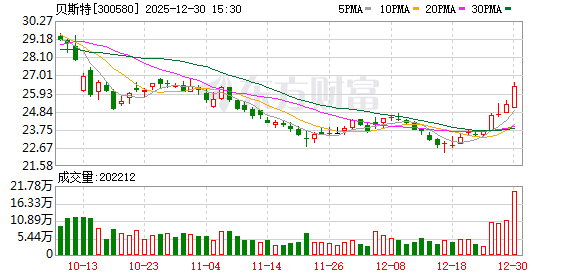
贝斯特:公司全资子公司宇华精机已全面布局直线运动部件领域
Zheng Quan Ri Bao· 2025-12-30 12:43
Core Viewpoint - Best has fully laid out its subsidiary Yuhua Precision Machinery in the linear motion components sector, targeting high-end equipment, automation, humanoid robotics, and intelligent connected vehicles industries [2] Group 1: Business Development - The company’s product offerings include high-precision ball screw assemblies, high-precision linear guide assemblies, planetary roller screw assemblies, micro screws, and linear actuators [2] - The company is actively expanding its market presence in the mid-to-high-end equipment industry and automation sector [2] Group 2: Information Disclosure - The company stated that specific business cooperation details are confidential and will adhere to information disclosure management regulations when necessary [2]

“微”观行业之变|大场景 新应用 人形机器人产业2026年值得期待
Xin Hua She· 2025-12-29 05:21
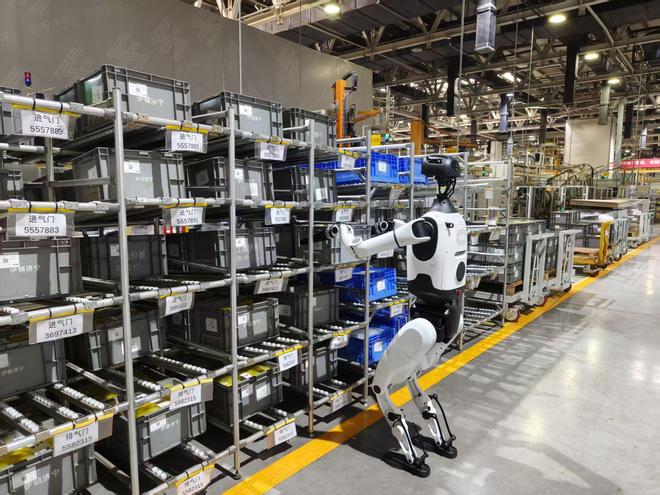
Core Insights - The humanoid robot industry in China is expected to transition from technology validation to large-scale commercialization by 2025, driven by systematic policies that encourage and regulate the sector, leading to key breakthroughs in self-research algorithms and hardware [1] - The industry is supported by a multi-dimensional policy framework that includes national strategies and local government measures, creating a solid foundation for development [2] Policy Framework - In 2025, the national strategy will focus on establishing entry and exit mechanisms for the embodied intelligence industry to prevent market saturation and ensure fair competition [2] - Local governments are implementing targeted policies to address industry pain points, such as financial incentives for data collection and support for community development [2][3] Technological Advancements - The focus of humanoid robot technology has shifted from showcasing capabilities to scalable applications, with cost and reliability being the top priorities for enterprises [4] - The Beijing Humanoid Robot Innovation Center has developed a comprehensive intelligent platform that integrates perception, decision-making, and execution, facilitating multi-robot collaboration [4] Capital Investment - Significant capital investment is flowing into the humanoid robot sector, with companies like Xingdong Jiyuan and Leju Robotics securing substantial funding, indicating strong market confidence [5][6] - The recognition from local state-owned assets, industrial capital, and financial institutions highlights the solid groundwork laid by these companies in technology and market application [6] Market Trends and Future Outlook - By 2026, the humanoid robot industry is anticipated to experience a wave of large-scale deliveries, particularly in industrial, logistics, and commercial service sectors [7] - The industry is moving towards replicable and scalable applications, with humanoid robots set to replace humans in repetitive tasks, enhancing efficiency and safety [7] - Companies are also looking to expand into emerging markets, adapting products to meet local needs and participating in international standard-setting to enhance their global presence [8]
光弘科技(300735.SZ):完全具备生产组装人形机器人的能力
Ge Long Hui· 2025-12-29 01:05
Group 1 - The company, Guanghong Technology, is a professional EMS (Electronic Manufacturing Services) provider and has the capability to produce and assemble humanoid robots [1] - The humanoid robot industry is still in its early development stage, indicating potential growth opportunities [1] - The company is closely monitoring market conditions and exploring business expansion opportunities in related fields based on customer demand [1]

新华财经|大场景 新应用 人形机器人产业2026年值得期待
Xin Hua She· 2025-12-26 10:11
Core Insights - The humanoid robot industry in China is expected to transition from technology validation to large-scale commercialization by 2025, driven by supportive and regulatory policies, significant breakthroughs in self-research, and a rich variety of application scenarios [1][2] Policy Framework - A multi-dimensional support system has been established for the humanoid robot industry, combining national strategic focus with local government measures to address industry challenges [2][3] - The National Development and Reform Commission announced plans to create a robust entry and exit mechanism for the embodied intelligence sector, aiming to prevent market saturation with redundant products and foster fair competition [2] Local Government Initiatives - Local policies, such as Beijing's "Ten Measures for Embodied Intelligent Robots," provide targeted support including training rewards, sales subsidies, and supply chain platforms [3] - Experts suggest that policies should further support foundational materials and core algorithms through stable long-term funding and the establishment of ethical and safety standards [3] Technological and Capital Advancements - The humanoid robot industry has made significant technological advancements, shifting focus from flashy demonstrations to scalable applications, with cost and reliability being top priorities [6][8] - Major funding rounds in 2025 saw companies like Xingdong Jiyuan and Leju Robotics raise approximately 1 billion and 1.5 billion respectively, indicating strong investor interest due to their comprehensive self-research capabilities and clear commercialization results [8] Market Trends and Future Outlook - The 2025 World Artificial Intelligence Conference highlighted the emergence of "blue-collar robots" in various sectors, indicating a clear path toward scalable applications in industrial, logistics, and commercial services [9][10] - Predictions for 2026 suggest a wave of large-scale deliveries in B-end scenarios, with a focus on logistics and manufacturing, as well as an emphasis on international market expansion [10]