
信用经济

Search documents
新华述评·聚焦中央经济工作会议|必须做到既“放得活”又“管得好”——学习领会“五个必须”做好明年经济工作
Xin Hua She· 2025-12-17 14:48
Group 1 - The core idea emphasizes the need for a balance between "letting go" and "managing well" in economic work, highlighting the importance of breaking down institutional barriers while ensuring a rule-based economy [1][10] - The "Five Musts" outlined by Xi Jinping provide a framework for addressing development challenges, stimulating internal dynamics, and mitigating risks [1][10] - The focus on creating a fair and competitive market environment is essential for promoting high-quality development, as indicated by the increase in the bidding success rate of private enterprises in Hunan from 73.65% to 82.9% [2] Group 2 - The establishment of a high-standard market system is crucial for maximizing resource allocation efficiency, as stated by experts [3] - Recent measures, such as the approval of the Administrative Law Enforcement Supervision Regulations, aim to clarify responsibilities and enhance market vitality through reduced administrative approvals [4] - The importance of market rules and a conducive environment for fair competition is emphasized, ensuring equal access to production factors for all business entities [5] Group 3 - The government's role is essential in regulating market order, with recent policies focusing on risk prevention and maintaining economic stability [12] - The ongoing reforms aim to enhance the efficiency of resource allocation and reduce institutional costs, as seen in various regional initiatives [16] - The need for continuous improvement in the relationship between an effective market and a proactive government is highlighted as a key focus for future reforms [15]
诚信力量汇聚台州 共绘信用经济新蓝图
Xin Hua She· 2025-12-14 00:27
Group 1 - The core theme of the forum is to promote the culture of integrity and the prosperity of the credit economy, highlighting the importance of credit in urban civilization and development [1] - The construction of the social credit system is entering a new stage focused on enhancing quality and efficiency, with six key dimensions identified for improvement, including data quality and credit service enhancement [2] - Experts emphasize the transformation from integrity culture to credit economy as a significant value change, requiring the integration of credit into resource allocation and the establishment of a stable credit economic foundation [2][3] Group 2 - Zhejiang's credit economy has undergone profound changes, with successful models like "Wentai Model" and "Yiwu Experience" demonstrating the effective relationship between government and enterprises [3] - Cities like Taizhou and Kaifeng are implementing innovative practices to integrate credit concepts into economic development, with Taizhou reporting a GDP growth of 6.3% and fixed asset investment growth of 3.9% in the first three quarters [4][5] - The forum resulted in significant outcomes, including the release of the "China Urban Integrity Construction Influence Report 2025" and the establishment of the "Taizhou Consensus" on credit construction [5]
洞见 | 申万宏源杨成长:建设统一信用市场 筑牢信用经济基石
申万宏源证券上海北京西路营业部· 2025-11-26 03:24
Core Viewpoint - The article emphasizes the importance of establishing a unified credit market as a foundation for a credit economy, highlighting the need for improved credit systems and infrastructure to enhance market efficiency and support economic development [6][10]. Group 1: Importance of Credit Market - The construction of a unified credit market is crucial for the efficient operation of the socialist market economy and the improvement of financial market functions [7][10]. - The "14th Five-Year Plan" suggests building a unified, open, competitive, and orderly market system, which underscores the growing significance of the credit market in economic reforms [6][10]. Group 2: Current Challenges in Credit Market - There are four main shortcomings in the current credit market: limited accessibility to credit services, low proportion of credit financing, inadequate credit infrastructure, and insufficient credit rating and pricing [11][12][14]. - Over 90% of small and micro enterprises have never received bank loans, indicating a significant gap in credit service availability [11]. - Credit loans account for less than 40% of total loans among major banks, with a slow development of the credit bond market, where corporate credit bonds only represent 18% of total bond issuance [12][14]. Group 3: Recommendations for Improvement - The article recommends enhancing the credit infrastructure by establishing a high-standard credit information platform to facilitate efficient data sharing and application [22][23]. - It suggests breaking down regional barriers to promote credit recognition and collaborative regulation across different areas [24]. - The need for a unified credit evaluation standard system is highlighted to ensure the marketization of credit value [25]. Group 4: Role of Enterprises and Intermediaries - Enterprises are encouraged to manage credit as a core asset, integrating credit management into their strategic operations [28][29]. - Intermediary institutions should enhance their credit assessment capabilities, transitioning from static evaluations to dynamic, real-time assessments [19][25]. - The establishment of a credit service and training support system is essential to help small and medium-sized enterprises improve their credit management skills [30].


坚持有效市场和有为政府相结合(学习贯彻党的二十届四中全会精神)
Ren Min Ri Bao· 2025-11-16 22:04
Core Viewpoint - The article emphasizes the importance of effectively combining a market-driven economy with proactive government intervention to enhance the socialist market economy in China, as outlined in the 15th Five-Year Plan [1][2]. Group 1: Significance of Combining Market and Government - The understanding of the relationship between government and market has deepened over 40 years of reform and opening up, with a focus on utilizing both the "invisible hand" of the market and the "visible hand" of the government [2][3]. - The 15th Five-Year period is crucial for achieving socialist modernization, making the combination of an effective market and a proactive government essential for maintaining stable economic and social development [2][3]. Group 2: Economic System Reform - Deepening economic system reform is a key requirement for leveraging the advantages of the socialist market economy, necessitating a clearer delineation of government and market roles to enhance productivity and social vitality [3][4]. - The need for market-oriented reforms is highlighted, addressing existing barriers to competition and government inefficiencies [3][4]. Group 3: High-Quality Development - High-quality development is the primary task during the 15th Five-Year period, requiring a comprehensive implementation of new development concepts to ensure effective qualitative and quantitative economic growth [4][5]. - The synergy between market forces and government actions is crucial for achieving high-quality development, with the market driving innovation and the government ensuring a healthy operational environment [4][5]. Group 4: Domestic Circulation and External Challenges - Strengthening domestic circulation is essential to counterbalance external uncertainties, with a focus on maximizing the roles of both government and market in resource allocation [5][6]. - The article emphasizes the importance of leveraging China's large population and economic scale to enhance domestic demand and resource utilization [5][6]. Group 5: Market System Construction - The establishment of a unified, open, competitive, and orderly market system is necessary for optimizing resource allocation and enhancing market vitality [6][7]. - The article outlines the need for a nationwide unified market that promotes fair competition and reduces barriers to entry [7][8]. Group 6: Fair Competition and Legal Framework - Ensuring fair competition is fundamental to market economics, with ongoing efforts to strengthen competition policies and eliminate monopolistic practices [8][9]. - The construction of a legal and credit-based economy is essential for guiding economic activities and enhancing the credibility of market participants [9][10]. Group 7: Government Regulation and Service Improvement - Effective government regulation is necessary to correct market failures and ensure compliance with competition standards [10][11]. - Improving government services is vital for fostering a conducive business environment, with a focus on efficiency and responsiveness to the needs of enterprises and citizens [11][12].
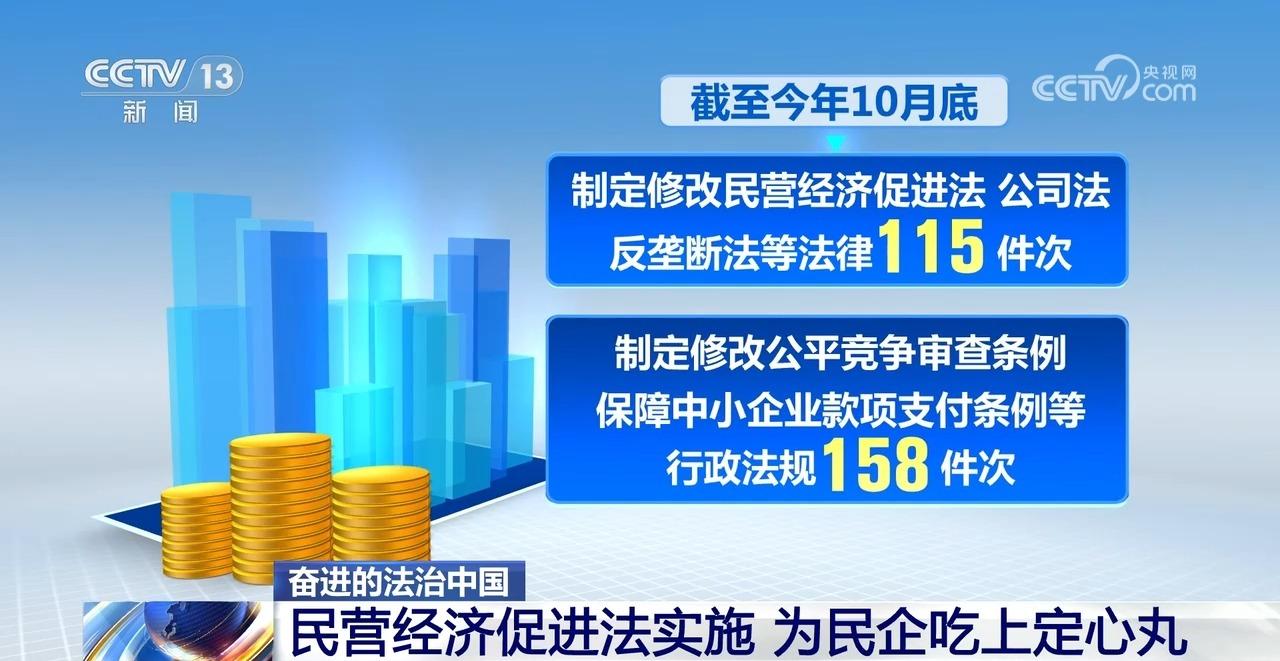
奋进的法治中国|民营经济促进法为民企吃上定心丸
Yang Shi Wang· 2025-11-12 23:35
Core Viewpoint - The construction of a rule of law-based business environment is crucial for attracting talent and capital, which is beneficial for development. Recent legal reforms have provided reassurance to private entrepreneurs [1][3]. Group 1: Legal Reforms - Over the past five years, China has made significant progress in establishing a rule of law-based business environment through scientific, democratic, and lawful legislation, with 115 laws related to private economy, company law, and anti-monopoly law being enacted or amended [3]. - Additionally, 158 administrative regulations, including those on fair competition review and payment guarantees for small and medium enterprises, have been established or amended [3]. - A comprehensive review of over 600 existing administrative regulations has been conducted to eliminate unequal policies and laws affecting enterprises, supporting the creation of a unified market and promoting high-quality development [3]. Group 2: Government Services - The previous challenges of bureaucratic inefficiency have been addressed, with new experiences such as "one-stop service" and "data-driven processes" becoming part of daily operations [5]. Group 3: Market Environment - The combination of an effective market and proactive government has led to the establishment of a legal economy and credit economy, resulting in a continuously optimized business environment. China is now recognized as one of the countries with the fastest and most significant improvements in the business environment among major global economies [7].
我国首项信用服务行业分类与编码国标实施
Zhong Guo Zhi Liang Xin Wen Wang· 2025-07-10 08:59
Core Points - The implementation of the national standard "Classification and Coding of Credit Service Institutions" (GB/T 45805—2025) marks a significant step towards the standardization and normalization of the credit service industry in China [1][2][3] - The standard establishes a three-level classification system consisting of 5 major categories, 11 subcategories, and 32 detailed categories, addressing long-standing issues of vague definitions and lack of classification standards in the industry [1][2] Group 1 - The standard provides crucial support for Shenzhen to build a national credit service industry cluster, particularly in the Qianhai area, enhancing the region's role as a hub for credit services [1][2] - It lays the groundwork for a pilot program in Qianhai to standardize the operational scope of credit service institutions, which will improve registration convenience and industry recognition [2] - The unified classification and coding system will facilitate the integration of credit service standards across the Guangdong-Hong Kong-Macau Greater Bay Area, enhancing the international competitiveness of China's credit economy [2][3] Group 2 - The release of the standard is expected to drive high-quality development in Shenzhen's credit service industry, positioning the city as a leader in the establishment of a credit economy experimental zone [3] - The standard will serve as a core engine for the development of the credit service industry in Shenzhen, contributing valuable "Shenzhen experience" to the national credit system construction [3]
前海打造信用服务产业集聚区 全国首个信用服务行业国家标准在深发布,助力构建“信用大湾区”
Shen Zhen Shang Bao· 2025-07-03 16:50
Core Points - The release of the national standard "Classification and Coding Specification for Credit Control Service Institutions" (GB/T 45805-2025) marks a significant step towards the standardization and normalization of the credit service industry in China [1][2] - The standard establishes a three-level classification system consisting of 5 major categories, 11 subcategories, and 32 detailed categories, addressing long-standing issues of vague definitions and lack of classification standards in the industry [1][2] Industry Impact - The implementation of the standard is expected to have profound strategic value and direct promotional effects on the development of Shenzhen's credit economy, facilitating the establishment of a credit service industry cluster in the Qianhai area [2] - The standardized classification and coding system will enhance the registration convenience and industry identification for credit control service institutions in Qianhai, promoting the integration of credit data services, integrity evaluation services, and credit consulting services [2] - The standard supports the creation of a "Credit Greater Bay Area" and enhances China's international competitiveness in the credit economy by fostering collaboration among the Guangdong-Hong Kong-Macau region [2]
场景重构 信用增值 数字赋能 江西新余塑造文旅消费新动能
Jing Ji Ri Bao· 2025-06-09 21:44
Group 1 - The core viewpoint is that Xinyu City in Jiangxi Province is successfully implementing dual pilot projects for cultural and tourism consumption, leveraging its industrial heritage to stimulate economic growth [1][2] - Since 2020, Xinyu City has invested 2.558 billion yuan in 26 key cultural and tourism projects, creating new attractions monthly and seasonal highlights [1] - The city is transforming industrial sites into consumer spaces, enhancing consumer trust through a credit-based system, and utilizing digital tools for targeted marketing [1] Group 2 - Xinyu City has established a dual-driven mechanism of "policy toolbox + digital platform," issuing 10.37 million yuan in consumption vouchers, which has stimulated over 120 million yuan in consumption [2] - The city aims to enhance its tourism consumption contribution to economic growth by introducing high-quality development policies and focusing on new business models like immersive performances and low-altitude flight experiences [2]
3A认证政策与融资贷款?
Sou Hu Cai Jing· 2025-05-30 06:39
Group 1 - The core viewpoint is that 3A certification has become a crucial asset for companies in the credit economy, serving as a "golden key" to unlock financing and loan opportunities [1] - Policies from government departments like the National Development and Reform Commission and the Ministry of Finance have integrated 3A certification into the financing evaluation system, prioritizing low-interest loans for high-credit enterprises [4] - Local governments offer subsidies covering up to 80% of certification costs for certified companies, promoting a "credit for capital" model that encourages businesses to build credit assets [4] Group 2 - The offline certification process involves selecting a third-party credit institution or provincial credit association, requiring submission of financial statements and other documents, with a typical review period of 7 to 15 working days [5] - A case example shows a manufacturing company obtaining a low-interest loan of 50 million yuan after offline certification, with a rate 15% lower than the market benchmark [5] - The online certification process simplifies procedures, allowing companies to receive electronic certificates within 3 working days, reducing costs by approximately 40% compared to offline methods [8] Group 3 - Online certification is particularly beneficial for small and micro enterprises facing urgent financing needs, as demonstrated by an e-commerce company that secured supply chain financing within 48 hours after online certification [9] - Companies are encouraged to establish a dynamic management mechanism for "certification financing upgrades," maintaining their credit rating through annual public disclosures [9] - The evolution of 3A certification from an "add-on" to a financing necessity highlights the complementary nature of online and offline channels, enabling diverse financing options for companies of varying sizes [9]

社会信用体系顶层设计出台 国家发改委:发展壮大信用经济
Zhong Guo Jing Ying Bao· 2025-04-02 22:11
Core Viewpoint - The recent issuance of the "Opinions on Improving the Social Credit System" by the Central Committee of the Communist Party of China and the State Council aims to strengthen the social credit system, which is essential for a market economy, to support the establishment of a unified national market and promote high-quality development [1] Group 1: Credit Information Collection and Sharing - The "Opinions" emphasize the establishment of comprehensive and accurate credit records, enhancing the collection and sharing of credit information, and promoting deep integration of the national credit information sharing platform with industry credit information systems [2][3] - The National Development and Reform Commission has connected the national credit information sharing platform with 46 departments and 31 provinces, creating a nationwide interconnected credit information network [2] - Future efforts will focus on improving the quality of credit information collection and sharing, addressing issues such as inconsistent data standards and incomplete fields [2][3] Group 2: Support for Small and Micro Enterprises - The "Opinions" aim to enhance financing convenience for small and micro enterprises by improving the sharing of credit information held by government departments, thereby addressing information asymmetry [8][9] - As of February 2025, banks have issued loans totaling 37.3 trillion yuan through the integrated financing credit service platform, with 9.4 trillion yuan in credit loans, significantly supporting the financing needs of small and micro enterprises [9][10] - The financial regulatory authority plans to continue enhancing the financing convenience for trustworthy small and micro enterprises by optimizing loan structures and increasing support for first-time, renewal, and credit loans [9][10] Group 3: Credit Repair System - The "Opinions" propose a unified credit repair system to encourage entities to correct their credit behaviors, with timely removal from the list of dishonest entities upon successful repair [11][12] - The National Development and Reform Commission aims to standardize the credit repair process and improve coordination among departments to address existing challenges in credit repair [11][12] - Measures will be taken to ensure that credit repair services are provided free of charge and to prevent illegal activities in the credit repair sector [13] Group 4: Information Security and Privacy Protection - The National Development and Reform Commission emphasizes the importance of information security and privacy protection in the credit system, adhering to the principle of minimal and necessary data collection [13] - The commission will implement strict security standards for credit information sharing platforms and explore the use of blockchain technology to enhance data security and traceability [13]