全面风险管理

Search documents
国家金融监管总局:持续加大对非法贷款中介、非法代理维权等重点领域打击力度
Zheng Quan Ri Bao Wang· 2025-12-25 06:54
Core Viewpoint - The Ministry of Public Security and the National Financial Regulatory Administration have jointly launched a crackdown on illegal financial activities, focusing on "black and gray industries" in the financial sector, with significant results reported in a recent press conference [1][2]. Group 1: Crackdown Measures and Achievements - From June to November, a six-month operation was conducted across 17 key provinces and cities to combat illegal financial activities, with a focus on enhancing regulatory effectiveness and market order [2]. - The regulatory authorities have shifted from a fragmented approach to a coordinated effort, resulting in the transfer of over 4,500 leads to law enforcement, involving amounts exceeding 21 billion yuan [3]. - The crackdown has led to the identification and reporting of over 1,700 cases by financial institutions, with amounts exceeding 17 billion yuan, showcasing the effectiveness of the "regulatory + police" collaboration [3]. Group 2: Strategic Shifts in Enforcement - The approach has evolved from "passive response" to "proactive measures," with financial institutions being urged to manage partnerships more effectively and to issue public statements to guide public perception [5]. - The regulatory framework has been enhanced to include the establishment of evidence transfer standards for criminal activities, aiming to improve the efficiency of law enforcement collaboration [2][4]. - The focus has also shifted from "end-of-line disposal" to "source governance," with extensive educational campaigns and the publication of typical cases to raise awareness and improve compliance [6]. Group 3: Recommendations for Financial Institutions - Financial institutions are encouraged to adopt the "three iron" internal control management principles to strengthen risk management and compliance [7]. - There is a call for increased investment in technology, utilizing big data and artificial intelligence to enhance the identification of risks associated with "black and gray industries" [7]. - Institutions are advised to refine their operational philosophies, ensuring that core services are not outsourced and that they maintain direct control over customer acquisition channels [8].
阜宁农商银行应用违约概率模型 提升资产质量
Jiang Nan Shi Bao· 2025-12-15 23:23
Core Viewpoint - Focusing on comprehensive risk management, Funing Rural Commercial Bank is implementing a credit risk management model based on the default probability model from Jiangsu Rural Commercial Bank, which is integrated throughout the entire loan process to ensure the safety of credit funds [1] Group 1: Pre-loan Approval - The bank uses the default probability rating as a key basis for credit approval, specifying that E-class customers are not allowed to receive new or increased credit, while D-class customers require elevated approval [1] - The bank has reduced the proportion of E-class customers through exit and reduction strategies, with a reported exit rate of 11.5% for E-class customers this year [1] Group 2: Loan Management - During the loan management phase, the bank utilizes model data to identify high-risk institutions and customer managers, conducting "bottom-out" actions on 5 high-risk institutions [1] - The bank has restricted business permissions and promotion channels for 18 customer managers classified as level four and five high-risk, aiming to enhance their risk control capabilities through discussions and guidance [1] Group 3: Post-loan Management - The bank applies model data extensively in managing expired loans, segmenting existing loans, and identifying responsibilities for non-performing loans [1] - A differentiated collection strategy is implemented through the "1211" management mechanism, which categorizes responsibilities for customers who did not pass the model assessment and increases accountability for high-default customers [1] Group 4: Future Plans - The bank plans to continuously upgrade its risk measurement capabilities and optimize management mechanisms to steadily improve the quality of credit assets [2]
中国建设银行2025年第三季度经营收入5,602.81亿元,较上年同期增长1.44%
Zhong Guo Xin Wen Wang· 2025-10-30 12:11
Core Viewpoint - China Construction Bank (CCB) reported solid performance in Q3 2025, focusing on enhancing its capabilities to support the real economy and maintain financial stability, while exploring high-quality development paths [1] Financial Performance - Operating income reached 560.281 billion RMB, a year-on-year increase of 1.44% [2] - Pre-provision profit was 411.36 billion RMB, up 1.03% year-on-year [2] - Net profit amounted to 258.446 billion RMB, reflecting a 0.52% increase compared to the previous year [2] - Net profit attributable to shareholders was 257.36 billion RMB, with a growth of 0.62%, marking an acceleration in growth over two consecutive quarters [2] - Non-interest income from fees and commissions rose to 89.668 billion RMB, a 5.31% increase year-on-year [2] - Total assets reached 45.37 trillion RMB, growing 11.83% from the end of the previous year [2] - Total loans and advances stood at 27.68 trillion RMB, up 7.10% from the end of last year [2] - Total liabilities increased to 41.71 trillion RMB, a 12.05% rise from the end of the previous year [2] - Non-performing loan ratio improved to 1.32%, down 0.02 percentage points from the end of last year [2] Business Development - CCB is actively supporting the real economy, with loans to the manufacturing sector exceeding 3.5 trillion RMB [3] - Loans to private enterprises surpassed 6.7 trillion RMB, demonstrating strong support for the private sector [3] - Green loan balance reached 5.89 trillion RMB, reflecting an 18.38% increase since the beginning of the year [3] - The bank issued over 500 billion RMB in green bonds and participated in underwriting 98 domestic green and sustainable development bonds, totaling 292.878 billion RMB [3] - Inclusive finance services improved significantly, with loans to small and micro enterprises reaching 3.81 trillion RMB, an increase of 397.69 billion RMB [3] Risk Management - CCB is enhancing its risk management framework, focusing on integrated risk control across its subsidiaries and institutions [4] - The bank aims to improve its risk monitoring and early warning systems through the development of an intelligent risk control system [4] - Future plans include aligning with the goals set forth in the 20th National Congress of the Communist Party of China, focusing on financial development in line with national modernization efforts [4]

东兴基金:加强合规风控建设,夯实高质量发展根基
Xin Lang Ji Jin· 2025-10-14 03:05
Group 1: Industry Overview - The "Beijing Public Fund High-Quality Development Series Activities" aims to enhance investor education and protection, promote the transformation and upgrading of the public fund industry, and improve its ability to serve the real economy [1] - The China Securities Regulatory Commission (CSRC) has introduced a series of regulations emphasizing the importance of compliance and risk management within fund companies, aiming to strengthen internal management and accountability [1] Group 2: Company Initiatives - Dongxing Fund recognizes the critical role of compliance and risk control, maintaining a "steady progress" approach while focusing on optimizing systems and enhancing capabilities in governance and internal control [2] - The company has established a comprehensive risk management framework that includes a board of directors, risk control committee, and various management levels to ensure effective compliance and risk management [2][3] - Since 2025, Dongxing Fund has intensified its compliance and risk control efforts in line with the CSRC's action plan, enhancing risk monitoring and analysis for key products amid increased market volatility [2] Group 3: Risk Management Strategy - Dongxing Fund has developed a holistic risk management system that integrates risk management into strategic planning, product design, investment operations, and customer service [3] - The company aims for high-quality development through effective risk control, viewing comprehensive risk management as both a safety net and a catalyst for seizing opportunities in areas like technology finance and green finance [3] - By embedding risk management throughout its operations, Dongxing Fund seeks to balance risk prevention with development, positioning itself as a protector of wealth and a stabilizing force in the capital market [3]
国资入主后 德邦证券又有大动作
Shang Hai Zheng Quan Bao· 2025-09-26 15:10
Core Insights - The recent appointments of senior executives at Debon Securities, including Wei Feng as Senior Vice President and Gao Li as Chief Risk Officer, reflect the company's commitment to enhancing its talent pool and management team following the restructuring of its board [1][2][3] Group 1: Executive Appointments - Wei Feng, a prominent figure in wealth management with over 20 years of experience, will oversee the company's wealth management business, aiming to drive professionalization and digitalization in this area [2][3] - Gao Li's appointment as Chief Risk Officer is expected to strengthen the company's risk management capabilities, establishing a more effective risk management system [2][3] Group 2: Business Development - Debon Securities is positioned as a national, comprehensive securities company under the Shandong Financial Group, focusing on expanding its business footprint from Shandong to nationwide [4][6] - The company has seen significant growth in its bond underwriting projects, with 100 projects completed by September 15, marking a nearly 100% increase year-on-year, placing it in the top 30 in the industry [4] Group 3: Wealth Management Strategy - The company is actively enhancing its wealth management services, with a focus on deepening client advisory services and improving institutional brokerage, leading to notable increases in trading volumes and revenues [4][5] - The assets under management (AUM) for non-monetary public funds have increased by nearly 20% year-on-year, indicating a successful transition in wealth management [5] Group 4: Corporate Governance - The recent board restructuring, which included the appointment of new directors from Shandong Financial Group, marks a significant step in the company's transition to state control, while maintaining operational independence [6][7] - The new governance structure aims to align with national regulations while leveraging market mechanisms to enhance the company's financial services [6][7]
中信集团党委通报中央巡视整改进展情况
Bei Jing Ri Bao Ke Hu Duan· 2025-09-22 11:37
Group 1 - The core viewpoint of the article is the progress report on the rectification of issues identified during the third round of inspections by the Central Committee of the Communist Party of China at CITIC Group, emphasizing the importance of political responsibility and systematic rectification measures [1][2][6]. Group 2 - The Group's Party Committee has established a rectification leadership team and office, with the Party Secretary as the leader, to ensure the implementation of rectification measures [2][3]. - The Group has conducted multiple meetings to study and understand the feedback from the Central Inspection Team and has organized special training to enhance rectification capabilities [2][4]. - The rectification process includes a comprehensive analysis of common issues identified in previous inspections, ensuring a systematic approach to problem-solving [4][5]. Group 3 - The Group is committed to implementing major decisions from the Central Committee, focusing on enhancing the political and people-oriented nature of financial work [7][8]. - The Group has initiated the "Strong Core" project to provide high-quality financial support to the real economy and has improved its international business strategy [8][9]. Group 4 - The Group has strengthened its risk management framework, including the establishment of a risk management committee and the implementation of a comprehensive risk governance mechanism [9][10]. - There is a focus on enhancing the risk control capabilities of subsidiaries and improving compliance with regulatory requirements [10][11]. Group 5 - The Group is actively pursuing reforms to strengthen its core business and improve its governance structure, aiming to create a world-class financial holding group [11][12]. - The Group is committed to deepening its financial services to support the real economy, with specific initiatives in technology finance and green finance [13][14]. Group 6 - The Group has established a robust mechanism for accountability and supervision to ensure the effective implementation of rectification measures and to prevent corruption [15][16]. - There is an ongoing effort to address issues related to formalism and bureaucratism within the organization, aiming to streamline processes and enhance efficiency [16][17]. Group 7 - The Group plans to continue its long-term rectification efforts, ensuring that all measures are effectively implemented and monitored [22][23]. - The Group aims to integrate the outcomes of the rectification process into its broader strategic initiatives, enhancing its overall operational effectiveness [23].

徽商银行资产总额突破2.25万亿元,服务实体经济质效双升
Zhong Guo Jin Rong Xin Xi Wang· 2025-09-19 03:46
Core Viewpoint - Huishang Bank demonstrates strong performance in supporting local economic development while achieving steady growth in scale and optimizing its business structure [1][2]. Group 1: Financial Performance - As of June 2025, Huishang Bank's total assets exceeded 2.25 trillion yuan, an increase of 11.82% from the end of the previous year [1]. - Total deposits reached 1.252 trillion yuan, growing by 9.92% year-on-year [1]. - Total loans amounted to 1.100 trillion yuan, reflecting a 9.82% increase compared to the previous year [1]. - The bank reported operating income of 21.157 billion yuan, up 2.25% year-on-year, and net profit of 9.328 billion yuan, a 3.81% increase from the same period last year [1]. Group 2: Business Structure Optimization - Huishang Bank has actively promoted business structure optimization, with significant performance in investment banking and transaction banking [2]. - The bank completed 98 debt financing tool issuances totaling 79.342 billion yuan, with an underwriting scale of 29.420 billion yuan [2]. - Supply chain finance in transaction banking increased by 64.53% year-on-year, and asset management scale surpassed 1.2 trillion yuan, growing by 7.4% [2]. Group 3: Financial Inclusion and Technological Innovation - The bank focuses on technology finance, green finance, and inclusive finance, with technology loans reaching 201.794 billion yuan, a 19.57% increase from the previous year [3]. - Inclusive loans for small and micro enterprises totaled 168.028 billion yuan, reflecting continuous growth [3]. - Green credit balance reached 144.468 billion yuan, increasing by 35.63% year-on-year [3]. Group 4: Asset Quality and Risk Management - Huishang Bank maintains a stable asset quality, with a non-performing loan ratio of 0.98%, down by 0.16 percentage points year-on-year [4]. - The non-performing loan provision coverage ratio improved to 289.94%, an increase of 17.43 percentage points from the previous year [4]. - The bank has enhanced its digital risk management capabilities through the integration of big data and artificial intelligence [4]. Group 5: Future Outlook - Huishang Bank aims to continue its high-quality development journey, focusing on digital transformation and deepening financial reform to better serve the real economy [5].
王欣正式获批出任平安信托董事长
2 1 Shi Ji Jing Ji Bao Dao· 2025-09-17 11:04
Group 1 - Wang Xin has been appointed as the Chairman of Ping An Trust, succeeding Fang Weihua, who has been reassigned [1][2] - Wang Xin has 29 years of experience in the banking and insurance asset management industries, with a strong background in risk management and market operations [1][2] - During his tenure at Ping An Bank, Wang Xin pioneered the "Merchant Bank" model in supply chain finance, enhancing credit asset quality [1][2] Group 2 - Wang Xin joined Ping An Asset Management in July 2020, focusing on comprehensive risk management and capital market strategies [2] - His leadership is expected to drive strategic transformation and enhance internal ecosystem capabilities at Ping An Trust [2] - Fang Weihua, the former chairman, has transitioned to a vice president role at Ping An Bank [2][3]
在不确定中构建确定:中信银行的稳健均衡与可持续之道
Di Yi Cai Jing Zi Xun· 2025-09-17 01:12
Core Viewpoint - The article emphasizes the need for banks, particularly CITIC Bank, to fundamentally reconstruct their value creation model in response to structural challenges in the banking industry, such as interest rate marketization and financial disintermediation [1][2][3]. Group 1: Financial Performance - CITIC Bank's 2025 mid-term report shows a steady profit growth, with a 2.8% increase in net profit attributable to shareholders in the first half of 2025, indicating resilience in a challenging environment [9]. - The bank's total assets grew by 8.28% year-on-year, and its net interest margin (NIM) of 1.63% ranks among the top in the industry, reflecting effective management of interest income and costs [5][13]. Group 2: Quality of Growth - The bank focuses on high-quality growth, which is not merely about improving financial metrics but involves a multi-dimensional evolution in structure, efficiency, risk, and innovation [4][5]. - CITIC Bank is transitioning from a scale-dependent model to one driven by capabilities, as evidenced by faster growth in off-balance sheet financing and wealth management compared to traditional lending [6][7]. Group 3: Systematic Approach - The bank's management prioritizes system construction and capability enhancement over short-term results, believing that a robust system is essential for sustainable growth [10][11]. - CITIC Bank's strategy includes a clear path for system advancement, focusing on core capabilities and integrated multi-dimensional capabilities to create a unique financial ecosystem [10]. Group 4: Structural Optimization - The bank emphasizes structural optimization across various dimensions, including business, asset, liability, and customer structures, to ensure balanced and resilient growth [12]. - CITIC Bank's approach to asset quality involves increasing credit support for high-quality assets while reducing the proportion of low-efficiency assets, aligning with national strategic goals [12]. Group 5: Risk Management - The bank has adopted a proactive risk management strategy, integrating risk considerations into all business processes rather than relying solely on traditional tightening measures [14][15]. - Key risk indicators, such as non-performing loan ratios and provisioning coverage, remain stable, with a focus on enhancing the value of problem assets through effective management [15]. Group 6: Competitive Advantage - The competitive advantage for CITIC Bank lies in its adaptive capabilities and deep systemic strength rather than mere speed or scale, positioning it for sustainable development in a complex environment [16].

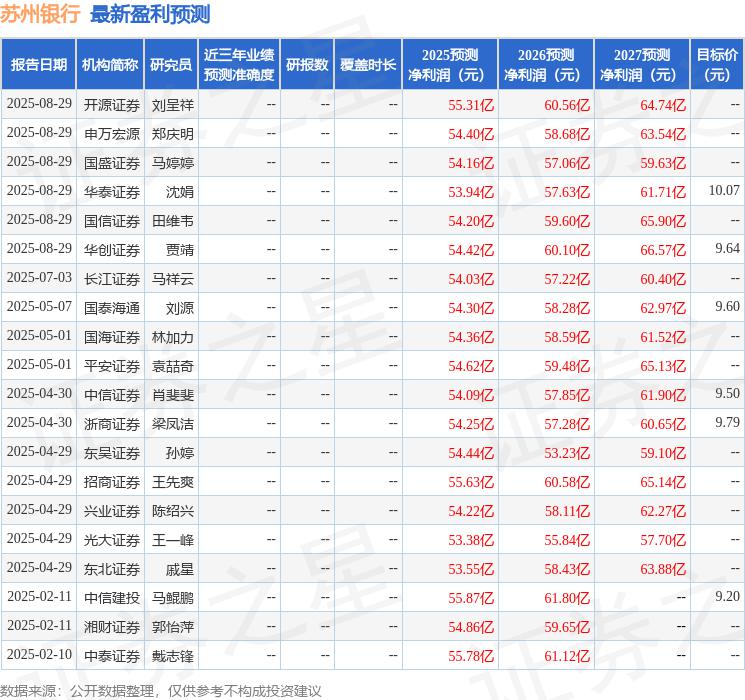
东吴证券:给予苏州银行买入评级
Zheng Quan Zhi Xing· 2025-08-30 09:20
Core Viewpoint - Suzhou Bank maintains resilient profitability and excellent asset quality, with a "buy" rating from Dongwu Securities based on its mid-2025 performance report [1][4]. Financial Performance - For H1 2025, Suzhou Bank reported operating income of 6.5 billion yuan, a year-on-year increase of 1.8%, with Q2 showing a 2.9% increase [2]. - The net profit attributable to shareholders was 3.13 billion yuan, up 6.2% year-on-year, with Q2 net profit increasing by 5.5% [2]. - As of the end of H1 2025, the net assets attributable to shareholders reached 58.6 billion yuan, reflecting a 10.7% increase from the beginning of the year [2]. - The weighted ROE for H1 2025 was 6.2%, a decrease of 0.5 percentage points year-on-year [2]. Revenue and Cost Management - Net interest income for H1 2025 increased by 2.7%, with Q2 showing a 6.2% increase, attributed to loan growth and declining deposit rates [2][3]. - Non-interest income remained flat year-on-year, with Q2 showing a 3% decline, primarily due to the decrease in fair value of trading financial assets [2]. - Operating expenses decreased by 3.7% year-on-year, indicating effective cost control [2]. Loan and Deposit Trends - The loan balance increased by 9% year-on-year, with loans accounting for 48.1% of total assets, a decrease of 1.8 percentage points [3]. - The proportion of corporate loans rose to 75.4%, with significant investments in manufacturing and leasing services [3]. - Total deposits reached 463.7 billion yuan, a year-on-year increase of 11% [3]. Asset Quality - The non-performing loan (NPL) ratio remained stable at 0.83%, with a slight increase in the NPL generation rate [3]. - The provision coverage ratio decreased by 9 percentage points to 438%, still leading the industry [3]. - The core Tier 1 capital adequacy ratio was 9.87%, and the total capital adequacy ratio was 14.57%, both significantly above regulatory requirements [3]. Profit Forecast and Investment Rating - The forecast for net profit attributable to shareholders for 2025-2027 is 5.44 billion, 5.32 billion, and 5.91 billion yuan, respectively [4]. - The current market capitalization corresponds to a 2025E PB of 0.70x, indicating a low valuation [4]. - The company is expected to enhance its capabilities across five areas, including integrated financial services and risk management [4].