养老金投资

Search documents
发挥保险资金长期投资优势!华泰资产荣获三项保险业投资金牛奖
Zhong Guo Zheng Quan Bao· 2025-10-09 08:31
Core Insights - The "Golden Bull Insurance Investment Award" was announced at the "Long Money, Long Investment, Long Green" conference, highlighting outstanding insurance institutions and asset management products in the industry [1] - Huatai Asset Management has won the "Golden Bull Insurance Asset Management Company Award" and multiple product awards, showcasing its consistent performance over five years [1] Industry Overview - The insurance asset management industry is increasingly significant, with 35 companies operating in China and a growing overall management scale [2] - Huatai Asset, established in 2005, has evolved from a single insurance fund management entity to a comprehensive asset management platform, managing assets worth 946 billion yuan as of June 30, 2025 [2] Competitive Strategy - Huatai Asset leads the industry in expanding third-party business, with over 90% of its managed assets coming from third-party entrusted funds, marking it as one of the top companies in this regard [3] - The company focuses on long-term fund management and quality asset provision, emphasizing professional talent and team building to enhance its core competitiveness [4] Investment and Banking Services - Huatai Asset has a dual focus on investment and banking services, aiming to provide stable long-term returns through various business areas, including entrusted investments and pension fund management [4] - The company has been a pioneer in the non-standard debt market since 2007, consistently ranking high in registered scale for asset securitization products [5] Pension Investment Strategy - As a long-term institutional investor, Huatai Asset has developed a strong advantage in pension fund management, offering a wide range of products and strategies [7] - The company integrates ESG factors into its investment decisions, actively seeking opportunities in environmentally friendly sectors [7] Future Outlook - Huatai Asset plans to align with national strategic deployments, enhancing its core competencies and leveraging the long-term investment advantages of insurance funds to support the real economy and capital market development [8]
上海调整商业性个人住房贷款利率定价机制;老铺黄金年内再次调价 | 金融早参
Mei Ri Jing Ji Xin Wen· 2025-08-25 23:34
Group 1 - The People's Bank of China, the Financial Regulatory Administration, and the National Forestry and Grassland Administration jointly issued a notice to enhance financial support for the high-quality development of the forestry industry, indicating a significant policy support for the sector [1] - The notice emphasizes the innovation of forest rights mortgage loan products and services, aiming to broaden the scope of mortgaged forest rights and extend loan terms legally and compliantly [1] - The policy encourages the establishment of forest rights storage institutions in suitable regions and promotes social capital to engage in forest rights storage guarantee services, providing broader financing channels for forestry enterprises and investors [1] Group 2 - Shanghai's recent adjustment of the pricing mechanism for commercial personal housing loans aims to alleviate residents' mortgage interest burdens by no longer differentiating between first and second home loans [2] - The adjustment reflects a trend towards market-oriented interest rates, emphasizing that loan rates will be determined based on the financial institution's operating conditions and customer risk profiles [2] - This change is expected to further standardize market competition and stabilize the real estate market in Shanghai [2] Group 3 - The former Vice President of Agricultural Bank of China, Lou Wenlong, was sentenced to life imprisonment for bribery, highlighting ongoing issues of corruption within the banking sector [3] Group 4 - As of August 25, pension funds were reported to be among the top ten circulating shareholders in 75 stocks, holding a total of 679 million shares valued at approximately 14.592 billion yuan [4] - The presence of pension funds in the top shareholders indicates their active positioning in the capital market, serving as a barometer for market trends and valuations [4] Group 5 - The price adjustment of Lao Pu Gold products, with an increase of approximately 10% to 12%, reflects the rising trend of gold prices amid global economic uncertainties and inflationary pressures [5] - The price changes are influenced not only by supply and demand but also by international political and economic conditions, which may affect consumer investment and purchasing decisions [5]
养老金二季度现身3只科创板股
Zheng Quan Shi Bao Wang· 2025-08-18 01:39
Core Insights - Pension funds have emerged as significant shareholders in several companies, indicating a growing interest in these stocks by institutional investors [1] Group 1: Company Holdings - Shengyi Electronics is now the 10th largest circulating shareholder of the pension fund, holding 5.33 million shares, which accounts for 0.64% of the circulating shares [1] - Rongzhi Rixin is the 4th largest circulating shareholder of the pension fund, with 3.5 million shares, representing 4.04% of the circulating shares [1] - Kaili New Materials is also the 4th largest circulating shareholder of the pension fund, holding 1.9967 million shares, which is 1.53% of the circulating shares [1] Group 2: Pension Fund Stock Data - Shengyi Electronics (688183) has a pension fund holding of 5.33 million shares, newly entered, with a market value of approximately 27.31 million yuan [1] - Rongzhi Rixin (688768) has a pension fund holding of 3.5 million shares, a decrease of 5.41% from the previous period, with a market value of about 15.54 million yuan [1] - Kaili New Materials (688269) maintains a pension fund holding of 1.9967 million shares, unchanged from the previous period, with a market value of around 6.63 million yuan [1]


GPFG2025半年报:股票收益良好,汇兑损失偏高
Ping An Securities· 2025-08-14 12:23
Core Insights - The report highlights that the Government Pension Fund Global (GPFG) achieved a return rate of 5.7% in the first half of 2025, slightly underperforming its benchmark by 0.05 percentage points [1][4] - The total asset size of GPFG decreased from 19.74 trillion Danish Krone at the end of 2024 to 19.59 trillion Danish Krone as of June 30, 2025, equivalent to approximately 1.94 trillion USD or 13.90 trillion RMB [1][2] Financial Performance - The Norwegian government injected approximately 158.3 billion Norwegian Krone into GPFG, marking the 15th consecutive quarter of fiscal contributions [2] - The investment income, before currency adjustments, was around 698 billion Norwegian Krone, while currency losses amounted to 1.01 trillion Norwegian Krone, primarily due to the appreciation of the Norwegian Krone against the US dollar [2][4] Asset Allocation - As of June 30, 2025, GPFG's asset allocation remained stable with a stock-to-bond ratio of 71.5% to 28.5%. The actual investment portfolio consisted of 70.6% in equities, 27.1% in fixed income, 1.9% in unlisted real estate, and 0.4% in unlisted renewable energy infrastructure [3][4] - The allocation to equities decreased by 0.8 percentage points compared to the end of 2024, while fixed income and unlisted infrastructure investments saw increases of 0.5 and 0.3 percentage points, respectively [3] Investment Returns - The report indicates that equities performed strongly with a return rate of 6.7% in the first half of 2025, with the financial, telecommunications, and utilities sectors showing the best performance, while healthcare lagged [4][5] - Fixed income investments yielded a return of 3.3%, supported by favorable conditions in the European market due to interest rate cuts by the European Central Bank and the appreciation of the Euro [4] - Non-listed renewable energy infrastructure had an impressive return of 9.4%, driven by currency effects and increased net income from electricity sales [4] Excess Returns - The underweight position in equities compared to the benchmark resulted in a negative excess return of -0.02 percentage points. Contributions to excess returns from various asset classes were 0.03 for equities, 0.06 for fixed income, -0.04 for unlisted real estate, and -0.08 for listed real estate [5]
养老金二季度现身12只个股!持股35.11亿元,新进7只标的显示积极布局
Sou Hu Cai Jing· 2025-08-12 03:34
Core Insights - Pension accounts have increasingly engaged in the secondary market, with a total of 0.89 billion shares held across 12 stocks, amounting to a market value of 3.511 billion yuan [1] Shareholding Structure and Investment Preferences - The shareholding distribution of pension accounts shows a clear structural characteristic, with Hongfa Co., Ltd. being the most heavily held stock, where two pension fund combinations hold a total of 28.2227 million shares [3] - Spring Power received the highest shareholding ratio from pension accounts, with a total of 7.9514 million shares held, representing 5.21% of the circulating shares [3] - Other notable stocks with significant pension holdings include Rongzhi Rixin and Guomai Culture, with holding ratios of 4.04% and 2.40%, respectively [3] Investment Strategy and Shareholding Changes - The pension accounts displayed an active strategy in the second quarter, with 7 new stocks added and 3 stocks increased, indicating a keen ability to capture new investment opportunities [4] - Seven stocks had a market value exceeding 100 million yuan at the end of the period, including Spring Power, Hongfa Co., Ltd., and Satellite Chemical [4] - Changlan Technology has been held the longest by pension accounts, appearing in the top ten shareholders for 14 consecutive reporting periods, maintaining a holding of 1.5841 million shares [4]



养老金二季度持股13.44亿元!新进3只个股,宏发股份获加仓64.93%
Sou Hu Cai Jing· 2025-08-11 09:05
Core Insights - Pension accounts have shown a significant investment presence in the capital market during the second quarter, appearing in the top ten shareholders of six stocks with a total holding of 51 million shares valued at 1.344 billion yuan [1][3]. Pension Holdings Distribution and Scale Characteristics - The holding structure of pension accounts at the end of the second quarter displayed a clear concentration, with Hongfa Co., Ltd. being the most held stock, where two pension fund combinations held a total of 28.22 million shares, accounting for 1.93% of the circulating shares [3]. - Other notable stocks favored by pension accounts include Jerry Holdings, Dongmu Co., Ltd., Hisense Home Appliances, Rongzhi Rixin, and Guomai Culture, with holdings of 6.27 million shares, 4.60 million shares, 3.50 million shares, and 1.93 million shares respectively [3]. - Five stocks held by pension accounts had a market value exceeding 100 million yuan, indicating a preference for sectors related to the real economy, such as power equipment, machinery, and home appliances [3]. Investment Strategy Adjustments and Changes in Holdings - Pension accounts demonstrated an active strategy of adjusting holdings in the second quarter, with three new entries and two increased holdings among the six stocks [4]. - New entries included Jerry Holdings, Hisense Home Appliances, and Guomai Culture, reflecting a positive outlook on these companies' growth prospects [4]. - Increased holdings were noted in Hongfa Co., Ltd. and Dongmu Co., Ltd., with share quantities growing by 64.93% and 43.23% respectively, indicating confidence in their long-term value [4]. - Rongzhi Rixin, the longest-held stock by pension accounts, maintained a holding of 3.50 million shares despite a 5.41% decrease from the previous quarter, representing the highest holding ratio at 4.04% of circulating shares [4]. - The distribution of the six stocks held by pension accounts included four from the main board and one each from the Sci-Tech Innovation Board and the Growth Enterprise Market, showcasing a balanced approach between stability and growth potential [4].




低利率时代海外养老金投资策略专题:低利率下美国养老金如何投资?
Hua Yuan Zheng Quan· 2025-07-24 09:55
Core Insights - The report discusses the investment strategies of U.S. pensions during low interest rate periods, highlighting the significant shifts in asset allocation in response to economic shocks and changing market conditions [2][5][9] - It emphasizes the importance of diversifying investments into alternative assets such as private equity, real estate, and infrastructure to enhance returns and mitigate risks in a low yield environment [2][78] Group 1: Low Interest Rate Environment - The U.S. has experienced two notable low interest rate periods: from January 2009 to December 2015 and from March 2020 to March 2022, characterized by federal funds rates below 0.3% and 0.2% respectively [5][9] - During these periods, the U.S. pension system, particularly the second pillar, saw significant changes in asset allocation, with a notable increase in bond and mixed fund investments [2][9] Group 2: U.S. Pension Structure - As of Q1 2025, the total scale of the U.S. pension system reached $44.1 trillion, with the second pillar (employer-sponsored plans) being the largest component at $24.2 trillion [9][12] - The second pillar consists of Defined Benefit (DB) plans and Defined Contribution (DC) plans, with the latter growing in prominence over the past three decades [12][18] Group 3: DC Plan Investment Characteristics - DC plans have maintained a core allocation to equity funds, with significant increases in mixed and bond fund allocations during economic downturns [21][23] - The report notes that during the early stages of economic shocks, DC plans rapidly increased their bond fund allocations, reflecting a shift towards safer assets [23][24] Group 4: DB Plan Investment Characteristics - The New York State Common Retirement Fund and Texas Teacher Retirement System are highlighted as examples of DB plans that have adjusted their asset allocations in response to low interest rates [43][66] - The New York fund has maintained a stable allocation to fixed income while increasing exposure to alternative investments, whereas the Texas fund has significantly increased its allocation to private equity and real estate [44][70] Group 5: Investment Implications - The report concludes that in low interest rate environments, U.S. pensions should focus on increasing allocations to fixed income and alternative investments to enhance portfolio resilience and returns [78]
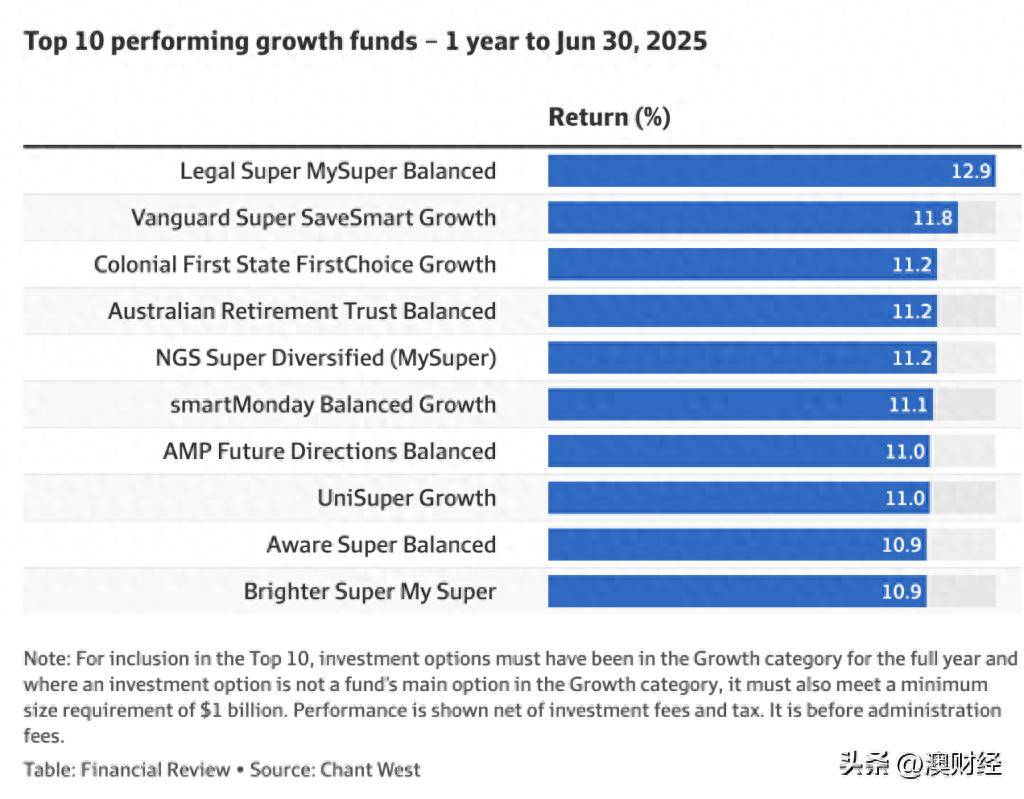
澳洲年度十大增长型养老金基金揭晓
Sou Hu Cai Jing· 2025-07-20 01:46
Core Insights - Legal Super has emerged as the best-performing growth superannuation option for the past financial year, achieving a 12.9% annual return [1] - Following closely is Vanguard with an 11.8% return, while Colonial First State and Australian Retirement Trust both recorded 11.2% [1] - The annual ranking was published by research firm Chant West, which defines "growth options" as superannuation products with 61% to 80% allocated to growth assets [1] Performance Summary - Legal Super MySuper Balanced: 12.9% [2] - Vanguard Super SaveSmart Growth: 11.8% [2] - Colonial First State FirstChoice Growth: 11.2% [2] - Australian Retirement Trust Balanced: 11.2% [2] - NGS Super Diversified (MySuper): 11.2% [2] - smartMonday Balanced Growth: 11.1% [2] - AMP Future Directions Balanced: 11.0% [2] - UniSuper Growth: 11.0% [2] - Aware Super Balanced: 10.9% [2] - Brighter Super My Super: 10.9% [2] Market Drivers - Legal Super's CEO, Luke Symons, attributes the fund's success to strong performance in the U.S. market, employing strategies such as risk-controlled portfolios and active allocation in mid-cap tech stocks [3] - The median return for growth superannuation options was 10.5%, an increase from 9.1% in the previous financial year [3] - Strong performances in both international and Australian stocks, which recorded returns of 13.7%, and double-digit returns from infrastructure investments contributed to overall market gains [3] Asset Allocation Insights - International stocks constitute the largest portion of growth superannuation portfolios, approximately 31%, with about 70% being unhedged investments [6] - The depreciation of the Australian dollar has significantly boosted returns, with unhedged international stock returns reaching 18.6% [6] - Non-listed property is expected to rebound in the 2024-25 financial year, with returns projected between 2% and 5% [6] Long-term Performance Outlook - Hostplus leads the balanced option category with an average annual return of 8.3%, followed by Australian Retirement Trust at 8.2% and AustralianSuper at 8.0% [7] - Despite a cumulative growth of over 30% in the past three years, this performance should not be considered the norm [7] - The long-term goal for growth superannuation is to outperform inflation by 3.5 percentage points, equating to an annual return of around 6% [7] - AMP's chief economist Shane Oliver suggests that after three consecutive years of 9-10% growth, returns may revert to a more sustainable range of 6-7%, especially given high stock market valuations [7]
日本,如何走出失去的30年?
大胡子说房· 2025-06-23 11:56
Core Viewpoint - The current economic situation is causing concerns about future income and retirement, similar to Japan's lost decades. The key to preserving wealth is effective asset allocation, with a focus on the Japanese pension system as a reference for investment strategies [1][10]. Group 1: Japanese Pension System - Japan's pension system has managed to provide substantial payouts despite economic stagnation and an aging population, primarily through investment strategies [2][11]. - The scale of Japan's pension fund is approximately $1.6 trillion (12 trillion RMB), with total returns reaching 5.2 trillion RMB since 2001 [2]. - The investment strategy of Japan's pension fund emphasizes long-term orientation and risk management, focusing on stable assets [3][4]. Group 2: Asset Allocation Strategy - The Japanese pension fund diversifies its investments: 25% in domestic bonds, 25% in foreign bonds, 25% in domestic stocks, and 25% in foreign stocks, which helps mitigate risks [5][6]. - High-yield stocks are a significant part of the investment strategy, with domestic high-yield stocks outperforming the market, providing stable dividends [7][8][9]. Group 3: Investment Recommendations - To ensure returns, it is recommended to invest in high-yield domestic stocks and allocate funds to lower-risk, stable-return assets like savings [11][18]. - The current market conditions suggest that investing in high-yield bank stocks could be beneficial, as they offer stable dividends of 5-8% [15][17]. - The trend of public funds needing to outperform the CSI 300 index indicates a significant flow of capital into bank stocks, which have shown resilience even during market downturns [16][17].

独家专访伦敦金融城主席贺凯思:中国对伦敦至关重要,期待深化中英金融合作
Di Yi Cai Jing· 2025-06-13 11:47
Group 1 - The core objective of the visit is to deepen cooperation between the UK and China in financial services, asset management, and green investment, particularly focusing on pension investments and asset management [1][3] - The UK has over 40 Chinese financial institutions established in the "Square Mile," creating more than 4,000 jobs, indicating a strong interest in attracting more Chinese investments [3][5] - The UK aims to share its experience in asset management and green finance with China, highlighting China's advanced ideas and solutions in carbon emissions [4][6] Group 2 - The UK pension funds are committed to allocating 10% of their assets to private markets, creating significant opportunities for collaboration with Chinese institutions [4][5] - There is a growing interest from UK pension funds in Chinese assets, driven by the rapid growth of Chinese enterprises, although the primary focus remains on domestic investments [6][9] - The UK asset management industry seeks to combine with China's growing wealth, supporting Shanghai's ambition to become a world-class asset management center [7][11] Group 3 - London remains a global financial center post-Brexit, with only about 7,000 jobs lost out of 2.5 million in the financial services sector, demonstrating resilience [9][11] - The importance of Asia, particularly China, is emphasized as a rapidly growing market, with London actively engaging in constructive dialogue with Chinese counterparts [11][12] - London aims to maintain an open attitude towards trade and investment, fostering a mutually beneficial cooperation mechanism with China [12][13]