十五五发展规划

Search documents
早盘直击|今日行情关注
申万宏源证券上海北京西路营业部· 2025-11-26 03:24
Market Overview - The A-share market has shown signs of recovery around the 3800-point level, ending a period of continuous adjustment and recording a small upward trend [1] - Over 4200 stocks rose during the trading day, indicating a shift in market sentiment as trading volume ended its continuous decline [1] - The market is expected to experience fluctuations around the 4000-point level as it prepares for a potential upward movement, driven by improved supply and demand conditions in the manufacturing sector by 2026 [1] Sector Focus - The technology sector remains a key area of interest in November, with opportunities for rebound in underperforming segments such as robotics, military, and smart vehicles [2] - The semiconductor industry continues to trend towards domestic production, with attention on semiconductor equipment, wafer manufacturing, materials, and IC design [2] - The military sector is anticipated to see a recovery in orders by 2025, with signs of bottoming out in the performance of various military sub-sectors [2] - The innovative pharmaceutical sector is entering a recovery phase after nearly four years of adjustment, with positive net profit growth expected to continue into 2025 [2] - The banking sector is witnessing a rebound in mid-year performance growth, attracting interest from long-term institutional investors due to its appealing dividend yield [2]


市人大常委会召开党组理论中心组学习(扩大)会
Zhen Jiang Ri Bao· 2025-11-26 00:00
Group 1 - The meeting emphasized the importance of understanding the significance of the Fourth Plenary Session of the 20th Central Committee, highlighting the need for legislative bodies to adapt to new missions in the context of modernization and rule of law [1][1][1] - The session provided fundamental guidelines for local legislative work, focusing on the effective implementation of the decisions made regarding the 15th Five-Year Plan [1][1][1] - The meeting called for a unified approach to align thoughts and actions with the central government's major decisions and policies, reinforcing the commitment to uphold the "two establishments" and "two safeguards" [1][1][1]
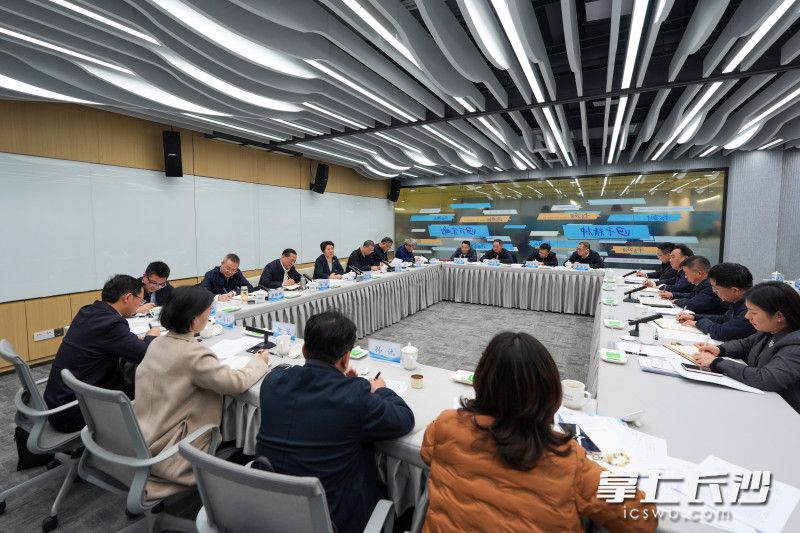
吴桂英在望城区宣讲党的二十届四中全会精神并开展调研
Chang Sha Wan Bao· 2025-11-19 02:34
Group 1 - The core message emphasizes the importance of implementing the spirit of the 20th Central Committee's Fourth Plenary Session and the directives from General Secretary Xi Jinping regarding Hunan's work [1][3] - The city has achieved significant progress in various sectors over the past year, which was acknowledged during the meeting [3] - There is a call for high-quality planning for the "14th Five-Year" development plan, focusing on unique advantages and clear urban functions and development goals [3] Group 2 - The need for collaborative efforts to integrate into national strategies and deepen connections with platforms like Hunan Xiangjiang New Area and the Malanshan Video Cultural and Creative Industry Park is highlighted [3] - The city aims to accelerate urbanization by optimizing existing resources and improving urban quality and spatial layout [3] - Enhancing urban governance and building resilient and safe cities are prioritized to ensure safety in development [3] Group 3 - The focus on the development of the micro-short drama industry ecosystem and the integration of technological and industrial innovation is noted [5][7] - There is an emphasis on strengthening policy support and regulation to promote the sustainable development of new cultural formats [8] - The initiative to deepen the construction of global R&D center cities aims to enhance the connection between technology research, application, and results transformation [8]
早盘直击|今日行情关注
申万宏源证券上海北京西路营业部· 2025-11-14 02:07
Market Overview - The A-share market has regained upward momentum, with the Shanghai Composite Index reaching new recent highs, indicating a strong performance with more stocks rising than falling [1] - The market is currently experiencing a phase of consolidation around the 4000-point level, which may prepare for further upward movement [1] - The recent breakthrough of the 3900-point resistance since late October suggests that the market has the potential for further upward expansion [1] Future Outlook - The market is expected to maintain a fluctuating upward trend, with key focus areas in November including the impact of the 14th Five-Year Plan on industries, event-driven dynamics in the technology sector, and price recovery driven by anti-involution [1] - The anticipated return of bullish sentiment is likely as the index breaks previous highs [1] Sector Highlights - The technology sector remains a focal point for November, with orderly rotation and high-low switching expected within the sector [2] - Underperforming segments such as robotics, military industry, and smart vehicles are anticipated to see a rebound, while leading sectors like computing hardware, domestic semiconductors, and new energy may present buying opportunities upon adjustment [2] - The anti-involution trend is showing results in sectors like photovoltaics, cement, coal, and express delivery, which are experiencing price increases and potential for further gains [2] Specific Sector Opportunities - Robotics is projected to expand from humanoid to quadruped and functional robots, creating opportunities in sensors, controllers, and dexterous hands [2] - The trend towards semiconductor localization continues, with attention on semiconductor equipment, wafer manufacturing, materials, and IC design [2] - The military sector is expected to see a recovery in orders by 2025, with signs of bottoming out in the performance of various military sub-sectors [2] - The innovative pharmaceutical sector is entering a recovery phase after nearly four years of adjustment, with positive net profit growth expected to continue [2] - The banking sector is witnessing a rebound in mid-year performance growth, attracting interest from long-term institutional investors due to appealing dividend yields [2]

早盘直击|今日行情关注
申万宏源证券上海北京西路营业部· 2025-11-12 02:07
Market Overview - The A-share market is experiencing repeated fluctuations around the 4000-point mark, with trading volume declining to approximately 2 trillion yuan, indicating a cautious market sentiment [1] - The market's resistance at the 4025-point level reflects a psychological barrier, as the A-share index has not surpassed 4000 points in the past decade [1] - The recent fluctuations may be preparing the market for a new upward phase, with conditions for further upward movement improving after a period of profit-taking and consolidation [1] Future Outlook - The focus for November includes the impact of the 14th Five-Year Plan on industries, technological sector events, and price recovery driven by anti-involution trends, which are expected to catalyze multiple sectors [1] - The short-term impact of tariff events is not anticipated to affect the medium-term trend of the market [1] Sector Highlights - The technology sector remains a key area of interest in November, with orderly rotation and high-low switching expected within the sector [2] - Underperforming segments such as robotics, military, and smart vehicles are likely to see a rebound, while leading sectors like computing hardware, domestic semiconductors, and new energy may present buying opportunities upon adjustment [2] - The anti-involution trend is showing results in sectors like photovoltaics, cement, coal, and express delivery, which are expected to experience price increases and subsequent rebounds [2] Specific Sector Opportunities - The trend towards domestic robotics is projected to continue, with advancements in various types of robots expected to create opportunities in related components like sensors and controllers [2] - The domestic semiconductor industry is on the rise, with attention on semiconductor equipment, wafer manufacturing, materials, and IC design [2] - The military sector anticipates a recovery in orders by 2025, with signs of bottoming out in the performance of various military sub-sectors [2] - The innovative pharmaceutical sector is entering a recovery phase after several years of adjustment, with positive profit growth expected to continue into 2025 [2] - The banking sector is seeing a rebound in mid-year performance growth, attracting interest from long-term institutional investors due to its appealing dividend yield [2]

早盘直击|今日行情关注
申万宏源证券上海北京西路营业部· 2025-11-05 02:18
Market Overview - The A-share market continues to experience a low-volume consolidation, with indices showing a slight recovery after a midday drop, indicating a challenge around the 4000-point mark [1] - Despite weak market performance, selling pressure is not significant, suggesting a strong support level below, making it difficult for the market to undergo a sustained deep correction [1] - The focus has shifted back to domestic industry trends as the impact of tariff events diminishes, with expectations for further upward movement in November following a period of profit-taking and consolidation [1] Sector Performance - The technology sector remains a focal point for November, with orderly rotation and high-low switching within the sector [2] - Underperforming segments such as robotics, military industry, and smart vehicles are expected to see a rebound, while leading sectors like computing hardware and domestic semiconductors may present buying opportunities upon adjustment [2] - Sectors that have shown results from anti-involution efforts, including photovoltaics, cement, coal, and express delivery, may also experience a rebound if validated by third-quarter reports [2] Key Trends and Opportunities - The trend towards robot localization and integration into daily life is expected to continue, with opportunities arising in sensors, controllers, and dexterous hands as the market anticipates updates to Tesla's humanoid robot [2] - The push for semiconductor localization remains strong, with attention on semiconductor equipment, wafer manufacturing, materials, and IC design [2] - The military sector is projected to see a recovery in orders by 2025, with signs of bottoming out in the performance of various military sub-sectors [2] - The innovative drug sector is entering a recovery phase after nearly four years of adjustment, with positive net profit growth expected to continue into 2025 [2] - The banking sector is witnessing a rebound in mid-year performance growth following the impact of loan rate re-pricing, attracting long-term institutional investors due to its appealing dividend yield [2]

早盘直击|今日行情关注
申万宏源证券上海北京西路营业部· 2025-10-31 02:05
Core Viewpoint - The A-share market is currently experiencing a consolidation phase below the 4000-point mark, with a focus shifting back to domestic industry trends as tariff concerns ease [1] Group 1: Market Overview - The A-share index failed to maintain the 4000-point level, closing below it, but the overall selling pressure is not significant, indicating a consolidation phase before potentially stabilizing above this level [1] - Since late October, the A-share market has broken through the 3900-point resistance, with a continued upward test towards 4000 points, attributed to a stronger market immunity to tariff shocks compared to April [1] - The market is expected to maintain a trend of oscillating upward, with strong support preventing significant declines, as the impact of tariff events is seen as short-term [1] Group 2: Future Outlook - In November, the focus will be on the stimulus effects of the 14th Five-Year Plan, the disclosure of Q3 reports, and event-driven factors in the technology sector, which are expected to catalyze multiple sectors and sustain the upward oscillation of the market [1] - The technology sector is anticipated to continue its orderly rotation, with potential rebound opportunities in underperforming areas such as robotics, military, and smart vehicles [2] - The semiconductor industry remains a key focus, with domestic production trends expected to continue, particularly in semiconductor equipment, wafer manufacturing, materials, and IC design [2] Group 3: Sector-Specific Insights - The robotics sector is projected to expand from humanoid robots to quadrupedal and functional robots, with related components like sensors and controllers likely to see repeated opportunities [2] - The military sector is expected to see a recovery in orders by 2025, with signs of bottoming out in the performance of various military sub-sectors [2] - The innovative pharmaceutical sector is entering a recovery phase after nearly four years of adjustment, with positive net profit growth expected to continue into 2025 [2] - The banking sector is showing signs of recovery in mid-year performance growth after the impact of loan rate re-pricing, making it attractive to long-term institutional investors due to its dividend yield [2]

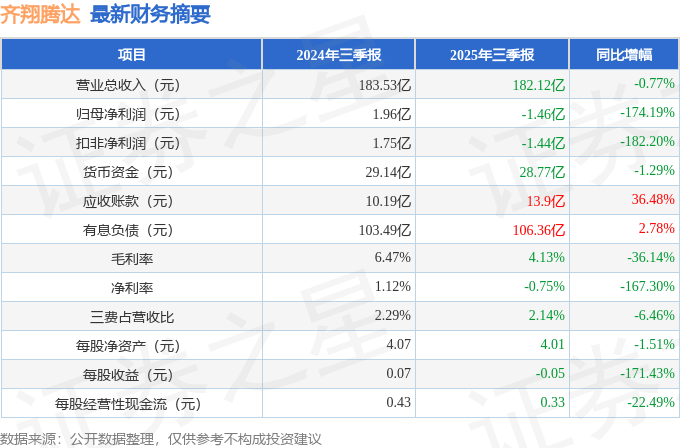
齐翔腾达(002408)2025年三季报简析:净利润同比下降174.19%,应收账款上升
Sou Hu Cai Jing· 2025-10-30 22:50
Core Viewpoint - Qixiang Tengda (002408) reported disappointing financial results for Q3 2025, with total revenue of 18.212 billion yuan, a year-on-year decrease of 0.77%, and a net profit attributable to shareholders of -146 million yuan, a decline of 174.19% compared to the previous year [1] Financial Performance - Total revenue for Q3 2025 was 6.004 billion yuan, an increase of 6.75% year-on-year [1] - The gross profit margin decreased to 4.13%, down 36.14% year-on-year [1] - The net profit margin was -0.75%, a decrease of 167.3% year-on-year [1] - Accounts receivable increased by 36.48% year-on-year, reaching 1.39 billion yuan [1] - Earnings per share dropped to -0.05 yuan, a decline of 171.43% year-on-year [1] Business Model and Strategy - The company relies on R&D, marketing, and capital expenditure for its performance, necessitating careful evaluation of capital projects and spending [3] - The company is focusing on expanding its product lines into new materials and high-value fine chemicals, leveraging partnerships for R&D [4] - The company is also developing its "15th Five-Year Plan," emphasizing optimization and expansion of existing product lines [4] Market Outlook - The price of acetone is expected to rise again after September due to seasonal demand, following a previous spike in prices [5] - The government’s policies aimed at eliminating outdated production capacities are expected to benefit leading companies in the industry by accelerating market consolidation [5] Export Performance - In the first half of 2025, the company exported 315,600 tons of products, generating 212 million USD in revenue, indicating a growing export business [6] - Major export markets include East Asia, Southeast Asia, West Asia, Europe, and South America [6]

市场情绪改善,品种价格修复为主
Zhong Xin Qi Huo· 2025-10-28 00:36
Report Industry Investment Rating - The mid - term outlook for the black building materials industry is "Oscillation" [5] Core Viewpoints - After the Fourth Plenary Session and the progress in Sino - US negotiations, market sentiment has improved. Steel and iron ore prices have risen, and the sector is expected to be driven by macro and policy factors. In the short term, prices of various products in the black building materials industry are expected to oscillate [1]. - Although there are signs of recovery in the steel market, the inventory is still at a relatively high level, and the fundamentals have limited highlights. The iron ore fundamentals have slightly weakened, and the scrap steel price is expected to follow the finished products. The supply - demand structure of coke is still tight, and the coking coal fundamentals are healthy. The alloy prices are supported by cost and output but face supply - demand pressure. The glass and soda ash prices are in an oscillating and weakening state [1][2] Summary by Category Iron Element - Iron ore: Affected by previous concentrated arrivals, the current arrival level has dropped rapidly. Considering the normal growth of shipments, the arrival level is expected to stabilize. The fundamentals of iron ore have slightly weakened, and the price is expected to oscillate in the short term. Scrap steel has no prominent fundamental contradictions. With poor electric furnace profits and steel mill production reduction expectations, its price is expected to follow the finished products in the short term [1] Carbon Element - Coke: Environmental protection restrictions affect both supply and demand, but the overall impact is limited. The short - term supply - demand structure is still tight, and the price is expected to oscillate [2] - Coking coal: Supply is difficult to improve, and the middle and lower reaches are actively purchasing. The upstream coal mine inventory is low, but considering the possible seasonal weakening of demand, the price is expected to oscillate in the short term [2] Alloys - Manganese silicon: Cost reduction is limited, and steel production is still high, which supports the price. However, the market supply - demand expectation is pessimistic, and there is obvious upward pressure on the price [2] - Ferrosilicon: High steel production and firm cost support the price, but the supply - demand relationship is loose, and the upward price space is expected to be limited [2] Glass and Soda Ash - Glass: Upstream inventory is continuously accumulating. After the negative feedback between futures and spot, the short - term price shows an oscillating and weakening trend. In the long - term, market - oriented capacity reduction is needed, and the price may continue to oscillate downward [2] - Soda ash: The supply surplus pattern remains unchanged. It is expected to oscillate widely following macro fluctuations, and the long - term price center will decline to promote capacity reduction [2] Steel - The spot market trading volume has improved, but the profits of blast furnaces and electric furnaces are not good. Steel production has increased, demand has recovered, and inventory has continued to decline but at a slow pace. In the short term, the futures market is expected to oscillate widely, and attention should be paid to domestic policies and Sino - US trade negotiations [7] Iron Ore - The spot market price is strong. Overseas mine shipments have slightly increased, and port inventory has decreased slightly. The fundamentals have slightly weakened, and the price is expected to oscillate in the short term, with attention to macro and policy factors [8][9] Scrap Steel - The fundamentals have no prominent contradictions. With poor electric furnace profits and steel mill production reduction expectations, the price is expected to follow the finished products in the short term [10] Coke - The second - round price increase has been implemented. Supply has tightened, and demand may decline slightly. The short - term supply - demand structure is still tight, and the price is expected to oscillate [11] Coking Coal - Supply recovery is slow, and the middle and lower reaches are actively purchasing. The upstream inventory is low, but considering the possible seasonal weakening of demand, the price is expected to oscillate in the short term [11][12] Glass - Manufacturers in Shahe and Hubei have continued to accumulate inventory, and the spot price has continued to decline. The supply - demand fundamentals are weak, and the short - term price shows an oscillating and weakening trend. In the long - term, market - oriented capacity reduction is needed [12] Soda Ash - Production has slightly fluctuated, and downstream procurement is stable. The supply surplus pattern remains unchanged. It is expected to oscillate widely following macro fluctuations, and the long - term price center will decline [14] Manganese Silicon - The futures price is strong, but the spot market is cold. Cost reduction is limited, and steel production is high, which supports the price. However, the market supply - demand expectation is pessimistic, and there is obvious upward pressure on the price [14][15] Ferrosilicon - The cost support is strengthened, and the futures price has slightly increased. High steel production and firm cost support the price, but the supply - demand relationship is loose, and the upward price space is expected to be limited [16]
国家电网与东方电气集团举行会谈
Zheng Quan Shi Bao Wang· 2025-08-22 12:21
Core Viewpoint - The meeting between State Grid Corporation and Dongfang Electric Group aims to enhance cooperation and develop a strategic plan for the "14th Five-Year" period, focusing on technological innovation and international business expansion [1] Group 1: Company Collaboration - State Grid Corporation and Dongfang Electric Group are both central enterprises in the energy sector, sharing common responsibilities and facing similar challenges [1] - The two companies plan to build a regular communication mechanism to deepen practical cooperation [1] Group 2: Strategic Planning - The discussion includes planning for the "14th Five-Year" development strategy, emphasizing the need for collaborative efforts on key projects [1] - There is a focus on strengthening technological innovation and coordinated efforts on major engineering projects [1] Group 3: International Business - Both companies aim to expand their international business cooperation as part of their strategic initiatives [1]