
历史修正主义

Search documents
欧美终于坐不住了,打算抢先对中国动手,高市早苗得意洋洋,甩出四个字
Sou Hu Cai Jing· 2026-01-07 05:17
Group 1: Economic Pressure from Europe - The European Union has implemented the Carbon Border Adjustment Mechanism (CBAM) starting January 1, 2026, requiring Chinese exports like steel, cement, and aluminum to pay additional fees based on their carbon pricing system, which is significantly higher than China's domestic carbon prices [3][6] - This move is perceived as a trade barrier disguised as an environmental initiative, potentially reducing profits for Chinese companies by over 10% and risking the export eligibility of smaller firms [3][6] - The EU's actions indicate a lack of genuine intent to improve relations with China, aiming instead to leverage negotiations for economic gain while increasing pressure on China [6] Group 2: U.S. Military and Economic Strategy - The U.S. has maintained a dual approach, increasing military pressure on China while avoiding economic decoupling, as evidenced by ongoing arms sales to Taiwan totaling over $30 billion since 2025 [8][10] - The U.S. is testing China's response to various provocations, including military sales and geopolitical maneuvers, to gauge whether China will retaliate or remain passive [10] - This strategy reflects a calculated effort to use Taiwan as a strategic asset without escalating to direct conflict, indicating a complex interplay of military and economic tactics [8][10] Group 3: Japan's Historical and Defense Posture - Japan's Prime Minister, Fumio Kishida, has emphasized a shift towards a more aggressive defense policy, including discussions on increasing defense spending and potentially revising nuclear principles, which aligns with a broader right-wing sentiment in the government [12][14] - The cancellation of a major business delegation to China signals a deterioration in economic relations, influenced by Japan's historical revisionism and military posturing [14] - Japan's strategy appears to be an attempt to enhance its position within the U.S.-Japan alliance while underestimating the potential backlash from neighboring countries and the economic consequences of escalating tensions with China [14][16] Group 4: Coordinated Pressure on China - The simultaneous actions from the EU, U.S., and Japan suggest a coordinated effort to test China's limits regarding economic concessions, military responses, and historical grievances [16] - Each entity is probing whether China will yield to pressures such as accepting carbon tariffs, tolerating military sales to Taiwan, or overlooking historical provocations for the sake of economic cooperation [16] - The evolving geopolitical landscape indicates that China is no longer a passive player and is actively developing its own carbon accounting and green standards to counteract unilateral measures from the EU [18]

《学习时报》刊文:警惕日本军国主义在文体领域的渗透
Xin Lang Cai Jing· 2026-01-02 11:14
Core Viewpoint - The article highlights the infiltration of militaristic elements in Japan's cultural and sports sectors, driven by far-right forces aiming to reshape public perception and glorify Japan's wartime history [3][4][6]. Group 1: Cultural and Sports Infiltration - Recent incidents in Japan's sports and cultural arenas include athletes posing with war criminal memorabilia and the incorporation of militaristic symbols in popular media, indicating a systematic effort to influence public sentiment [3][4]. - The far-right's strategy involves using the emotional appeal of cultural activities to obscure the brutal realities of Japan's militaristic past, targeting especially the youth to foster a distorted historical narrative [4][5]. Group 2: Characteristics of the Infiltration - The infiltration exhibits three notable characteristics: the use of popular culture for political messaging, a gradual approach to testing international reactions, and a focus on shaping the perceptions of younger generations [4][5][6]. - The far-right's tactics include embedding militaristic symbols in everyday cultural products, thereby normalizing a revisionist view of history [5][6]. Group 3: Structural Factors in Japanese Society - The persistence of historical revisionism in Japan is rooted in a lack of thorough reflection on wartime actions, with government narratives downplaying Japan's aggression and avoiding accountability [6][7]. - Political structures in Japan have allowed far-right elements to thrive, with a conservative power base influencing policy and perpetuating a narrative that favors militaristic ideologies [7][8]. Group 4: Societal Implications - The erosion of collective memory regarding Japan's wartime history, combined with social anxieties, has created fertile ground for far-right narratives to take hold, particularly among younger generations [8][9]. - The far-right's actions pose significant threats to regional security and international relations, undermining trust and cooperation with neighboring countries [9][10]. Group 5: Proposed Countermeasures - Recommendations include enforcing stricter regulations against the use of militaristic symbols in cultural contexts and promoting historical accuracy in international sports and cultural organizations [11][12]. - Collaborative efforts among affected nations to counteract far-right narratives and promote a truthful representation of history are essential for maintaining peace and stability [13][14].
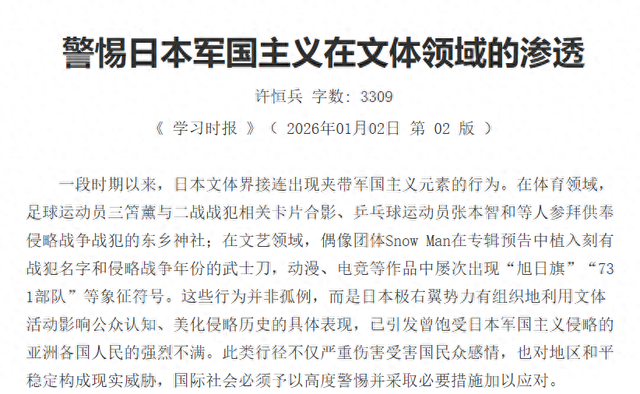
警惕日本军国主义在文体领域渗透,学习时报点名三笘薰、张本智和、Snow Man等
Xin Lang Cai Jing· 2026-01-02 10:14
Core Viewpoint - The article highlights the infiltration of militaristic elements in Japan's cultural and sports sectors, driven by extreme right-wing forces, which poses a threat to regional peace and stability [15][16][18]. Group 1: Cultural and Sports Infiltration - Recent incidents include athletes and cultural figures engaging with symbols and actions associated with Japan's militaristic past, such as football player Mitsuhiro Mitsu and idol group Snow Man [15][16]. - The use of symbols like the "Rising Sun Flag" and references to war crimes in popular media reflects a systematic effort to reshape public perception and glorify Japan's militaristic history [15][16][18]. Group 2: Strategies of Right-Wing Forces - Right-wing groups utilize cultural activities to subtly embed political messages, targeting youth through popular media, thereby bypassing rational historical critique [16][17]. - The approach includes a gradual, exploratory strategy to gauge international reactions while promoting a distorted historical narrative [16][17]. Group 3: Societal and Political Context - The rise of historical revisionism in Japan is linked to a lack of thorough reflection on wartime actions, with government policies downplaying historical responsibilities [17]. - Structural flaws in Japan's political system have allowed extreme right-wing ideologies to gain traction, influencing national policies and public sentiment [17]. Group 4: Implications for Regional Stability - The actions of right-wing forces threaten regional security and challenge the post-World War II international order, potentially exacerbating tensions with neighboring countries [18][19]. - Historical grievances hinder diplomatic relations and economic cooperation, creating a persistent barrier to healthy bilateral ties [19]. Group 5: Recommendations for Response - The international community is urged to take measures against the glorification of militarism, including sanctions and public accountability for organizations promoting such narratives [19][20]. - Establishing a historical safety line in cultural exchanges and promoting accurate historical narratives through international cooperation is essential [20][21].
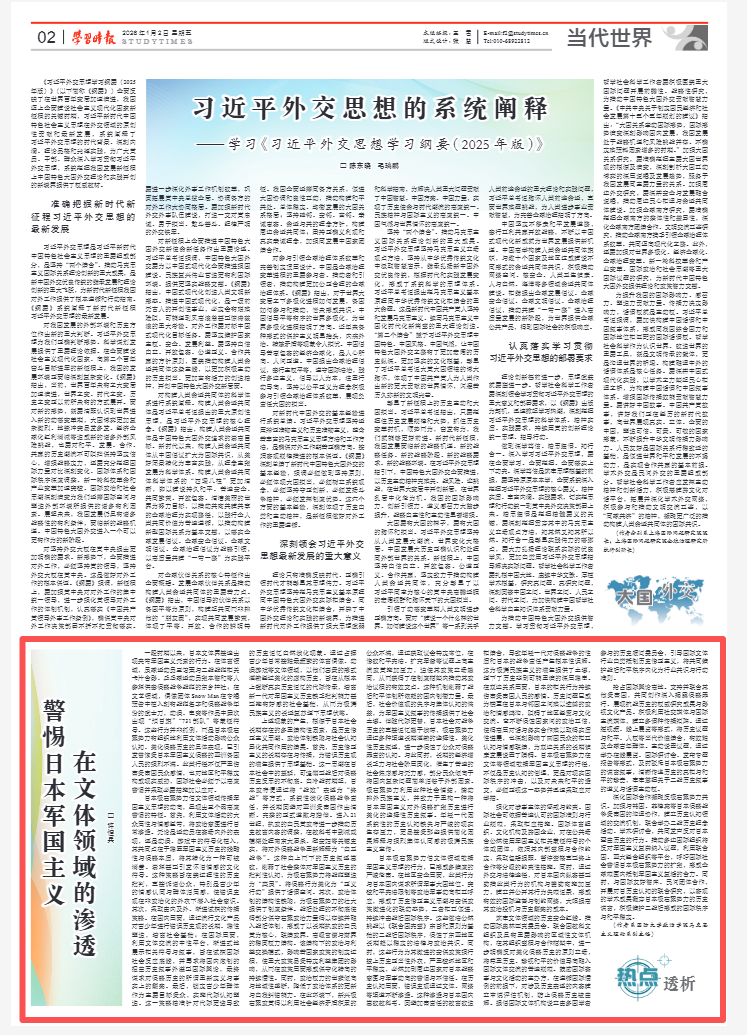
警惕日本军国主义在文体领域的渗透
Xin Lang Cai Jing· 2026-01-02 09:14
Core Viewpoint - The rise of militaristic elements in Japan's cultural and sports sectors reflects a coordinated effort by far-right forces to influence public perception and glorify historical aggression, provoking strong discontent among nations affected by Japan's militarism [1][4]. Group 1: Characteristics of Militaristic Propagation - The far-right in Japan utilizes the emotional appeal of cultural and sports activities to subtly embed political intentions, transforming the brutal history of militarism into consumable cultural symbols [2]. - A gradual and exploratory strategy is employed, where domestic cultural products shape youth perceptions of history, while international platforms are used to test reactions to militaristic symbols [2]. - The youth demographic is targeted as a primary audience, aiming to sever the intergenerational transmission of accurate historical memory and foster a new generation with a favorable view of militarism [2][3]. Group 2: Structural Factors Contributing to the Phenomenon - Historical revisionism has provided a foundation for the proliferation of erroneous historical views, stemming from Japan's incomplete reflection on its wartime actions [3]. - Structural flaws in the political system have allowed far-right forces to thrive, creating a stable power structure that influences policy-making and promotes conservative agendas [3]. - Social disarray and distorted collective cognition have created fertile ground for militaristic narratives, as younger generations, facing economic pressures, are more susceptible to simplified nationalist propaganda [3]. Group 3: Consequences of Militaristic Propagation - The actions of Japan's far-right in the cultural and sports sectors pose a significant threat to regional security, undermining the post-war international order and challenging the principles of the United Nations [4][5]. - Misconceptions about Japan's wartime actions are perpetuated through cultural channels, leading to a fundamental misunderstanding among the youth regarding the nature of aggression and Japan's responsibilities [5]. - Historical grievances continue to strain Japan's relations with neighboring countries, hindering economic and cultural exchanges and eroding political trust [5]. Group 4: Recommendations for International Response - The international community should impose sanctions and constraints on individuals and organizations that publicly endorse militaristic symbols, enhancing accountability through established international norms [6]. - It is essential to fortify historical safety lines in cultural sectors by integrating principles against the glorification of aggression into the frameworks of international sports and cultural organizations [6]. - Collaborative efforts among victim nations should be strengthened to counteract the narratives of Japan's far-right, promoting a unified stance against historical distortion [7].
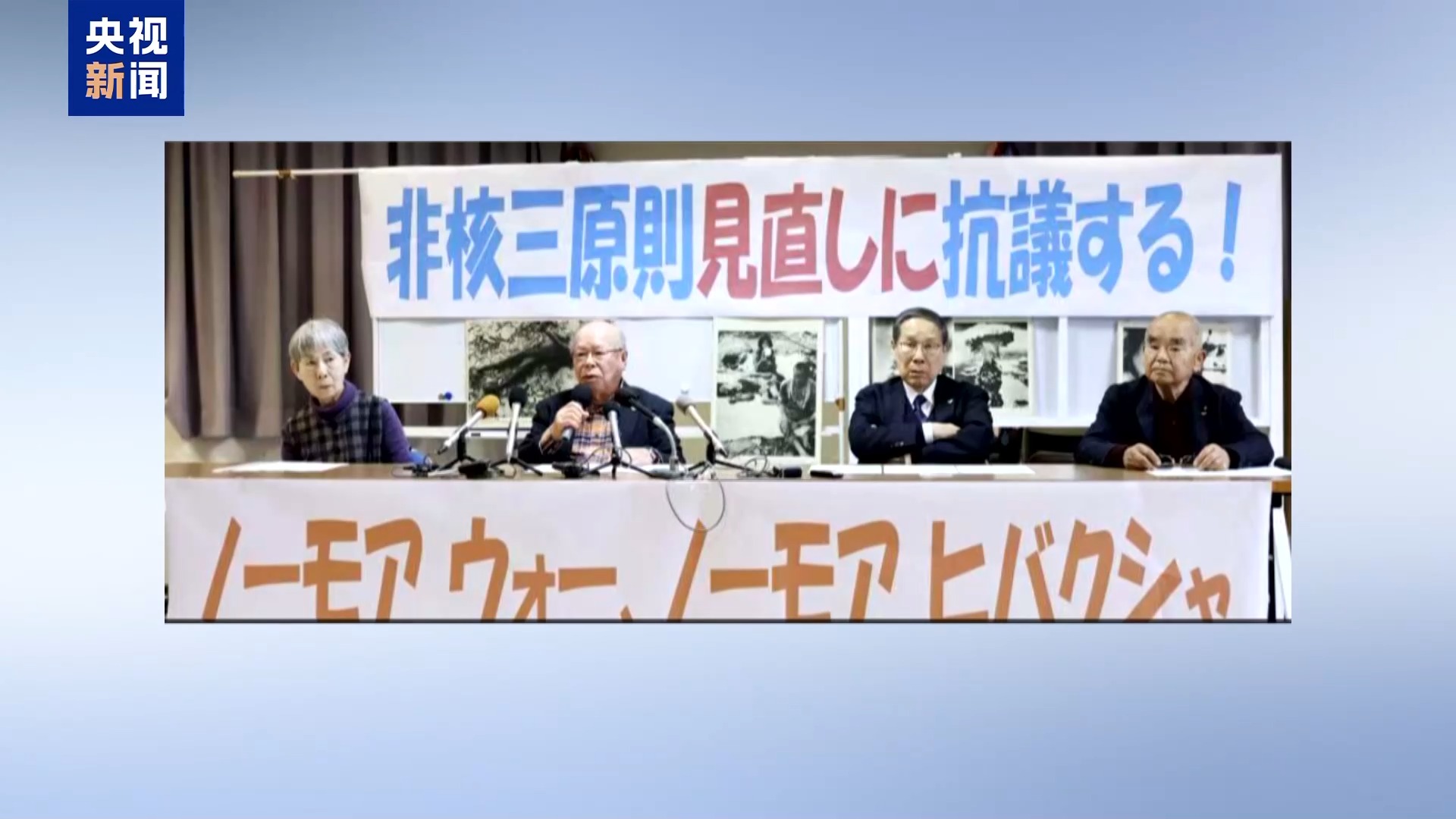
视频丨从拥核言论到巨额军费 日本右翼“冒天下之大不韪”或酿重大灾难
Yang Shi Xin Wen Ke Hu Duan· 2025-12-26 02:28
Core Viewpoint - Recent statements from high-ranking officials in Japan advocating for nuclear armament have sparked strong domestic backlash and international concern, revealing a dangerous trend towards historical revisionism and military expansion within the Japanese government [1][3][18] Group 1: Nuclear Armament Discussions - Japanese Prime Minister Fumio Kishida's aide, Seiji Oe, responsible for nuclear disarmament, made pro-nuclear comments, raising questions about his competence [6] - The Chinese government has condemned Japan's nuclear rhetoric as a serious provocation against post-war international order and nuclear non-proliferation [3][18] - Domestic criticism of nuclear armament is growing, with various groups, including nuclear bomb survivors, protesting against the notion of Japan possessing nuclear weapons [4][8] Group 2: Military Expansion and Budget - Japan's upcoming budget for fiscal year 2026 is projected to reach a record 122 trillion yen, with defense spending exceeding 9 trillion yen for the 14th consecutive year [13] - The budget includes plans to enhance Japan's capability to supply weapons to other countries, with a specific allocation of 18.1 billion yen for this purpose [13] - Prime Minister Kishida has emphasized the need for Japan to improve its "sustained combat capabilities" in light of global conflicts, indicating a clear intent to accelerate military development [15] Group 3: Historical Revisionism - The influence of historical revisionism is evident in Japan's education system, with military training materials incorporating the "Yasukuni view" of history [17] - Experts warn that Japan's nuclear ambitions could embolden right-wing factions, potentially leading to aggressive foreign policies and regional instability [19]
社评:日本已成国际社会麻烦制造者
Xin Lang Cai Jing· 2025-12-25 16:20
Core Viewpoint - The Japanese government is signaling a shift towards militarization and potential nuclear capabilities, which poses a challenge to the post-World War II international order [1][2][4] Group 1: Military Policy Changes - Prime Minister Fumio Kishida has indicated that Japan does not rule out the introduction of nuclear submarines and is accelerating the revision of security documents to prepare for potential long-term military conflicts [1] - Defense spending has been raised to over 2% of GDP, and there are plans to relax weapon export restrictions, indicating a shift towards a more aggressive military posture [2] - The ruling Liberal Democratic Party is reportedly in agreement to amend the "Three Principles on Transfer of Defense Equipment," aiming to fully open up the export of lethal weapons [2] Group 2: Diplomatic Maneuvers - The Japanese government is employing a dual diplomatic strategy, claiming openness to dialogue with China while simultaneously provoking tensions over Taiwan [3] - A significant number of Japanese lawmakers are expected to visit Taiwan, and former military officials are taking advisory roles in Taiwan's government, which breaches official diplomatic boundaries [3] Group 3: Regional Tensions - Japan's actions are seen as attempts to disrupt regional unity and serve as a pawn for external intervention, particularly in disputes over territories like the Dokdo and the Southern Kuril Islands [4] - The aggressive stance of the Kishida administration is accelerating regional crises and could lead to Japan's isolation [4] - Historical lessons indicate that the resurgence of militarism could bring severe consequences for both the region and the world [4]
寰宇平:警惕日本军国主义阴魂不散
Ren Min Ri Bao· 2025-12-25 03:43
Core Viewpoint - The article discusses the resurgence of militarism in Japan, particularly through the actions and statements of political figures like Prime Minister Sanae Takaichi, which reflect a troubling trend of historical revisionism and militaristic rhetoric that threatens regional and global stability [1][9][16]. Group 1: Historical Context and Current Developments - The article highlights the historical context of Japanese militarism, tracing its roots back to events such as the First Sino-Japanese War and the Pacific War, where Japan used the concept of "crisis" to justify military aggression [3][4]. - Recent statements by Japanese leaders, particularly Takaichi's assertion that "Taiwan's issues" could trigger Japan's collective self-defense, mark a significant shift in Japan's military posture and reflect a revival of militaristic ambitions [1][9]. Group 2: Ideological Underpinnings - The article outlines the ideological foundations of Japanese militarism, including the "Emperor-centered" view and the promotion of a sense of racial superiority, which have historically justified Japan's expansionist policies [4][7]. - The militaristic ideology is further reinforced by cultural elements such as the glorification of war and the dehumanization of enemies, which have been perpetuated through education and public discourse [6][11]. Group 3: Political and Military Implications - The rise of "new militarism" in Japan poses significant risks to regional peace, as it undermines commitments made in international agreements regarding Taiwan and other territorial issues [16][20]. - Japan's military budget has seen unprecedented increases, with plans to enhance its defense capabilities, indicating a shift from a defensive to a more aggressive military stance [12][17]. Group 4: International Reactions and Consequences - The article notes that Japan's militaristic rhetoric has drawn criticism not only from neighboring countries but also from within Japan, highlighting a growing concern over the potential for conflict [16][22]. - The international community, including countries like China and South Korea, has expressed strong opposition to Japan's revisionist history and militaristic ambitions, emphasizing the need for accountability and historical reflection [20][24].
警惕日本自卫队的“靖国旧梦”
Xin Lang Cai Jing· 2025-12-24 18:49
Core Viewpoint - The resurgence of militaristic sentiments in Japan is evident through the activities of the Japan Defense University students and the increasing influence of the Yasukuni Shrine on the Self-Defense Forces [1][2][3][4] Group 1: Activities and Traditions - Japan Defense University students are required to participate in a "night march" to the Yasukuni Shrine at least once during their four years of study, indicating a long-standing tradition [1] - On August 15, Japan's defeat day, members of the Self-Defense Forces (SDF) in uniform are frequently seen collectively visiting the Yasukuni Shrine, showcasing the infiltration of historical revisionism into the SDF [1] Group 2: Policy and Regulations - The Japanese Ministry of Defense has internal regulations prohibiting collective visits to shrines by SDF personnel, yet these rules are increasingly ignored, as evidenced by a high-ranking official leading a group to the Yasukuni Shrine [2] - The Ministry's investigation into such incidents often downplays them as "private visits," undermining the seriousness of the violations [2] Group 3: Educational Content and Historical Narratives - The Defense University’s required course materials reflect the "Yasukuni view of history," distorting Japan's military actions as self-defense against Western imperialism [3] - Criticism has emerged regarding the university's choice of guest speakers, who promote a narrative that glorifies Japan's wartime actions [3] Group 4: Personnel and Leadership - The appointment of a former high-ranking SDF officer as the head of the Yasukuni Shrine marks a significant intertwining of military and religious leadership, raising concerns about the militarization of the shrine [3] - The advisory board of the Yasukuni Shrine includes several former SDF leaders, further solidifying the connection between the military and the shrine [3] Group 5: Broader Implications - The increasing militarization of Japan, coupled with political rhetoric advocating for military intervention, raises alarms about the potential revival of aggressive military policies reminiscent of Japan's past [4] - Statements from SDF officials regarding the Yasukuni Shrine as a "spiritual home" and the notion of preparing for "death in battle" reflect a troubling shift towards militaristic ideology [4]
解放军报:篡改历史包藏祸心,扩军黩武野心毕露
Xin Lang Cai Jing· 2025-12-24 00:17
Core Viewpoint - The article highlights the concerning trend in Japan of downplaying its historical aggression, particularly regarding the Nanjing Massacre, as part of a broader revisionist narrative that seeks to reshape public perception of Japan's wartime actions [1][2][3] Group 1: Historical Revisionism - Japan's Nagasaki Atomic Bomb Museum plans to change the term "Nanjing Massacre" to "Nanjing Incident," reflecting a wider trend of minimizing Japan's wartime atrocities [1] - There is a systematic reduction or removal of exhibits that accurately portray Japan's colonial aggression, leading to a scarcity of museums that present a complete and objective history [1] - Right-wing forces in Japan continue to propagate false narratives, claiming Japan never invaded and framing its actions as liberatory, while ignoring the atrocities committed [2] Group 2: Impact on Public Perception - A recent survey indicates a significant decline in the recognition of Japan's wartime actions as aggression, with only 35% of respondents acknowledging it as such, down from 52% in 1994 [2] - The number of respondents who are unsure about Japan's wartime history has risen dramatically to 48%, compared to 15% in 1994, indicating a troubling trend in historical awareness [2] Group 3: Military Expansion and Nationalism - Japan is increasingly abandoning its "defensive" military posture, seeking to expand its military capabilities under the guise of external threats, which raises concerns about regional stability [3] - The Japanese government is planning to deploy missiles on the Yonaguni Island and is discussing revisions to its "Three Non-Nuclear Principles," signaling a shift towards militarization [3] - The resurgence of militaristic ideologies poses a significant risk to peace in Asia, necessitating vigilance from countries that suffered under Japanese militarism [3]
日本右翼涉台狂言背后的军国主义扩张逻辑
Xin Lang Cai Jing· 2025-12-23 19:08
(来源:光明日报) 当下高市政府炒作"台湾议题"的逻辑与战前一脉相承。高市早苗不仅在上台前窜访台湾,推动建立 所谓"准安全联盟",上台后更以台海、独岛、南千岛群岛为抓手,炒作"危机关联"与"主权争议"。其在 国会答辩中将"台湾有事"与行使集体自卫权挂钩,这种锁定周边敏感地缘议题、突破秩序红线的做法, 与战前日本的扩张策略具有高度同质性。 转自:光明日报 当前日本虽面临不同的中日力量对比与国际局势,却以历史修正主义为思想铺垫、危机叙事为动员 工具、军备扩张为物质支撑、地缘冒险为政策指向,复刻战前扩张路径,对此必须高度警惕。 日本首相高市早苗在11月7日的国会答辩中,将"台湾有事"与行使集体自卫权挂钩,暗示武力介入 台海局势。这与战前日本军国主义扩张逻辑如出一辙。 (作者:孙继强,系苏州大学外国语学院教授) 1937年日本全面侵华前夕,日本军队主导集权统治,建立战时经济与军事体系,外交沦为侵略工 具,形成"舆论造势—矛盾转移—战略试探—权力协同"的扩张链条。日本的强权逻辑根深蒂固,炒 作"中国威胁论",均以"强弱对比"为国家关系核心标尺,将对外掠夺与军事征服视为实现民族利益的正 当途径,为侵略扩张提供精神支撑。而 ...