品牌忠诚度

Search documents
45%消费者在晚安助眠茶价格上涨后保持忠诚!2025中国晚安助眠茶市场研究报告
Sou Hu Cai Jing· 2025-10-19 03:26
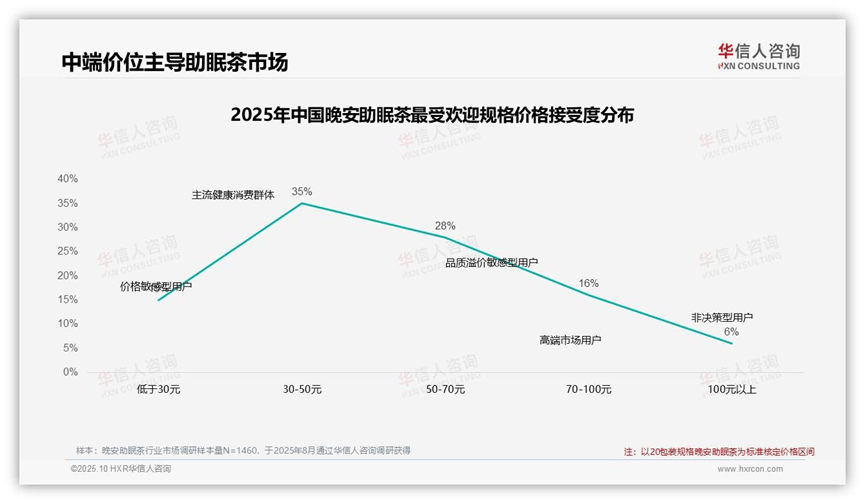
Core Insights - The research by HXR Consulting indicates that even with a 10% price increase for sleep tea, 45% of consumers continue to purchase, reflecting high brand loyalty [1][3] - The study, part of the "Insights 2025" series, surveyed 1,460 respondents, providing reliable and representative data for market dynamics and consumer behavior [1] Price Acceptance - The survey shows that the price range of 30-50 yuan dominates the market, accounting for 35% of consumer preferences, indicating a tendency towards mid-to-low priced products [1] - The 50-70 yuan range follows closely with 28%, while products priced below 30 yuan only represent 15% of the market [1] - High-end price segments (70-100 yuan and above 100 yuan) account for 16% and 6% respectively, suggesting limited acceptance for premium pricing among consumers [1] Price Sensitivity and Promotion Dependency - Despite the price increase, 32% of consumers would reduce their purchase frequency, and 23% would switch to other brands, highlighting the presence of price-sensitive consumers [3] - In terms of promotional dependency, 30% of consumers are lightly dependent on promotions, 27% moderately, and 18% highly dependent, totaling 75% influenced by promotional activities [3] - Conversely, 20% of consumers do not rely on promotions, and 5% have a negative attitude towards them, indicating the need for brands to carefully strategize their promotional efforts to avoid adverse effects [3] Summary - The sleep tea market is primarily driven by mid-range pricing, with consumers showing a strong focus on product value for money and notable brand loyalty amidst price fluctuations [5] - The insights derived from the data provide substantial support for industry decision-making, emphasizing the importance of understanding consumer purchasing preferences and behaviors [5]

United(UAL) - 2025 Q3 - Earnings Call Transcript
2025-10-16 15:30
Financial Data and Key Metrics Changes - United Airlines reported a 2.6% increase in top-line revenues to $15.2 billion in Q3 2025, with a 7.2% increase in capacity [23] - The earnings per share for Q3 was $2.78, exceeding the guidance range of $2.25 to $2.75 and Wall Street expectations of $2.68 [44] - The pretax margin was 8%, with a projected EPS for Q4 between $3.00 and $3.50, positioning the company to be the only airline to grow earnings in 2025 [45][46] Business Line Data and Key Metrics Changes - Domestic PRASM decreased by 3.3% in Q3 on a 6.6% increase in capacity, while international PRASM fell by 7.1% [23][24] - Premium cabin revenues increased by 6% year-over-year, outperforming the main cabin by five points [24] - MileagePlus loyalty revenues rose over 9%, with whole brand remuneration up 15% year-over-year [29] Market Data and Key Metrics Changes - The third quarter marked the busiest in United's history, with over 48 million customers flown and the lowest cancellation rate for any third quarter [16][17] - All seven hubs were profitable in Q3, despite challenges in the broader industry [26] - The company expects Q4 to have the highest absolute RASM of any quarter in 2025, with international RASMs anticipated to outperform domestic [25] Company Strategy and Development Direction - United Airlines is focused on transforming into a brand-loyal airline, investing over $1 billion annually in customer product enhancements [9][39] - The company aims to achieve double-digit margins by driving efficiencies through technology and optimizing capacity in profitable markets [14][15] - The strategy includes a shift towards premium leisure demand, which has been growing and is expected to continue to outperform traditional corporate yields [68][70] Management's Comments on Operating Environment and Future Outlook - Management expressed confidence in the resilience of the brand-loyal customer base, which has shown stability during economic downturns [45][46] - The company anticipates continued margin expansion, driven by a focus on brand loyalty and operational efficiencies [89] - Management highlighted the importance of technology investments in improving operational performance and customer experience [40][41] Other Important Information - United Airlines is planning to hire over 2,000 pilots and 3,200 flight attendants in 2026, reflecting growth in operations [19] - The company has eliminated all expensive financing from its balance sheet, achieving a credit rating upgrade to BB+ from S&P [48] - The introduction of Starlink Wi-Fi is expected to enhance the in-flight experience significantly [21] Q&A Session Summary Question: Impact of main cabin supply changes on margins - Management discussed the historical view of the airline industry as a commodity and emphasized the shift towards brand loyalty, which is expected to stabilize margins despite changes in main cabin supply [54][56] Question: Update on fourth quarter costs and CASM - Management indicated that Q4 costs would trend up from Q3 levels, with benefits from maintenance and labor agreements contributing to cost management [64][66] Question: Premium leisure yields versus corporate yields - Management confirmed that premium leisure yields have been growing and often exceed traditional corporate yields, particularly in domestic markets [68][70] Question: Air traffic liability and its implications - The slight decline in air traffic liability was attributed to strong bookings and positive momentum heading into Q4, indicating a favorable outlook [76][78] Question: Latin America performance and future strategy - Management acknowledged disappointing results in Latin America but expects significant sequential improvement in Q4, focusing on core markets and removing underperforming routes [80][82]

黄牛号炒至80元、日排队上千桌,8元寿司为何遭年轻人疯抢
2 1 Shi Ji Jing Ji Bao Dao· 2025-09-27 02:18
Core Insights - Sushi Lang has gained immense popularity among young consumers in China, often referred to as the "Luckin Coffee of Japanese cuisine" due to its affordable pricing and social media presence [1][4] - The brand's success is attributed to a combination of aggressive pricing, engaging dining experiences, technological innovations, and effective social media marketing [6][9] Sales Performance - Sushi Lang's parent company, FOOD & LIFE Companies (F&LC), reported a revenue of 313.15 billion yen for the first nine months of the 2025 fiscal year, marking an 18.3% year-on-year increase [4] - Operating profit surged by 68.4% to 29.2 billion yen, with international business revenue growing by 41.2% and segment profit increasing by 118.9% [4] - As of September 25, F&LC's market capitalization reached 9.448 trillion yen, with a stock price increase of 204% over the past year [4] Market Presence - Sushi Lang has opened 65 stores across 13 cities in mainland China, with Guangzhou having the highest number at 18 stores [4] - The brand also operates over 15 locations in Hong Kong, covering key commercial areas [5] Consumer Engagement - The pricing strategy includes sushi priced between 10 to 28 yuan, with limited-time offers starting at 8 yuan, appealing to young consumers' desire for affordable dining [7] - The dining experience is gamified, with rewards and interactive elements that resonate with younger audiences [7] - Collaborations with popular IPs and a strong social media presence have further enhanced brand engagement [9] Challenges - Despite its popularity, Sushi Lang faces challenges in expansion, having closed three stores in 2024 and falling short of its overseas expansion goals [11] - The competitive landscape in the affordable sushi market is intensifying, with rivals like Hamazushi and Genki Sushi launching similar low-priced offerings [12] - Ongoing concerns regarding food safety and the impact of Japan's nuclear wastewater discharge on consumer confidence pose additional risks [13]
市场简报:即时成像的生态构建:拍立得如何打造用户粘性护城河?-20250905
Tou Bao Yan Jiu Yuan· 2025-09-05 13:24
Investment Rating - The report does not explicitly state an investment rating for the instant photography industry Core Insights - The instant photography market is segmented into traditional instant cameras, electronic instant cameras, and mobile photo printers, each with distinct characteristics and functionalities [2][4] - Traditional instant cameras, while popular for their nostalgic appeal, have lower image quality compared to professional digital cameras due to limitations in film sensitivity and lens design [3][4] - The instant photography industry has seen a resurgence due to the unique experience it offers, appealing to consumers' desire for tangible memories in a digital age [15][16] Market Overview - The Chinese instant photography market is projected to reach approximately 2 billion yuan in 2024, with Fujifilm holding a dominant market share of 70%-80% [22] - Fujifilm's instax series has sold over 100 million units globally, showcasing its strong market presence and consumer loyalty [22] Product Comparison - Traditional instant cameras utilize film and chemical development, while electronic instant cameras combine digital sensors with instant printing capabilities [4] - Mobile photo printers, although not classified as instant cameras, allow users to print photos from their smartphones, expanding the market's reach [2][4] Historical Development - Instant photography originated in the 1940s with Polaroid's introduction of the first commercial instant camera, leading to significant innovations over the decades [15][18] - Fujifilm entered the instant photography market in the late 1990s and has since revitalized the sector with diverse product offerings and collaborations with fashion brands [15][22] Consumer Behavior - Consumers are drawn to traditional instant cameras for their unique aesthetic and the physicality of printed photos, which contrasts with the digital experience [16] - The nostalgic and experiential aspects of instant photography contribute to its appeal, particularly among younger demographics [16]
政治漩涡中销量逆势大增24%!挪威车主用钱包投票支持特斯拉(TSLA.US)
智通财经网· 2025-08-14 09:24
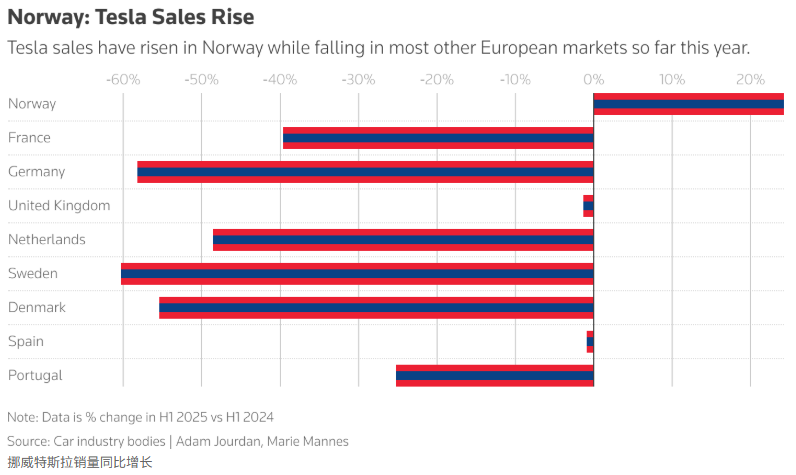
Core Viewpoint - Despite growing consumer backlash against Elon Musk's political stance, Tesla continues to see sales growth in Norway, highlighting the brand's strong loyalty among Norwegian consumers [1][3]. Group 1: Sales Performance - Tesla's sales in Norway increased by 24% year-on-year in the first half of the year, making it the second-largest market for Tesla in Europe, while sales in Germany, Sweden, Denmark, and the Netherlands saw a significant decline [1][3]. - In 2021, Tesla was the best-selling car brand in Norway, maintaining a new car registration share of 11%-20% over the past five years [3]. Group 2: Market Dynamics - Norway has played a crucial role in shaping Tesla's brand, being the first country outside North America to introduce the Model S and establishing the first Supercharger network outside North America [3]. - Electric vehicles now account for 94% of new car sales in Norway, with Tesla's Model S quickly becoming a top seller [3]. Group 3: Consumer Sentiment - Despite 40% of Tesla owners believing Musk's political activities harm the brand, over half of the surveyed owners indicated they would consider purchasing another Tesla [6]. - Promotional strategies, such as zero-interest loans and free supercharging, led to a 213% increase in new Tesla registrations in May [6].

从“偶然购买”到“习惯性选择”:揭秘品牌忠诚的神经密码
Sou Hu Cai Jing· 2025-08-09 20:49
Group 1 - The core idea of consumer decision-making is that up to 95% of purchasing decisions are driven by subconscious automatic responses, indicating that brand loyalty is based on "cognitive autopilot" [2][16] - The book "Why Customers Buy Again" by Leslie Zane reveals the neural mechanisms behind the formation of consumer habits, showing that repeated choices of the same brand lead to decreased brain activity in decision-making areas [2][4] - Understanding consumer behavior is crucial for brands to maintain growth amidst economic cycles and uncertainties, emphasizing the need for a deep understanding of consumers [4][23] Group 2 - Effective marketing can change consumer behavior by leveraging existing associations and memories rather than relying solely on persuasion or promotions [5][10] - Metaphors are powerful tools in marketing that can quickly and effectively alter entrenched beliefs and behaviors by creating positive associations [6][8] - Humor, when relevant to the brand, can also break down psychological barriers and establish strong brand connections, enhancing consumer engagement [10][12] Group 3 - The concept of brand connection groups suggests that consumer choices do not follow a linear marketing funnel but can develop organically through various associations in the brain [13][14] - Brands that establish deep connections with consumers can create intuitive brand preferences, leading to automatic purchasing behaviors without conscious thought [16][17] - The ability of the human brain to change and adapt, known as neuroplasticity, allows for the formation of new neural networks based on experiences and interactions with brands [19][22] Group 4 - The competition for consumer attention occurs not just in the marketplace but within the memory and neural pathways of individuals, highlighting the importance of brand presence in consumers' minds [22][23] - Growth is essential for the survival of brands and businesses, and it can occur regardless of external circumstances, emphasizing the need for strategies that foster growth [23]
2025年塑造消费品包装行业的消费者购买趋势研究报告消费转换浏览
Sou Hu Cai Jing· 2025-08-03 09:32
Core Insights - The consumer goods market is undergoing significant transformation driven by changing shopping habits, brand loyalty erosion, and a focus on health and sustainability [1][4][5] Consumer Sentiment - In the US, consumer confidence rose to 108.7 in October 2024, with 76% of consumers opting for cheaper alternatives while 42% plan to splurge on experiences [2][19] - European consumers are more cautious, with only 16% remaining loyal to specific brands, while 66% prioritize quality and 59% are influenced by price promotions [2][20][21] Key Consumer Trends - Health and wellness consumption is booming, with the global wellness market reaching $1.8 trillion, and 82% of American consumers prioritizing health in their daily lives [4][22][23] - Brand loyalty is declining, with 60% of US consumers and 53% of Europeans only purchasing branded products when on sale, and 38% not returning to brands after trying private labels [4][25][26] - Sustainability remains important, with 85% of consumers feeling climate change impacts, but affordability is becoming a priority, leading to a decline in willingness to pay a premium for sustainable products [5][28][30] Social Commerce and Direct-to-Consumer Models - Social commerce is rapidly growing, with US sales projected to reach $145 billion by 2027, driven by Gen Z and Millennials who are four times more likely to shop on social platforms [6][34] - Direct-to-consumer (D2C) strategies are increasingly adopted by brands to connect directly with consumers, allowing for better control over pricing and messaging [6][37][39] Marketing Strategies - Brands need to adopt micro-targeting and personalization strategies, leveraging AI and data analytics to create tailored consumer experiences [7][46] - Integrating wellness into product offerings and loyalty programs is essential to resonate with health-conscious consumers [7][54][57] Future Outlook - The consumer market is expected to evolve towards more immersive and emotionally connected experiences, with technology playing a key role in shaping consumer interactions [10][9]

马斯克进军餐饮业?不好好卖车,马斯克卖汉堡干嘛?
Sou Hu Cai Jing· 2025-08-03 00:12
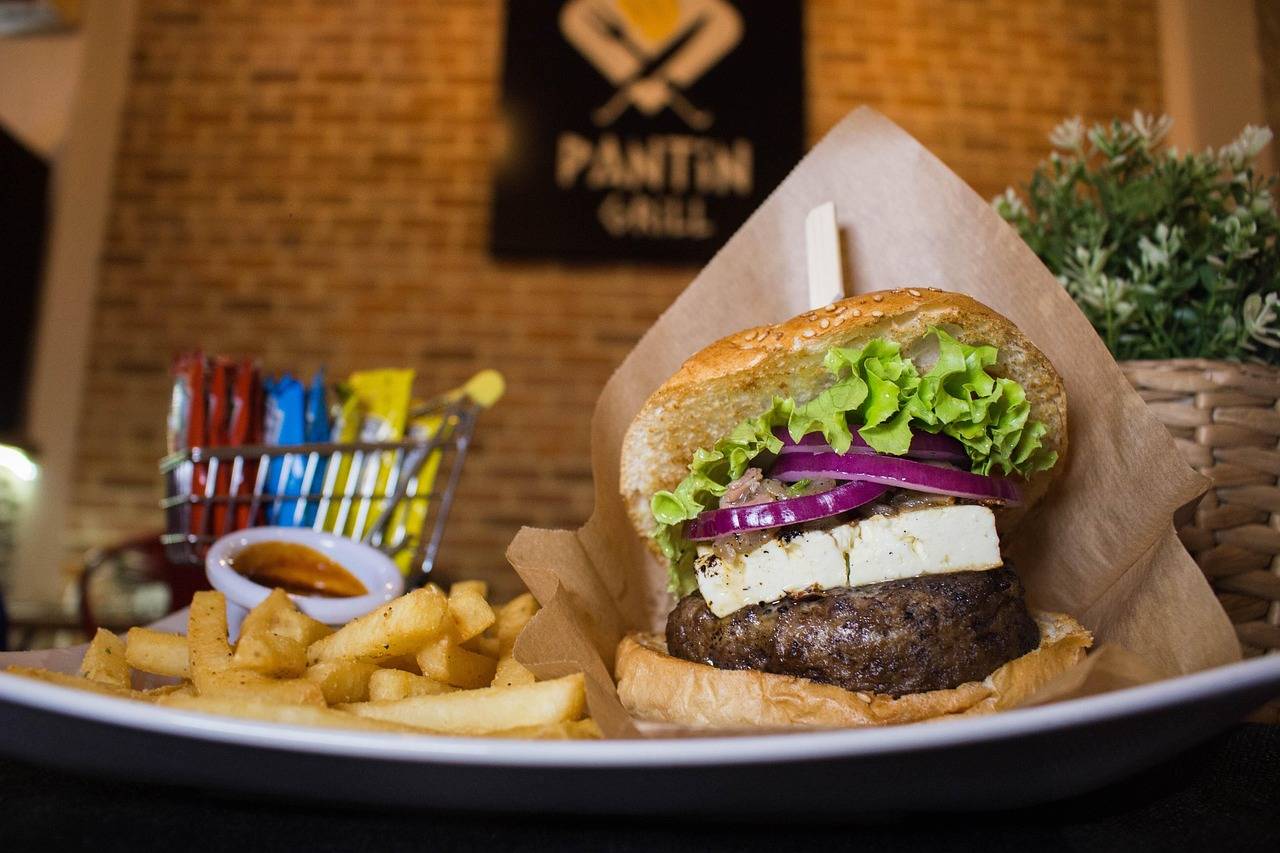
Core Viewpoint - Elon Musk's recent venture into the restaurant industry with the opening of a combined "restaurant + cinema + supercharging station" in Los Angeles signifies a strategic move to enhance brand loyalty and consumer engagement for Tesla [3][6][10]. Group 1: Restaurant Concept - The first Tesla restaurant, located at 7001 Santa Monica Boulevard in West Hollywood, features a retro-futuristic design inspired by 1950s car cinemas, with 80 V4 supercharging stations and two 45-foot LED movie screens [3][4]. - The restaurant offers a menu of American fast food, including burgers, fries, and milkshakes, with food delivered by staff on roller skates [3][4]. Group 2: Strategic Implications - Musk's entry into the restaurant business aligns with a broader trend where automotive brands create experiential spaces that combine dining and brand engagement, similar to Mercedes-Benz's experience store in Beijing [6][7]. - By integrating dining into Tesla's ecosystem, the company aims to enhance user experience and loyalty, allowing customers to enjoy meals while charging their vehicles [10][12]. - The restaurant serves as a platform to showcase Tesla's technological innovations, such as the Optimus robot, enhancing consumer interaction with the brand's cutting-edge services [9][10]. - If successful, this restaurant model could expand globally, increasing Tesla's brand visibility and customer base while providing valuable consumer data to improve automotive services [12].
United(UAL) - 2025 Q2 - Earnings Call Transcript
2025-07-17 15:30
Financial Data and Key Metrics Changes - United Airlines reported a top line revenue increase of 1.7% to a record $15.2 billion in Q2 2025 [24] - Earnings per share (EPS) was $3.87, exceeding Wall Street expectations of $3.81, and if excluding the impact of Newark disruptions, EPS would have been at the high end of guidance [36][37] - The company ended Q2 with $18.6 billion in liquidity and generated over $1.1 billion in free cash flow [40] Business Line Data and Key Metrics Changes - Consolidated TRASM decreased by 4% on a 5.9% increase in capacity, with adjusted TRASM expected to be down 2% to 3% without Newark's impact [24] - Premium cabin revenues increased by 5.6% year over year, while economy cabin revenues were negative [26] - Cargo performance was strong, with revenue up 4% year over year on record volumes [26] Market Data and Key Metrics Changes - International flying outperformed domestic, with a RASM decrease of 1% for international compared to a 7% decrease for domestic [25] - The Atlantic market experienced a 23% RASM growth since the pandemic but had negative RASM year over year in Q2 [25] - The company noted a significant recovery in Newark, with bookings largely recovered and operational performance improved [17][18] Company Strategy and Development Direction - The company emphasized revenue diversity as a key strategy, including both basic economy and premium offerings [11] - United Airlines plans to further lean into premium products and capacity in the coming years [26] - The company is focused on building domestic connectivity at its hubs and plans to introduce the Polaris Studio Suite to enhance premium capacity [34] Management's Comments on Operating Environment and Future Outlook - Management noted a positive inflection in demand due to reduced macroeconomic uncertainty, with a six-point positive swing in sales in July compared to Q2 [30] - The company expects continued stabilization in the geopolitical environment, which is driving stronger bookings [39] - Management expressed confidence in achieving double-digit margins in the long term, driven by brand loyalty and diversified revenue streams [38] Other Important Information - The company repurchased $235 million worth of shares during the quarter, leaving $829 million in authorization [42] - United Airlines paid down the remaining $1.5 billion balance of its MileagePlus bonds two years early, unencumbering a significant asset [40][41] Q&A Session Summary Question: Cost performance outlook - Management expressed pride in the cost performance, expecting similar results in Q3 and Q4, with distribution expenses decreasing as more customers choose direct channels [45][48] Question: Demand recovery status - Management indicated a six-point inflection in demand, particularly strong for business traffic, and noted that bookings have improved significantly [49][50] Question: Guidance adjustments - Management explained the conservative guidance approach, emphasizing the importance of delivering on commitments while acknowledging strong recent bookings [56][58] Question: Industry capacity dynamics - Management discussed the distinct demand situations among carriers and the natural tendency to push aircraft harder during peak periods, leading to capacity adjustments [96][98] Question: Newark's impact on performance - Management confirmed that the six-point improvement in performance is broad-based, with Newark showing significant recovery [102] Question: JetBlue partnership significance - Management highlighted the importance of the JetBlue partnership for expanding market presence and enhancing customer loyalty [104][106] Question: Connected Media update - Management reported progress in building technology and client roster for Connected Media, aiming to double revenues in 2025 [111] Question: Fleet and supply chain updates - Management noted that Boeing is performing well with narrow-body deliveries, while wide-body deliveries face some constraints [115][116]
特斯拉放大,求生欲太强啦
半佛仙人· 2025-07-16 13:48
Core Viewpoint - The article emphasizes that Tesla's unique brand loyalty and consumer attachment are crucial for its success, suggesting that the company should focus on expanding its vehicle offerings to cater to existing fans rather than trying to attract new customers [5][21][43]. Group 1: Brand Loyalty - Tesla users exhibit a strong preference for the brand, often disregarding competitors regardless of price or features [6][19]. - The article compares Tesla's consumer loyalty to that of Apple and Sony, indicating that once consumers are attached to the brand, they are unlikely to switch [20][21]. - The notion that Tesla buyers prioritize the brand itself over luxury features or interior design is highlighted, suggesting that the emotional connection to the brand is paramount [7][10][19]. Group 2: Product Expansion Strategy - The author argues that Tesla should focus on producing larger models to meet the needs of existing customers who may be constrained by space, such as those starting families [24][28]. - The recommendation is to "scale up" the product line, which is seen as a straightforward and effective strategy to increase sales [23][28]. - Historical examples from other brands (BBA) are cited to illustrate the success of expanding product offerings in the automotive industry [31][33]. Group 3: Market Positioning - The article asserts that Tesla's market position is not threatened by competitors, as its loyal customer base is unlikely to consider alternatives [35][36]. - The focus should be on removing barriers for existing fans to purchase more Tesla vehicles, rather than trying to convert non-fans [21][43]. - The discussion includes the idea that Tesla's identity as a brand is strong enough to withstand competition, emphasizing that the brand's essence is what drives sales [39][40].