
商品周期

Search documents
有色商品周期如何投射在A股?
Hua Er Jie Jian Wen· 2026-01-22 10:21
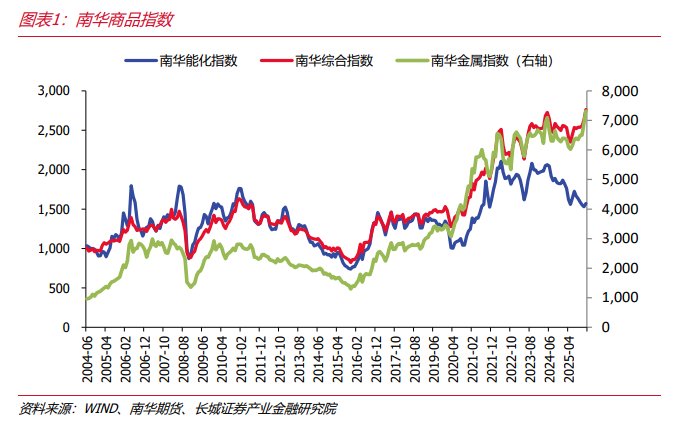
Group 1 - The current commodity market shows a significant divergence compared to previous cycles, with energy and non-ferrous metals exhibiting distinct trends [1][2] - The performance of non-ferrous metal stocks is influenced not only by commodity price movements but also by the overall market environment and style shifts in the A-share market [1][6] - Industrial metal stocks have shown greater elasticity in bull markets, outperforming commodity price increases, while precious metals stocks remain closely tied to commodity prices [1][6] Group 2 - The report outlines four typical commodity bull markets since 2004, highlighting the distinct phases of global demand expansion, liquidity easing, supply-side reforms, and pandemic recovery [2] - Post-2022, the commodity market has displayed notable differentiation, with energy and black metals stabilizing after volatility, while non-ferrous metals, particularly precious metals, have shown strong upward trends [2][4] - The correlation between commodity prices and stock performance varies, with industrial metals being more affected by A-share market performance, while precious metals exhibit a stronger independent trend [6][9] Group 3 - Recent data indicates that the valuation elasticity of the A-share non-ferrous metal sector has significantly surpassed that of commodity price elasticity, particularly for copper, aluminum, and energy metals [8] - The report concludes that sectors leaning towards "forward logic" (copper, aluminum, energy metals) contribute more to valuation, while those focused on "current profitability" (precious metals) tend to follow commodity price trends closely [8]

厦门象屿20251010
2025-10-13 01:00
Summary of Xiamen Xiangyu Conference Call Company Overview - Xiamen Xiangyu is a commodity trading supply chain company related to energy, profiting through wholesale price differences, transportation, and light processing services, while also providing financial and information services [2][4] Financial Performance - Since its listing in 2012, Xiamen Xiangyu's revenue has significantly increased from over 20 billion to 450 billion in 2022, and profits rose from over 200 million to 2.7 billion [2][5] - Despite a projected profit decline in 2024 to 1.4 billion, a recovery to nearly 2 billion is expected in 2025, with further growth anticipated to 2.2-2.3 billion in 2026 [2][5][6] - The company is characterized as a cyclical growth stock with a compound annual growth rate exceeding 20% [5] Market Dynamics - Xiamen Xiangyu's performance is closely tied to commodity cycles, with profitability increasing during active commodity markets [6] - The impact of de-capacity policies has diminished, leading the company into a new growth phase, with a reported growth of approximately 30% in Q2 2025 [6][7] Strategic Initiatives - The implementation of equity incentives and targeted placements, including the introduction of strategic investors like China Merchants and Shandong Port, indicates the company's confidence in future growth [2][7] - If profits recover to the 2.2-2.3 billion level in 2026, the corresponding valuation could reach around 40 billion, suggesting a growth potential of 60-100% [2][7] Industry Context - Other notable companies in the commodity trading supply chain include Wuchan Zhongda and Xiamen International Trade, each with unique characteristics but reliant on the commodity market for profitability [3][8] - Wuchan Zhongda has a strong financial attribute, while Xiamen International Trade focuses more on logistics development [8] Conclusion - The overall outlook for Xiamen Xiangyu is optimistic, supported by a recovering commodity market and strategic initiatives aimed at enhancing growth and profitability [7]

大宗商品会有新一轮牛市吗?
对冲研投· 2025-09-22 13:53
Core Viewpoint - The article emphasizes the importance of understanding economic cycles as a comprehensive product of economic, technological, and social systems, rather than merely focusing on macroeconomic indicators [2]. Group 1: Commodity Market Dynamics - Following the pandemic, global fiscal stimulus, geopolitical tensions, and a surge in AI capital expenditures have led to a bullish trend in metals and various commodities [3]. - The article questions whether the current commodity bull market can sustain itself and what underlying bullish drivers remain unrecognized by investment banks and media [3]. - The series aims to provide insights and materials for readers to make informed judgments and decisions regarding the commodity market [3]. Group 2: Market Participation and Trading Behavior - The article discusses the role of top traders and their actions in influencing market prices, suggesting that asset price changes are a result of complex interactions within economic and social systems [4]. - It highlights the importance of understanding market rhythms and the process of trading rather than relying solely on predictive models [4][5]. - Historical cycles of economic prosperity and recession (Kondratiev waves) are presented, indicating that the current phase may be entering a recovery period with increased investment demand [6]. Group 3: Strategic Role of Commodities - Recent political developments have led investment banks to believe that commodities will play a more strategic role in investment portfolios, with even a small allocation being considered beneficial [7]. - Goldman Sachs outlines a four-step "control cycle" for commodities, emphasizing the need for supply chain security, market share expansion, concentration of supply, and leveraging geopolitical tools [8][9][10]. - The article suggests that as commodities become a necessary part of investment strategies, their market dynamics will change, potentially leading to increased price volatility and inflation risks [10]. Group 4: Gold as a Safe Haven - The World Gold Council is planning to introduce "digital gold" to innovate the gold trading and settlement process, which could significantly alter the existing gold market ecosystem [15]. - The rising price of gold, particularly since the election of Trump, signals a shift in the global macro environment, indicating a potential bull market for commodities [17]. - The influx of capital into gold futures is expected to have a spillover effect on other commodities, leading to a broad-based bull market [17].

COMEX黄金价格创新高,有色金属ETF表现突出
Sou Hu Cai Jing· 2025-09-16 14:07
Group 1 - COMEX gold prices have reached a historical high of $3736 per ounce, with a cumulative increase of over 40% since 2025, significantly stimulating the A-share market, particularly the gold and non-ferrous metal sectors [1] - The leading non-ferrous metal ETF (159876) has seen a remarkable increase of 51.5% this year, attracting market attention [1] - The Federal Reserve's anticipated interest rate cut of 25 basis points, driven by a weak U.S. labor market, is expected to support economic growth rather than focus on controlling inflation [1] Group 2 - The non-ferrous metal ETF (159876) has a diversified investment portfolio, including 25.3% copper, 14.2% aluminum, and 13.6% gold, providing a good risk diversification mechanism for investors [2] - The domestic policy shift towards optimizing production capacity in the chemical industry is expected to create new development opportunities, as indicated by a narrowing decline in China's PPI to 2.9% year-on-year in August [2] Group 3 - The chemical industry is expected to experience a slowdown in capacity expansion due to orderly competition driven by anti-involution policies, which may enhance the overall industry outlook [3] - Leading chemical companies are showing signs of improvement, with Yangmei Chemical reducing its losses by 20.18% year-on-year in the first half of 2025 and decreasing financial expenses by 33.92% [3] Group 4 - The market is presenting a clear investment logic with the rise of gold prices and non-ferrous metals, suggesting that investors should focus on non-ferrous metal investment opportunities in a loose monetary environment [4] - The non-ferrous metal ETF (159876) and chemical ETF (516020) have seen significant year-to-date scale increases of 340% and 524%, respectively, indicating proactive market positioning [4]
2025 vs 1984:美国经济四大共性如何影响商品周期?
对冲研投· 2025-04-24 11:09
文 | 魏鑫 来源 | CFC商品策略研究 编辑 | 杨兰 审核 | 浦电路交易员 近期在美国关税政策的影响下,商品整体呈现偏弱态势,短期市场受困于捉摸不定的 美国政策,以及不明朗的经济前景。2025与1984年前后,美国经济与政策的存在共 性,我们复盘20世纪80年代的大宗商品走势,寻找未来商品行情演绎的方向。 当前美国与1984年的美国,在 经济环境、政府压力、汇率、政策 方面存在四大共 性,商品长期走势存在趋同的可能。当然, 历史并不会简单重复,在阶段性的行情表 现中,或存在走势的分化 。 01 商品价格周期性:1977、1984与2025 工业金属具有较高的价格弹性,且对经济、政策的变化极为敏感。为方便复盘,我们选 取CRB现货指数作为商品价格的代表,选取道琼斯工业指数作为美股的代表,并采用月 度均值,忽略较为短期的波动。可以发现在70年代,CRB金属的走势与2018年至今十分 相似,先从低位大幅上行,在高位明显回落之后,到达比上涨前更高的价格中枢并趋势 上行;从美股的表现来看,两个阶段的趋势性变化也有相似之处。 我们也可以找到80年代初与近五年市场走势的相似性。如果单纯地刻舟求剑,会认为近 年的价格 ...