
因城施策

Search documents
房地产去库存再加速!买商业用房最低首付降至30%
Di Yi Cai Jing· 2026-01-17 10:53
Core Viewpoint - The People's Bank of China and the National Financial Regulatory Administration have announced a policy to lower the minimum down payment ratio for commercial property loans to no less than 30%, aiming to adapt to changes in the real estate market and support a new development model [1][5] Group 1: Policy Implementation - The policy allows provincial branches of the People's Bank of China and local regulatory agencies to set their own minimum down payment ratios based on local government requirements, following the principle of "differentiated measures" [1] - Prior to this policy, most cities had a minimum down payment requirement of around 50%, with some banks setting it as high as 60% or more [1][2] Group 2: Market Conditions - The commercial property market is facing high inventory levels and slow absorption rates, with office buildings and commercial properties accounting for 25.7% of the total unsold residential properties in China as of November 2025 [2] - The average absorption period for commercial properties is reported to be around 30 months, with some areas experiencing periods of 50 to 70 months [2] Group 3: Demand Dynamics - There is a rising interest from institutional and individual investors in commercial properties, particularly in long-term rental products such as serviced apartments [3] - In Shenzhen, the proportion of non-residential new home transactions reached 31.4% in 2025, indicating a growing preference for rental-oriented products [3] Group 4: Local Measures - Various cities have implemented localized measures to stimulate the commercial property market, including allowing the conversion of commercial properties to rental housing and providing purchase subsidies [4] - For example, Shanghai permits business buildings to be used for various functions, while Wuhan offers a 50% subsidy on deed tax for new commercial property purchases [4] Group 5: Strategic Shift - The shift in policy reflects a broader trend of extending support from residential to commercial and industrial real estate, embodying a "precise drip irrigation" approach to regulation [5] - Lowering financial barriers for commercial real estate is seen as a targeted easing measure to invigorate the market and support a stable transition to a new development model in the real estate sector [5]
控增量、优供给 稳定房地产市场
Ren Min Ri Bao· 2026-01-13 22:13
Core Viewpoint - Nanning, Guangxi is implementing various subsidy policies for different housing groups, with a maximum subsidy of 60,000 yuan, to enhance the housing market and meet diverse residential needs [1] Group 1: Subsidy Policies - Subsidy policies are available for newlyweds, families with multiple children, recent college graduates, and those participating in "trade-in" programs [1] - The maximum subsidy amount is set at 60,000 yuan [1] Group 2: Housing Supermarket - Nanning's housing supermarket, the first of its kind in Guangxi, opened to the public in early 2025 and has already received over 5,000 visitors [1] - The supermarket displays information on nearly 200 projects across six main urban areas and three development zones, covering various housing types [1] Group 3: Supply Control and Quality Improvement - Nanning aims to control supply and optimize housing quality by focusing on key areas and ensuring land supply for essential and improved housing projects [1] - The city plans to enhance housing quality through revised technical standards and improved construction practices, addressing the diverse needs for comfortable and healthy living [1]
公积金迎大改革:10万亿“沉睡资金”怎么用
2 1 Shi Ji Jing Ji Bao Dao· 2026-01-13 12:46
Core Viewpoint - The recent discussions around the reform of the housing provident fund system indicate a significant shift aimed at enhancing its effectiveness and expanding its usage, reflecting a broader commitment to improving housing accessibility for residents [1][2]. Group 1: Current Issues with the Provident Fund - The call for reform is driven by several issues, including the narrowing interest rate gap between commercial loans and provident fund loans [2]. - Some cities impose restrictions requiring the provident fund deposit location, home purchase location, and household registration to be the same, complicating cross-city home purchases [2]. - There are limitations on the conditions and amounts for converting commercial loans to provident fund loans [2]. Group 2: Future Directions for Reform - The reform will focus on expanding the usage of the provident fund beyond home purchases to include down payments, property fees, and renovations [3]. - There will be an emphasis on improving fund efficiency to ensure that more money is actively utilized rather than remaining idle in accounts [4]. - The reform aims to support inter-city recognition and lending, allowing the provident fund to follow individuals' work and life changes [5]. - More flexible employment individuals, such as freelancers and self-employed workers, will be encouraged to participate in the provident fund system [5]. - Increased support for affordable housing, urban renewal, and the renovation of old neighborhoods will be prioritized, enhancing urban livability [5].
公积金迎来大改革:10万亿“沉睡资金”怎么用?
2 1 Shi Ji Jing Ji Bao Dao· 2026-01-12 12:58
Core Viewpoint - The recent discussions around the reform of the housing provident fund system indicate a significant shift aimed at enhancing its effectiveness and expanding its usage, reflecting the government's commitment to address existing issues and improve housing accessibility for residents [1][2]. Group 1: Current State of the Housing Provident Fund - The housing provident fund has been a crucial tool for adjusting real estate policies since its implementation in the 1990s, with a total balance expected to reach 10.9 trillion yuan by the end of 2024 [1]. - The fund's effectiveness has room for improvement, prompting the need for substantial reforms rather than minor adjustments [1]. Group 2: Reasons for Reform - Recent calls for reform stem from issues such as the narrowing interest rate gap between commercial loans and provident fund loans, and restrictive policies in some cities that hinder cross-city home purchases [2]. - Limitations on converting commercial loans to provident fund loans also contribute to the need for reform [2]. Group 3: Future Directions of Reform - The reform is expected to expand the usage of the provident fund beyond home purchases to include down payments, property fees, and renovations [2]. - Enhancing fund efficiency is a priority, aiming to increase the flow of money rather than allowing it to remain idle [2]. - The reform will support inter-city recognition and lending, allowing the fund to follow individuals' work and life changes [2]. - More flexible employment groups, including freelancers and self-employed individuals, will be encouraged to participate in the provident fund system [2]. - Increased support for affordable housing, urban renewal, and the renovation of old neighborhoods is also a key focus, aiming to improve living conditions [2].
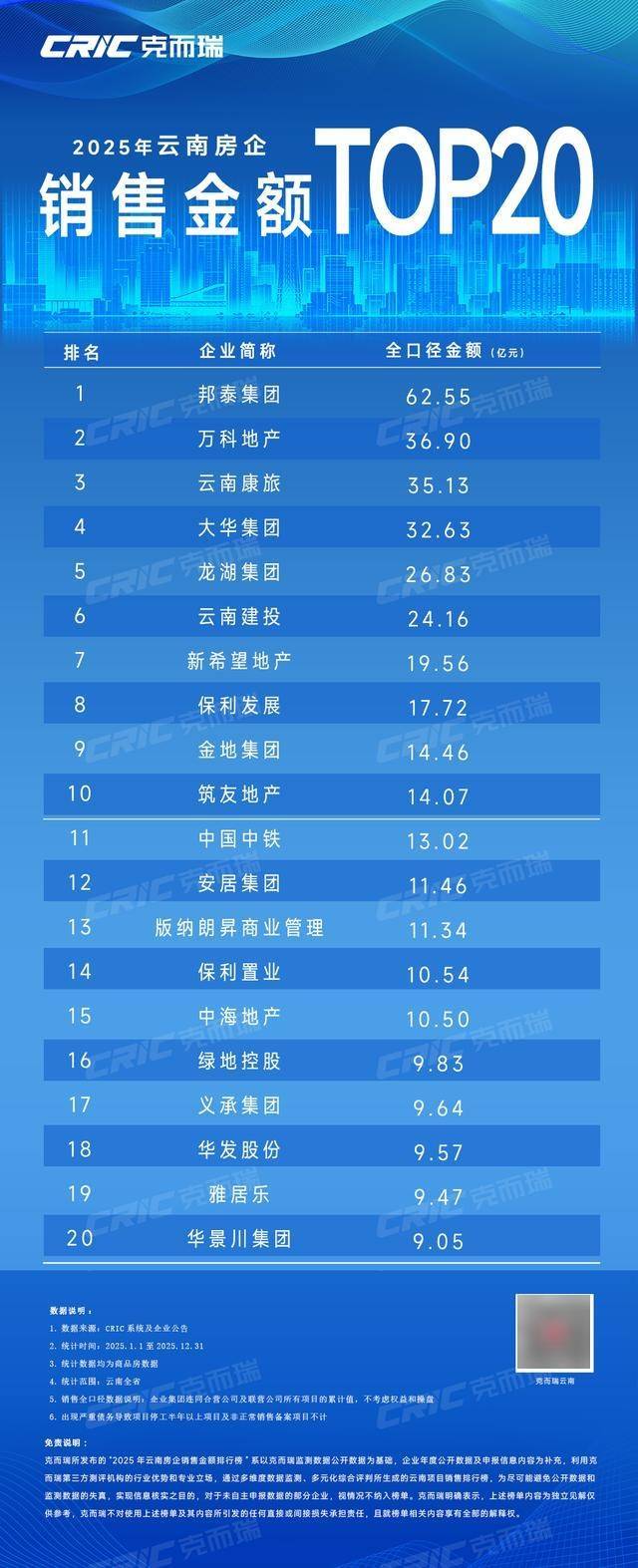
2025年云南房企销售TOP20榜单公布
Sou Hu Cai Jing· 2026-01-11 16:05
Core Insights - The 2025 Yunnan real estate market is under pressure, but leading companies have achieved performance breakthroughs through efficient new project launches and marketing innovations [1][4] - The strategic focus of real estate companies is shifting, with contributions from cities gradually decreasing and market differentiation becoming more pronounced [1][7] Group 1: Sales Rankings and Performance - The top 20 real estate companies in Yunnan for 2025 have a sales threshold of 9.05 billion yuan, a 17% decrease year-on-year, indicating increased competitive pressure in the industry [4] - Bangtai Group leads the rankings with a sales amount of 62.55 billion yuan, showing a 25% year-on-year increase and a remarkable 164% growth compared to 2024 [4][5] - Vanke Real Estate and Yunnan Kanglv follow in second and third place with sales of 36.90 billion yuan and 35.13 billion yuan, respectively, with Vanke showing a two-position improvement in the rankings [4][5] Group 2: Market Trends and Dynamics - The overall market for commodity housing in Yunnan faces challenges, with new construction area down 3% and real estate investment down 5% year-on-year [4] - The land market shows a significant decline in supply area by 19%, while transaction area increased by 8%, and floor prices rose by 37.85% year-on-year [4] - The contribution of city-level performance has decreased to 18%, down 6 percentage points from the first half of the year, as national brands adjust their regional strategies [7] Group 3: City-Level Insights - Kunming remains the main support for land transactions, accounting for 22% of the total transaction area in the province, with both transaction volume and prices rebounding despite overall supply declines [8] - Other cities like Dali, Lijiang, and Zhaotong are experiencing localized structural recoveries, benefiting from the sales of quality residential projects [8] - The tourism and cultural sectors in cities like Xishuangbanna are facing price declines due to promotional discounts, while Dali and Lijiang show healthy market conditions with rising volumes and prices [8] Group 4: Future Outlook - Future policies are expected to focus on more precise and actionable measures to stimulate demand, as the effectiveness of housing purchase subsidies diminishes [9] - The market is anticipated to become more refined and differentiated, with leading companies leveraging their strengths to seize opportunities amid structural adjustments and regional differentiation [9]



地产及物管行业周报:住建部明确因城施策稳定房地产市场,北京进一步放松限购政策-20251228
Shenwan Hongyuan Securities· 2025-12-28 06:12
Investment Rating - The report maintains a "Positive" rating for the real estate and property management sectors [4][31]. Core Insights - The real estate market is showing signs of recovery, with new home sales in 34 key cities increasing by 17.3% week-on-week, and a notable policy shift in Beijing to relax purchase restrictions [4][31]. - The report identifies two major opportunities: the rise of favorable housing policies and the strong performance of quality commercial enterprises during a monetary easing cycle, which could lead to a revaluation of consumer-oriented commercial real estate assets [4][31]. Industry Data Summary New Home Sales - New home sales in 34 key cities totaled 3.63 million square meters, up 17.3% week-on-week, with first and second-tier cities seeing a 19.9% increase, while third and fourth-tier cities experienced a 13.6% decline [5][7]. - Year-on-year, December sales in 34 cities dropped by 29%, with first and second-tier cities down 28.4% and third and fourth-tier cities down 35.7% [7][8]. Second-Hand Home Sales - Second-hand home sales in 13 key cities reached 1.22 million square meters, a 2.4% increase week-on-week, but down 31.2% year-on-year [12][24]. Inventory and Market Dynamics - The inventory of unsold residential properties in 15 cities increased by 0.3% to 90.67 million square meters, with a month’s supply of 22.7 months, reflecting a slight increase [24][31]. Policy and News Tracking Macro Policies - The Ministry of Housing and Urban-Rural Development has emphasized city-specific policies to stabilize the real estate market, with measures to control supply and reduce inventory [31][34]. - Beijing has announced adjustments to purchase restrictions, including reduced social security or tax requirements for non-local families and optimized credit policies [31][34]. Company Developments - Poly Real Estate has received approval to issue 5 billion yuan in convertible bonds, while Vanke has extended the grace period for a 2 billion yuan medium-term note [39][40]. - China Jinmao successfully sold its 100% stake in the Ritz-Carlton Hotel in Sanya for 2.26 billion yuan [40].
21社论丨发挥协同效应,稳定房地产市场
2 1 Shi Ji Jing Ji Bao Dao· 2025-12-26 19:54
Core Viewpoint - The recent policy adjustments in Beijing aim to stabilize the real estate market by optimizing purchase restrictions and housing credit policies, with expectations for more cities to follow suit [1] Group 1: Policy Adjustments - Beijing has issued a notice to further optimize and adjust real estate policies, focusing on stabilizing the market [1] - The adjustments are in line with the requirement to eliminate unreasonable restrictive measures on housing consumption and are tailored to local conditions [1] - The central economic work conference has set a clear goal for next year's real estate work, emphasizing the need to stabilize the market and implement city-specific measures [2] Group 2: Market Dynamics - The real estate market is currently experiencing a "strong supply and weak demand" situation due to a large stock of new homes and the inclusion of second-hand homes in the market [1] - The stock of unsold homes should be encouraged to be purchased by local governments for use as affordable housing, which can help restore market confidence [2] - The proportion of second-hand home transactions has increased from less than 28% at the end of the 13th Five-Year Plan to 45% currently, with major cities seeing over 60% [2] Group 3: Rental Market and Investment - Rental yields in first-tier cities are recovering, and declining interest rates are making rental returns more attractive, creating favorable conditions for market stability [3] - The relationship between market supply and demand has fundamentally changed, necessitating a comprehensive approach to stabilize the real estate market [3] - Cities should balance various aspects such as market and security, rental and purchase, and new and second-hand homes to effectively reduce inventory [3]
控增量、去库存、优供给丨2026年我国房地产市场供给侧三大重点解读
Xin Hua Wang· 2025-12-26 02:41
Core Viewpoint - The recent Central Economic Work Conference emphasizes a policy of "controlling increment, reducing inventory, and optimizing supply" in the real estate sector, with a focus on adapting strategies to local conditions [1][2]. Group 1: Policy Implementation - The policy of "controlling increment" is essential for stabilizing the market, as the real estate market exhibits significant regional characteristics and varying supply-demand dynamics across different areas [1]. - Experts suggest that local governments should implement precise controls based on core data such as population trends, housing inventory, and second-hand housing listings, adhering to the principle of "people-land-housing-money" coordination [1][2]. - The shift to a stock-dominated real estate market is a necessary trend, with the majority of demand now coming from improvement needs, which are typically met through a "buy-sell" replacement model [2]. Group 2: Inventory Reduction - The key to "reducing inventory" lies in achieving a basic balance between supply and demand, addressing the mismatch between excess stock and effective housing demand [2]. - Measures to control new real estate land supply in cities with excess inventory and to encourage the renovation of old housing can significantly alleviate supply-demand conflicts and stabilize market expectations [2][3]. Group 3: Supply Optimization - The initiative to acquire existing residential properties for use as affordable housing can quickly reduce market inventory while also broadening the supply channels for affordable housing, thus achieving dual breakthroughs in "reducing inventory" and "supplying guarantees" [3]. - The focus on optimizing supply aims to enhance housing quality and better meet the diverse needs of different demographic groups, with an emphasis on improving the precision and effectiveness of housing guarantees [3][4]. - The integration of "controlling increment, reducing inventory, and optimizing supply" forms a complete logical chain for the supply-side reform of the real estate sector, aiming for a dynamic balance in market supply and demand [4].
控增量 去库存 优供给
Xin Lang Cai Jing· 2025-12-25 19:23
Core Viewpoint - The recent Central Economic Work Conference emphasizes a policy of "controlling increment, reducing inventory, and optimizing supply" in the real estate sector, with a focus on utilizing existing housing stock for affordable housing and other purposes [1] Group 1: Policy Implementation - The policy of "controlling increment" is essential for stabilizing the market, as the real estate market exhibits significant regional characteristics and varying supply-demand dynamics across different cities and districts [1] - Experts suggest that local governments should implement precise controls based on core data such as population trends, existing housing stock, and inventory levels, adhering to the principle of "people-land-housing-money" coordination [1] Group 2: Market Transition - The real estate market in China is transitioning to a stage dominated by existing stock, driven by substantial urban housing inventory and a shift towards improvement demand as the market's main driver [2] - Measures to control new real estate land supply in cities with excess inventory and to encourage the renovation of old housing are crucial for stabilizing market expectations and alleviating supply-demand conflicts [2] Group 3: Inventory Reduction - The "reducing inventory" initiative is not merely about clearing stock but involves a systematic approach that balances market stability, public welfare, and urban upgrades [2] - The acquisition of existing housing for use as affordable housing can quickly alleviate market inventory and financial pressures on developers while expanding the supply of affordable housing [2] - Provinces like Zhejiang, Sichuan, Shandong, and Hunan have issued special bonds to acquire existing housing and convert it into affordable housing, creating replicable practices [2] Group 4: Quality Improvement - Enhancing the precision and effectiveness of housing security is vital for ensuring that everyone has access to housing [3] - The focus on quality construction involves promoting standards, designs, materials, and maintenance practices to lower costs and improve housing quality [3] - The integration of "controlling increment, reducing inventory, and optimizing supply" forms a complete logical chain for real estate supply-side reform, aiming for a dynamic balance in market supply-demand relationships [3]
控增量、去库存、优供给——2026年我国房地产市场供给侧三大重点解读
Xin Hua Wang· 2025-12-25 12:23
Core Viewpoint - The central economic work meeting emphasizes "controlling increment, reducing inventory, and optimizing supply" as key strategies for the real estate market in China by 2026, focusing on tailored policies for different cities to stabilize the market [1][2]. Group 1: Controlling Increment - The concept of "controlling increment" aligns with the transition to a stock-dominated market, indicating a shift in development strategy as the real estate market matures [2]. - Experts highlight the necessity of strict control over new real estate land in cities with excess supply, promoting urban renewal and the repurposing of existing land to alleviate supply-demand imbalances [2][3]. Group 2: Reducing Inventory - The primary challenge in the current real estate market is the mismatch between excess inventory and effective housing demand, necessitating a systematic approach to inventory reduction that balances market stability and urban upgrading [2][3]. - Initiatives to acquire existing housing for use as affordable housing can quickly alleviate market inventory and reduce financial pressure on developers, while also broadening the supply channels for affordable housing [3]. Group 3: Optimizing Supply - The focus on optimizing supply aims to enhance housing quality and better meet diverse housing needs, which is crucial for long-term market stability [3][4]. - Experts advocate for improving the precision and effectiveness of housing guarantees, promoting high standards in construction and design to lower costs and enhance the overall quality of housing [3][4]. Group 4: Integrated Approach - The integrated approach of "controlling increment, reducing inventory, and optimizing supply" forms a complete logical framework for supply-side reform in the real estate sector, aiming for dynamic balance in market supply and demand [4][5].