增值税新政

Search documents
中加基金权益周报︱央行呵护增值税新券发行,债市情绪不弱
Xin Lang Ji Jin· 2025-08-14 09:19
Market Overview and Analysis - The primary market saw the issuance of government bonds, local government bonds, and policy financial bonds amounting to 468.6 billion, 165.5 billion, and 174.5 billion respectively, with net financing of 338.6 billion, 82.8 billion, and 174.5 billion [1] - Financial bonds (excluding policy financial bonds) totaled an issuance of 132.0 billion with a net financing of 12.5 billion [1] - Non-financial credit bonds had an issuance of 357.9 billion and a net financing of 198.7 billion [1] - One new convertible bond was issued with an expected financing scale of 1.17 billion [1] Secondary Market Review - The bond market showed resilience amidst a strong stock market environment, influenced by factors such as the month-end liquidity, new VAT policies, and central bank's buyout operations [2] Liquidity Tracking - Post month-end, the liquidity naturally eased, and the central bank's announcement of buyout reverse repos further supported new bond issuance, leading to an overnight funding rate dropping below 1.3%, which pushed down funding prices [3] - The R001 and R007 rates decreased by 1.3 basis points and 3.3 basis points respectively compared to the previous week [3] Policy and Fundamentals - July economic data indicated resilient export growth, with core CPI rising for five consecutive months, although the anti-involution policy slightly hindered PPI transmission [4] - High-frequency data showed a slight decline in production and sustained low levels in consumption, with both food and commodity prices decreasing [4] Overseas Market - The easing of the Russia-Ukraine conflict improved market risk sentiment, while deviations in U.S. Treasury auctions put pressure on U.S. bonds, with the 10-year U.S. Treasury closing at 4.27%, up 4 basis points from the previous week [5] Equity Market - The market returned to an upward trend, with the Shanghai Composite Index reaching a new high for the year, while the overall A-share market rose by 1.94% with reduced trading volume, maintaining an average daily trading volume of 1.7 trillion [6] - As of August 7, 2025, the total financing balance for the entire A-share market was 1,998.9 billion, an increase of 27.9 billion from July 31 [6] Bond Market Strategy Outlook - In a low-interest-rate environment, traditional allocations of new funds by residents and institutions towards deposits and bonds are beginning to shift towards assets with rights, forming the basis for the stock market bull run this year [7] - This behavior will not change the downward trend of bond market interest rates but may delay the speed of decline and increase short-term volatility [7] - With the impact of the VAT recovery subsiding, the 10-year bond yield may return below 1.7%, potentially weakening market bullish sentiment [7] - The further downward space for interest rates depends on the central bank's continued support for new bond issuances affected by VAT and the pace of stock market increases [7] - For credit bonds, a relatively loose liquidity environment remains favorable, but attention should be paid to the issue of excessive narrowing of credit spreads [7] - In the convertible bond market, following the rollback of previous anti-involution expectations, there is renewed selection space for convertible bonds, with high-priced bonds not entering conversion periods and those not strongly redeemed gradually moving towards dual highs, maintaining a good overall profit effect [7] - It is important to note that the current risk-reward asymmetry has weakened, and some volatility is inevitable, making participation more challenging for low-volatility strategy investors [7]
【中国银河固收】周报 | 债市震荡偏多,关注交易性机会
Xin Lang Cai Jing· 2025-08-11 10:54
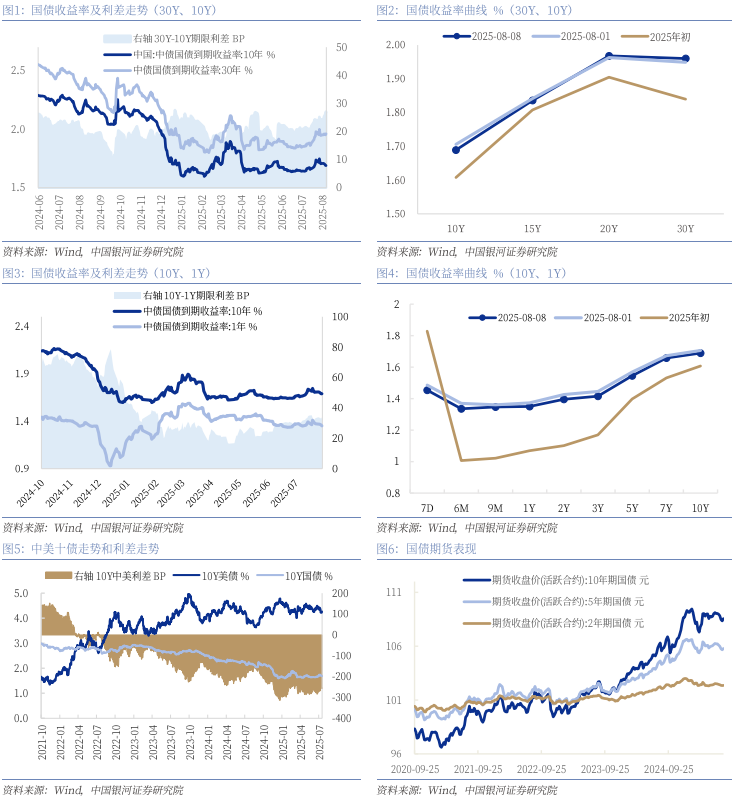
Group 1 - The core viewpoint of the article indicates that the bond market experienced a downward trend in yields, primarily influenced by a loose funding environment and the new VAT policy, resulting in a steepening yield curve [1][6] - As of August 8, the yields for 30Y, 10Y, and 1Y government bonds changed by 1.1BP, -1.68BP, and -2.28BP, respectively, closing at 1.96%, 1.69%, and 1.35% [1][6] - The yield spread between 30Y-10Y and 10Y-1Y increased by 2.78BP and 0.6BP to 27.09BP and 33.85BP, indicating a steepening of the yield curve [1][6] Group 2 - The bond issuance scale from August 4 to August 10 saw an overall increase, with government bonds issued amounting to 468.55 billion yuan, local bonds at 165.46 billion yuan, and interbank certificates of deposit at 775.88 billion yuan, totaling an increase of 505.72 billion yuan compared to the previous week [2][18] - The issuance progress of local bonds reached 64.7%, with new special bonds and general bonds at 64% and 68.2%, respectively, indicating a steady issuance pace [2][18] Group 3 - The central bank's net withdrawal through reverse repos was 536.5 billion yuan from August 4 to August 8, with a subsequent announcement of a 700 billion yuan buyout reverse repo, maintaining a balanced and loose funding environment [3][20] - The DR001 rate slightly decreased by 0.23BP to 1.31%, while the DR007 remained stable at 1.43% [3][20] Group 4 - The bond market strategy suggests a bullish outlook with a focus on trading opportunities, emphasizing the need to monitor four key factors: improvement in the fundamentals, the central bank's support for a balanced funding environment, the impact of the VAT policy on market volatility, and the balance between stocks and bonds [4][22] - The strategy recommends maintaining duration in a volatile market while focusing on trading values of old bonds and allocation values of new bonds, with a caution to take profits when yields are low [5][23]


【机构观债】2025年7月债市成交持续回温 信用利差延续震荡
Xin Hua Cai Jing· 2025-08-06 08:15
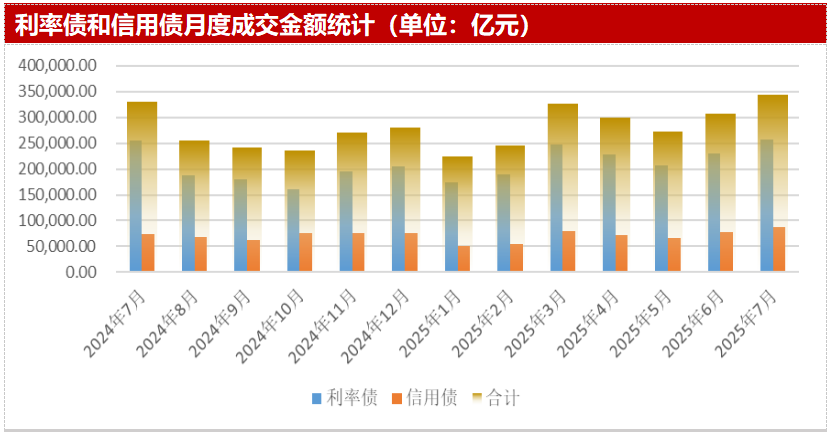
Core Viewpoint - The bond secondary market showed increased trading activity in July, particularly in credit bonds, with a "V-shaped" trend in credit spreads, which first narrowed and then widened, ending the month at a low level for the year [1][4]. Trading Activity - The total transaction amount in the bond secondary market for July reached 413,960.27 billion, representing a year-on-year increase of 3.28% and a month-on-month increase of 9.36% [2]. - In terms of bond types, interest rate bonds had a transaction amount of 256,461.17 billion, with a year-on-year increase of 0.38% and a month-on-month increase of 11.88%. Credit bonds had a transaction amount of 86,840.69 billion, showing a year-on-year increase of 16.32% and a month-on-month increase of 12.28% [4]. Credit Bond Characteristics - The transaction structure of credit bonds showed divergence, with industrial bonds experiencing a significant increase in transaction volume by 22.35%, but a decline in quality as the proportion of AAA-rated bonds decreased while AA+ and AA-rated bonds increased. The duration extended towards the 3-5 year medium to long term [4]. - Conversely, city investment bonds saw a slight decrease in transaction volume by 2.40%, with credit quality concentrating towards AAA-rated bonds and durations extending beyond 5 years [4]. Credit Spread Trends - The overall credit spread exhibited a "V-shaped" trend, narrowing initially and then widening, with the month-end spread at 44.99 basis points, which is an increase of 14.54 basis points compared to the same period last year, but a slight decrease of 1.33 basis points from the end of the previous month [4]. Industry Spread Analysis - As of July 31, the median credit spreads by industry showed high spreads in textiles and apparel (153.07 bp), real estate (98.47 bp), and electrical equipment (86.35 bp), while public utilities and transportation had lower spreads (44.89 bp and 46.84 bp respectively) [5]. - Most industries in the industrial bond sector saw a decrease in credit spreads, with upstream energy remaining stable, while the communication sector in midstream manufacturing experienced a slight widening [5]. Future Outlook - The trading activity in credit bonds is expected to continue to rise, with credit spreads likely to remain within a fluctuating range. The implementation of the new VAT policy is expected to maintain the tax burden on industrial and city investment bonds, enhancing their comparative advantages and potentially increasing institutional demand [4][5].
增值税新政落地前夕,政策性金融债单日发行数量创20余年来新高
Sou Hu Cai Jing· 2025-08-06 00:16
Group 1 - The core point of the article is that China Agricultural Development Bank and China Exim Bank are set to issue a total of 6 financial bonds on August 6, marking the highest number of financial bonds issued in a single day since 2002 [1] - China Agricultural Development Bank plans to issue financial bonds totaling no more than 42 billion yuan across four maturities: 392 days, 3 years, 5 years, and 10 years [1] - China Exim Bank plans to issue financial bonds totaling no more than 9 billion yuan with maturities of 15 months and 66 months [1] Group 2 - After August 8, the interest income from newly issued national bonds, local government bonds, and financial bonds will be subject to value-added tax again [1]
恢复征收国债等利息增值税,居民月购10万免税
Sou Hu Cai Jing· 2025-08-05 21:43
Core Viewpoint - The new VAT policy for individual investors aims to alleviate fiscal pressure and redirect funds from the bond market to the stock market, with the exemption lasting until December 31, 2027 [2][3]. Group 1: Policy Changes - From August 8, 2025, interest income from newly issued government bonds, local government bonds, and financial bonds will be subject to VAT [2][3]. - Existing bonds issued before August 8, 2025, will continue to be exempt from VAT until maturity [2][3]. - Small-scale VAT taxpayers with monthly sales below 100,000 yuan will be exempt from VAT until December 31, 2027 [2][3]. Group 2: Fiscal Implications - The new policy is expected to increase fiscal revenue, with estimates suggesting a potential short-term revenue of approximately 33.7 billion yuan from the new VAT on bond interest [3][4]. - The total issuance of government bonds, local government bonds, and financial bonds in 2024 is projected to reach 32.6 trillion yuan [3]. - The overall VAT revenue from bond interest could reach around 100 billion yuan in the future, considering the expanding fiscal policy and increasing bond issuance [3][4]. Group 3: Market Impact - The adjustment in VAT policy is anticipated to enhance the attractiveness of equity assets compared to bonds, as the after-tax returns on bonds will decrease [4]. - Financial institutions may prefer to hold older bonds that remain exempt from VAT, limiting the impact of the new policy on the market [4][5]. - The overall influence of the tax policy change on the bond market is expected to be limited due to the large existing bond issuance and the market's capacity to absorb new bonds [5].