
大宗商品价格指数

Search documents
数览今年大宗商品市场“稳+升” 我国经济结构朝着更健康、更可持续方向优化
Yang Shi Wang· 2025-12-19 09:53
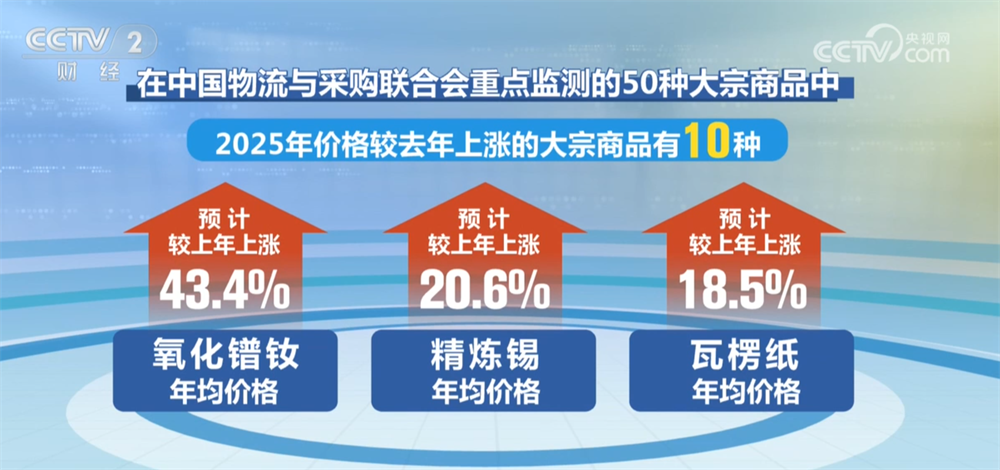
Core Viewpoint - The report indicates that the overall operation of the bulk commodity market in China is stable, with significant characteristics of new and old kinetic energy conversion [1] Group 1: Price Index Forecast - The average price index for bulk commodities in China is expected to be 112.1 points in 2025, a decrease of 0.1% compared to the previous year [2] - Among the 50 bulk commodities monitored, 10 are expected to see price increases, with neodymium oxide, refined tin, and corrugated paper projected to rise by 43.4%, 20.6%, and 18.5% respectively [2] Group 2: Industry Analysis - The non-ferrous metal industry is expected to see a 4.2% increase compared to 2024, driven by the rapid growth of high-tech manufacturing and high-end equipment manufacturing in sectors such as new energy, photovoltaics, and wind power [3] - The average price index for agricultural products is projected to be 96.7 points, reflecting a 0.4% decrease from the previous year, with stable supply and demand for key agricultural products [3] Group 3: Economic Outlook - Experts suggest that the overall trend of the bulk commodity index will show a pattern of low at the beginning and high at the end, indicating a stabilization and recovery, which reflects a healthier and more sustainable optimization of China's economic structure [4] - The strong resilience and significant domestic demand potential of the Chinese economy are expected to remain the solid foundation for the bulk commodity market in 2026 [4]

报告:2025年大宗商品价格指数呈现前低后高、企稳回升态势
Xin Hua Cai Jing· 2025-12-19 03:10
Group 1 - The core viewpoint of the report indicates that the overall price index for bulk commodities in China is expected to show a trend of low first and high later, stabilizing and recovering, reflecting a healthier and more sustainable economic structure [1] - The average price index for bulk commodities in China for 2025 is projected to be 112.1 points, a slight decrease of 0.1% compared to the previous year [1] - Among the 50 monitored bulk commodities, 10 are expected to see price increases, with notable rises in neodymium oxide (43.4%), refined tin (20.6%), and corrugated paper (18.5%) [1] Group 2 - The non-ferrous price index is expected to stand out with an average of 131 points, an increase of 4.2% year-on-year, driven by high growth in high-tech manufacturing and equipment sectors, alongside supply disruptions from incidents like the mudslide at Indonesia's Grasberg copper mine [1] - The black, energy, chemical, and mineral indices are projected to decline, with average values of 78.8 points, 99.1 points, 102.7 points, and 73.9 points respectively, reflecting decreases of 7.5%, 9.9%, 10.2%, and 10.6% [2] - The agricultural product price index is expected to fluctuate downwards, averaging 96.7 points, a slight decrease of 0.4%, attributed to effective implementation of national food security strategies and balanced supply and demand for key agricultural products [2] Group 3 - The overall stability of the bulk commodity market is highlighted, with a clear transition between old and new growth drivers, supported by government policies aimed at promoting consumption and stabilizing growth [3] - The resilience of the Chinese economy and its substantial domestic demand potential are seen as the strongest foundation for the global bulk commodity market moving forward into 2026 [3] - The conference focused on enhancing international influence and building credible trade rules, discussing future trends, challenges, and opportunities in global bulk commodity trade [3]
新旧动能转换特征明显 今年我国大宗商品价格指数报告发布
Yang Shi Xin Wen· 2025-12-19 02:24
Core Insights - The China Logistics and Purchasing Federation released the "China Commodity Price Index Report (2025)" indicating a stable overall operation of the commodity market in 2023, with significant characteristics of new and old energy conversion [1] Group 1: Commodity Price Index - The average commodity price index in China for 2025 is expected to be 112.1 points, a decrease of 0.1% compared to the previous year [1] - Among the 50 monitored commodities, 10 are expected to see price increases in 2025, with neodymium oxide, refined tin, and corrugated paper projected to rise by 43.4%, 20.6%, and 18.5% respectively [1] Group 2: Industry Performance - The non-ferrous metal industry is expected to see a 4.2% increase compared to 2024, driven by the rapid growth of high-tech manufacturing and high-end equipment manufacturing sectors such as new energy, photovoltaics, and wind power [1] - The agricultural product price index is projected to average 96.7 points, reflecting a 0.4% decrease from the previous year, with stable supply and demand for key agricultural products [1] Group 3: Economic Outlook - Experts predict that the overall commodity index will show a trend of low to high, stabilizing and recovering, indicating a healthier and more sustainable optimization of China's economic structure [1] - The strong resilience and significant domestic demand potential of the Chinese economy are expected to remain the most solid foundation for the commodity market in 2026 [1]
《中国大宗商品价格指数报告(2025)》发布 市场总体平稳
Xin Lang Cai Jing· 2025-12-19 02:08
Core Viewpoint - The report from the China Federation of Logistics and Purchasing indicates a stable operation of the bulk commodity market in 2025, with a slight expected decline in the average price index compared to the previous year [1] Group 1: Price Index Forecast - The average price index for bulk commodities in China is projected to be 112.1 points in 2025, a decrease of 0.1% from the previous year [1] - Among the 50 monitored bulk commodities, 10 are expected to see price increases in 2025, including neodymium oxide (up 43.4%), refined tin (up 20.6%), and corrugated paper (up 18.5%) [1] Group 2: Sector Analysis - The non-ferrous metals industry is expected to see a 4.2% increase compared to 2024, driven by the rapid growth of high-tech manufacturing sectors such as new energy, photovoltaics, and wind power [1] - The agricultural product price index is forecasted to average 96.7 points, reflecting a 0.4% decline from the previous year, with stable supply and demand for key agricultural products [1] Group 3: Economic Outlook - Experts suggest that the overall trend for the bulk commodity index in 2025 will show a pattern of initial decline followed by stabilization and recovery, indicating a healthier and more sustainable economic structure in China [1] - The strong resilience and significant domestic demand potential of the Chinese economy are expected to remain the solid foundation for the bulk commodity market in 2026 [1]
连涨七个月!国内大宗商品市场“暖意”延续 经济内生动力和韧性稳步增强
Yang Shi Wang· 2025-12-05 02:45
Core Viewpoint - The China Logistics and Purchasing Federation reported that the commodity price index for November has shown a continuous month-on-month increase for seven consecutive months, indicating a better performance compared to the same period last year [1]. Group 1: Commodity Price Index - The commodity price index for November stands at 114.1 points, reflecting a month-on-month increase of 0.8% and a year-on-year increase of 1.6% [3]. - Among the 50 monitored commodities, 25 experienced a month-on-month price increase, with lithium carbonate, coke, and corrugated paper leading the gains at 15%, 7.2%, and 7.1% respectively [3]. Group 2: Industry Analysis - The non-ferrous metal price index rose by 1.4% month-on-month, driven by the rapid development of the global new energy industry and the continued expansion of domestic high-tech manufacturing [5]. - Energy and agricultural product price indices rebounded, increasing by 1.2% and 0.9% respectively, influenced by seasonal heating demand and tight supply of certain agricultural products [5]. Group 3: Economic Outlook - The overall commodity market is showing a recovery in prosperity levels, maintaining a stable and positive trend, which suggests that the domestic economic resilience and internal driving forces are steadily strengthening [7]. - The acceleration of the transition between old and new growth drivers is providing strong support for achieving the annual economic growth targets [7].

视频丨中国大宗商品价格指数连续七个月环比上升
Yang Shi Xin Wen Ke Hu Duan· 2025-12-05 01:09
11月份中国大宗商品价格指数为114.1点,环比上涨0.8%,同比上涨1.6%。 中国物流与采购联合会今天(5日)公布11月份中国大宗商品价格指数。从指数运行情况看,连续七个月实现环比上升,且好于去年同期水平。 分行业看,得益于全球新能源产业快速发展,以及国内高技术制造业持续保持扩张,有色金属价格指数继续走高,环比上涨1.4%。随着冬季取暖需求季节 性增长及部分农产品供应偏紧等影响,能源价格指数和农产品价格指数止跌反弹,环比分别上涨1.2%和0.9%。 总体来看,大宗商品市场景气水平继续回升,保持稳中向好态势。这表明在国家各项稳经济措施的协同发力下,国内经济的内生动力和韧性正稳步增强,新 旧动能转换进一步加快,为实现全年经济增长目标提供了有力支撑。 在中国物流与采购联合会重点监测的50种大宗商品中,11月价格环比上涨的大宗商品有25种。其中碳酸锂、焦炭和瓦楞纸涨幅居前,较上月分别上涨15%、 7.2%和7.1%。 ...
10月份大宗商品市场总体保持稳中向好态势 景气水平持续回升
Sou Hu Cai Jing· 2025-11-05 05:27
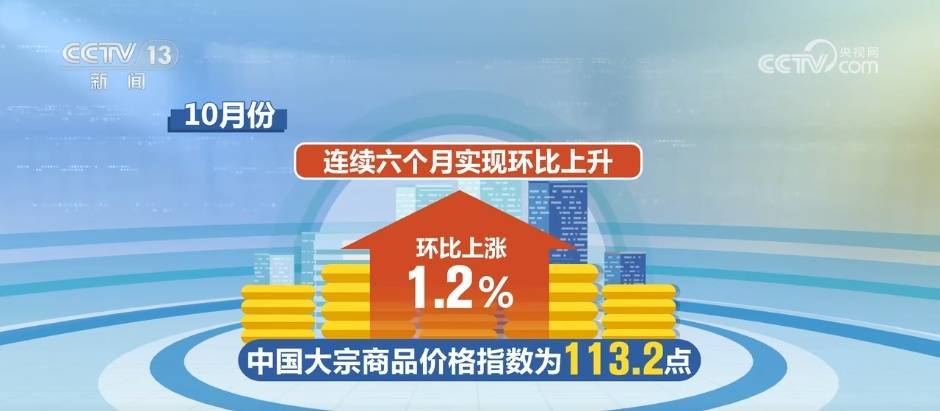
Core Insights - The China Logistics and Purchasing Federation reported that the commodity price index for October increased for the sixth consecutive month, indicating a recovery in the commodity market driven by government policies and improved business confidence [1][4]. Price Index Summary - The commodity price index for October stood at 113.2 points, reflecting a month-on-month increase of 1.2% [4]. - Among the 50 monitored commodities, 16 saw price increases, with electrolytic copper, corrugated paper, and coking coal leading the gains at 6.9%, 6%, and 6% respectively [4]. Industry Analysis - The non-ferrous metals price index rose by 3.5% due to increased global demand for new energy, traditional production peaks, and incidents in Indonesian copper mines and Icelandic aluminum smelting plants [7]. - The mineral price index rebounded by 0.7% thanks to a recovery in the construction industry [7]. - Conversely, the energy price index and chemical price index fell by 1.3% and 3.1% respectively, influenced by declining international oil prices [7]. Economic Outlook - Experts noted rapid growth in high-tech manufacturing, equipment manufacturing, and consumer goods sectors, alongside positive signals from US-China negotiations and the Federal Reserve's second interest rate cut of the year [10]. - Despite the optimistic outlook, global economic uncertainties persist, and some commodity prices remain low, indicating ongoing supply-demand imbalances [10].
中国大宗商品价格指数连续6个月环比上升
Yang Shi Xin Wen Ke Hu Duan· 2025-11-05 03:54
Group 1 - The core viewpoint of the articles indicates that China's commodity price index has shown a continuous increase for six months, reflecting improved business confidence and a recovery in the commodity market due to effective government policies and easing international trade tensions [1][2] - In October, the China Commodity Price Index reached 113.2 points, with a month-on-month increase of 1.2%, marking the sixth consecutive month of growth [1] - Among the 50 monitored commodities, 16 saw price increases in October, with notable rises in electrolytic copper (6.9%), corrugated paper (6%), and coking coal (6%) [1] Group 2 - The non-ferrous metal price index rose by 3.5% month-on-month, driven by increased global demand for new energy, traditional production peaks, and incidents in Indonesian copper mines and Icelandic aluminum smelters [1] - The mineral price index rebounded by 0.7% due to a recovery in the construction industry [1] - Energy and chemical price indices fell by 1.3% and 3.1% respectively, influenced by declining international oil prices [1][2]
【财经分析】10月中国大宗商品价格指数(CBPI)为113.2点 连续六个月环比上升
Xin Hua Cai Jing· 2025-11-05 03:32
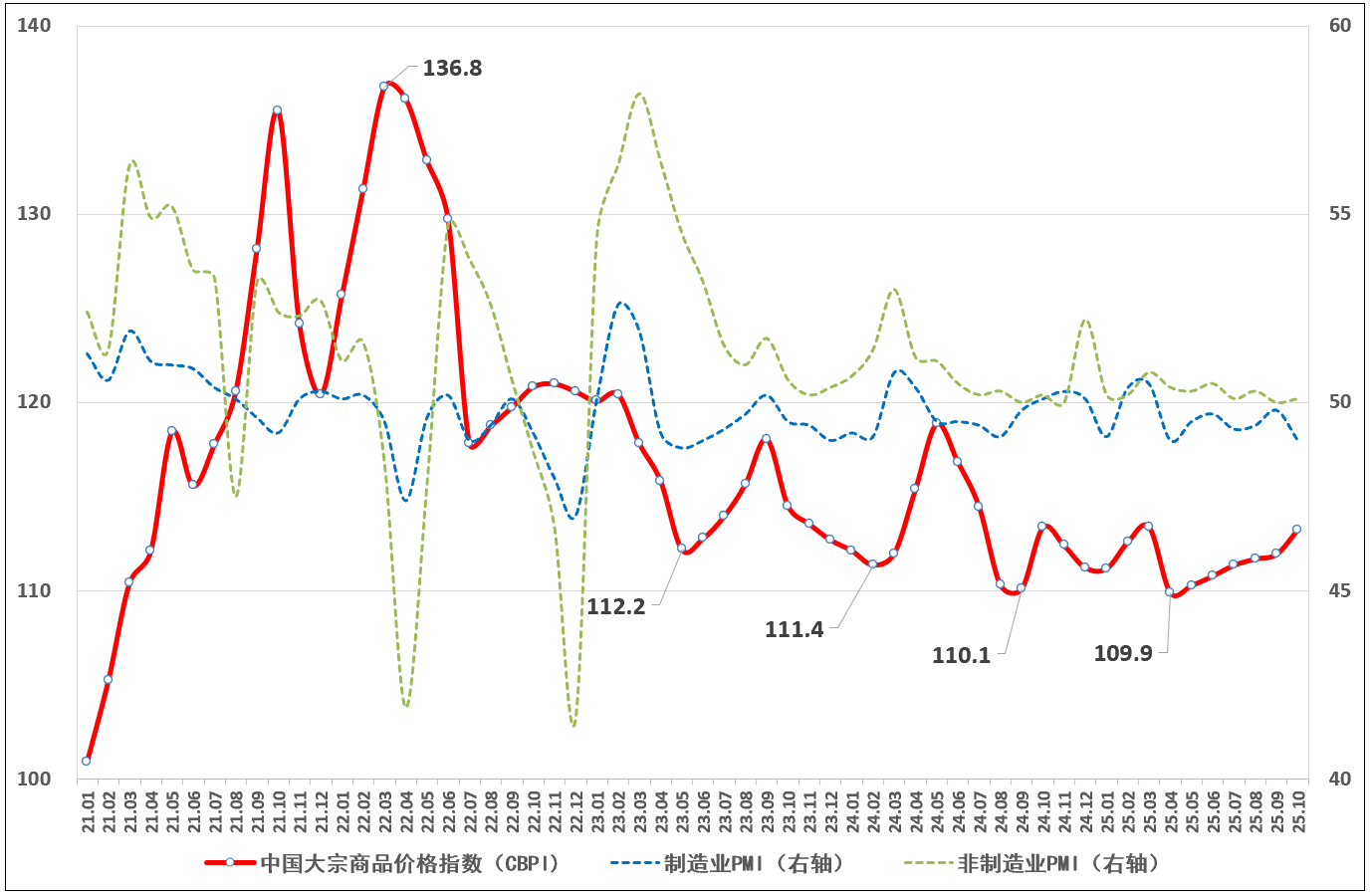
Core Insights - The China Commodity Price Index (CBPI) for October 2025 is reported at 113.2 points, reflecting a month-on-month increase of 1.2% but a year-on-year decrease of 0.1% [2][7] - The index has shown a continuous month-on-month recovery for six months, indicating a positive trend in the commodity market driven by government policies and improved business confidence [2][7] Commodity Price Trends - The non-ferrous price index rose to 136.4 points, with a month-on-month increase of 3.5% and a year-on-year increase of 5.2% [4] - The mineral price index rebounded slightly to 70.9 points, with a month-on-month increase of 0.7% but a year-on-year decrease of 12.5% [4] - The agricultural product price index decreased to 94.8 points, with a month-on-month decline of 2% but a year-on-year increase of 2.1% [4] - The energy price index fell to 96.8 points, with a month-on-month decrease of 1.3% and a year-on-year decrease of 7.3% [4] - The black commodity price index continued to weaken at 77.8 points, with a month-on-month decrease of 1.5% and a year-on-year decrease of 8.3% [4] - The chemical price index accelerated its decline to 96.9 points, with a month-on-month decrease of 3.1% and a year-on-year decrease of 12.7% [5] Market Analysis - Analysts suggest that the overall commodity market is expected to maintain stability in the fourth quarter, supporting the annual economic development goals [7] - The positive signals from the US-China negotiations and the Federal Reserve's interest rate cuts have contributed to increased business confidence and expansion in production [7] - The demand for certain products, such as coking coal, has increased due to domestic supply constraints and seasonal factors [4][5]
十月大宗商品价格指数公布 连续6个月环比上升
Yang Shi Xin Wen Ke Hu Duan· 2025-11-05 00:28
Core Insights - The China Logistics and Purchasing Federation reported that the commodity price index for October increased for the sixth consecutive month, indicating a recovery in the commodity market driven by government policies and improved international trade conditions [1][2] Price Index Overview - The October commodity price index reached 113.2 points, with a month-on-month increase of 1.2% [1] - Among 50 monitored commodities, 16 saw price increases, with electrolytic copper, corrugated paper, and coking coal leading the gains at 6.9%, 6%, and 6% respectively [1] Sector Analysis - The non-ferrous metals price index rose by 3.5% due to increased global demand for renewable energy, traditional production peaks, and incidents in Indonesian copper mines and Icelandic aluminum smelters [2] - The mineral price index rebounded by 0.7% thanks to a recovery in the construction industry [2] - The energy and chemical price indices fell by 1.3% and 3.1% respectively, influenced by declining international oil prices [2] Market Outlook - Experts noted rapid growth in high-tech manufacturing, equipment manufacturing, and consumer goods sectors, alongside positive signals from US-China negotiations and the Federal Reserve's second interest rate cut of the year [2] - Despite the overall positive trend, uncertainties in the global economy persist, and some commodity prices remain low, indicating ongoing supply-demand imbalances [2]