存量优化

Search documents
汽车产能大挪移
Jing Ji Guan Cha Wang· 2025-11-21 14:13
Group 1 - The automotive industry is witnessing a trend where manufacturers in need of new production capacity are acquiring or managing other factories to supplement their production capabilities [1][5] - Recent examples include Changan Automobile taking over Beijing Hyundai's Chongqing factory, which has been converted to a Deep Blue Automotive production line, and Geely acquiring the former SAIC-GM Beisheng factory in Shenyang [1][2] - The shift in idle capacity has moved from domestic brands to joint venture companies, with companies like Dongfeng acquiring production capacity from Nissan and Shenlong [1][5] Group 2 - Geely and Changan are both targeting ambitious sales goals of 5 million vehicles by 2030, prompting their recent acquisitions to match production capacity with these targets [2][3] - Geely's production capacity for 2024 is projected at 4.23 million vehicles, but its utilization rate is only 45%, necessitating expansion due to the rapid growth of its Galaxy brand [3][4] - Changan's production capacity for 2024 is set at 2.25 million vehicles, with a utilization rate of 84%, indicating a tighter capacity situation as it aims for a sales target of 3 million vehicles [3] Group 3 - The automotive market has seen a significant shift in market share, with domestic brands increasing their share from 35.7% in 2020 to 68.7% currently, leading to the exit of several joint venture companies [6] - Many joint venture companies have closed factories or sold them to domestic brands, such as GAC Fiat and GAC Mitsubishi, which have seen their facilities taken over by companies like GAC Aion and Lantu [6][7] - The trend of optimizing existing production capacity is being supported by local government policies aimed at revitalizing idle assets in the automotive sector [7][8] Group 4 - The Chinese government has recognized the need to optimize existing automotive production capacity, with policies aimed at activating over 1 trillion yuan of idle assets through market mechanisms [7] - Local governments are implementing strategies to utilize existing automotive production capacity, as seen in Hubei's plan to achieve 350 billion yuan in new energy vehicle output by 2025 [7][8] - New automotive startups are emerging in response to local government initiatives to revitalize idle production capacity, such as Jiangling Group's new energy vehicles and Haima Automobile's new product lines [8]


从跑马圈地到存量优化,惠民保新趋势:重点突破特药保障目录
Bei Jing Shang Bao· 2025-10-19 13:01
Core Insights - The article discusses the rapid development and evolution of urban customized commercial health insurance (Hui Min Bao) in China since its launch in 2020, highlighting its significance in the multi-tiered medical security system [1][3]. Group 1: Market Development - As of July 2023, a total of 313 local Hui Min Bao products have been launched nationwide, with a market growth rate of 2.96% [4]. - The market is transitioning from "incremental expansion" to "stock optimization," indicating a shift towards high-quality development [4]. - The proportion of normally operating products is expected to decrease from 74.3% in 2023 to 66.78% in 2024, reflecting a decline of approximately 7.5 percentage points [4]. Group 2: Product Diversification - The need for product stratification is emphasized to meet the diverse needs of different income groups and health conditions, suggesting a model of "basic version + upgraded version + inclusive critical illness insurance" [5]. - New products have been introduced to enhance coverage, such as a new inclusive critical illness insurance product in Guangdong and three "Guardian Insurance" products in Guangxi [4]. Group 3: Special Drug Coverage - Special drug coverage has become a key innovation area for Hui Min Bao, with an average of 41 special drugs covered per product, focusing on 28 types of indications [6]. - Over 80% of traditional Hui Min Bao products include special drug responsibilities, primarily targeting malignant tumors and expanding to rare diseases and other treatment areas [6]. - The inclusion of CAR-T therapy and local innovative drugs aims to alleviate the financial burden on patients and support the development of the domestic biopharmaceutical industry [6]. Group 4: Sustainability Concerns - The low premium model raises concerns about the sustainability of expanding special drug coverage, with risks of adverse selection and medical cost inflation [7]. - Future sustainability relies on refined management strategies, including setting reasonable deductibles, controlling drug costs, and increasing enrollment rates to diversify risk [7].


从1款到313款,惠民保十年由“增量扩张”迈入“存量优化”
Di Yi Cai Jing· 2025-10-19 09:12
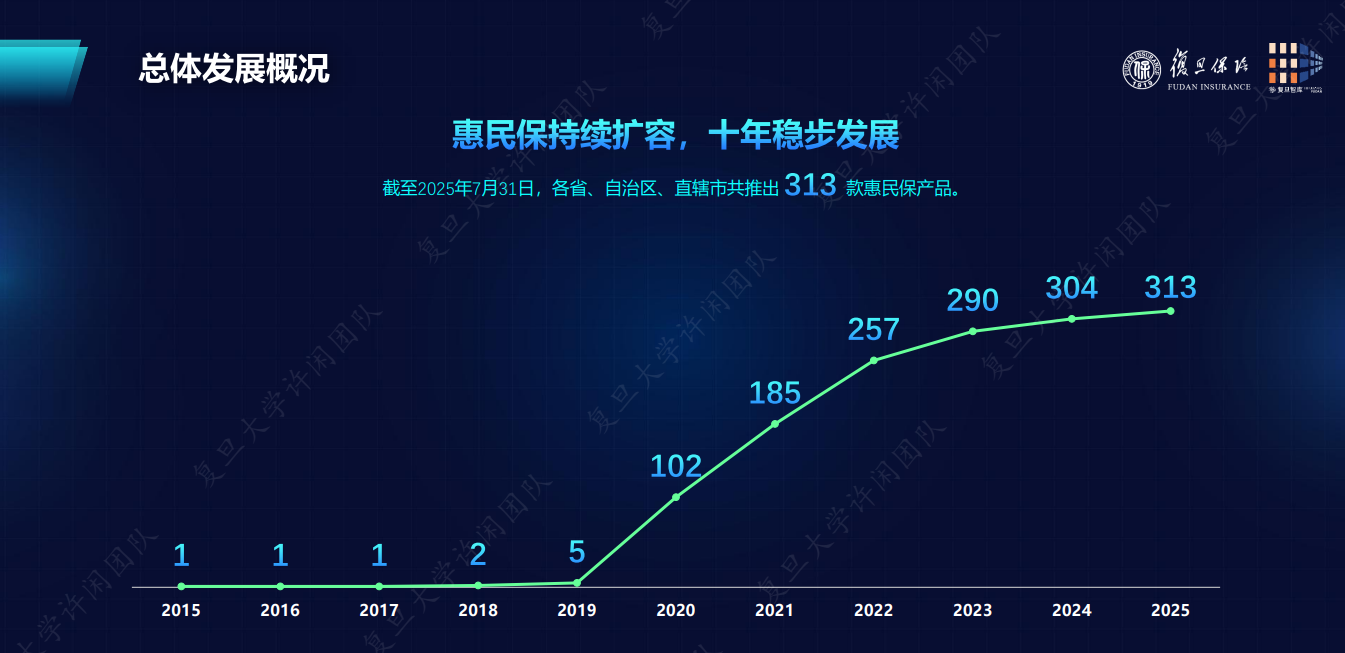
Core Insights - The report indicates that the Huiminbao market is transitioning from "incremental expansion" to "stock optimization" and high-quality development, with a stable market base [4][10] - As of July 31, 2025, a total of 313 local Huiminbao products have been launched, with 9 new products added in 2025, reflecting a market growth rate of 2.96% [2][4] - The number of operational Huiminbao products decreased from 211 in 2023 to 199 in 2024, before increasing to 202 in 2025, indicating a process of elimination and optimization [4][7] Market Trends - The Huiminbao market has shown significant growth since its inception in 2015, with the number of products increasing from 5 in 2019 to 102 in 2020, and reaching 290 by 2023 [2][4] - The current product landscape is characterized by a dominance of traditional products, which still account for over 80% of operational offerings, while new products are being introduced to cover underserved markets [8][9] Product Innovation - Recent innovations in Huiminbao products include the introduction of special drug coverage, with an average of 41 special drugs and 28 indications covered per product [8] - The pricing mechanism is shifting from a uniform pricing model to a differentiated pricing model, with the average price of basic Huiminbao products rising to 95 yuan, compared to approximately 60 yuan in 2021 [8][10] - Nearly half of the products now offer multiple versions to cater to different consumer needs, with some products providing additional coverage options [9] Regulatory Environment - The report highlights the challenges ahead for Huiminbao, including the need for scientific rate-setting, reasonable exclusion clauses, and effective risk prevention [10] - Recent regulatory guidance from the National Financial Supervision Administration emphasizes the importance of standardizing sales practices and encouraging product innovation, which is expected to support the healthy development of Huiminbao [10]
惠民保迈入存量优化新阶段:特药目录扩围,差异化设计满足多元需求
Guo Ji Jin Rong Bao· 2025-10-18 16:00
Core Insights - The "Hui Min Bao" insurance product has rapidly expanded across China since 2020, becoming a significant component of the multi-tiered medical insurance system, with 313 local products launched by July 2023, reflecting a market growth rate of 2.96% [1] - The market is transitioning from "incremental expansion" to "stock optimization," indicating a shift towards high-quality development, with over 80% of products still being traditional types [1][2] - The average price of basic Hui Min Bao products has increased to 95 yuan, up from approximately 60 yuan in 2021, as the pricing mechanism shifts from a single pricing model to a differentiated pricing model based on various factors [3] Market Dynamics - The number of operational products has stabilized at 202, with a slight decrease in the proportion of operational products expected from 2023 to 2025 [1] - New products are being introduced with a "dual-driven" approach, expanding into lower-tier markets while innovating within existing markets, such as the introduction of critical illness insurance products in Guangdong and Guangxi [2] - The average Hui Min Bao product now covers 41 types of special drugs, with over 80% of traditional products including special drug responsibilities, primarily focusing on cancer treatment and expanding to rare diseases and other conditions [2] Product Features - Many Hui Min Bao products now offer multiple versions for consumer choice, with nearly half providing various options to cater to different needs and payment capabilities [3] - The introduction of "add-on packages" allows consumers to enhance their coverage, such as hospitalization and online consultation reimbursements [3] - The development of Hui Min Bao faces challenges, including the need for scientific rate determination and effective risk management to ensure long-term stability [3]
“知识图谱”解读惠民保:“增量扩张”转向“存量优化”
Xin Hua Cai Jing· 2025-10-18 14:23
Core Insights - The article discusses the evolution of urban customized commercial health insurance ("Hui Min Bao") over the past decade, highlighting a shift from "incremental expansion" to "stock optimization" with a focus on innovative special drug coverage [1][2]. Group 1: Market Development - The report indicates that by 2025, nine new products are expected to be launched, with a market growth rate of 2.96%. As of July 31, a total of 313 local Hui Min Bao products have been introduced nationwide [1]. - The current product landscape is characterized by a dominance of traditional products, which account for over 80% of those in normal operation. The proportion of operational products is expected to decline by approximately 7.5 percentage points from 2023 to 2024, and by about 1.2 percentage points from 2024 to 2025, indicating a stabilization of the market [1]. Group 2: Product Innovation - New products exhibit a "dual-driven" characteristic, focusing on expanding coverage to lower-tier markets while also innovating and upgrading existing products to meet diverse health insurance needs [2]. - Special drug coverage has become a key area of innovation, with an average of 41 special drugs covered per product, addressing 28 types of conditions. Over 80% of 169 basic traditional Hui Min Bao products include special drug responsibilities, primarily targeting malignant tumors and expanding to rare diseases and other medical fields [2]. Group 3: Pricing and Regulation - The pricing mechanism for Hui Min Bao products is transitioning from a uniform pricing model to a differentiated pricing model, with 141 products currently using a uniform pricing model averaging 95 yuan, an increase from approximately 60 yuan in 2021. Differentiated pricing considers factors such as age, health status, income, and group insurance [2]. - The National Financial Regulatory Administration has issued guidelines to promote high-quality development in urban commercial health insurance, emphasizing the need for regulated sales practices and encouraging product innovation and differentiated pricing [3].
《报告》:惠民保从“增量扩张”迈入“存量优化”
Zhong Guo Jing Ying Bao· 2025-10-18 13:08
Core Insights - The report indicates that by 2025, there will be 9 new Huiminbao products launched, with a market growth rate of 2.96%. As of July 2025, a total of 313 local Huiminbao products will have been introduced nationwide, marking a shift from "incremental expansion" to "stock optimization" for high-quality development in the market [1][2] - The product landscape is characterized by "traditional dominance and diversified progress," with traditional Huiminbao products still accounting for over 80% of currently operational products. The proportion of normally operating products is expected to decrease by approximately 7.5 percentage points from 2023 to 2024, and by about 1.2 percentage points from 2024 to July 2025, indicating a stabilization of the basic product base [1] - The report highlights that the negative lists and exemption clauses of current Huiminbao products mainly focus on areas such as work-related injuries, childbirth, third-party liability, overseas medical treatment, non-medical insurance settlement, cosmetic surgery, illegal activities, and restrictions on special drug usage [1] Pricing Mechanism - The report notes a transition from a single pricing model to a differentiated pricing model for Huiminbao products. Among the currently operating basic version Huiminbao products, 141 products adopt a single pricing model, with an average price of 95 yuan, which is an increase from approximately 60 yuan reported in 2021 [2] - The differentiated pricing is primarily based on factors such as age, health status, income, and group insurance participation [2]
石化化工市场机会在哪儿?分析人士:长期看这三大赛道|观策论市
Qi Huo Ri Bao· 2025-10-04 23:47
Core Viewpoint - The "Stabilizing Growth Work Plan for the Petrochemical Industry (2025-2026)" emphasizes a transformation direction of "stabilizing total volume and optimizing structure," avoiding a one-size-fits-all approach to capacity reduction [1][2] Policy Impact on Chemical Prices - The plan focuses on controlling new capacity and upgrading existing facilities rather than eliminating current capacity, indicating that supply will not significantly shrink in the short term [1][2] - The core contradiction in the chemical market remains high capacity investment with weak demand, leading to a pessimistic market outlook despite policy changes [2] Specific Chemical Products Analysis - The plan supports refining enterprises to "reduce oil and increase chemicals," which may increase the total supply of chemical products, particularly affecting prices of basic chemicals like synthetic resins and ethylene glycol [2][5] - PX is viewed positively by multiple institutions due to the peak of capacity expansion being over, with no new capacity expected from 2024 to 2025, leading to a favorable supply-demand balance [3][4] - Ethylene is still in a capacity expansion cycle, and while the policy may slow down supply growth, the basic market remains loose, with price fluctuations expected to be limited [4] Long-term Market Opportunities - The policy aims to curb blind capacity expansion and improve the supply-demand mismatch, potentially increasing industry profit margins by 3-5 percentage points by 2026 [3] - Long-term investment opportunities are identified in three areas: high-end fine chemicals, green transition sectors, and companies with integrated layouts and technological advantages [5] Short-term Trading Strategies - Short-term trading strategies should focus on "swing trading" to avoid blind chasing of price increases, with attention to short-term mismatches due to policy windows and facility maintenance [6] - Investors are advised to be cautious of the potential for policy expectations to be overvalued in the market, particularly in high-end products [6]
告别“八毛发全国”,快递业迎来涨价潮
第一财经· 2025-09-17 13:49
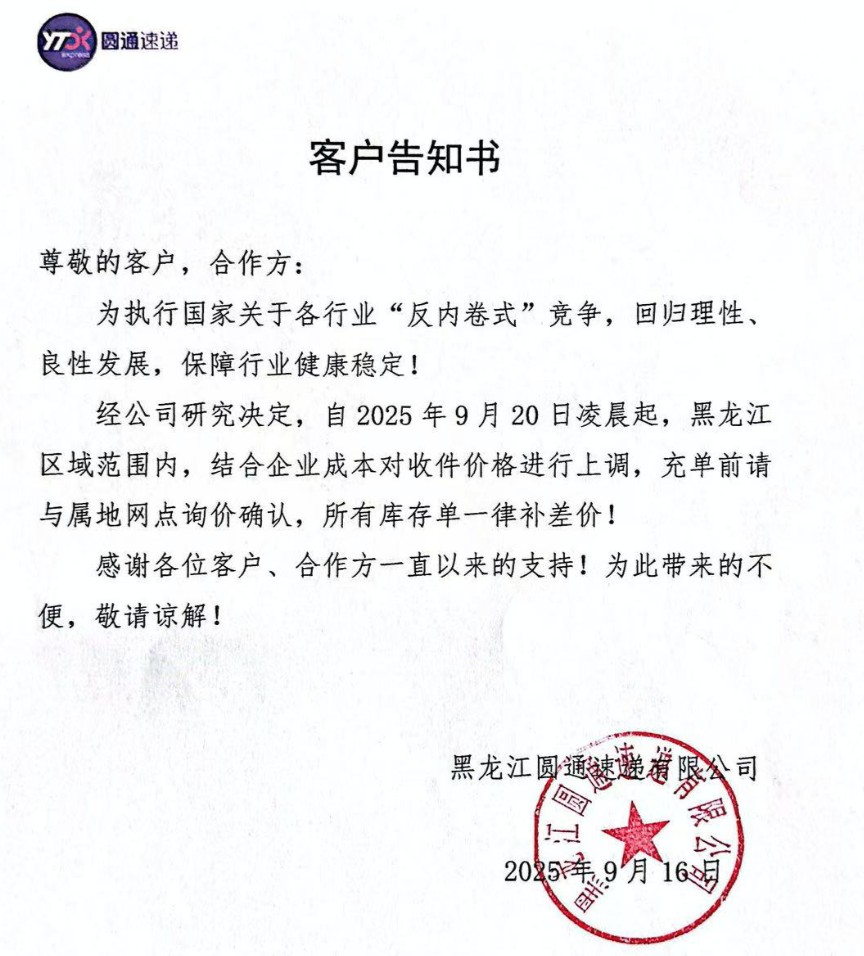
Core Viewpoint - The continuous increase in express delivery fees across various regions is aimed at alleviating losses and improving the competitive landscape of the industry [3][6][15] Summary by Sections Price Increase Trends - Recent announcements of express fee increases have been made in regions including Hubei, Tianjin, Shandong, and Liaoning, following earlier adjustments in Zhejiang and Guangdong [4] - For instance, in Heilongjiang, major express brands, including YTO, announced price hikes effective September 20, citing the need to return to rational competition [4] Impact on Operations - The price increase has led to noticeable changes at frontline outlets, with reports indicating significant improvements in financial conditions and cash flow for many [7][8] - An outlet manager in Yiwu noted that prior to the price hike, some outlets faced monthly losses of tens of thousands, which have since improved due to the price adjustments [8] Customer Acceptance - The general sentiment among outlet managers is that if all brands uniformly raise prices, customer acceptance will not be a major issue [10][13] - A regional manager indicated that the price increase was coordinated by the postal authority and all express brands, ensuring a collective approach to the adjustment [11] Market Dynamics - The price hikes are expected to slow down the ongoing price wars in the industry, with a belief that a collective increase can foster a fairer competitive environment [14] - Regulatory bodies are closely monitoring the pricing competition within the express delivery sector, emphasizing the need to address issues of "involution" and unfair pricing practices [14] Future Outlook - Experts predict that the trend of price increases will continue, potentially leading to a more optimized market structure where competition shifts from price to value [15] - The top eight express companies currently hold an 85% market share, indicating a move towards consolidation and higher industry concentration as smaller players may exit the market [15]
告别“八毛发全国”,快递业迎来涨价潮
Di Yi Cai Jing· 2025-09-17 08:12
Core Viewpoint - The increase in express delivery fees is expected to alleviate the loss pressure on companies and improve the long-standing "price war" in the industry [1][5] Summary by Sections Price Increase Trends - The trend of increasing express delivery fees continues, with regions such as Hubei, Tianjin, Shandong, and Liaoning recently announcing fee hikes, following earlier adjustments in Zhejiang and Guangdong [2] - In Heilongjiang, major express brands announced price increases effective September 20, aimed at rationalizing competition and addressing cost issues [2] Impact on Operations - One express outlet in Yiwu reported significant improvements in its financial situation following the fee increase, with losses previously reaching tens of thousands per month now showing signs of recovery [7] - The outlet's cash flow has improved, with a potential increase of 1 million in liquidity for large outlets if prices rise by 0.1 yuan per package [7] Customer Reactions - The outlet manager noted that if all brands uniformly adjust prices nationwide, customer acceptance would likely be high [9] - Despite some instances of outlets offering rebates to retain customers, the overall market remains stable, with 90% of clients reportedly unaffected by the price hikes [11] Industry Dynamics - The price adjustments are being coordinated by the postal administration, with all express brands participating, indicating a collective effort to stabilize the market [10] - The increase in fees is seen as a necessary step to enhance the survival and self-sustaining capabilities of outlets, as well as to improve the welfare of frontline workers [10] Future Outlook - Experts predict that the price increases will continue, with a potential nationwide implementation around the National Day holiday, leading to a shift from price competition to value competition in the industry [12][13] - The top eight express companies now hold an 85% market share, indicating a move towards industry consolidation and optimization [12][13]
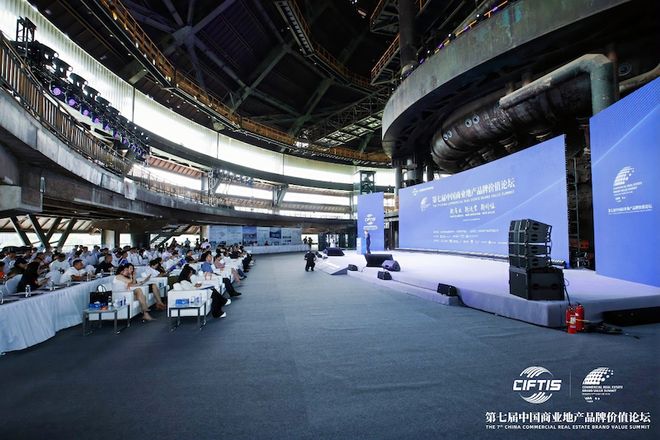
商业地产进入“以存量优化替代增量扩张”深度转型期
Zhong Guo Jing Ying Bao· 2025-09-15 09:19
Core Viewpoint - The commercial real estate industry in China is undergoing a transformation towards high-quality development, emphasizing brand building as a key driver for sustainable growth and structural adjustment [3][6]. Group 1: Industry Overview - The commercial real estate sector is a crucial part of the national economy, with office buildings and shopping centers being the two main formats that reflect B-end enterprise activity and C-end consumer spending, respectively [3]. - The total office space in Beijing has reached approximately 23 million square meters, with Grade A office space accounting for 12.88 million square meters [4]. - There are over 640 industrial parks in Beijing, with a total construction area of 54 million square meters, showcasing the rich commercial real estate landscape [4]. Group 2: Current Challenges and Trends - The commercial real estate market is currently in an adjustment phase, facing challenges such as declining investment and new construction, weak rental demand, and rising vacancy rates [6][7]. - Major characteristics of the current market include a more cautious expansion strategy among some leading companies, a focus on light-asset operations, and an emphasis on enhancing operational capabilities and brand building [6]. - The market is at a crossroads between continuing price wars and evolving through brand, technology, and sustainability [7]. Group 3: Future Outlook - The demand for high-quality, green, and smart commercial products is increasing, indicating a shift towards a "good office" era [7]. - In the medium term, there is a growing expectation for commercial spaces to be more intelligent, ecological, and human-centered, necessitating continuous improvement in operational management and brand development [7]. - Long-term success will depend on the ability to leverage brand value to establish core competitiveness, as consumers are willing to pay a premium for recognized brands [7].