
深蓝汽车

Search documents
年味拉满!中国品牌刷屏泰国街头
Guo Ji Jin Rong Bao· 2026-02-25 11:43
Core Viewpoint - Thailand has become a top destination for Chinese tourists during the Spring Festival, showcasing not only its welcoming atmosphere but also the integration of Chinese brands into local culture and commerce [1][2]. Group 1: Tourism and Cultural Integration - The Spring Festival celebrations in Chiang Mai included traditional decorations and activities, making it a festive experience for both locals and tourists [1]. - Chinese brands such as Ora, BYD, and Nezha have established a presence in Thailand, indicating a successful integration into the local market beyond just catering to Chinese consumers [2]. Group 2: Beverage and Food Industry Expansion - The hot climate and favorable economic conditions in Thailand have facilitated the expansion of new tea beverage brands, with several stores like Mixue and Nayuki opening in key locations [3][4]. - Nayuki has adapted its product offerings to local tastes, with a focus on combining beverages with baked goods, which has been well-received by local consumers [5]. - Haidilao has successfully attracted both Chinese and Korean tourists, offering a unique dining experience that incorporates local flavors while maintaining its core offerings [6][8]. Group 3: Retail and Brand Localization - Retail brands like Miniso and Pop Mart are rapidly expanding in Thailand, becoming recognizable symbols for both local youth and Chinese tourists [8][9]. - Pop Mart has tailored its products to include local cultural elements, enhancing its appeal in the Southeast Asian market [8].
长安汽车董事长:智能汽车正在学会“思考”
Zhong Guo Xin Wen Wang· 2026-02-17 04:15
Core Insights - The chairman of Changan Automobile, Zhu Huarong, emphasizes that smart cars are learning to "think" through advanced data processing and deep learning algorithms, showcasing significant technological progress in the industry [1][4]. Group 1: Technological Advancements - Changan's smart vehicles are now capable of driving decisions akin to experienced drivers, indicating a leap in autonomous driving technology [1]. - The company plans to initiate large-scale testing of L3 autonomous driving by the end of 2025, marking a significant milestone in the field [4]. - Zhu Huarong outlines four stages of technology development: virtual simulation testing, closed-course system testing, real-world scenario challenges, and open-road pilot testing [4]. Group 2: Industry Evolution - The initial goal of replacing human drivers has evolved into a focus on providing higher safety standards for human travel, reflecting a broader understanding of the industry's direction [3]. - The Chinese automotive industry has transitioned from relying on foreign technology to exporting its own innovations through international collaborations [3]. Group 3: Legislative and Regulatory Framework - Zhu advocates for accelerating the legislative process in the autonomous driving sector and establishing a forward-looking standard system to lead in global autonomous driving regulations [4]. - Addressing data security concerns, he stresses the importance of creating a regulatory framework to protect user privacy alongside technological advancements [4]. Group 4: Global Market Expansion - Changan's Thailand factory represents a successful localization of production for its electric vehicles, expanding its market reach to Southeast Asia and Europe [6]. - The company is shifting its focus from domestic auto shows to international platforms, enhancing the global presence of Chinese automotive products [6]. - Zhu Huarong envisions smart cars as "intelligent automotive robots," redefining the relationship between humans and vehicles, emphasizing safety and technological aspirations [6].



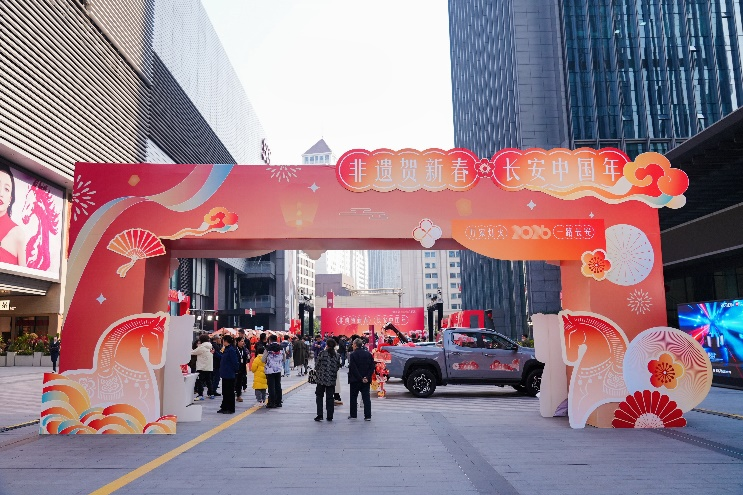
非遗贺新春,长安中国年——重庆“巴渝非遗年俗文化展”举行
Zhong Guo Jin Rong Xin Xi Wang· 2026-02-14 06:48
Group 1 - The event "2026 Year of the Horse Spring Festival Gala" and the "Bashu Intangible Cultural Heritage New Year Customs Cultural Performance" took place in Chongqing, showcasing local traditions and culture [1][3] - The performance featured national-level intangible cultural heritage artists, attracting over a thousand citizens who celebrated the event [3] - The event included a cultural experience area with traditional crafts such as sugar painting, wood carving, and paper art, appealing to both young and old attendees [3] Group 2 - Changan Automobile represented "Chongqing-made" products at the event, highlighting its achievements, including the production of the 30 millionth vehicle and obtaining the first domestic L3-level autonomous driving license [5] - During the Spring Festival, Changan Automobile will collaborate on a large drone show and display on major landmarks to send New Year blessings to global Chinese communities [5] - On February 16, Changan Qiyuan will participate in the CCTV Spring Festival Gala, further promoting the brand and celebrating the New Year with citizens [5]
长安旗下引力、深蓝品牌负责人换岗
Cai Jing Wang· 2026-02-09 02:04
Core Viewpoint - The leadership change between Chang'an Inertia and Deep Blue Automotive signifies a strategic shift in brand management for both companies, with a focus on enhancing brand communication and market presence [1] Group 1: Leadership Changes - Fang Nan, the global brand manager of Chang'an Inertia, will now oversee brand communication for Deep Blue Automotive [1] - Li Pan, the former chief brand officer of Deep Blue Automotive, will take over the brand communication responsibilities at Chang'an Inertia [1]
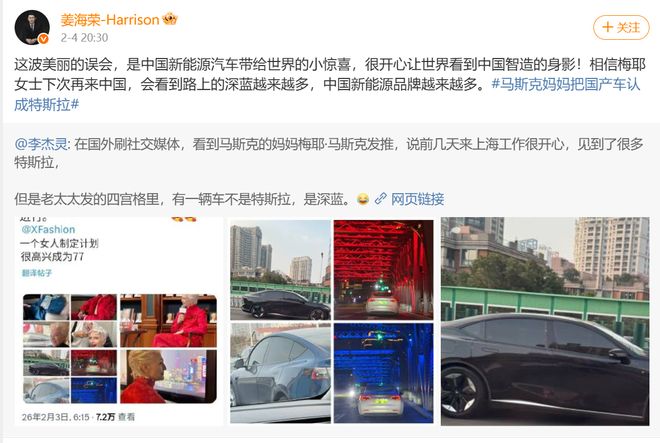
马斯克母亲误将深蓝认作特斯拉 深蓝汽车CEO姜海荣回应
Huan Qiu Wang Zi Xun· 2026-02-06 05:07
Group 1 - Deep Blue Automotive's CEO Jiang Hairong responded to a misunderstanding where Elon Musk's mother, Maye Musk, mistook a Deep Blue vehicle for a Tesla, highlighting the global recognition of Chinese electric vehicle manufacturing [1][3] - Jiang expressed optimism about the increasing visibility of Deep Blue vehicles in China, suggesting that more Chinese electric vehicle brands will emerge in the future [3] - Deep Blue Automotive is among the first to receive market access for L3 conditional autonomous driving vehicles, as announced by the Ministry of Industry and Information Technology on December 15, 2025 [3] Group 2 - On December 25, 2025, Deep Blue Automotive announced the completion of its Series C financing round, raising a total of 6.122 billion yuan [3] - In 2025, Deep Blue Automotive's cumulative sales exceeded 330,000 units, indicating strong market performance [3]
长安汽车:旗下阿维塔、深蓝等多品牌,未来将搭载宁德时代钠新电池
3 6 Ke· 2026-02-05 07:36
Core Insights - Changan Automobile officially launched its global sodium battery strategy on February 5, showcasing the world's first mass-produced passenger vehicle powered by sodium batteries [1] - The event was held in Yakeshi in collaboration with CATL, highlighting the strategic partnership between the two companies [1] - Multiple brands under Changan, including Avita, Deep Blue, Qiyuan, and Inertia, will adopt CATL's new sodium batteries in their future models [1]

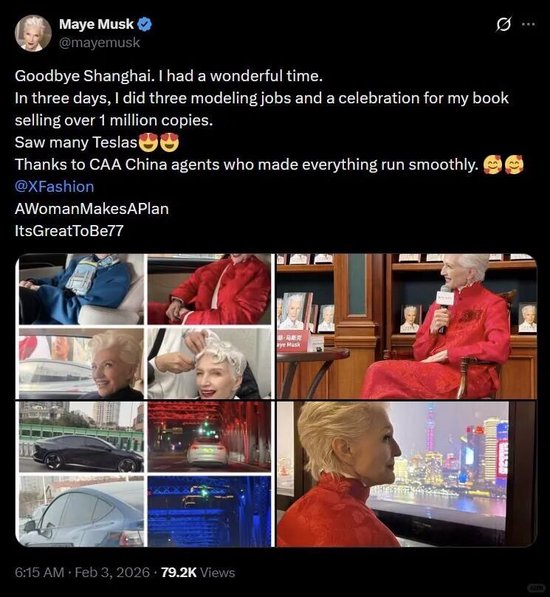
太抓马!马斯克母亲晒偶遇特斯拉图片,网友:这是深蓝
Xin Lang Cai Jing· 2026-02-04 01:51
Core Viewpoint - Maye Musk, mother of Elon Musk, shared her positive experiences from her recent trip to Shanghai, highlighting her work as a model and the success of her book sales reaching over one million copies [1][3][8]. Group 1 - Maye Musk completed three modeling jobs during her three-day trip to Shanghai [3][8]. - She celebrated her book sales surpassing one million copies while in Shanghai [3][8]. - The trip included sightings of many Tesla vehicles, indicating the brand's presence in the region [3][8]. Group 2 - A notable observation was made regarding a black car in her photo, which was identified as a model from Changan Automobile's Deep Blue brand, not a Tesla [5][10]. - This led to humorous comments from netizens, with one stating that they often get asked if their Deep Blue car is a Tesla [5][11].

深蓝汽车余龙:L3级普及到消费端,需跨过成本与保险两道关
Xin Jing Bao· 2026-01-30 08:17
Core Insights - The transition from L2 to L3 autonomous driving represents a shift from driver assistance to conditional automation, indicating a change in responsibility from the driver to manufacturers and system suppliers [2][4] - The Ministry of Industry and Information Technology announced that Changan Automobile's Deep Blue brand and BAIC's Arcfox received the first licenses for L3 conditional autonomous driving vehicles in China, marking a new phase from technology validation to mass production [2] Group 1 - The key points for the transition from L2 to L3 include system reliability, functional safety, human-machine takeover boundaries, and refined operational design domain management [2] - The establishment of AI decision-making models needs further breakthroughs in terms of reliability and interpretability [2] - L3 vehicles may not have a single entity responsible for safety; it requires a combination of technical reliability, regulatory standards, and insurance resources to mitigate risks [2][3] Group 2 - L2 and L3 vehicle insurance will differ significantly, with L2 insurance primarily protecting the owner's rights, while L3 insurance may innovate to cover system suppliers and manufacturers [3] - Challenges for promoting L3-specific insurance include pricing, data barriers among manufacturers, and the profitability potential for insurance companies [3] - L3 vehicles are expected to rapidly advance in the To B operational sector by Q1 2026, with L2 systems penetrating approximately 150,000 models [4] Group 3 - The introduction of L3 vehicles is anticipated to positively impact China's intelligent connected vehicle industry by enhancing industry standards and accelerating development through improved user experience [4] - Four areas are identified for collaborative efforts to ensure the healthy development of autonomous driving: policy collaboration, standardization, industry chain collaboration, and consumer education [4]
智能化迈出“破冰”行动 汽车产销再创历史新高
Jing Ji Ri Bao· 2026-01-20 19:59
Core Insights - In 2025, China's automotive industry demonstrated remarkable resilience and vitality, achieving record production and sales figures of 34.53 million and 34.40 million vehicles, respectively, marking year-on-year growth of 10.4% and 9.4% [1] - The year marked a significant shift in the market, with new energy vehicles (NEVs) surpassing 50% of domestic new car sales, establishing themselves as the mainstream product in the automotive market [2][3] - The automotive export volume exceeded 7 million units, with NEV exports reaching 2.615 million units, reflecting a strong competitive edge in international markets [11] NEV Market Dominance - NEVs accounted for 50.8% of domestic new car sales in 2025, indicating that for every two new cars sold, one was an NEV [3] - NEV production and sales reached 16.626 million and 16.49 million units, respectively, with year-on-year growth of 29% and 28.2%, maintaining a global leadership position for 11 consecutive years [3] - The competitive landscape has shifted, with domestic brands capturing nearly 70% of the passenger car market share, reversing the dominance of joint venture brands [3][4] Technological and Policy Support - The growth of NEVs is attributed to supportive policies, technological advancements, and a robust supply chain, with over 11.5 million vehicles replaced under the trade-in policy, generating sales exceeding 1.6 trillion yuan [5] - Technological innovations have led to significant improvements in vehicle performance, such as a 30% reduction in battery costs and a 40% increase in battery lifespan [6] - The establishment of a comprehensive supply chain has positioned China as a leading supplier of battery materials and power batteries globally, with 70% and 60% market shares, respectively [6] Smart Driving Developments - The approval of the first L3-level conditional autonomous driving models in December 2025 marked a pivotal moment in China's autonomous driving industry, transitioning from technology validation to mass production [7] - The penetration rate of vehicles equipped with L2-level driving assistance features reached 64%, with a year-on-year growth of 21.2% in the first three quarters of 2025 [9] - The integration of AI technologies into smart driving systems has accelerated advancements, with new models emerging that enhance driving experiences and product forms [9][10] International Expansion and Localization - In response to intensified domestic competition, Chinese automakers are accelerating their international expansion, with exports reaching 7.098 million units in 2025, a 21.1% increase [11] - Localization strategies are being implemented in key markets such as Southeast Asia and Europe, with several Chinese brands establishing manufacturing bases to enhance competitiveness [12] - Collaborations with multinational companies are facilitating the entry of Chinese automotive supply chains into global markets, strengthening China's position in the global automotive value chain [12] Market Competition Restructuring - The introduction of compliance guidelines aims to curb price wars and establish a more orderly competitive environment in the automotive industry [13] - Measures to address "involution" in the market have begun to take effect, with a shift from price competition to a focus on technology, quality, and service [13][14] - The automotive industry is transitioning from a phase of scale expansion to one of quality enhancement, necessitating a comprehensive approach to market regulation and competition [15]

长安汽车(000625) - 2026年01月16日投资者关系活动记录表
2026-01-16 10:38
Sales Performance - In 2025, Changan Automobile's total sales reached 2.913 million units, a year-on-year increase of 8.5%, marking a nine-year high [1] - New energy vehicle (NEV) sales exceeded 1.1 million units, up 51% year-on-year, with a compound annual growth rate (CAGR) of 97.3% during the 14th Five-Year Plan [1] - Overseas sales reached 637,000 units in 2025, an 18.9% increase, with a CAGR of 50.5% during the same period [1] - The sales target for 2026 is set at 3.3 million units, a 13.3% increase, with NEV sales projected at 1.4 million units (up 26.2%) and overseas sales at 750,000 units (up 17.7%) [5] Brand Development - During the 14th Five-Year Plan, Changan launched three smart NEV brands: Avita, Deep Blue, and Changan Qiyuan [2] - Avita has maintained over 10,000 units in monthly sales for 10 consecutive months, while Deep Blue surpassed 700,000 units in sales within three years [2] - A total of 24 NEV models were launched, including 6 from Avita, 6 from Deep Blue, and 7 from Changan Qiyuan [2] Technological Advancements - Changan's self-developed battery brand "Jinzhongzhao" has superior thermal insulation performance, outperforming the industry by 30% [2] - The company has introduced the world's first multi-in-one electric drive and a hybrid engine with a thermal efficiency of 44.39% [2] - The "Beidou Tianshu" intelligent safety plan has evolved to version 2.0, focusing on comprehensive safety across various dimensions [3] Global Expansion - Changan's global sales network expanded from 63 countries in 2020 to 117 countries by 2025 [4] - The company established 7 spare parts centers and 5 service engineering centers globally, covering over 100 countries [4] - The number of overseas models increased from 17 to 41 during the 14th Five-Year Plan, including 25 fuel vehicles and 16 NEVs [4] Future Goals - By 2028, Changan aims to achieve cumulative sales of 40 million units for Chinese brands and break through 5 million units in annual production and sales by 2030, with NEVs accounting for over 60% [5] - The company plans to launch 43 new models over the next three years, including 35 NEVs and 8 fuel-efficient vehicles [6] - Continuous investment of over 5% of revenue in R&D is planned, focusing on AI, software, and next-generation battery technologies [7]