
安全发展

Search documents
筑牢高质量发展的安全屏障
Xin Lang Cai Jing· 2025-12-20 23:10
Core Viewpoint - The articles emphasize the importance of balancing development and security, highlighting that both are essential for sustainable economic and social progress [1][2]. Group 1: Development and Security - The 11th Plenary Session of the Municipal Party Committee emphasizes the need to advance safety and stability to ensure high-quality development [1]. - The 20th Central Committee's Fourth Plenary Session stresses the principle of "coordinating development and security" as crucial for the 15th Five-Year Plan, indicating a strategic focus on integrating safety into development [1][2]. - Development and security are described as two interdependent aspects, where security is a prerequisite for development, and development provides solutions to many security issues [1]. Group 2: Risk Management - The articles highlight that the 15th Five-Year period is a critical time for addressing risks and challenges while seizing development opportunities [2]. - There is a call for enhancing national security systems and capabilities, particularly in key areas, to maintain production and social safety [2]. - The importance of proactive risk awareness and comprehensive problem-solving measures is emphasized to ensure steady economic and social development [2].
又到年关话平安
Xin Lang Cai Jing· 2025-12-20 17:01
Group 1 - Recent major safety incidents in Hong Kong and Shenzhen have raised alarms about safety production as the year-end approaches [1] - The government emphasizes the importance of balancing development and safety, stating that safety is paramount for meaningful progress [1] - Small safety issues, if ignored, can lead to significant consequences, highlighting the need for constant vigilance in safety management [1] Group 2 - There is a gradual process from minor issues to major problems, often overlooked until they escalate, exemplified by the "boiling frog" phenomenon [2] - The lack of decisive execution and implementation of safety regulations contributes to risks, as complacency can lead to unfortunate outcomes [2] - As the year concludes, safety remains the top priority despite busy schedules, necessitating a focus on proactive measures to prevent potential hazards [2]
马建堂:深刻把握党的二十届四中全会建议的三条主线
Zhong Guo Fa Zhan Wang· 2025-12-17 06:40
Core Viewpoint - The article emphasizes the importance of the 14th National Committee of the Chinese People's Political Consultative Conference's discussions on the "15th Five-Year Plan" and its focus on high-quality development, common prosperity, and security in the context of China's modernization efforts [1][6]. Group 1: High-Quality Development - The primary focus of the "15th Five-Year Plan" is to promote high-quality development, aiming for decisive progress in achieving Chinese-style modernization [1][4]. - High-quality development is highlighted as a key theme throughout the plan, with specific goals and principles emphasizing its importance [1][4]. - The plan outlines practical paths for achieving high-quality economic and social development across eight sections [1]. Group 2: Common Prosperity - The plan underscores the principle of putting people first and aims to enhance the overall well-being of the population, with a focus on common prosperity as a fundamental goal [4][5]. - Specific targets for reducing income disparities among different regions and between urban and rural residents are set, aiming for a more equitable distribution of wealth [5]. - The plan emphasizes the need to balance efficiency and fairness in the socialist market economy to promote common prosperity [5]. Group 3: Security and Development - The "15th Five-Year Plan" includes a strong emphasis on the integration of development and security, ensuring that modernization efforts are not disrupted by global changes or significant international events [6]. - It identifies the need to modernize the national security system and enhance the resilience of the economic and industrial systems [6]. - The plan addresses the challenges posed by changes in population structure and emphasizes the importance of stabilizing birth rates for long-term economic and social stability [6].
A股市场总体活跃 证券公司总资产达到14.5万亿元
Zhong Guo Jing Ji Wang· 2025-12-07 07:50
Core Viewpoint - The Chinese securities industry is focusing on enhancing compliance and risk management while transitioning from price competition to value competition, aiming to create internationally influential benchmark institutions and specialized service providers [1][2] Group 1: Compliance and Risk Management - The China Securities Regulatory Commission (CSRC) emphasizes the importance of safety and development as the industry's bottom line, urging institutions to strengthen compliance and risk awareness [1] - Institutions are required to improve corporate governance and employee management, clarify responsibilities, and prevent internal interference [1] - Key risks such as financing, margin trading, off-market activities, credit, liquidity, and compliance need to be monitored proactively [1] Group 2: Market Performance and Structural Optimization - The A-share market has been active this year, with market capitalization surpassing 100 trillion yuan since August, indicating reasonable quantitative growth and effective qualitative improvement [2] - Total assets of securities companies have reached 14.5 trillion yuan, with net assets around 3.3 trillion yuan, reflecting growth rates of over 60% and 40% respectively over the past four years [2] - The industry structure is continuously optimizing, with notable cases like the merger of Guotai Junan and Haitong Securities demonstrating initial success in achieving synergies [2] Group 3: Institutional Development and Market Opening - Smaller institutions are focusing on niche markets and achieving breakthroughs, while foreign institutions are accelerating their domestic business expansion [2] - The capital market is further opening up, with 11 foreign wholly-owned or controlling companies currently operating in China [2]
吴清:严防非法交易与市场秩序扰乱行为
Feng Huang Wang· 2025-12-06 08:04
Core Viewpoint - The Chairman of the China Securities Regulatory Commission, Wu Qing, emphasized that safety development is the industry's bottom line, urging institutions to strengthen compliance and risk management awareness [1] Group 1: Compliance and Governance - Institutions need to enhance compliance risk awareness and establish rigid requirements for corporate governance and employee management [1] - Clear delineation of responsibilities and authority is necessary to prevent internal interference [1] Group 2: Risk Management - There is a focus on managing related party transactions and compliance education to improve fairness in trading services [1] - The industry must be vigilant against illegal trading and disruptions to market order [1] - Key risk areas include margin financing, over-the-counter business, credit, liquidity, and compliance [1] Group 3: Industry Adaptation - The industry should strengthen analysis of new business models and respond promptly to market concerns [1]
迎“十五五”:在变局中开新局 在改革中聚合力
Zhong Guo Zheng Quan Bao· 2025-12-02 20:22
Group 1: Economic Overview - The economy is showing a trend of stability with changes, laying a solid foundation for the "14th Five-Year Plan" [1] - Consumer confidence is gradually improving, and corporate profit pressures are easing, indicating a strengthening microeconomic foundation [1][2] - External uncertainties are diminishing, which helps stabilize corporate expectations [1] Group 2: Structural Adjustments and Policy Measures - There is a noticeable temperature difference between macroeconomic improvement and microeconomic recovery, typical during structural adjustments [2] - The government has introduced measures to address structural constraints, including "anti-involution" policies and debt management [2] - The "14th Five-Year Plan" will focus on key areas such as modernizing the industrial system, expanding domestic demand, ensuring safety in development, and promoting high-level openness [2][3] Group 3: Modernizing the Industrial System - Building a modern industrial system is crucial for enhancing national competitiveness and promoting high-quality development [3] - The plan emphasizes high-quality development, technological self-reliance, and the establishment of a modern industrial system centered on advanced manufacturing [3] Group 4: Strengthening Domestic Demand - Expanding domestic demand is identified as a strategic priority to enhance development vitality and consolidate economic recovery [4] - Improving residents' consumption capacity is fundamental, with a focus on increasing the consumption rate and enhancing income distribution [4] - Optimizing investment structure and promoting urban-rural integration are key to supporting domestic demand growth [4][5] Group 5: Ensuring Safety in Development - The "14th Five-Year Plan" integrates safety considerations across various dimensions, including national, economic, technological, and social security [5] - Emphasis is placed on building new combat capabilities and enhancing economic resilience through energy security and supply chain stability [5][6] Group 6: Advancing High-Level Opening Up - The plan aims for a higher level of opening up, transitioning from a "follower" to a "leader" in global economic engagement [6][7] - China is positioned to play a role as a "shaper" in the new wave of globalization, leveraging its competitive advantages in manufacturing and technology [6][7] - The focus will be on institutional opening, improving the investment environment, and participating in global economic governance reforms [7][8]
既要开放,又要安全?虹桥分论坛顶级专家聚首,干货满满
Sou Hu Cai Jing· 2025-11-07 15:44
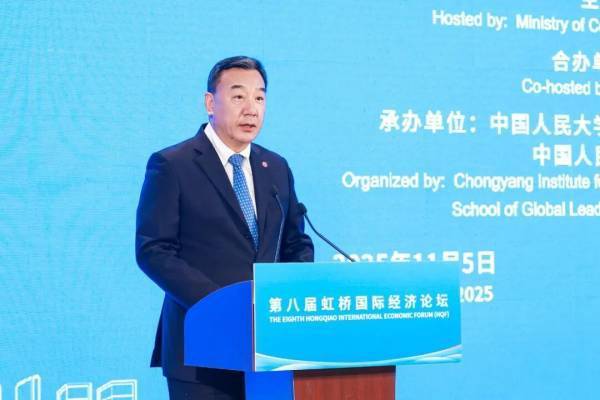
Core Viewpoint - The eighth Hongqiao International Economic Forum emphasizes the importance of open trade and security development in the context of global economic challenges, including protectionism and unilateralism [1][3]. Group 1: Forum Overview - The forum, held in Shanghai, gathered nearly 20 experts from academia, strategy, business, and think tanks to discuss building an open, inclusive, and balanced global trade system [1]. - The event included the release of a think tank research report titled "Pathways to Coexistence in Trade Security Development between China and the World by 2050" [1][10]. Group 2: Key Themes and Discussions - Open trade is highlighted as a means to build trust among different governments and systems, promoting shared prosperity [5]. - The report emphasizes that future trade security will involve not only national strategies but also micro-level enterprise survival and macro-level governance [10]. - Experts agree that China's ongoing high-level opening-up efforts provide a stable foundation for reconstructing the global economic order amidst rising uncertainties [25][31]. Group 3: Expert Insights - Michelle Umulenge from Rwanda stressed that open trade is a driving force for peace and development, supported by initiatives like the Belt and Road [5]. - Jeffrey Sachs criticized the U.S. protectionist policies, arguing they undermine multilateralism and global prosperity [8][29]. - Martin Jacques noted a shift in global narratives from economic growth to security priorities, influenced by Western countries' strategies against China [17]. Group 4: Future Directions - The report outlines a vision for 2050, proposing a "coexistence security" model as a core pathway for trade development [10]. - It calls for innovative rules and collaborative global governance to address trade security challenges [10]. - The discussions highlighted the need for countries to seek balance through openness amidst structural changes in globalization [23][32].

X @外汇交易员
外汇交易员· 2025-10-31 03:03
Trade Policy - The Ministry of Commerce emphasizes that export controls are focused on security issues [1] - The Ministry of Commerce links security with development, stating that ensuring security enables better development and stronger security [1] Green Development - The Ministry of Commerce clarifies that green development is a concept [1] - The Ministry of Commerce addresses concerns about how China's rare earth regulations might affect its green development [1]
12段话速览“十五五”时期发展重要着力点
Xin Hua She· 2025-10-29 14:52
Core Viewpoint - The article discusses the key strategies and focus areas outlined in the "15th Five-Year Plan" for China's economic and social development, emphasizing the importance of a modernized industrial system, technological innovation, and a strong domestic market as foundational elements for achieving Chinese-style modernization [1][3][8]. Industrial Development - A modernized industrial system is identified as the material and technological foundation for Chinese-style modernization, with a focus on developing the real economy, emphasizing intelligent, green, and integrated development, and constructing a manufacturing powerhouse [3]. Technological Innovation - Technological modernization is highlighted as essential for supporting Chinese-style modernization, with an emphasis on seizing opportunities from the new round of technological revolutions and enhancing the national innovation system to boost autonomous innovation capabilities [5][6]. Domestic Market - A strong domestic market is deemed a strategic support for Chinese-style modernization, advocating for the expansion of domestic demand and promoting a virtuous cycle between consumption and investment [7][8]. Economic System - A high-level socialist market economic system is considered crucial for ensuring the stability and quality of development, with a focus on improving the macroeconomic governance system [9][10]. Opening Up - The necessity of open cooperation and mutual benefit is emphasized, with plans to steadily expand institutional openness and maintain a multilateral trade system [11][12]. Rural Revitalization - The modernization of agriculture and rural areas is recognized as vital for the overall success of Chinese-style modernization, with a focus on addressing "three rural issues" and promoting urban-rural integration [14][15]. Regional Development - Coordinated regional development is seen as an inherent requirement, aiming to optimize the layout of productive forces and create a high-quality regional economic structure [16][17]. Cultural Development - Cultural prosperity is identified as an important marker of Chinese-style modernization, with a commitment to developing a socialist culture with strong ideological and international influence [18][19]. Social Welfare - The realization of people's aspirations for a better life is positioned as the starting point and goal of Chinese-style modernization, focusing on enhancing social welfare and addressing urgent public concerns [21][22]. Green Development - Green development is highlighted as a distinctive feature of Chinese-style modernization, promoting ecological safety and sustainable growth through carbon neutrality initiatives [23][24]. Security Development - The construction of a safe China is emphasized as a key component, advocating for a comprehensive national security approach and effective social governance [25][26]. National Defense - Strengthening national defense and military capabilities is framed as a strategic support for Chinese-style modernization, with a focus on modernizing the military and enhancing its operational capabilities [27][28].

数据显示“十四五”时期我国经济总量跃升、质量提升—— 继续跑好“十五五”基础坚实底气足
Jing Ji Ri Bao· 2025-10-21 03:40
Economic Growth and International Influence - During the "14th Five-Year Plan" period, China's GDP increased from 103.5 trillion yuan in 2020 to 134.9 trillion yuan in 2024, with an average annual growth rate of 5.5%, significantly higher than the global average of 3.9% [1] - China's contribution to global economic growth remained around 30% annually, highlighting the resilience and vitality of the economy [1] - Per capita GDP rose from 10,632 USD in 2020 to 13,445 USD in 2024, maintaining a position among upper-middle-income countries [1] Technological Innovation - R&D investment reached a record high, with an intensity of 2.69% in 2024, surpassing the EU average [2] - The total number of R&D personnel exceeded 7 million, ranking first globally [2] - By 2025, China's innovation index is expected to rank among the top ten globally, improving by four positions since 2020 [2] Modern Industrial System - The focus on the real economy led to significant advancements in traditional and emerging industries, with the agricultural technology contribution rate reaching 63.2% by the end of 2024, up 2.5 percentage points from 2020 [3] - The added value of equipment manufacturing and high-tech manufacturing industries grew at average annual rates of 8.2% and 9.2% respectively from 2021 to 2024 [3] - The service sector's added value grew at an average annual rate of 5.9%, contributing 60.6% to economic growth during the same period [3] Urban-Rural Coordination - The urbanization rate reached 67.00% by the end of 2024, an increase of 3.11 percentage points since 2020 [3] - The ratio of per capita disposable income between urban and rural residents decreased from 2.56 in 2020 to 2.34 in 2024 [3] Reform and Opening Up - The number of negative list items for market access decreased from 123 in 2020 to 106 by 2025 [4] - Domestic demand contributed an average of 86.8% to economic growth from 2021 to 2024, with final consumption expenditure contributing 59.9%, an increase of 11.1 percentage points compared to the "13th Five-Year Plan" period [4] - The scale of goods trade increased from 32.2 trillion yuan in 2020 to 43.8 trillion yuan in 2024, with an average annual growth rate of 8.0% [4] Green Transformation - The share of non-fossil energy consumption in total energy consumption rose from 16.0% in 2020 to 19.8% in 2024 [5] - The average number of days with good air quality in cities reached 87.2% in 2024, an increase of 2.4 percentage points since 2020 [5] Social Development - The urban unemployment rate remained stable between 5.1% and 5.5% from 2021 to 2024 [6] - The cultural industry saw a revenue increase of 37.7% by 2024 compared to 2020 [6] - The average life expectancy reached 79 years by 2024 [6] Security and Stability - Grain production stabilized above 1.3 trillion jin, exceeding 1.4 trillion jin in 2024 [6] - The manufacturing value added grew at an average annual rate of 5.4% from 2021 to 2024, accounting for nearly 30% of global manufacturing [6]