
工业绿色微电网

Search documents
五部门发文: 推进工业绿色微电网建设与应用
Xin Lang Cai Jing· 2026-01-10 00:54
Core Insights - The Ministry of Industry and Information Technology, along with four other departments, has issued the "Guidelines for the Construction and Application of Industrial Green Microgrids (2026-2030)" to promote the development and application of industrial green microgrids, aiming to expand green electricity usage in the industrial sector and enhance energy conservation and carbon reduction in key industries [1][2] Group 1: Overview of Industrial Green Microgrids - Industrial green microgrids are designed to provide green electricity to industrial users, integrating technologies such as photovoltaics, wind power, efficient heat pumps, new energy storage, hydrogen energy, and smart energy management systems [1] - Currently, over 300 projects have been put into operation across the country, but the overall development of industrial green microgrids remains in the pilot and demonstration phase, facing challenges in technical standards, market mechanisms, and coordination with the main power grid [1] Group 2: Guidelines Structure - The guidelines consist of five parts: construction principles, main construction content, construction models, application scenarios, and construction requirements [1] - In terms of main construction content, it specifies that newly built renewable energy generation facilities, such as solar and wind power, should have a self-consumption ratio of at least 60% annually [1] Group 3: Application Scenarios and Technical Guidance - The application scenarios for industrial green microgrids are categorized into four types based on energy consumption characteristics: high energy load, flexibility, adjustability, and high reliability, with examples of load characteristics and functional requirements provided for each scenario [2] - The guidelines emphasize technical guidance to assist industrial enterprises and parks in understanding construction models and encourage stakeholders to participate in project implementation [2]
【8点见】市场监管总局:平台“补贴大战”得到遏制
Yang Shi Wang· 2026-01-10 00:06
Group 1 - The Ministry of Water Resources reported that China completed water conservancy construction investments of 1.28 trillion yuan last year [1] - Five departments issued a document to promote the construction and application of industrial green microgrids [1] - The State Administration for Market Regulation stated that the "subsidy war" among platforms has been curbed [1] Group 2 - A record 223 million cases of online illegal and harmful information reports were accepted nationwide in 2025 [1] - A breakthrough in mineral exploration was achieved with the discovery of a new chromium-iron ore deposit in Xinjiang [1] Group 3 - The first record of the national first-class protected wild animal, the white pelican, was made at Poyang Lake [3]


五部门联合推动工业绿色微电网建设与应用
Zheng Quan Shi Bao· 2026-01-09 17:48
Core Viewpoint - The release of the "Guidelines for the Construction and Application of Industrial Green Microgrids (2026-2030)" aims to promote the construction and application of industrial green microgrids, expand the use of green electricity in the industrial sector, and facilitate energy conservation and carbon reduction in key industrial areas [1][2]. Group 1 - The guidelines are a response to the "14th Five-Year Plan" and the Central Economic Work Conference, emphasizing the acceleration of new energy system construction and the expansion of green electricity applications [1][3]. - The construction of industrial green microgrids is seen as a crucial pathway for achieving low-carbon transformation in industrial energy use and reaching carbon peak targets [1][2]. - Over 300 projects related to industrial green microgrid construction are currently operational across the country, indicating active exploration by industrial enterprises and parks [2]. Group 2 - The guidelines highlight five basic principles: promoting efficient multi-energy complementary utilization, facilitating high local consumption of renewable energy, enhancing friendly interaction with the power grid, ensuring industrial load regulation capabilities, and improving the management level of intelligent systems [3]. - Different application scenarios for industrial green microgrids are categorized based on energy consumption characteristics, including high energy load, flexibility, adjustability, and high reliability [3]. - The guidelines set specific requirements for renewable energy generation, stating that new solar and wind energy projects should achieve a local self-consumption ratio of at least 60% annually [3].
首批试点名单公示,7个储能项目入选
行家说储能· 2026-01-09 12:10
Core Viewpoint - The National Energy Administration has announced the first batch of pilot projects for enhancing the construction capacity of the new power system, including 43 pilot projects and 10 pilot cities, with a focus on energy storage and microgrid technologies [2][6]. Energy Storage Projects - Seven energy storage-related projects have been included, primarily focusing on grid-friendly technology applications, distributed across Inner Mongolia, Zhejiang, Anhui, Yunnan, Shanxi, and Gansu [2][3]. - The Baotou City grid-friendly energy storage project has a total planned capacity of 30MW, with a total scale of 10.2MW/40.8MWh, designed to provide voltage and frequency support to the grid [3][5]. - The Zhejiang Longyou shared energy storage project has a total scale of 80MW/160MWh, with a specific configuration of 10MW/20MWh grid-friendly units, improving equipment utilization by over 30% and reducing cost per kilowatt-hour to below 0.2 yuan [5]. - The Yunnan Wenshan Qiubei independent energy storage project leads with a scale of 200MW/400MWh, featuring a sodium-ion battery system, marking it as the first large-scale lithium-sodium hybrid energy storage station in the country [5]. - The Gansu Juhua New Energy project includes a planned capacity of 150MW/600MWh for its energy storage system, associated with a 1GW wind farm [5]. Microgrid Projects - The pilot list includes seven microgrid projects located in Jilin, Jiangsu, Henan, Hubei, Guangdong, and Xinjiang, involving major companies such as China National Petroleum, State Grid, and China Huadian [6][7]. - The projects aim to enhance the integration of renewable energy sources and improve energy management within industrial settings [6]. Virtual Power Plant Projects - Thirteen virtual power plant projects are distributed across Hebei, Jiangsu, Zhejiang, Anhui, Shandong, Hubei, Hunan, and Guangdong, involving companies like State Grid and China Power Investment [7][8]. - These projects focus on resource aggregation and market interaction to optimize energy supply and demand [8]. Pilot Cities - The ten pilot cities selected include Zhangjiakou, Baotou, Shenyang, Changzhou, Ningbo, Ningde, Qingdao, Xiangyang, Guangzhou, and Guiyang, indicating a broad geographical focus for the new power system initiatives [8].

五部门联合印发《工业绿色微电网建设指南》
Qi Huo Ri Bao· 2026-01-09 09:57
Core Viewpoint - The article discusses the issuance of the "Guidelines for the Construction and Application of Industrial Green Microgrids (2026-2030)" by five Chinese government departments to promote green electricity applications in the industrial sector and enhance energy conservation and carbon reduction efforts [1][2] Group 1: Construction Principles - The construction principles include promoting efficient multi-energy complementary utilization, facilitating high local consumption of renewable energy, enhancing friendly interaction with the power grid, ensuring industrial load adjustment capabilities, and improving the operational management level of digital intelligence systems [1] Group 2: Main Construction Content - The main construction content encompasses six areas: renewable energy generation, utilization of industrial waste energy, production and utilization of clean low-carbon hydrogen, application of new energy storage, power conversion and flexible interconnection, and digital energy-carbon management systems [1] Group 3: Construction Models - The construction models are categorized based on the construction entity and operational mode, primarily including self-funded self-built models and third-party co-construction models, with responsibilities for construction and operation outlined for relevant entities [1] Group 4: Application Scenarios - The application scenarios of industrial green microgrids are divided into four categories based on energy consumption characteristics: high energy load, flexibility, adjustability, and high reliability, with specific load characteristics, functional requirements, and application examples provided for each scenario [2] Group 5: Construction Requirements - The construction requirements emphasize strict adherence to standards and regulations, acceleration of advanced technology applications, ensuring safe and reliable operations, and achieving economic feasibility [2]
五部门印发《工业绿色微电网建设与应用指南(2026—2030年)》
国家能源局· 2026-01-09 09:24
Core Viewpoint - The article emphasizes the importance of developing industrial green microgrids as a key strategy for achieving low-carbon transformation in industrial energy use and meeting carbon peak targets in the industrial sector. It outlines guidelines for the construction and application of these microgrids from 2026 to 2030, integrating renewable energy sources and advanced technologies to enhance energy efficiency and sustainability [2][4]. Summary by Sections Construction Principles - Promote efficient multi-energy complementary utilization by integrating local solar, wind, hydrogen, and waste heat resources to create a clean energy supply system that meets diverse industrial energy needs [2]. - Encourage high local consumption of renewable energy by analyzing industrial load conditions and planning the scale and mix of renewable energy and new storage systems [2]. Main Construction Content - Industrial green microgrids should include renewable energy generation, industrial waste energy utilization, clean hydrogen production and use, new energy storage applications, energy conversion, and digital energy management systems [5]. - Renewable energy generation should aim for a self-consumption rate of at least 60% for new solar and wind projects, with distributed photovoltaic systems participating in the electricity market [5][6]. Construction Models - Two main construction models are proposed: self-built by industrial enterprises or parks, and third-party co-built with qualified service providers. Each model has specific operational and regulatory responsibilities [13][14]. Application Scenarios - High energy-consuming industries such as steel, petrochemicals, and non-ferrous metals should utilize waste heat and renewable energy to improve energy efficiency and reduce reliance on fossil fuels [17]. - Flexible application scenarios for industries like machinery and textiles should leverage clean energy output and load forecasting to optimize energy use and reduce costs [15]. - Scalable adjustable applications in sectors like electrolytic aluminum and polysilicon should utilize real-time load adjustment capabilities to participate in demand response and ancillary services [16]. Construction Requirements - Strict adherence to standards and regulations for microgrid construction and operation is essential to ensure safety and reliability [18]. - Accelerate the application of advanced technologies such as AI, big data, and IoT to enhance the intelligence of industrial green microgrids [19]. - Ensure economic feasibility by analyzing cost-effectiveness and encouraging social capital participation in project construction [20].

工信部: 工业企业和园区新建太阳能、风能等可再生能源发电每年就近就地自消纳比例原则上不低于60%
Mei Ri Jing Ji Xin Wen· 2026-01-09 08:52
Core Viewpoint - The Ministry of Industry and Information Technology (MIIT) has released the "Guidelines for the Construction and Application of Industrial Green Microgrids (2026-2030)", emphasizing the integration of renewable energy and advanced technologies in industrial settings [1] Group 1: Industrial Green Microgrid Components - Industrial green microgrids will include renewable energy generation, utilization of industrial waste energy, clean low-carbon hydrogen production and utilization, new energy storage applications, power conversion and flexible interconnection, and digital energy-carbon management systems [1] Group 2: Renewable Energy Utilization Requirements - New industrial enterprises and parks are required to ensure that the self-consumption ratio of locally generated renewable energy, such as solar and wind power, is not less than 60% annually [1] Group 3: Market Participation and Regulations - In regions with continuous operation of the electricity spot market, distributed photovoltaic systems can connect to user-side grids or engage in dedicated supply to users, with a self-consumption surplus electricity feed-in model allowed, where the feed-in electricity does not exceed 20% of the total available generation [1] Group 4: Grid Integration and Control - There is a focus on continuously enhancing the grid's capacity to accommodate renewable energy generation facilities and improving control capabilities to achieve "observable, measurable, adjustable, and controllable" standards [1]

收评:沪指16连阳站上4100点 AI应用方向领涨 卫星互联网延续活跃态势
Xin Hua Cai Jing· 2026-01-09 07:47
Market Performance - The Shanghai Composite Index closed at 4120.43 points, up 0.92%, marking a 16-day consecutive rise [1] - The Shenzhen Component Index rose 1.15% to 14120.15 points, while the ChiNext Index increased by 0.77% to 3327.81 points [1] - The total trading volume for the Shanghai market was approximately 12.892 billion yuan, and for the Shenzhen market, it was about 18.336 billion yuan [1] Sector Performance - AI application sectors led the market, with significant gains in various related concepts such as Kimi, Sora, and AIGC [1] - Other active sectors included satellite internet, commercial aerospace, and space big data, along with notable increases in small metals, precious metals, and duty-free shops [1] Institutional Insights - The market is showing an upward trend, with many sectors supported at the 60-day moving average, indicating a new round of bullish momentum [2] - Long-term investment opportunities are suggested in high-growth sectors such as semiconductors, consumer electronics, artificial intelligence, and commercial aerospace [2] - A recent improvement in the overall industry prosperity index and PMI supports the positive outlook for the market [2][3] Policy Developments - The "Guidelines for the Construction and Application of Industrial Green Microgrids (2026-2030)" were issued to promote green energy applications in industrial sectors [4] - The guidelines emphasize a minimum of 60% self-consumption of renewable energy for new industrial projects [4] Robotics Market - A report indicates that by 2025, the top six companies in global humanoid robot shipments will be Chinese, with a total expected shipment of 13,000 units [5] - The leading company, Zhiyuan, is projected to capture 39% of the market share with over 5,100 units shipped [5] Company News - MiniMax, an AGI company, saw its stock price surge by 90.9% upon its listing on the Hong Kong Stock Exchange, reaching a market capitalization of approximately 91.94 billion HKD [7] - The company raised about 5.54 billion HKD through its IPO, which will be allocated for model upgrades and AI product development [7]
微电网利好政策发布 上市公司积极布局微电网业务
Zheng Quan Shi Bao Wang· 2026-01-09 07:17
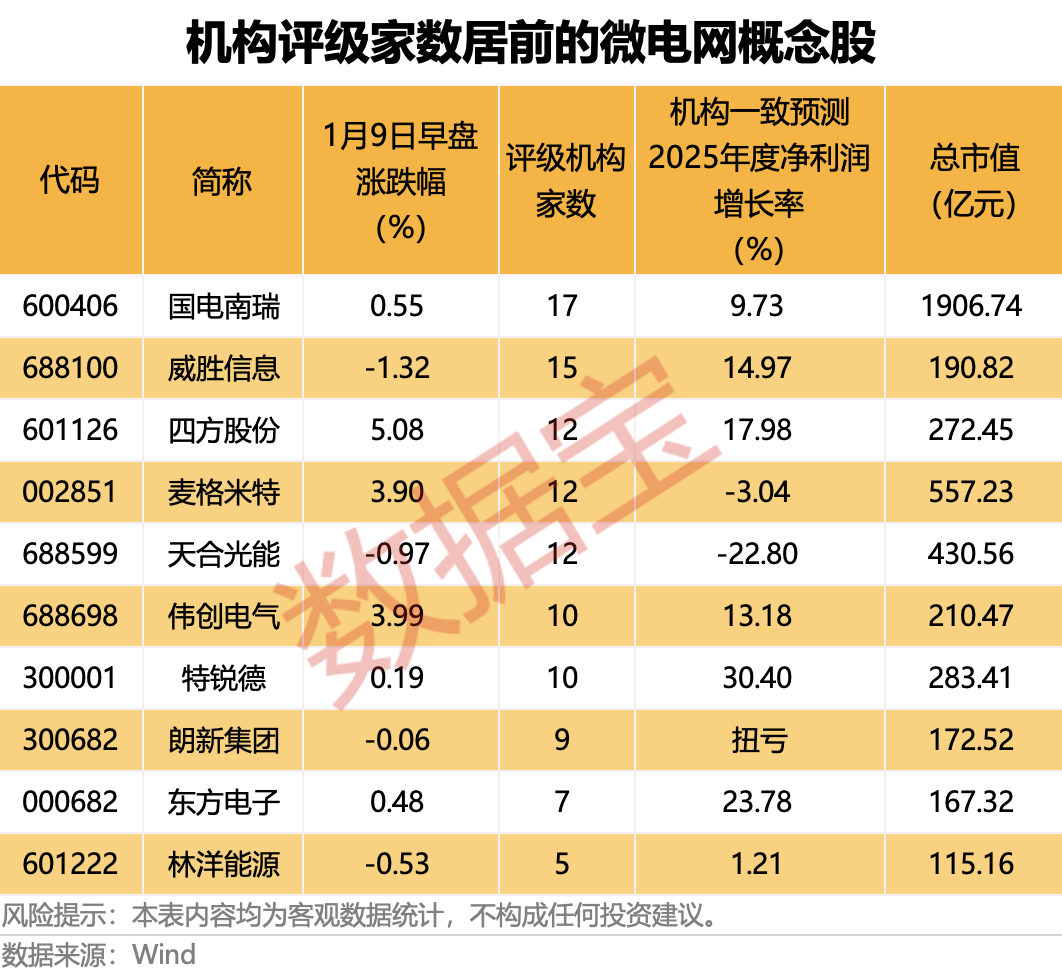
Core Insights - The Ministry of Industry and Information Technology, along with four other departments, has issued the "Guidelines for the Construction and Application of Industrial Green Microgrids (2026-2030)" to promote the development and application of green microgrids in the industrial sector, aiming to enhance the use of green electricity and reduce carbon emissions in key industrial areas [1] Group 1: Industry Overview - In the past six months, 40 listed companies have disclosed their involvement in microgrid-related businesses through investor Q&A platforms or research activities, primarily in the power equipment sector with 19 companies [1] - Other sectors involved include machinery equipment, construction decoration, and telecommunications, with 4, 3, and 3 companies respectively [1] Group 2: Company Performance and Predictions - Among the concept stocks, 20 have received institutional ratings, with 10 stocks attracting significant attention from institutions, having ratings from five or more agencies [1] - According to consensus forecasts, 8 out of the 10 stocks are expected to achieve year-on-year growth in net profit attributable to shareholders by 2025, with Teruide (300001) projected to have the highest net profit growth rate of 30.4%, and Dongfang Electronics (000682) expected to increase by over 20% [1] Group 3: Stock Performance Data - The table lists various companies along with their stock performance on January 9, including: - Guodian Nari (600406) with a 0.55% increase and a projected net profit growth of 9.73% [2] - Weisheng Information (688100) with a 1.32% decrease and a projected growth of 14.97% [2] - Sifang Co. (601126) showing a 5.08% increase with a 17.98% growth forecast [2] - Teruide (300001) with a slight increase of 0.19% and a projected growth of 30.4% [2] - Dongfang Electronics (000682) with a 0.48% increase and a forecasted growth of 23.78% [2]



五部门发文推进工业绿色微电网建设与应用
Xin Hua She· 2026-01-09 06:02
新华社北京1月9日电(记者周圆)记者9日获悉,工业和信息化部等五部门联合印发《工业绿色微电网 建设与应用指南(2026—2030年)》,引导工业企业和园区推进工业绿色微电网建设与应用,扩大工业 领域绿电应用,促进工业重点行业领域节能降碳。 ...