恶性通胀

Search documents
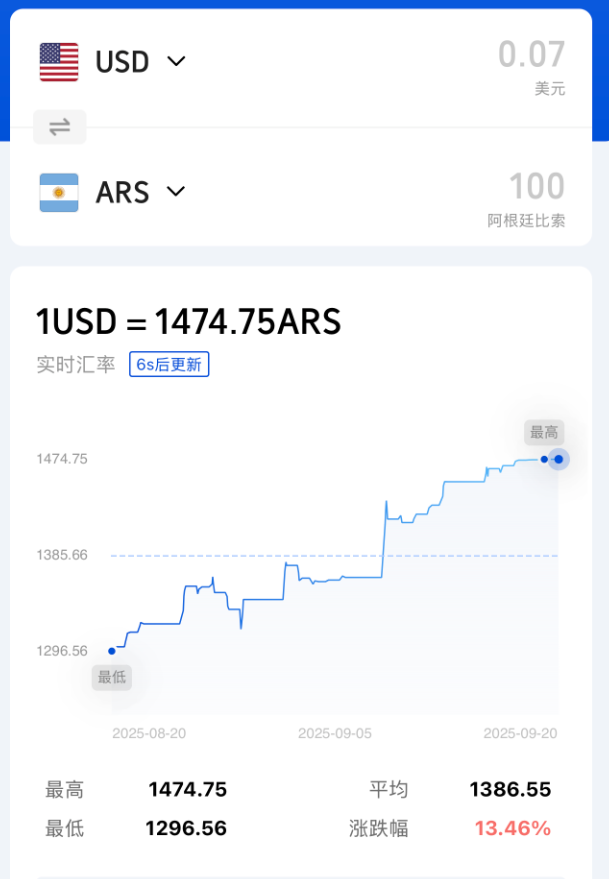
突然,暴跌!阿根廷紧急救市!
Zheng Quan Shi Bao· 2025-09-21 04:55
Core Viewpoint - Argentina is facing a severe currency crisis, prompting the central bank to intervene in the foreign exchange market by selling a total of $1.11 billion to support the peso, which has depreciated significantly against the dollar [1][3][4]. Group 1: Currency Intervention - The Argentine central bank sold $678 million on Friday, following sales of $379 million on Thursday and $53 million on Wednesday, marking a total intervention of $1.11 billion over three days [3]. - The peso has depreciated nearly 11% against the dollar in the past month and has seen a year-to-date decline of 30.1% [3]. Group 2: Government Response - Economy Minister Luis Caputo vowed to use "the last dollar" to defend the exchange rate and plans to guarantee payments on international bonds maturing in January and July 2026 [4]. - The government has implemented new foreign exchange controls to stabilize the currency, including stricter regulations on banks and prohibiting certain financial transactions [9][10]. Group 3: Political Context - The peso's collapse is attributed to a political crisis, following unexpected electoral losses for President Javier Milei's party, which undermined investor confidence in his ability to maintain a free-market agenda [8][9]. - The upcoming midterm elections on October 26 are critical, as they will reflect public sentiment towards Milei's economic policies and could influence the stability of his administration [9]. Group 4: Economic Implications - Analysts warn that the massive sale of dollars to support the peso could lead to a significant contraction in economic activity, potentially resulting in credit tightening and economic recession [4]. - The International Monetary Fund's (IMF) $20 billion loan has provided temporary relief but has not led to a sustainable accumulation of reserves, leaving Argentina with limited foreign exchange resources [4].
阿根廷,突然最大规模救市
Zhong Guo Ji Jin Bao· 2025-09-20 22:54
Core Insights - The Argentine central bank conducted its largest single-day dollar sale in nearly six years, amounting to $678 million, to support the peso amid political instability and increased demand for dollars from institutional investors [1] - The total dollar sales over the past three trading days reached $1.1 billion, indicating a significant intervention to manage liquidity as the peso hovers at historical lows [1] - Economic Minister Luis Caputo stated that the central bank will sell every dollar in reserves at the upper limit of the floating exchange rate [1] Group 1 - The peso fell to a historical low of 1,520 per dollar in the parallel exchange market, depreciating over 6% this week [3] - Since the agreement with the International Monetary Fund (IMF) in mid-April, the central bank had not intervened in the market until now [4] - Analysts estimate that if the current pace of dollar sales continues, reserves could decrease by approximately $10 billion before the elections, which is about 70% of the funds already disbursed by the IMF [4] Group 2 - The central bank's net international reserves are reported at $39.26 billion, but usable reserves for intervention are estimated to be only around $6 billion [4] - Continuous dollar sales may accelerate the depletion of reserves, jeopardizing short-term debt repayments, and could lead to increased issuance of local currency bonds to cover funding gaps [5] - The "country risk" indicator has risen to its highest level since August 2024, hovering around 1,500 basis points, with off-market bonds averaging a decline of 1.4% this week [6] Group 3 - The stability of the Argentine peso is deemed crucial; failure to maintain it could lead to soaring prices and undermine President Milei's support for necessary reforms [8] - President Milei vowed to defend the peso at all costs, echoing statements from his chief economic advisor [8] - Analysts warn that maintaining the current exchange rate could risk returning the country to rampant inflation, which contradicts Milei's promise to end it [10]

一旦美国狂印37万亿美元,把欠债都还了,会发生什么?
Sou Hu Cai Jing· 2025-09-20 14:57
Core Viewpoint - The United States is facing a severe debt crisis, with national debt exceeding $37 trillion, which is 1.27 times the projected GDP for 2024, resulting in nearly $110,000 debt per citizen [1][4]. Group 1: Debt Levels and Historical Context - The U.S. national debt has escalated dramatically, from $20 trillion in 2017 to $30 trillion in 2022, and then to $37 trillion in just 19 months [4]. - The historical context of U.S. debt includes the transition from a gold-backed dollar to a system reliant on oil, which has contributed to the current debt levels [4][6]. Group 2: Financial Implications - In the fiscal year 2024, the U.S. is projected to spend $882 billion on net interest, surpassing military expenditures for the first time, with expectations to exceed $952 billion in 2025 [6]. - A significant amount of debt, $9.3 trillion, will mature in 2025, requiring daily repayments of $25 billion, indicating a precarious financial situation [6]. Group 3: Inflation Risks - The potential for hyperinflation looms if the U.S. resorts to printing money to address its debt, which could lead to severe economic consequences similar to historical cases in Germany and Venezuela [9][11]. - Predictions suggest that prices for essential goods could double within weeks, and unemployment rates may rise significantly due to inflationary pressures [13]. Group 4: Global Impact and Currency Trends - The decline in the dollar's share of global foreign exchange reserves to 57.8% by the end of 2024 indicates a trend towards de-dollarization, with countries like China reducing their holdings of U.S. debt [15][18]. - The International Monetary Fund (IMF) warns that excessive money printing could reduce global economic growth to below 3% [20]. Group 5: Political and Economic Challenges - Efforts to reform U.S. fiscal policy, such as the 2024 Fiscal Responsibility Act, have not adequately addressed the underlying issues of fiscal deficits [20][22]. - Political polarization complicates potential reforms, making it difficult to implement tax increases or spending cuts necessary to stabilize the economy [22][26].

美联储理事提名人米兰承诺维护央行独立性
Xin Hua Cai Jing· 2025-09-03 23:13
Core Viewpoint - The Senate Banking Committee will hold a hearing for Stephen Milan, nominated by Trump for the Federal Reserve Board, emphasizing the importance of preventing economic recession and hyperinflation as the central bank's primary tasks [1] Group 1: Monetary Policy and Independence - Milan asserts that the independence of monetary policy is crucial for its success [1] - He plans to fulfill his duties based on macroeconomic analysis and long-term beneficial judgments if confirmed [1] - Milan intends to maintain the independence of the Federal Open Market Committee, which is tasked with significant responsibilities [1] Group 2: Regulatory Concerns - Milan raises questions regarding the Federal Reserve's activities beyond its dual mandate, particularly concerning its balance sheet [1] - He highlights the Fed's role in regulating major financial institutions and setting different capital prices for borrowers and lenders, including other central banks [1] - The final composition of the Federal Reserve's balance sheet remains an unresolved issue [1]
瑞·达利欧新书最新警告:当下全球正处于 “ 死亡螺旋 ” 临界点
首席商业评论· 2025-07-11 03:53
Core Viewpoint - The article discusses the significant changes in the global order due to the convergence of the "Great Debt Cycle" and "Five Forces," as articulated by Ray Dalio in his new book "Why Nations Fail: The Great Cycle" [1][3]. Group 1: Great Debt Cycle - The Great Debt Cycle typically spans about 80 years, leading to significant debt bubbles and their eventual bursts [6][9]. - The cycle consists of five stages: 1. Sound monetary phase with low net debt levels [11]. 2. Debt bubble phase characterized by low-cost borrowing and economic expansion [12]. 3. Peak phase where the bubble bursts, leading to simultaneous contraction in debt, credit, and the economy [13]. 4. De-leveraging phase where debt levels adjust painfully to match income levels [14]. 5. Recovery phase where a new balance is achieved, initiating a new cycle [15]. Group 2: Five Forces Influencing the Future - The first force is the debt/credit/money/economic cycle, which creates purchasing power and drives asset prices but also leads to debt accumulation [19]. - The second force involves internal order and chaos cycles, where political fluctuations can lead to significant changes in governance over approximately 80 years [20][21]. - The third force is the external order and chaos cycle, highlighting the shift from multilateralism to unilateralism, with increasing competition among nations [24][25]. - The fourth force is natural forces, where disasters like droughts and pandemics have historically caused more disruption than wars [26][27]. - The fifth force is human creativity, particularly technological advancements like AI, which will profoundly impact various sectors [28][42]. Group 3: Future Predictions - There is a high probability (65%) of a global debt restructuring crisis within the next five years, which could severely impact the dollar's dominance [3][35]. - Political shifts towards authoritarianism may occur as populist conflicts intensify within nations [36]. - The next five years are expected to witness significant technological advancements, particularly in AI, which will reshape industries [40][41].

最后一年了
猫笔刀· 2025-05-04 14:20
Group 1 - Buffett announced his retirement at the Berkshire shareholder meeting, with Abel nominated as his successor [1] - Buffett criticized current tariff policies, stating that trade should not be used as a weapon and that the U.S. should not be hostile towards the global population [1] - Berkshire currently holds $23.5 billion in Japanese stocks, which Buffett considers long-term, high-quality assets, with plans to continue increasing this position [2] Group 2 - Buffett holds $347.7 billion in cash, primarily in short-term U.S. Treasury bonds, indicating a cautious approach to potential market downturns [3] - He expressed concerns about the unsustainable U.S. national debt and emphasized the importance of protecting cash flow over capital appreciation in the face of inflation [3] - Buffett stated that he will not sell any Berkshire stock even after retirement, intending to leave it to a charitable foundation [4]