扩大高水平对外开放

Search documents
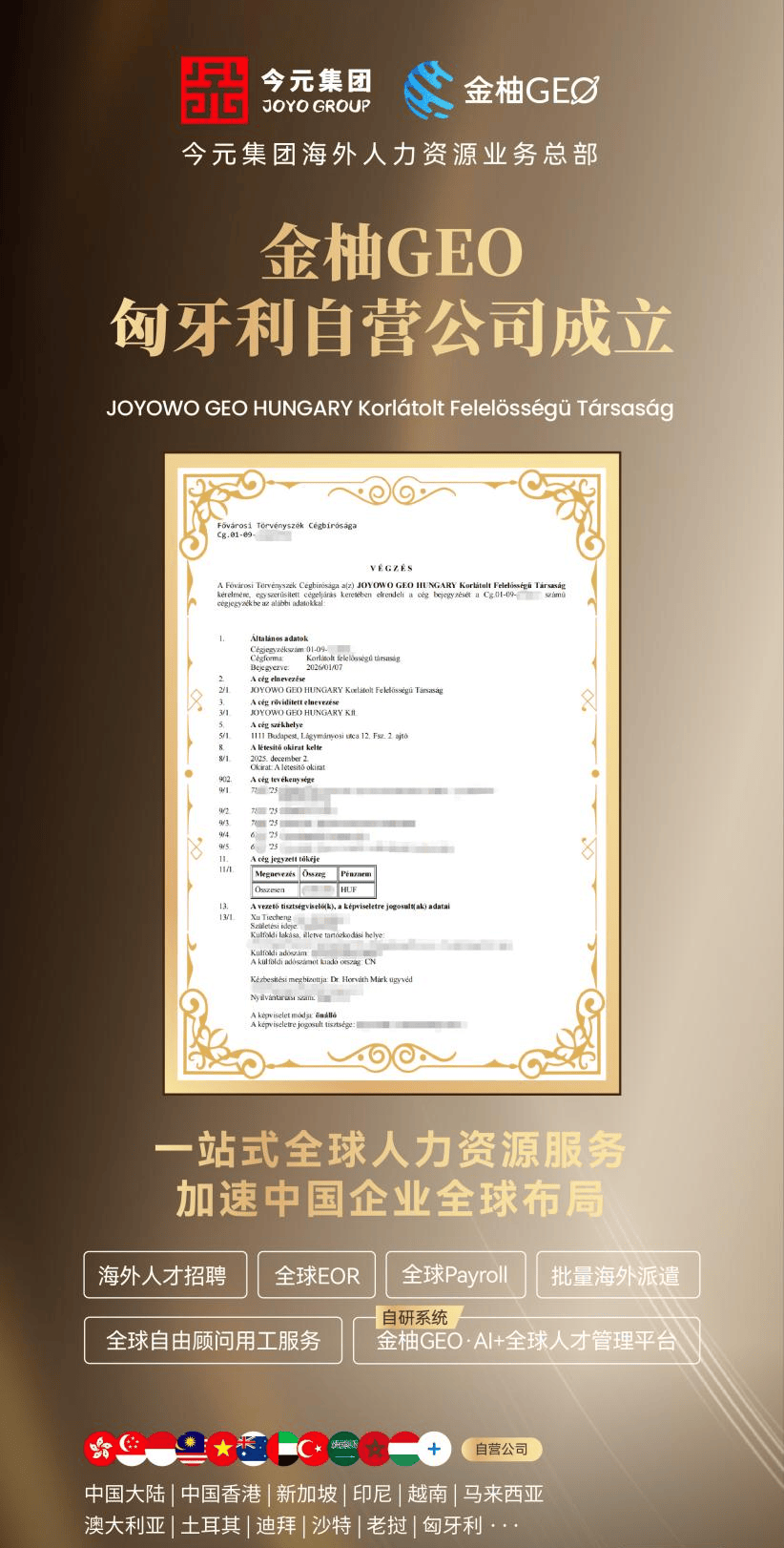
今元集团匈牙利自营公司成立,锚定中东欧枢纽,响应扩大高水平对外开放
Sou Hu Cai Jing· 2026-01-16 03:08
Core Viewpoint - The establishment of the self-operated company by Jinyuan Group's brand Jinyou GEO in Hungary marks a significant step in the company's globalization strategy, enhancing its service network along the "Belt and Road" initiative in Europe, and aligning with China's 14th Five-Year Plan for high-level opening-up and win-win cooperation [1][13]. Group 1: Strategic Importance of Hungary - Hungary is strategically positioned as a key gateway for Chinese enterprises under the "Belt and Road" initiative, serving as a vital portal for high-level opening-up during the 14th Five-Year period [4]. - The geographical location of Hungary connects Western Europe, Central Eastern Europe, and the Balkans, supported by significant "Belt and Road" projects like the Hungary-Serbia railway, facilitating logistics and industrial networks for Chinese companies [4]. Group 2: Investment Environment and Opportunities - Hungary offers a highly attractive investment environment with diverse incentives for foreign enterprises, including funding subsidies, tax reductions, and rent discounts, enhancing the business climate [6]. - In 2024, China is projected to invest €5.2 billion in Hungary, becoming the largest foreign investor, accounting for 51% of the total foreign investment in the country [6]. - The automotive and electronics sectors in Hungary are experiencing strong investment demand, with nearly 40% of foreign capital flowing into the automotive industry and 38.7% into electronics in 2024 [6]. Group 3: Human Resource Challenges - Chinese enterprises face significant human resource challenges in Hungary, including strict labor regulations and a reduced quota for foreign workers, which will be limited to 35,000 by 2025 [8]. - The local labor laws prioritize domestic employment, making it difficult for foreign companies to hire international talent, especially in high-skilled sectors like automotive and electronics [8]. Group 4: Jinyou GEO's Solutions - Jinyou GEO provides a comprehensive cross-border human resource solution leveraging its "localized deep cultivation + technological innovation + full-chain service" model, addressing the core pain points of Chinese enterprises in Hungary and Europe [9]. - The company has developed a one-stop global human resource service system, covering overseas talent recruitment, global Employer of Record (EOR), payroll services, and more, to meet the needs of enterprises in Hungary and over 150 countries [9][10]. - Jinyou GEO's local professional team is well-versed in EU and Hungarian labor standards, providing compliance consulting and operational support to enterprises [10]. Group 5: AI Technology Integration - The integration of AI technology into Jinyou GEO's global talent management platform enhances cross-border human resource management efficiency, automating processes such as employee onboarding and payroll calculations [11]. - The platform monitors labor regulations in real-time, providing alerts for compliance risks, and connects data across enterprises, personnel, and service providers for better management visibility [11][12].

释放消费潜力活力 以高水平开放赢得战略主动
Xin Lang Cai Jing· 2026-01-15 18:26
Group 1: Core Insights - The "14th Five-Year Plan" emphasizes the importance of building a strong domestic market and expanding high-level opening-up, with specific measures to boost consumption and promote trade innovation [1][2] - The Ministry of Commerce aims to achieve a steady growth in the consumption market, projecting a retail sales total of over 50 trillion yuan for the year, with a 4.0% increase in the first eleven months [2][3] Group 2: Consumption Strategies - Focus on cultivating service consumption and optimizing the old-for-new policy for consumer goods, with an emphasis on green and smart products [3][4] - The strategy includes enhancing service consumption in key areas such as transportation, home services, and entertainment, while also promoting local consumption through events like "Service Consumption Season" [3][4] Group 3: Trade Innovation - The Ministry of Commerce identifies three pillars for trade development: goods trade, service trade, and digital trade, aiming to stabilize foreign trade amidst global economic challenges [5][6] - Emphasis on diversifying trade markets and balancing trade development, with initiatives to enhance import trade and support cross-border e-commerce [6][7] Group 4: High-Level Opening-Up - The Ministry plans to expand autonomous opening-up in various service sectors and implement zero-tariff measures for all trading partners in Africa [8][9] - Focus on enhancing the global supply chain and participating in global economic governance through significant events like APEC and WTO meetings [9][10]
1月15日晚间央视新闻联播要闻集锦
Yang Shi Xin Wen Ke Hu Duan· 2026-01-15 14:09
Group 1 - Xi Jinping's important speech at the fifth plenary session of the 20th Central Commission for Discipline Inspection emphasizes the need for strict governance of the Party, aiming to provide strong support for the goals of the "14th Five-Year Plan" [6] - The speech has sparked enthusiastic responses among Party members and officials, who express commitment to advancing strict governance as a guiding principle for the "14th Five-Year Plan" [6] Group 2 - The Chinese government plans to introduce multiple financial policies by 2026 to support high-quality development of the real economy [3] - A press conference revealed that by the end of December 2025, the social financing scale is expected to grow by 8.3% year-on-year, and the broad money supply (M2) is projected to increase by 8.5%, significantly outpacing nominal GDP growth [12]
【权威访谈:开局“十五五”】建设强大国内市场 扩大高水平对外开放
Yang Shi Wang· 2026-01-15 12:01
Core Viewpoint - The article discusses China's economic strategies for the 14th Five-Year Plan, focusing on boosting domestic consumption, expanding high-level openness, and enhancing foreign trade resilience [1] Group 1: Domestic Consumption - By the end of November 2025, China's total retail sales of consumer goods are expected to grow by 4.0% year-on-year, with an annual total projected to exceed 50 trillion yuan for the first time [1] - China aims to cultivate new growth points in service consumption, particularly in transportation, housekeeping, performances, and sports events [1] - Measures will be taken to enhance circulation facilities and enrich consumption scenarios to stimulate potential in lower-tier markets [1] Group 2: Foreign Trade - In 2025, China's goods import and export are expected to surpass 45 trillion yuan, maintaining its position as the world's largest trading nation for nine consecutive years [1] - The country will promote a balanced development of goods trade, service trade, and digital trade while consolidating and expanding diversified markets [1] - There will be a focus on expanding autonomous openness and promoting a reasonable and orderly cross-border layout of industrial and supply chains [1]
释放消费潜力活力 以高水平开放赢得战略主动——访商务部党组书记、部长王文涛
Xin Hua Wang· 2026-01-15 10:54
Group 1: Core Insights - The "14th Five-Year Plan" emphasizes the importance of building a strong domestic market and expanding high-level openness, with specific measures to boost consumption and promote trade innovation [1][2] - The Ministry of Commerce aims to achieve a retail sales total of over 50 trillion yuan for the year, with a 4.0% growth in social retail sales in the first eleven months [2][3] Group 2: Consumption Strategies - Focus on cultivating service consumption and optimizing trade-in policies, with an emphasis on green and smart product consumption [3][4] - The Ministry plans to enhance consumption in lower-tier markets, which account for 70% of the population and 60% of retail sales, by improving circulation facilities and market environments [4] Group 3: Trade Innovation - The Ministry of Commerce identifies three pillars for trade development: goods trade, service trade, and digital trade, in response to global trade slowdowns [5][6] - Emphasis on diversifying markets, promoting balanced trade, and developing service trade through improved policies and international cooperation [6][7] Group 4: High-Level Openness - The Ministry will expand autonomous openness in various service sectors and enhance the implementation of free trade agreements to boost trade [8][9] - Plans to deepen cooperation under the Belt and Road Initiative and participate actively in global economic governance, including APEC and WTO meetings [9]
商务部:以扩大高水平对外开放推动外资工作固稳促优
Zheng Quan Ri Bao Wang· 2026-01-15 10:24
本报记者 刘萌 据商务部消息,1月14日至15日,2026年全国外资工作会议暨重点外资项目工作专班会议在京召开。会议全面总结2025年 及"十四五"时期吸引外资工作成效和经验,深入研判当前引资面临的形势,部署2026年外资重点工作。 (编辑 李家琪) 会议指出,2025年,稳外资政策接续加力,自主开放试点工作深入推进,"投资中国"品牌活动有序展开,外资企业服务保 障持续强化,开放平台创新提升加速推进,总体实现了回稳提质。"十四五"时期,我国引资规模居发展中国家第一,利用外资 大国地位保持稳定,结构持续优化,圆满完成外资工作各项目标任务。 会议强调,2026年是"十五五"时期开局之年,外资工作要立足商务工作"三个重要"定位,深入贯彻落实党的二十大和二十 届历次全会精神,认真落实中央经济工作会议部署,按照全国商务工作会议要求,以深化外商投资促进体制机制改革为牵引, 充分发挥我国超大规模和统一大市场优势,着力塑造吸引外资新优势,以扩大高水平对外开放推动外资工作固稳促优:一是把 稳外资工作与扩大内需、提振消费、科技创新等各项经济工作贯通起来综合施策,积极支持外资企业参与提振消费行动,深入 挖掘服务业引资新增长点,全面 ...
塑造吸引外资新优势,做好这三件事!
Xin Lang Cai Jing· 2026-01-14 01:02
Core Viewpoint - The article discusses China's ongoing efforts to attract foreign investment through various policy measures and initiatives, highlighting the importance of foreign enterprises in China's modernization and economic integration with the global market [1]. Group 1: Foreign Investment Contribution - Foreign enterprises contribute significantly to China's economy, accounting for one-third of the country's imports and exports, one-fourth of industrial added value, and one-seventh of tax revenue, while creating over 30 million jobs [1]. Group 2: Policy Initiatives - The Chinese government has completed its foreign investment target of $700 billion six months ahead of schedule during the 14th Five-Year Plan period [1]. - The National Development and Reform Commission and the Ministry of Commerce will release the "Encouraging Foreign Investment Industry Catalog (2025 Edition)" by the end of December 2025, which will include 1,679 items, an increase of 205 items compared to the 2022 version [1]. Group 3: Key Focus Areas for Attracting Foreign Investment - The Ministry of Commerce aims to enhance foreign investment by focusing on three main areas: 1. Expanding market access for foreign investment, particularly in the service sector, and addressing specific market entry issues faced by foreign enterprises [4]. 2. Improving the service level for foreign investment by reforming the investment promotion system and leveraging various open platforms to create favorable conditions for foreign enterprises [5]. 3. Continuously optimizing the investment environment by addressing the needs of foreign enterprises and ensuring a market-oriented, law-based, and international business environment [6].
如何塑造吸引外资新优势(政策问答·回应关切)
Ren Min Ri Bao· 2026-01-13 22:16
Core Viewpoint - China is enhancing its foreign investment policies to attract more foreign capital, with a focus on advanced manufacturing, modern services, and high-tech industries, while also promoting investment in central and northeastern regions [1][2]. Group 1: Foreign Investment Contributions - Foreign enterprises contribute one-third of China's total imports and exports, one-fourth of industrial added value, and one-seventh of tax revenue, creating over 30 million jobs [1]. - During the 14th Five-Year Plan period, China achieved its foreign investment target of $700 billion six months ahead of schedule [1]. Group 2: Policy Initiatives - The 2025 version of the Encouraged Foreign Investment Industry Catalogue will include 1,679 items, with a net increase of 205 items and 303 modifications compared to the 2022 version [1]. - The Ministry of Commerce is implementing the "Investment China" brand initiative, hosting investment promotion activities domestically and internationally to showcase investment opportunities in China [1]. Group 3: Key Focus Areas for Attracting Foreign Investment - Expanding market access for foreign investment, particularly in the service sector, and addressing specific market entry challenges faced by foreign enterprises [2]. - Enhancing the service level for foreign investment by reforming the investment promotion system and leveraging various open platforms to create favorable conditions for foreign enterprises [2]. - Continuously optimizing the foreign investment environment by addressing the needs of foreign enterprises and ensuring a market-oriented, law-based, and international business environment [2].
商务部部长:坚定不移推动“十五五”时期扩大高水平对外开放
Xin Lang Cai Jing· 2026-01-13 06:22
Core Viewpoint - The report emphasizes the importance of expanding high-level opening-up to promote inclusive and beneficial economic globalization, highlighting its significance in China's modernization efforts and global economic cooperation [2][4][5]. Group 1: Significance of High-Level Opening-Up - High-level opening-up is a strong driving force for comprehensive high-quality development, enhancing competitiveness in various industries such as high-speed rail, 5G, and artificial intelligence [2]. - It is a crucial pathway to meet the people's needs for a better life, directly impacting employment and consumer choices, with over 200 million jobs created through foreign trade and investment [3]. - High-level opening-up is a proactive approach to promote inclusive globalization, transitioning from a "follower" to a "leader" in global economic engagement [4]. Group 2: Achievements in High-Level Opening-Up - The open economy has reached new heights, with China's foreign trade maintaining its position as the world's largest, with imports and exports exceeding 41.2 trillion yuan, a 3.6% increase year-on-year [8]. - Significant breakthroughs in autonomous opening-up include zero tariffs on 100% of products for least developed countries and a reduction in overall tariff levels to 7.3% [9]. - Open cooperation has shown new initiatives, such as the Belt and Road Initiative, which has become a popular international cooperation platform, enhancing trade and investment partnerships [10]. Group 3: Challenges and Opportunities - The current environment for opening-up is characterized by complex changes, with strategic opportunities and risks coexisting, necessitating proactive adaptation to external uncertainties [12][13]. - The transition period involves reshaping the economy towards digital and green sectors, with digital trade expected to reach 2.9 trillion yuan, growing by 6.5% [14]. - The vision for opening-up emphasizes shared development and global governance, with China aiming to provide more global public goods and take on greater responsibilities [15]. Group 4: Key Tasks for Future Opening-Up - The focus will be on expanding autonomous opening-up, aligning with international standards, and enhancing market access in service sectors [16]. - Promoting trade innovation and integrating domestic and international markets will be essential for strengthening the domestic economy while enhancing external trade [17]. - High-quality cooperation in the Belt and Road Initiative will be prioritized, fostering strategic partnerships and enhancing legal protections for overseas investments [19].
学习丨国学新韵:志合者,不以山海为远
Xin Lang Cai Jing· 2026-01-13 04:19
Core Viewpoint - The article emphasizes the role of the Communist Party of China as a faithful inheritor and promoter of excellent traditional Chinese culture, highlighting its commitment to expanding high-level opening-up through the integration of traditional wisdom with contemporary values [2]. Group 1 - The speaker, He Ping, is the Vice Dean and Professor at Tsinghua University's School of Economics and Management [2]. - The discussion centers around a classical quote referenced by President Xi Jinping, "志合者,不以山海为远," which translates to "Those with shared aspirations are not deterred by mountains and seas," illustrating the deep wisdom of traditional Chinese culture [2]. - The article showcases China's determination to expand high-level foreign openness, reflecting its contemporary significance and relevance [2].