
贸易平衡发展

Search documents
外贸“开门红”!前2个月我国货物贸易进出口增长18.3%
券商中国· 2026-03-10 12:35
Core Viewpoint - The foreign trade data for the first two months of the year shows a strong start, with both imports and exports growing over 10% year-on-year, indicating the competitiveness of China's goods trade and a trend towards balanced development in trade [2][3]. Group 1: Trade Performance - In the first two months, China's total goods trade value reached 7.73 trillion yuan, a year-on-year increase of 18.3%. Exports amounted to 4.62 trillion yuan, growing by 19.2%, while imports were 3.11 trillion yuan, increasing by 17.1% [3]. - The last time China's goods trade saw such growth rates was in the first two months of 2022, with current global market demand showing good growth and effectively absorbing the negative impacts of trade frictions [4]. Group 2: Factors Driving Growth - The strong performance in foreign trade is attributed to four main factors: the release of policy dividends, the highlighting of industrial advantages, the activation of micro-entity vitality, and the overall improvement in market expectations [4]. - The Ministry of Commerce aims to stabilize foreign trade by balancing imports and exports, focusing on expanding imports while maintaining export stability [5]. Group 3: Product and Trade Structure - The structure of foreign trade is continuously optimizing, with a significant increase in product value-added. Exports of electromechanical products accounted for over 60%, with notable growth in labor-intensive products [6]. - In the first two months, electromechanical product exports reached 2.89 trillion yuan, growing by 24.3%, while labor-intensive products saw exports of 702.67 billion yuan, increasing by 15.6% [6][8]. Group 4: Trade Partners and Methods - ASEAN and countries involved in the Belt and Road Initiative have become key growth points, with trade with ASEAN reaching 1.24 trillion yuan, a growth of 20.3% [9]. - Private enterprises have solidified their position in foreign trade, with imports and exports totaling 4.51 trillion yuan, a growth of 22.8% [9]. - General trade imports and exports reached 4.78 trillion yuan, growing by 13.5%, while processing trade saw a growth of 19.3% [9].


王文涛回应去年我国出口“一增一降”
证券时报· 2026-03-06 08:39
Group 1 - The core viewpoint of the article highlights the importance of balancing imports and exports to promote stable trade development, as emphasized by Minister Wang Wentao [3][4] - In 2022, China's exports to the US decreased by 19.5%, while overall exports increased by 6.1% in RMB terms, showcasing the results of diversified trade strategies [2] - China's online drama revenue accounts for 90% of the global market, with app downloads making up 80% of the global total, indicating strong domestic content consumption reflected in international markets [3] Group 2 - Minister Wang Wentao expressed concerns about increasing uncertainties in the external environment due to geopolitical conflicts and disruptions in international trade and supply chains, stating that there is no "most uncertain" year, only "more uncertain" ones [4] - The focus for the current year will be on building a strong trade nation through three pillars: goods trade, service trade, and digital trade, while enhancing overall coordination to stabilize the foreign trade foundation [4]

两会|王文涛:深入实施提振消费专项行动
券商中国· 2026-03-06 08:31
Core Viewpoint - The article discusses the recent press conference held by key Chinese government officials, focusing on economic development, consumer spending, and trade dynamics in the context of the current global environment. Group 1: Consumer Spending and Economic Growth - The Ministry of Commerce emphasizes the combination of improving people's livelihoods and promoting consumption, implementing special actions to boost consumption and expand domestic demand [2] - During the 14th Five-Year Plan period, China's per capita consumption GDP is projected to increase from $10,000 to $13,000, indicating a shift from traditional consumption to high-quality, green, and low-carbon consumption [4] - Service consumption, particularly experiential consumption, is expected to grow significantly, with an annual growth rate of 10.4% in service retail from 2022 to 2025 [4] Group 2: Trade and Export Dynamics - In the previous year, China's exports to the U.S. decreased by 19.5%, but overall exports grew by 6.1% in RMB terms, reflecting the results of diversified trade strategies [7] - The Ministry of Commerce aims to balance imports and exports to promote trade development [8] - The external environment is increasingly uncertain due to intensified geopolitical conflicts, impacting international trade and global industrial order [9] Group 3: Service Sector and Market Opportunities - The Ministry of Commerce plans to promote pilot programs for opening up in sectors such as value-added telecommunications, biotechnology, and foreign-funded hospitals, aiming to expand market access and enhance the supply of quality services [5] - China's online drama industry accounts for 90% of global market revenue, with domestic app downloads representing 80% of the global total, indicating strong international demand for Chinese content [6]

商务部部长王文涛:让中国成为更多国家最佳出口目的地
2 1 Shi Ji Jing Ji Bao Dao· 2026-02-04 12:49
Group 1 - The core message of the event "Export to China" is to invite countries to leverage new opportunities in exporting to China, aiming to make China a preferred destination for exports [1] - The Ministry of Commerce plans to hold over 100 events in 2026, inviting countries like the UK, Kazakhstan, Kenya, and Thailand to participate as annual theme countries, enhancing international cooperation and trade balance [1] - Beijing aims to integrate imports with consumption, positioning itself as a primary destination for global quality goods and services, supported by improved business environments and supply chain optimization [1] Group 2 - In 2025, China's imports reached a record high of 18.48 trillion yuan, maintaining its position as the world's second-largest import market for 17 consecutive years [2] - The number of participating companies in the China International Import Expo reached a new high, with intended transaction amounts exceeding 80 billion USD, reflecting strong international interest [2] - The import of various categories, including mechanical and electrical products, increased significantly, with electronic components and computer parts growing by 9.7% and 20% respectively [2] Group 3 - The increase in imports reflects a transformation in domestic industrial structure and an enhancement in the quality of life for consumers, with high-tech product imports rising by 9.9% [3] - There is a notable shift in consumer preferences towards a more diverse range of products, as evidenced by a 13.4% increase in the import of dried fruits and nuts [3] - The "Export to China" initiative is part of a broader strategy to enhance China's openness and create a synergistic system with "Invest in China" and "Buy in China" [3]
商务部:愿做“世界工厂”更愿做“世界市场”
Xin Hua Wang· 2026-01-26 10:36
Core Viewpoint - In 2026, China will steadfastly promote high-level opening-up to the outside world, aiming to innovate and balance trade development, aspiring not only to be the "world's factory" but also the "world's market" [1] Group 1 - The Director of the Department of Foreign Trade of the Ministry of Commerce, Wang Zhihua, emphasized the commitment to advancing high-level opening-up [1] - The focus will be on promoting innovative and balanced trade development [1] - China expresses a willingness to transition from being solely a manufacturing hub to becoming a significant global market [1]
商务部:中国不仅愿做“世界工厂”,更愿做“世界市场”
Yang Shi Wang· 2026-01-26 08:28
Core Viewpoint - In 2026, China will steadfastly promote high-level opening-up and drive innovative and balanced trade development, aiming to transition from being the "world's factory" to becoming the "world's market" [1] Group 1: Trade Development - China’s vast market will provide broader opportunities for products and services from various countries [1] - The focus will be on promoting trade innovation and balanced development [1] Group 2: Economic Impact - China's high-quality development is expected to continuously inject new momentum into the global economy [1]
消费“新”、外贸“稳”、高水平对外开放“进”……“十五五”开局之年这样干↓
Yang Shi Wang· 2026-01-16 02:04
Group 1: Consumer Market Insights - The core viewpoint emphasizes the importance of boosting consumption and expanding the supply of quality consumer goods and services as outlined in the "14th Five-Year Plan" [1] - In the first 11 months of 2025, China's total retail sales of consumer goods increased by 4.0% year-on-year, with an expected annual total surpassing 50 trillion yuan [1] - Service retail growth outpaced goods retail by 1.3 percentage points, indicating strong vitality and potential in the market [1] Group 2: Service Consumption Growth - The government is focusing on key areas such as transportation, housekeeping, performances, and sports events to cultivate new growth points in service consumption [3] - Initiatives like "Service Consumption Season" and "Chinese Food Festival" will be organized to promote distinctive service consumption brands [3] Group 3: Trade and Export Strategies - China's foreign trade is expected to exceed 45 trillion yuan in 2025, with a growth rate of 3.8%, maintaining its position as the world's largest goods trader for nine consecutive years [12] - The government plans to enhance trade balance through exhibitions and targeted procurement to expand imports [16] Group 4: Open Market Initiatives - The government aims to expand high-level opening-up by increasing access in sectors like telecommunications and biotechnology, and by implementing zero-tariff measures for all African countries with diplomatic relations [20][22] - The establishment of a comprehensive overseas service platform is planned to facilitate international market expansion and trade investment integration [26]
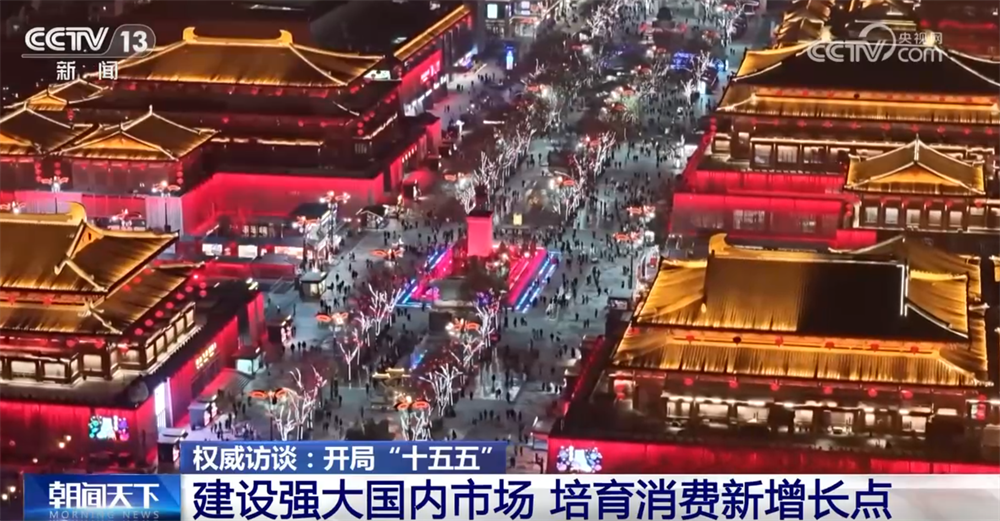
释放消费潜力活力 以高水平开放赢得战略主动
Xin Lang Cai Jing· 2026-01-15 18:26
Group 1: Core Insights - The "14th Five-Year Plan" emphasizes the importance of building a strong domestic market and expanding high-level opening-up, with specific measures to boost consumption and promote trade innovation [1][2] - The Ministry of Commerce aims to achieve a steady growth in the consumption market, projecting a retail sales total of over 50 trillion yuan for the year, with a 4.0% increase in the first eleven months [2][3] Group 2: Consumption Strategies - Focus on cultivating service consumption and optimizing the old-for-new policy for consumer goods, with an emphasis on green and smart products [3][4] - The strategy includes enhancing service consumption in key areas such as transportation, home services, and entertainment, while also promoting local consumption through events like "Service Consumption Season" [3][4] Group 3: Trade Innovation - The Ministry of Commerce identifies three pillars for trade development: goods trade, service trade, and digital trade, aiming to stabilize foreign trade amidst global economic challenges [5][6] - Emphasis on diversifying trade markets and balancing trade development, with initiatives to enhance import trade and support cross-border e-commerce [6][7] Group 4: High-Level Opening-Up - The Ministry plans to expand autonomous opening-up in various service sectors and implement zero-tariff measures for all trading partners in Africa [8][9] - Focus on enhancing the global supply chain and participating in global economic governance through significant events like APEC and WTO meetings [9][10]
释放消费潜力活力 以高水平开放赢得战略主动——访商务部党组书记、部长王文涛
Xin Hua Wang· 2026-01-15 10:54
Group 1: Core Insights - The "14th Five-Year Plan" emphasizes the importance of building a strong domestic market and expanding high-level openness, with specific measures to boost consumption and promote trade innovation [1][2] - The Ministry of Commerce aims to achieve a retail sales total of over 50 trillion yuan for the year, with a 4.0% growth in social retail sales in the first eleven months [2][3] Group 2: Consumption Strategies - Focus on cultivating service consumption and optimizing trade-in policies, with an emphasis on green and smart product consumption [3][4] - The Ministry plans to enhance consumption in lower-tier markets, which account for 70% of the population and 60% of retail sales, by improving circulation facilities and market environments [4] Group 3: Trade Innovation - The Ministry of Commerce identifies three pillars for trade development: goods trade, service trade, and digital trade, in response to global trade slowdowns [5][6] - Emphasis on diversifying markets, promoting balanced trade, and developing service trade through improved policies and international cooperation [6][7] Group 4: High-Level Openness - The Ministry will expand autonomous openness in various service sectors and enhance the implementation of free trade agreements to boost trade [8][9] - Plans to deepen cooperation under the Belt and Road Initiative and participate actively in global economic governance, including APEC and WTO meetings [9]
中央财办有关负责同志:明年将进一步放宽市场准入,扩大增值电信、生物技术等领域开放试点
Xin Hua She· 2025-12-16 14:07
Group 1 - The central economic work conference has made a series of deployments to expand high-level opening up, focusing on three main measures for the next year [1] - The first measure is to orderly expand the autonomous opening of the service sector, including enhancing market access and optimizing pilot programs for service trade [1] - The second measure involves creating diverse open highlands, optimizing the layout of free trade pilot zones, and aligning with international high-standard economic and trade rules [1] - The third measure aims to promote the signing of more regional and bilateral trade and investment agreements, including high-standard free trade agreements and zero-tariff measures for African countries [1] Group 2 - To enhance foreign trade quality and efficiency, the focus will be on integrating trade and investment, developing service trade, digital trade, and green trade, while also expanding the import of quality consumer goods [2] - The policy goal is to achieve a basic balance of international payments, with over a hundred import promotion activities planned under the theme "Shared Big Market, Export to China" [2] - To optimize the business environment and attract foreign investment, new policies will be introduced to deepen reforms in foreign investment promotion systems, including easing market access and expanding pilot openings in sectors like telecommunications and biotechnology [2] - The support policies for foreign investment will be improved, promoting reinvestment and local production by foreign enterprises, and establishing a comprehensive service guarantee system for foreign investors [2]