
投资者风险偏好

Search documents
中信证券:投资者风险偏好有望保持高位,股票表现占优的格局预计还将持续
Xin Lang Cai Jing· 2025-08-30 16:46
Core Viewpoint - The significant stock-bond seesaw market since the second quarter is attributed to the complex macroeconomic environment, where the economic cycle has bottomed out but recovery mainly relies on policy-driven factors [1] Group 1: Market Dynamics - The current stock-bond seesaw market is somewhat similar to that of 2015, driven by a global emerging market bull market, accelerated entry of medium to long-term funds, and a rapid increase in market risk appetite [1] - Investors' risk appetite is expected to remain high, with a continued favorable performance of stocks anticipated [1] Group 2: Valuation and Inflation - High market valuations are not necessarily a barrier to market growth, with a focus on whether inflation can rebound in the fourth quarter [1] - Bond yields have returned to reasonable levels corresponding to policy rates due to the stock-bond seesaw effect, indicating a gradual desensitization of bonds to this effect [1] Group 3: Interest Rate Outlook - The high risk appetite among investors suggests that short-term interest rates are unlikely to quickly return to a rapid downward trend, with short-term rates expected to fluctuate [1] - Waiting for clearer interest rate cut guidance from the central bank may be a better strategy for investors [1]

上半年理财收益率降至2.12%,二季度新增千万投资者
Di Yi Cai Jing· 2025-07-29 11:29
Core Insights - The average annualized return of wealth management products in the first half of the year was 2.12%, down 68 basis points from 2.8% in the same period last year [1][5] - The total scale of the wealth management market reached 30.67 trillion yuan, with a year-to-date increase of 720 billion yuan [2][3] - The number of investors holding wealth management products increased by over 8% to 136 million, with a significant influx of new investors in the second quarter [4][5] Wealth Management Market Overview - As of June 30, 2025, there were 194 banks and 32 wealth management companies offering 41,800 products, with a total scale of 30.67 trillion yuan, which is 3.72 trillion yuan less than the public fund scale [2] - The wealth management market's growth rate has slowed, with a year-to-date increase of 2.38% and a year-on-year increase of 7.53% [2][3] - The wealth management companies' product scale reached 27.48 trillion yuan, accounting for 89.6% of the total market, reflecting a 1.8 percentage point increase from the beginning of the year [3] Investor Behavior and Preferences - The number of personal investors increased by 10.29 million in the first half of the year, with a notable shift in risk appetite towards higher-risk products [4][5] - The average annualized return for wealth management products was 2.12%, with a total of 389.6 billion yuan generated for investors, marking a 14.18% increase from the previous year [5] - The proportion of low-risk and high-risk investors has shown a contrasting trend, indicating a shift in investor sentiment [5] Product Structure and Trends - Cash management products have seen a significant decline, with a scale reduction of nearly 1 trillion yuan, attributed to low yields and regulatory constraints [7][8] - As of June 30, 2025, the scale of fixed-income products was 29.81 trillion yuan, accounting for 97.20% of the total, while mixed and equity products saw slight increases [8][9] - The trend towards longer-term products is evident, with over 72.86% of closed-end products having a duration of more than one year [10] Asset Allocation Strategies - Wealth management products have increased their allocation to public funds, cash, and deposits, while reducing exposure to credit bonds [11][12] - The total investment assets of wealth management products reached 32.97 trillion yuan, with a significant increase in cash and bank deposits [11] - The allocation to public funds rose to 1.38 trillion yuan, reflecting a growing preference for high liquidity assets [12]
美股创历史新高!分析师警告:泡沫风险显著上升,投资者风险偏好创2001年来最快增长
Jin Rong Jie· 2025-07-26 15:42
Group 1 - The US stock market has recently reached historical highs, but several analysts warn that the risk of a bubble is significantly increasing [1][3] - The current market environment shows extreme investor optimism, with risk appetite at a multi-month high, which may indicate an impending correction due to the high level of consensus among investors [1][3] Group 2 - Global central banks' shift towards loose monetary policy has created a conducive environment for stock market bubbles, with US, UK, and European central banks significantly lowering borrowing costs, reducing global policy rates from 4.8% last year to 4.4% [3] - It is expected that this rate will further decline to 3.9% within the next 12 months, providing ample liquidity support for asset price increases [3] - US policymakers are considering regulatory reforms to increase retail investor participation, which may further amplify market volatility, as a larger retail investor base often leads to increased liquidity and volatility, key drivers of bubble formation [3] Group 3 - A recent fund manager survey indicates that investor risk appetite has grown at the fastest pace since 2001 over the past three months, with the largest increase in US stock allocation since December of the previous year [4] - The allocation to technology stocks has seen the largest three-month increase since 2009, reflecting extreme optimism that historically appears near market tops [4] - Fund managers' cash levels have dropped to 3.9%, falling below the critical 4.0% threshold, which is viewed as a clear "sell signal" in trading rules [4] - The proportion of respondents believing that the economy will not enter a recession in the next year has completely reversed, with pessimistic expectations nearly vanishing, indicating a one-sided market consensus that could trigger rapid adjustments with any negative data [4]


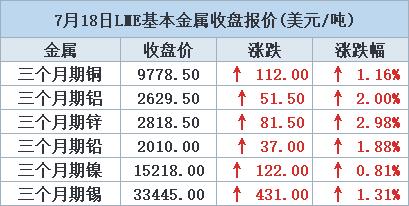
金属全线上涨 期铜收高,因投资者风险偏好增强【7月18日LME收盘】
Wen Hua Cai Jing· 2025-07-19 10:58
Group 1 - LME copper prices rose to a one-week high, closing at $9,778.50 per ton, up $112.00 or 1.16% due to increased investor risk appetite and bargain buying [1][2] - Other base metals also saw price increases, with three-month aluminum up 2.00% to $2,629.50, zinc up 2.98% to $2,818.50, and lead up 1.88% to $2,010.00 [2] - BHP Group reported a slight increase in copper production for the fourth quarter, reaching 516,200 tons, up 2.25% year-on-year, and an annual copper production of 2,016,700 tons, an 8% increase from the previous fiscal year [4] Group 2 - Analysts noted that U.S. economic data has improved, boosting hopes for better copper demand and reducing the likelihood of immediate interest rate cuts [4] - LME copper inventories have been rising, particularly in Asian warehouses, as some traders bet on increased buying following recent price declines, though uncertainty remains about whether this will materialize [4] - Peru's copper production fell by 4.6% year-on-year in May, totaling 220,849 tons, highlighting challenges in one of the world's largest copper-producing countries [5] Group 3 - Nickel prices underperformed due to rising inventories and weak demand, with Commerzbank lowering its nickel price forecast for the end of 2025 from $18,000 to $16,000 per ton [6] - Three-month aluminum reached a three-week high of $2,637 per ton, reflecting positive market sentiment [7]

固收、宏观周报:关注经贸协议最终落地情况-20250701
Shanghai Securities· 2025-07-01 10:12
Report Summary 1. Report Industry Investment Rating No industry investment rating is provided in the report. 2. Core Viewpoints - The end of the conflict between Israel and Iran significantly boosted investor risk appetite, leading to substantial gains in the equity markets of A - shares, Hong Kong stocks, and US stocks [9]. - The US may reach agreements with 10 major trading partners, and whether the China - US agreement is signed needs further observation [10]. - Focus on A - share structural opportunities such as banks and non - ferrous metals, and the possibility of short - term long opportunities for gold [11]. 3. Summary by Related Content Equity Markets - In the past week (20250623 - 20250629), US stocks soared, with the Nasdaq, S&P 500, and Dow Jones Industrial Average changing by 4.25%, 3.44%, and 3.82% respectively. The Nasdaq China Technology Index rose 5.50%, and the Hang Seng Index rose 3.20% [2]. - Most A - share sectors rose, with the wind all - A index up 3.56%. The comprehensive finance sector led the gains, with a weekly increase of over 14%. Other sectors with weekly increases of over 5% included computer, comprehensive, national defense and military industry, non - bank finance, and non - ferrous metals [3]. Bond Markets - In the past week, interest - rate bond prices slightly declined, and the yield curve steepened. The 10 - year Treasury bond futures main contract fell 0.10%, and the yield of the 10 - year Treasury bond active bond rose 0.66 BP to 1.6462% [4]. - The capital price increased significantly, and the central bank made a net injection of 10672 billion yuan in open - market operations [5]. - The bond market leverage level decreased, with the 5 - day average of inter - bank pledged repurchase volume dropping from 8.32 trillion yuan on June 20, 2025, to 7.77 trillion yuan on June 27, 2025 [6]. - US Treasury yields declined, and the curve shifted downward overall. The 10 - year US Treasury yield fell 9 BP to 4.29% as of June 27, 2025 [7]. Foreign Exchange and Commodities - The US dollar depreciated, and the US dollar index dropped 1.52%. Gold prices fell, with the London gold spot price down 2.86% to $3271.75 per ounce, and the Shanghai gold spot price down 1.81% to 763.3 yuan per gram [8].
摩根士丹利基金市场洞察:中美和谈取得实质性进展,市场风险偏好上行
Xin Lang Ji Jin· 2025-05-13 02:04
Group 1 - The A-share market showed positive performance in the first week of May, with major indices rising and small-cap indices and the ChiNext Index increasing by over 3% [1] - The market's upward trend was supported by the resumption of trade talks between China and the U.S., as well as a series of financial measures including interest rate cuts and reserve requirement ratio reductions [1] - The average daily trading volume in the market stabilized and rebounded to 1.35 trillion yuan, indicating increased market activity [1] Group 2 - The recent high-level economic and trade talks between China and the U.S. in Geneva are expected to enhance investor risk appetite, with substantial progress reported by the Chinese delegation [2] - The China Securities Regulatory Commission issued a new action plan to promote the high-quality development of public funds, emphasizing stability in fund investment behavior and establishing clear performance benchmarks for each fund [2] - Recent export data significantly exceeded market expectations, indicating strong current performance despite weaker future expectations, with the outcome of trade negotiations likely influencing future market reactions [2] Group 3 - The MACD golden cross signal has formed, indicating a positive trend for certain stocks [3]
日债收益率上涨,因中美贸易会谈提振风险偏好
news flash· 2025-05-12 05:59
Core Viewpoint - Japanese government bond yields rose due to signs of progress in US-China trade talks, which boosted investor risk appetite and led to a sell-off of safe-haven assets [1] Group 1: Market Reaction - The yield on Japan's 10-year government bonds reached 1.4%, the highest since April 10, and was last reported at 1.38%, an increase of 3 basis points from the previous trading day [1] - Senior strategist Katsutoshi Inadome from Sumitomo Mitsui Trust Asset Management noted that the signs of progress in US-China talks have enhanced investor risk appetite [1] Group 2: Implications for Trade Talks - While there has been no visible progress in Japan-US talks, the outcome of US-China discussions is deemed crucial [1]
中美贸易会谈提振风险偏好 日债收益率上涨
news flash· 2025-05-12 05:58
Core Viewpoint - The progress in China-US trade talks has boosted investor risk appetite, leading to a sell-off of safe-haven assets and an increase in Japanese government bond yields [1] Group 1 - Japanese government bond yields rose on Monday due to signs of progress in China-US trade talks [1] - The yield on Japan's 10-year government bonds reached 1.4%, the highest since April 10, and was last reported at 1.38%, an increase of 3 basis points from the previous trading day [1]