
指数投资

Search documents
2026资本市场开年定调:政策赋能高质量发展 ETF成关键抓手
Zhong Guo Xin Wen Wang· 2026-02-06 08:59
Core Viewpoint - The capital market in 2026 is set to focus on high-quality development, with ETFs identified as a key tool for achieving this goal [1] Group 1: ETF Growth and Investment Trends - By the end of 2025, the total scale of index fund products has officially surpassed 8 trillion yuan, marking a nearly 40% increase since the beginning of the year [2] - Broad-based index funds now account for 49% of the overall index fund scale, indicating a significant shift towards index investing [2] - The number of investors trading index products on the Ant Fund platform has exceeded 100 million, with over 50% being post-90s and post-00s generations [4] Group 2: Factors Driving ETF Development - Three irreversible forces are driving the growth of index funds: the achievements of high-quality development in the capital market, the resonance of policy dividends, and the reshaping of tool value [4] - The "Long Money Long Investment" policy and the new "National Nine Articles" have instilled strong confidence in the market, leading to increased investment in ETFs [4] Group 3: ETF as a Tool for Financial Inclusion - ETFs are recognized for their unique advantages of risk diversification, low cost, and operational transparency, making them a key tool for fulfilling the capital market's mission [6] - The current challenges in the ETF market include insufficient tools and disconnected channels, necessitating optimization in product design, institutional supply, and ecological construction [6] Group 4: Investment Opportunities in New Resources - The focus of investment is shifting towards "new resources" that support the intelligent world and green revolution, driven by a combination of cyclical factors [8] - The AI industry is expected to experience significant growth, with a shift from scale pursuit to efficiency enhancement, making ETFs a favorable tool for investing in this evolving landscape [8]

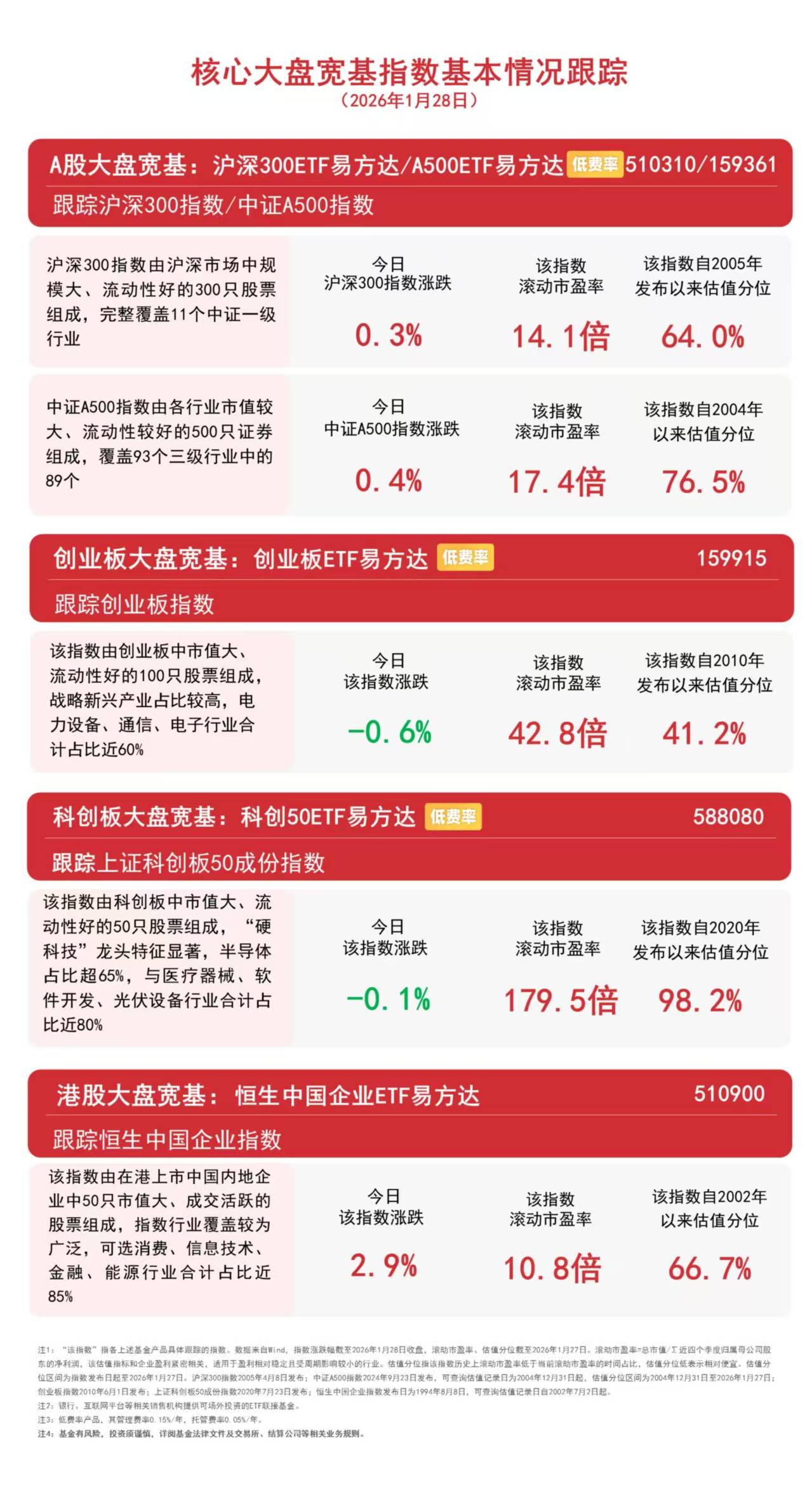
沪指放量上涨,关注A500ETF易方达(159361)、沪深300ETF易方达(510310)等产品配置价值
Sou Hu Cai Jing· 2026-01-28 10:40
Market Performance - On January 28, A-shares showed mixed performance with the Shanghai Composite Index rising by 0.27% and total market turnover approaching 3 trillion yuan, an increase of over 70 billion yuan compared to the previous day [1] - The CSI 500 Index increased by 0.4%, while the CSI 300 Index rose by 0.3%. In contrast, the ChiNext Index fell by 0.6%, and the STAR Market 50 Index decreased by 0.1% [1][3] - The Hang Seng Index surged, reaching a nearly four-year high, with significant gains in the metals, oil, and semiconductor sectors [1] Sector Performance - Leading sectors included non-ferrous metals, oil and natural gas, coal, chemicals, soybeans, semiconductors, and real estate, which saw notable increases [1] - Conversely, sectors such as photovoltaic equipment, biopharmaceuticals, education, military equipment, beauty care, and PEEK materials experienced declines [1]
新手投资指数基金,适合从哪些品种入门?|第424期精品课程
银行螺丝钉· 2026-01-28 04:01
Core Viewpoint - The article discusses the recognition of various stock indices by institutional investors and their suitability for ordinary investors, particularly beginners. It emphasizes the importance of diversified allocation and rebalancing in index investing [1]. Group 1: Common Stock Index Guidance - The rapid growth of index funds is noted, with projections indicating that by 2025, the total scale of index funds will exceed 5.5 trillion, making it the largest type of stock fund in China [4]. - The introduction of new indices, such as the China Securities A500 index fund launched in September 2024, which reached several hundred billion in scale within just over a year, highlights the increasing variety of index funds available [5]. - The article identifies common stock index guidance suitable for both institutional and ordinary investors, focusing on key indices that can serve as investment references [7][8]. Group 2: Public Fund Performance Benchmark Library - The establishment of a standardized "benchmark library" for public funds aims to address issues of vague performance benchmarks and inconsistent investment strategies among funds [12]. - The current public fund performance benchmark library includes a variety of stock indices, with 69 indices in the first category and 72 in the second category, focusing on strong market representation and high recognition [14]. - The first category includes widely recognized indices such as the CSI 300 and the CSI 500, which are essential for fund managers in developing actively managed funds [14][15]. Group 3: Personal Pension Accounts - The introduction of the personal pension system in 2022 allows individuals to voluntarily open accounts with a maximum annual contribution of 12,000 yuan, which can be deducted from taxable income [17]. - By the end of 2025, the number of pension index funds will expand to 91, covering 16 mainstream indices, indicating a growing focus on retirement investment options [19]. - The first batch of pension index funds includes 85 funds, emphasizing the importance of risk control for new investors [21]. Group 4: Constant Proportion Stock-Bond Indices - Constant proportion stock-bond indices are designed to maintain a fixed ratio of stocks and bonds, with periodic rebalancing to adhere to this ratio [23]. - These indices typically have a higher allocation to bonds, often exceeding 70%, and are characterized by a target risk strategy [28]. - The introduction of these indices aligns with the trend of multi-asset investment strategies, which may include stocks, bonds, and potentially other assets like gold in the future [24]. Group 5: Insurance Company Risk Factor Adjustments - In December 2025, regulatory adjustments reduced the risk factors for insurance companies investing in indices like the CSI 300 and the low-volatility dividend index, allowing for more capital to be allocated to these assets [32]. - The reduction in risk factors from 0.3 to 0.27 for the CSI 300 means that insurance companies can free up more funds for investment, enhancing their capacity to invest in stable assets [38][39]. - The implications of these adjustments are significant for ordinary investors, as they reflect a conservative investment approach focused on long-term value appreciation with manageable volatility [40]. Group 6: Suitable Indices for Beginner Investors - The article identifies the most frequently referenced indices in various guidance categories as suitable for beginner investors, primarily focusing on broad-based indices like the CSI 300 and CSI 500 [67]. - The recommended investment strategy for beginners includes a combination of broad-based indices and growth/value strategies, such as the leading strategy and dividend strategy [68]. - The article suggests that new investors can benefit from diversified exposure to both growth and value styles, which can enhance returns while managing risk [45].

指数投资迎来黄金时代,投资者如何买ETF更省钱?
Sou Hu Cai Jing· 2026-01-27 06:38
Core Viewpoint - The Chinese public fund industry is reaching a milestone with the total scale of ETFs expected to exceed 6 trillion yuan by the end of December 2025, reflecting a significant shift towards index-based investment tools due to their low fees, high liquidity, and convenience for investors [2][3]. Group 1: ETF Market Growth - The Chinese ETF market has experienced explosive growth over the past five years, with the scale increasing from 1.42 trillion yuan in 2021 to 6.25 trillion yuan by early 2026, representing a compound annual growth rate of 35%, making it one of the fastest-growing ETF markets globally [2][8]. - In 2025, 96% of ETFs achieved positive returns, with an average return rate of 28.5%, and nine products saw their value double, providing substantial returns for investors [8]. Group 2: Advantages of ETFs - ETFs allow investors to reduce non-systematic risk associated with individual stocks or sectors by providing exposure to a basket of assets [4]. - The passive index-tracking model of ETFs typically results in lower annual management fees [5]. - ETFs offer flexibility and strong liquidity, enabling trading at market prices throughout the trading day, which is beneficial for capturing short-term market opportunities [5]. - High transparency is a key feature of ETFs, with daily disclosures of subscription and redemption lists [6]. Group 3: Regulatory Support and Industry Trends - The China Securities Regulatory Commission (CSRC) released a plan in May 2025 to promote high-quality development in public funds, emphasizing index-based investment as a crucial direction for optimizing the product system [8]. - The plan encourages the development of products that cater to different funding attributes, investment goals, and risk preferences, supporting the diversification and refinement of index funds [8]. Group 4: E Fund's Competitive Edge - E Fund has been proactive in reducing ETF management fees since 2015, with the management fee for its CSI 300 ETF decreasing from 0.5% to 0.15% per year, making it the lowest in the market at that time [9]. - As of December 31, 2025, over 370 ETFs in the market have a combined management and custody fee of 0.2% per year, with E Fund leading the industry with 62 such products [9]. - E Fund's extensive experience in index investment, having launched its first index product in 2004, positions it as a strong player in capturing investment opportunities in sectors like technology and healthcare [13].
学指数投资更方便!“指数直通车”小程序上线“学堂”专区
Sou Hu Cai Jing· 2026-01-27 02:02
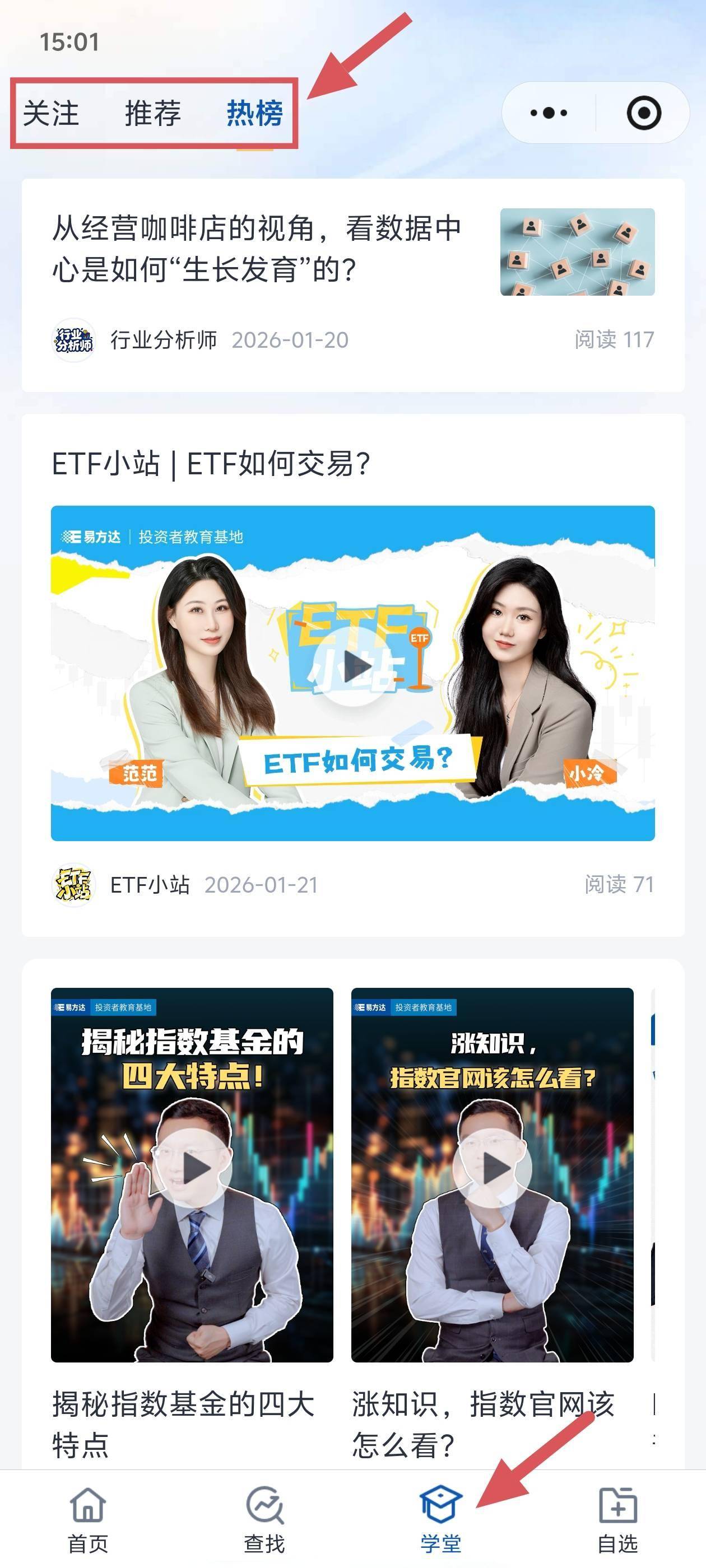
Core Viewpoint - The launch of the "Learning Hall" section in the "Index Express" mini-program by E Fund aims to enhance user experience by providing integrated access to knowledge and information related to index searching, product comparison, and investment processes [1][12]. Group 1: Features of the "Learning Hall" - The "Learning Hall" offers a variety of formats including text and video, integrating high-quality educational resources from E Fund's investor education base, making professional knowledge accessible and easy to understand [1][9]. - It covers topics such as index basics, ETF operations, and industry hot topics, allowing investors to learn at their convenience and gradually master index investment [1][9]. - The section includes three main areas: "Follow," "Recommended," and "Hot List," designed to meet different learning needs and help users build an investment knowledge system [9]. Group 2: User Engagement and Interface - The "Follow" section allows users to subscribe to preferred columns, creating a personalized information channel to focus on areas of interest [9]. - The "Recommended" section intelligently suggests quality educational content based on users' reading habits, efficiently filling knowledge gaps [9]. - The "Hot List" aggregates popular educational content, enabling users to quickly browse trending topics and stay updated with market rhythms [9]. - The "Index Express" mini-program has also undergone a layout upgrade, consolidating previously separate sections into a more user-friendly homepage module [9][12]. Group 3: Company Commitment - The launch of the "Learning Hall" reflects E Fund's commitment to inclusive finance, continuously optimizing investor experience and enhancing functionality to provide better tools and services for understanding and utilizing indices [12].
兴证全球基金申庆:指数产品是养老投资的重要载体
Zhong Guo Zheng Quan Bao - Zhong Zheng Wang· 2026-01-25 23:11
Core Viewpoint - The inclusion of index funds in the personal pension fund directory and the establishment of Y shares has led to significant growth, with total scale expanding from 316 million to 4.243 billion by 2025, indicating a strong potential for index products in domestic pension investments [1][3]. Group 1: Index Fund Growth and Importance - The total scale of Y shares in index funds is projected to grow from 316 million to 4.243 billion by 2025, highlighting a rapid expansion [1]. - Index products are expected to become a crucial vehicle for domestic pension investments, similar to their role in the U.S. 401K plans [3]. - The low cost of index products provides investors with flexible and convenient investment options, making them attractive for long-term investment [3]. Group 2: Investment Strategy and Risk Management - The management of index-enhanced products must focus on providing stable long-term returns while controlling downside volatility [4]. - Excessive pursuit of short-term excess returns can lead to greater losses during market corrections, emphasizing the need for stable investment strategies [5]. - The importance of managing downside volatility is crucial for maintaining investor experience and avoiding forced selling during market downturns [6]. Group 3: Value Investing and Market Trends - The principle of maintaining industry balance and value stock selection is emphasized, with a focus on minimizing trading friction costs to enhance long-term returns [7]. - Value stocks, characterized by low volatility, are seen as resilient during market downturns, providing a safer investment option [7]. - Recent trends in the A-share market indicate a pattern where previously favored stocks continue to perform well, suggesting a potential strategy for fund managers to track and adapt to these changes [7].

兴证全球基金申庆: 指数产品是养老投资的重要载体
Zhong Guo Zheng Quan Bao· 2026-01-25 21:56
Core Insights - The inclusion of index funds in the personal pension fund catalog and the establishment of Y shares has led to significant growth, with the total scale of Y shares expected to expand from 316 million to 4.243 billion by 2025 [1] - Index products are anticipated to become a crucial vehicle for domestic pension investments, offering low fees and flexible investment options [2] Group 1: Index Fund Growth and Importance - The rapid growth of Y shares in index funds reflects a shift towards passive investment strategies in the context of personal pensions [1] - The U.S. market's experience with index products, particularly in 401K plans, serves as a model for the potential success of similar strategies in China [2] Group 2: Investment Strategy and Risk Management - The management of index-enhanced products must focus on stabilizing returns while controlling downside volatility to ensure long-term sustainable gains [3] - High volatility in fund products can lead to poor investment experiences for investors, emphasizing the need for effective management strategies [4][5] Group 3: Cost Management and Value Investing - The principle of minimizing friction costs in trading is crucial for maintaining long-term returns, even if it means missing some short-term opportunities [7] - Value stocks, characterized by low volatility, are seen as resilient during market downturns, making them attractive for long-term investment strategies [7]
指数产品是养老投资的重要载体
Zhong Guo Zheng Quan Bao· 2026-01-25 21:06
Core Viewpoint - The inclusion of index funds in personal pension fund listings and the establishment of Y shares has led to significant growth, with total scale expanding from 316 million to 4.243 billion by 2025, indicating a strong potential for index products in domestic pension investments [1] Group 1: Index Fund Growth and Importance - The rapid growth of Y shares in index funds reflects a shift towards more flexible and cost-effective investment options for individuals, aligning with long-term economic growth in China [1] - The U.S. market's experience with pension fund investments, particularly the role of index products in 401K plans, serves as a reference for the future of index products in China's pension investment landscape [1] Group 2: Investment Strategy and Risk Management - Emphasizing long-term investment, the management of index-enhanced products must focus on stable returns and controlling downside volatility to ensure sustainable performance [2] - The pursuit of short-term excess returns can lead to greater losses during market corrections, highlighting the importance of managing net asset value fluctuations to enhance investor experience [3] Group 3: Cost Management and Value Investing - The impact of trading friction costs on long-term returns is significant, and strategies should aim to minimize these costs while balancing risk and opportunity [3] - Value stocks, characterized by low volatility, are seen as resilient during market downturns, suggesting that they may offer better risk-adjusted returns in uncertain conditions [4]
“专业买手”,持仓曝光
Zhong Guo Ji Jin Bao· 2026-01-24 08:04
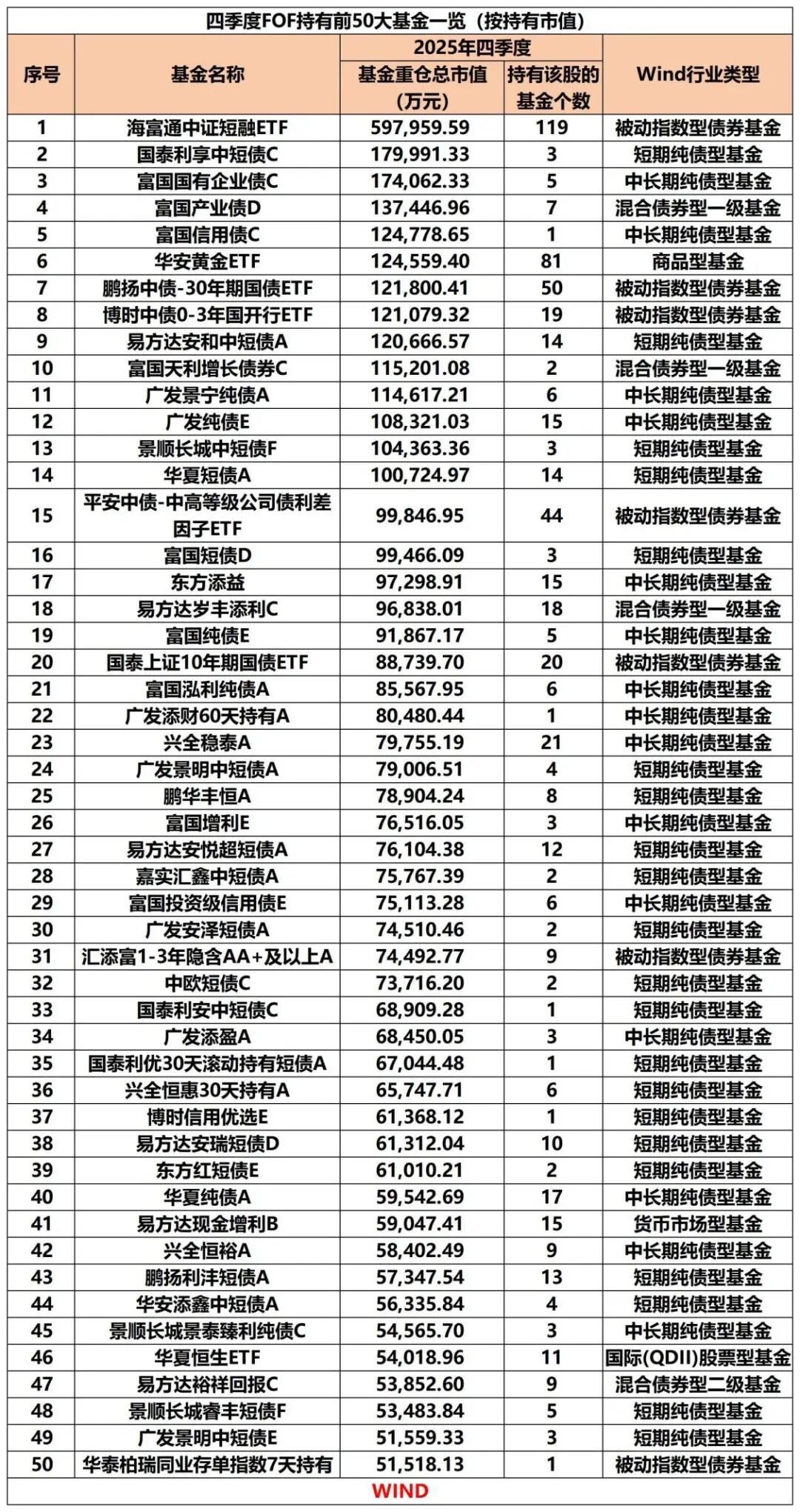
Core Viewpoint - The latest quarterly report reveals that bond funds remain the primary focus for public FOFs, with significant investments in ETFs as well. The top five funds favored by FOFs in Q4 2025 include various bond and ETF products, indicating a strong preference for fixed-income investments [1]. Group 1: FOF Holdings Overview - As of the end of Q4 2025, bond funds dominate the top 50 holdings of public FOFs, with 40 out of 50 being bond-related [1]. - The top fund held by FOFs is the Hai Fu Tong Zhong Zheng Short Bond ETF, with a market value exceeding 5.98 billion yuan, held by 119 FOFs [2]. - Other notable funds include Guotai Li Xiang Short and Medium Bond C and Fu Guo State-Owned Enterprise Bond C, each with holdings exceeding 1.7 billion yuan [2]. Group 2: Active Equity Fund Holdings - The top active equity fund held by FOFs is Xing Quan Commercial Model Preferred A, with a total holding value of 406.73 million yuan, held by 16 FOFs [4]. - Following closely is Yi Fang Da Information Industry Selected C, with a holding value of 365.40 million yuan, held by 10 FOFs [5]. - Other significant active equity funds include Yi Fang Da Ke Rong and Yi Fang Da Supply Reform, each with holdings above 300 million yuan [4]. Group 3: Fund Increases in Q4 - The fund with the highest increase in holdings during Q4 2025 is the Hai Fu Tong Zhong Zheng Short Bond ETF, which saw an increase of 2.69 billion yuan, bringing its total holding value to 5.98 billion yuan [6]. - Guotai Li Xiang Short and Medium Bond C also experienced a significant increase of 1.14 billion yuan, with a total holding value of 1.80 billion yuan [7]. - Other funds with notable increases include Jing Shun Chang Zhong Short Bond F and Fu Guo State-Owned Enterprise Bond C, each with increases exceeding 600 million yuan [7]. Group 4: Investment Strategies and Focus Areas - FOF managers express confidence in the A-share market, with increased allocations in technology, resources, and non-bank financial sectors during Q4 2025 [8]. - Specific strategies include focusing on gold and silver stocks, rare earths, and other metals, as well as exploring opportunities in the tourism sector [8]. - Long-term asset allocation strategies remain a priority, with a focus on consumer sectors and non-bank financials, alongside participation in overseas bond markets and REITs [8].
夯实指数投资“所见即所得”标准 嘉实基金31只ETF集体更名
Zheng Quan Ri Bao Wang· 2026-01-23 05:43
Core Viewpoint - The article discusses the collective renaming of 31 ETF products by Harvest Fund to comply with the standardized naming requirements of the Shanghai and Shenzhen Stock Exchanges, aiming to enhance investor experience through clearer product identification [1][2][3] Group 1: Renaming Details - Harvest Fund will implement a standardized naming convention for its ETFs, adopting the format "Underlying Index + ETF + Manager Name" [1] - The renaming includes 16 products from the Shenzhen Stock Exchange and 15 from the Shanghai Stock Exchange, resulting in a total of 58 products that have undergone naming standardization [1] - Notable products such as the CSI 300 ETF and the CSI 500 ETF have been renamed to "CSI 300 ETF Harvest" (159951) and "CSI 500 ETF Harvest" (159922) respectively [1] Group 2: Investor Experience Enhancement - The new naming convention aims to provide clarity by incorporating key information about the underlying index, product type, and management company, thereby reducing information screening costs for investors [2] - Specific product names have been optimized to directly reflect their underlying indices, such as changing "Hong Kong Dividend ETF" to "Hong Kong Stock Connect High Dividend ETF Harvest" (513830) [2] - The adjustments also include simplifications, such as renaming "Shanghai Gold ETF Harvest" to "Gold ETF Harvest" (159831), making it easier for investors to categorize and identify products [2] Group 3: Market Impact and Future Plans - The renaming only affects the market abbreviation, with product codes and fee structures remaining unchanged, ensuring no impact on existing shareholder rights [3] - Harvest Fund representatives indicated that the full implementation of ETF naming standards will contribute to a clearer and fairer environment for index investment in the domestic market, promoting high-quality development in the capital market [3] - The company plans to continue focusing on index investment, enhancing its product system and service ecosystem based on investor needs [3]