沙盒监管

Search documents
刚刚!发改委,来利好!
Zhong Guo Ji Jin Bao· 2025-09-26 09:05
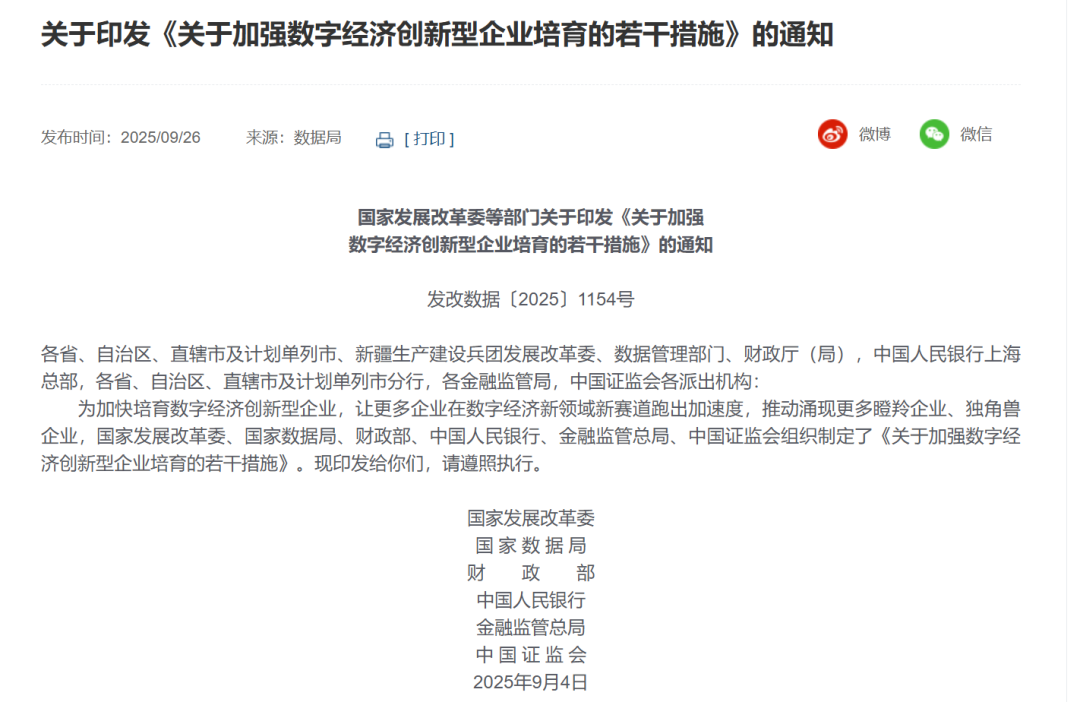
Core Viewpoint - The National Development and Reform Commission and five other departments have issued measures to strengthen the cultivation of innovative enterprises in the digital economy, aiming to accelerate the emergence of more "gazelle" and "unicorn" companies in this sector [18]. Group 1: Mechanisms and Support - Establish a mechanism for discovering innovative digital enterprises by creating a cultivation database that selects and categorizes enterprises with strong innovation capabilities and development potential annually [4][19]. - Strengthen multi-dimensional data usage guarantees by encouraging local governments to establish public data authorization and operational mechanisms, promoting sustainable supply and utilization of public data [5][20]. - Enhance computing power resource support through the implementation of the "East Data West Computing" project, optimizing the deployment of computing resources across key application areas [6][21]. Group 2: Innovation and Transformation - Improve original innovation capabilities by encouraging state-owned enterprises and industry leaders to lead collaborative innovation and share various innovation resources with digital enterprises [8][22]. - Establish a mechanism for the transformation of scientific and technological achievements, promoting deep integration of production, education, and research [10][22]. - Strengthen the supply of scenarios and opportunities by aligning urban digital transformation with market opportunities for enterprises, enhancing the availability of high-quality application scenarios [11][23]. Group 3: Internationalization and Financing - Enhance services for enterprises going abroad by supporting participation in international exhibitions and technology exchanges, showcasing innovative achievements [13][24]. - Optimize financing services by encouraging financial institutions to provide market-oriented financial services tailored to the needs of digital enterprises, and support qualified enterprises in going public [14][25]. Group 4: Regulatory Environment and Talent Development - Establish an open and prudent innovation environment by exploring "sandbox regulatory" models to minimize unnecessary disruptions to enterprise operations [15][26]. - Strengthen talent development by optimizing digital economy-related academic programs in higher education institutions and promoting a talent evaluation system [17][26].

六部门:鼓励有条件地区探索发放“数据券”“算法券”
Zhong Guo Xin Wen Wang· 2025-09-26 08:55
Core Points - The article discusses measures to accelerate the cultivation of innovative enterprises in the digital economy, aiming to foster more "gazelle" and "unicorn" companies [1][2] Group 1: Measures for Digital Economy Enterprises - The measures encourage regions to explore the issuance of "data vouchers" and "algorithm vouchers" to reduce data usage costs [1] - It promotes the construction of data service platforms by state-owned enterprises, industry leaders, and platform companies to provide inclusive data products and services [1] - The measures support the registration of data resources by digital innovation enterprises using public data resource registration platforms [1] Group 2: Regulatory and Support Framework - The measures propose a cautious exploration of "sandbox regulation" tailored to industry characteristics, allowing for controlled experimentation [2] - It emphasizes the need for precise inspections to minimize unnecessary disruptions to business operations, including the exploration of non-intrusive regulatory methods [2] - The measures advocate for flexible enforcement mechanisms to address minor violations through guidance and administrative advice [2] Group 3: Talent Development in Digital Economy - The measures support higher education institutions in optimizing digital economy-related academic programs based on actual demand [2] - It explores the establishment of a digital talent recognition and evaluation system, incorporating various assessment standards [2] - The measures aim to enhance the mobility of digital talent and encourage collaboration between academia and industry [2]
国家发展改革委:鼓励有条件地区探索发放“数据券”“算法券” 降低治数用数成本
Xin Hua Cai Jing· 2025-09-26 08:42
Core Viewpoint - The National Development and Reform Commission (NDRC) has released measures to strengthen the cultivation of innovative enterprises in the digital economy, aiming to foster more "gazelle" and "unicorn" companies through a forward-looking layout and an open innovation ecosystem [1]. Group 1: Mechanisms for Discovering and Cultivating Digital Enterprises - The NDRC and the National Data Bureau will establish a database for cultivating digital enterprises, selecting a batch of innovative and high-potential companies annually for dynamic adjustment [1]. - Local data management departments will enhance services and monitoring for these enterprises, providing targeted support and policies [1]. - A specialized selection and cultivation team will be formed, integrating government, enterprises, innovation, and investment [1]. Group 2: Data Utilization and Security - Local governments are encouraged to establish public data authorization and operational mechanisms to promote sustainable supply and utilization of public data [2]. - Digital enterprises will be supported to participate fairly in public data resource development, exploring cost-sharing and revenue-sharing models [2]. - The issuance of "data vouchers" and "algorithm vouchers" is encouraged to reduce data usage costs for enterprises [2]. Group 3: Support for Computing Resources - The implementation of the "East Data West Computing" project will be deepened, focusing on the deployment of computing resources and optimizing demand in key application areas [3]. - A national integrated computing network will be constructed, promoting orderly pooling and operation of computing resources [3]. - Digital enterprises will be encouraged to access low-cost and reliable computing services from national hub nodes [3]. Group 4: Investment and Financing Services - Financial institutions are encouraged to provide market-oriented financial services tailored to the needs of digital enterprises [4]. - Venture capital guidance will be strengthened, and the evaluation mechanism for state-owned venture capital will be optimized [4]. - Financial institutions are urged to develop credit evaluation models suited to digital enterprises, enhancing financial support [4]. Group 5: Innovation Environment - A "sandbox regulatory" model will be explored to allow for cautious experimentation while minimizing unnecessary disruptions to enterprises [5]. - The regulatory framework will be refined to prevent redundant inspections and promote efficient resolution of enterprise issues [5]. - Local governments will be supported in optimizing services related to enterprise governance, utilizing smart technology for policy implementation [5].
国家发改委:加强数字经济创新型企业培育 健全数创企业源头发现机制
智通财经网· 2025-09-26 07:37
Core Viewpoint - The National Development and Reform Commission (NDRC) has issued measures to strengthen the cultivation of innovative enterprises in the digital economy, aiming to foster more agile and high-growth "data innovation enterprises" (数创企业) through a structured support system and collaboration among various stakeholders [1][3]. Group 1: Mechanisms for Discovery and Support - Establishment of a "data innovation enterprise cultivation database" to annually select and categorize innovative enterprises with strong potential, ensuring dynamic adjustments and targeted support from data management departments [3][4]. - Formation of specialized selection and cultivation teams comprising professionals from government, enterprises, research institutions, and investment agencies to create a collaborative support mechanism [3][4]. Group 2: Data Utilization and Resource Support - Encouragement for local governments to develop public data authorization and operational mechanisms, ensuring sustainable supply and utilization of public data for innovation [4][5]. - Promotion of "data vouchers" and "algorithm vouchers" in certain regions to reduce costs associated with data usage [4][5]. Group 3: Innovation and Transformation - Support for the establishment of a "research and development + organized results transformation" mechanism to enhance the integration of industry and academia, facilitating the commercialization of innovative outcomes [6][7]. - Encouragement for localities to create specialized service institutions for project selection, validation, and incubation to assist data innovation enterprises [6][7]. Group 4: Market Opportunities and International Cooperation - Support for localities to align urban digital transformation strategies with market opportunities for data innovation enterprises, fostering the development of replicable high-quality application scenarios [7][8]. - Strengthening international cooperation in the digital economy, providing better policy support for data innovation enterprises to expand into overseas markets [8][9]. Group 5: Financial and Investment Services - Encouragement for financial institutions to provide tailored financial services to data innovation enterprises, enhancing access to funding and investment opportunities [9][10]. - Promotion of a credit evaluation system that aligns with the characteristics of data innovation enterprises to improve their financing conditions [9][10]. Group 6: Talent Development and Regulatory Environment - Support for educational institutions to optimize digital economy-related programs and establish a talent evaluation system to meet industry needs [10][11]. - Exploration of a "sandbox regulatory" model to encourage innovation while minimizing unnecessary disruptions to enterprise operations [10][11].
广东8万亿服务业如何进化?广东人大建议探索实施“沙盒监管”
2 1 Shi Ji Jing Ji Bao Dao· 2025-08-22 10:29
Core Insights - Guangdong's service industry is projected to reach a value of 8.14 trillion yuan in 2024, accounting for 10.6% of the national total and contributing 47.9% to GDP, maintaining its position as the leading province in service industry development for 40 consecutive years [1] - The digital economy in Guangdong has reached 6.9 trillion yuan, also ranking first in the country for eight consecutive years [1] - Challenges identified include insufficient high-quality supply in modern service industries, a shortage of skilled talent, and limited depth and breadth of openness [1] Group 1: Current State of the Service Industry - The productive service sectors, including finance, information transmission, software, and technology services, dominate the landscape [1] - There are significant gaps in the quality and capability of productive service supply to manufacturing, with critical technologies like industrial software facing bottlenecks [1] - High-end lifestyle services, such as specialized elderly care and smart elderly services, are lacking in capacity and quality, with a notable shortage of caregivers [1] Group 2: Recommendations for Development - The Guangdong Provincial People's Congress suggests accelerating the domestic replacement of high-end software industries, including basic and industrial software, and promoting the development of technology, green, and digital finance [2] - Encouragement for large manufacturing enterprises to outsource non-core businesses or establish dedicated productive service companies is recommended to strengthen the market [2] - Support for the establishment of national-level high-quality silver economy industrial parks and the promotion of elderly-friendly renovations is advised, along with securing funding for infrastructure projects [2] Group 3: Innovation and Regulatory Environment - To foster innovation in the modern service industry, the Guangdong Provincial People's Congress recommends exploring "sandbox regulation" for new technologies and business models, and establishing a fault-tolerance mechanism to encourage a more open and innovative regulatory environment [3]
国务院发布相关《通知》 复制推广77条“上海经验” 推进高水平制度型开放
Zheng Quan Shi Bao· 2025-07-03 18:50
Core Viewpoint - The State Council has issued a notification to replicate and promote a total of 77 pilot measures from the Shanghai Free Trade Zone across the country and other free trade zones, focusing on high-standard international trade rules and institutional openness [1][2]. Group 1: Key Measures - The 77 measures cover seven areas including service trade, goods trade, digital trade, intellectual property protection, government procurement reform, "post-border" management reform, and risk prevention [1]. - Among the measures, 34 will be promoted to other free trade zones, including innovations in digital renminbi applications and cross-border fund management for multinational companies [1][2]. - The remaining 43 measures will be implemented nationwide, such as enhancing cross-border electronic payment applications and promoting data security management certification [1][2]. Group 2: Focus Areas - The notification emphasizes the importance of "implementing high-standard digital trade rules" and "advancing government procurement reform," with 15 specific measures in these areas [2]. - Key digital trade measures include provisions for data transfer to foreign entities under national security requirements and the establishment of a digital identity certification system [2]. - In government procurement reform, many measures will continue to be tested within the free trade zone before broader implementation [2]. Group 3: Service Trade and Financial Risk - Service trade is highlighted as a key area for institutional openness, with measures to support the introduction of foreign electronic payment institutions and data transmission for financial institutions [3]. - Financial risk prevention measures include enhanced data collection and innovative regulatory mechanisms like "sandbox regulation" to ensure effective risk isolation [3].
探路产业“沙盒监管”,一线城市瞄准这三个新领域
21世纪经济报道· 2025-06-17 09:12
Core Viewpoint - The article discusses the introduction and expansion of "sandbox regulation" in various industries, particularly in artificial intelligence, smart connected vehicles, and medical devices, as a means to foster innovation while managing risks [1][5][6]. Group 1: Sandbox Regulation Concept - The concept of "sandbox regulation" originated in the financial sector and is now being applied to industries like AI, allowing for flexible regulatory measures to encourage innovation in areas where legal frameworks are not yet established [1][3]. - The UK's Financial Conduct Authority (FCA) first proposed the "regulatory sandbox" in 2015, creating a "safe space" for fintech companies to test new products without immediate regulatory consequences [3][4]. - Research indicates that companies completing FCA sandbox tests receive 6.6 times more fintech investment than their peers, highlighting the effectiveness of this regulatory approach [4]. Group 2: Implementation in China - Shenzhen is set to expand its sandbox regulation framework to include AI, smart vehicles, and medical devices, allowing for innovative business processes and service models under flexible regulatory oversight [1][8]. - Beijing has also initiated its own sandbox exploration, focusing on data circulation and security governance, with specific plans for AI, smart vehicles, and healthcare [5][9]. - The importance of these sectors is underscored by their close ties to consumer safety and data privacy, necessitating careful regulatory approaches to mitigate risks [6][9]. Group 3: Future Directions and Collaboration - The article emphasizes the potential for Shenzhen's sandbox initiatives to draw from successful experiences in Beijing and other regions, aiming to create a comprehensive regulatory framework that supports innovation while ensuring safety [9][10]. - The collaboration between Shenzhen and Hong Kong is highlighted, with initiatives like the "Deep-Hong Kong Data Cross-Border Security and Convenience Channel" aimed at facilitating data sharing in healthcare [10]. - The article suggests that the sandbox regulation model can be adapted from international practices to foster innovation in emerging technologies within Shenzhen and beyond [10].

探路产业“沙盒监管” 一线城市瞄准这三个新领域
2 1 Shi Ji Jing Ji Bao Dao· 2025-06-16 14:10
Core Viewpoint - The introduction of "sandbox regulation" in Shenzhen aims to foster innovation in emerging industries such as AI, smart connected vehicles, and medical devices by allowing flexible regulatory measures while ensuring quality and safety [1][5]. Group 1: Sandbox Regulation Concept - The concept of "regulatory sandbox" was first proposed by the UK's Financial Conduct Authority (FCA) in 2015, creating a "safe space" for fintech companies to test new products and services without immediate regulatory consequences [2]. - Research indicates that companies completing FCA sandbox tests receive 6.6 times more fintech investment than their peers, and the average time for market authorization is reduced by 40% compared to conventional approval processes [2][3]. - The sandbox model has been adopted globally, with 73 regulatory sandboxes established, particularly in the fintech sector, to balance innovation and risk [2]. Group 2: Application in AI and Other Industries - The challenges posed by generative AI, such as DeepSeek and ChatGPT, mirror those faced in fintech, necessitating updated regulatory frameworks to keep pace with rapid innovation [3]. - The EU's 2024 AI Act introduces the concept of an "AI Regulatory Sandbox," allowing AI system providers to develop and test innovations under controlled conditions [3][4]. - Beijing has also initiated sandbox explorations, with a focus on AI, smart connected vehicles, and medical health, aligning closely with Shenzhen's targeted sectors [4][5]. Group 3: Implementation and Future Directions - Shenzhen's 2025 market environment optimization plan emphasizes expanding sandbox regulation to new technologies and industries, allowing for innovation in areas like digital economy and green economy [5][6]. - The operational phase of sandbox regulation in Shenzhen may draw from Beijing's experiences, which include a comprehensive AI data training base that offers a full range of services for companies [6]. - The development of cross-border data channels in the Qianhai area aims to facilitate medical data sharing and enhance cooperation with Hong Kong, leveraging international standards and experiences [7].
喜提中央“大礼包”,深圳拟从八个方面兑现含金量
Di Yi Cai Jing· 2025-06-14 09:54
Core Viewpoint - Shenzhen is set to accelerate the implementation of 24 special measures to relax market access, as outlined in the recently issued "Opinions" by the central government, marking a significant reform initiative for the city as it approaches its 45th anniversary as an economic special zone [1][2]. Group 1: Key Reform Measures - The focus of the reforms includes the integration of education, technology, and talent systems to enhance innovation and attract diverse talent without geographical or background restrictions [2][3]. - Shenzhen aims to deepen the integration of financial, technological, and data resources to support high-quality development of the real economy, with specific initiatives to attract insurance funds for investment in technology innovation [2][3]. - The city will enhance its openness by promoting service trade and establishing a competitive edge in various sectors such as gaming, software outsourcing, and international logistics [2][3]. Group 2: Market Access and Regulatory Framework - Shenzhen will further relax market access by exploring new regulatory mechanisms in fields like artificial intelligence and smart connected vehicles, and will implement a "sandbox regulatory" approach in the medical device sector [4][5]. - The city plans to facilitate resource acquisition by breaking down departmental barriers and expanding public data resource availability, particularly in healthcare and finance [5][6]. - Shenzhen will align with international high-standard trade rules, using the Qianhai-Shekou Free Trade Zone as a testing ground for these standards [5][6]. Group 3: Business Environment Optimization - The city aims to create a first-class business environment characterized by efficient administrative processes, robust legal frameworks, and a supportive industrial ecosystem [6]. - Shenzhen has been recognized for its favorable business environment, with a significant number of operating entities, reflecting its status as a leading city for entrepreneurship in China [6].
深圳拆解改革“大礼包”:对创新人才体制机制先行先试,加快推进放宽市场准入24条实施⋯⋯
Mei Ri Jing Ji Xin Wen· 2025-06-13 11:25
Core Viewpoint - The release of the "Opinions" document marks a significant milestone for Shenzhen, aiming to deepen reforms and expand openness, thereby injecting strong momentum into high-quality development and the modernization of China [1][2]. Group 1: Implementation of the Opinions - Shenzhen has promptly communicated, studied, and arranged the implementation of the "Opinions," establishing a task division plan to ensure effective execution [2]. - The city emphasizes a systematic approach, focusing on key areas and practical outcomes in the reform process [2]. Group 2: Talent and Innovation - Shenzhen aims to innovate its education and technology talent mechanisms, striving to build a globally influential industrial and technological innovation center [4]. - The city plans to attract and cultivate diverse talents, creating optimal conditions for innovation and entrepreneurship [4]. Group 3: Industry Integration - The integration of innovation chains, industry chains, capital chains, and talent chains is highlighted as a crucial direction for Shenzhen's industrial development [4]. - The city will support key industries and enterprises to accelerate their growth and optimize traditional industries [4]. Group 4: International Cooperation - Shenzhen intends to expand cooperation with Hong Kong, Macau, and internationally, enhancing its service sector's openness and establishing a strategic base for high-end service exports [5]. Group 5: Market Access and Regulatory Framework - The city will accelerate the implementation of 24 special measures to relax market access, exploring "sandbox regulatory" mechanisms in various sectors [6]. - The "sandbox regulatory" approach aims to provide a flexible testing environment for innovative technologies and business models [6]. Group 6: Open Economic System - Shenzhen plans to adapt to high-standard trade rules such as CPTPP and RCEP, gradually extending measures from tariffs to intellectual property and environmental standards [7]. - The city will leverage its status as a pilot city for expanding service sector openness to enhance various fields, including telecommunications and healthcare [7]. Group 7: Monitoring and Accountability - The city will implement a monitoring system with monthly updates, quarterly analyses, and annual reviews to ensure the effective execution of the "Opinions" [7]. - Special adjustments will be made for challenging reform tasks to promote better implementation and achieve tangible results within the year [7].