
油价下跌

Search documents
加纳石油收入骤降
Shang Wu Bu Wang Zhan· 2026-01-01 16:46
Core Insights - Ghana's oil revenue is projected to plummet by 56% in the first half of 2025, primarily due to declining production and falling global oil prices, threatening fiscal stability [1] - The report from the Public Interest and Accountability Committee (PIAC) indicates that oil revenue will drop to $370.3 million, down from $840.8 million in the same period of 2024, marking the lowest mid-year revenue since 2022 [1] Group 1: Production Decline - Crude oil production is expected to decrease by nearly 26% to 18.42 million barrels by June 2025, compared to 24.86 million barrels in the first half of 2024 [1] - The Jubilee oil field, which began production in December 2010, has seen the most significant decline, with output dropping by 32.8% to 11.02 million barrels, and daily production falling from 90,755 barrels to 60,898 barrels [2] - The Tweneboa Enyenra Ntomme (TEN) oil field's production decreased by 14% from 3.45 million barrels to 2.97 million barrels, with daily output declining from 19,065 barrels to 16,420 barrels [2] - The Sankofa Gye Nyame oil field experienced the smallest decline at 11.6%, with production falling from 5 million barrels to 4.42 million barrels, and daily output decreasing from 27,600 barrels to 24,463 barrels [2] Group 2: Revenue Composition - In the first half of 2025, the composition of oil revenue includes $178.48 million from Carry-Over and Additional Participating Interests (CAPI), accounting for 48% of total revenue; $148.75 million from corporate income tax, making up 40%; and $40.15 million from royalties, approximately 10.8% of total revenue [3] - Interest income from the oil holding fund was $2.1 million, while ground lease income was only $863,000, representing less than 1% of total revenue [3] - The reliance on upstream production taxes and profit-sharing rather than direct extraction fees highlights a structural vulnerability in Ghana's oil sector [3] Group 3: Industry Challenges and Responses - Since 2018, Ghana has not signed any new oil agreements, raising structural risks for the long-term viability of the industry [3] - As of June 2025, there are 13 active oil agreements in Ghana, but only the Jubilee, TEN, and Sankofa Gye Nyame fields are currently in production [3] - The government has initiated measures to address the production crisis, including significant upstream investments starting in 2026, and has signed memorandums of understanding with Tullow Oil, Kosmos Energy, PetroSA, and GNPC to extend production licenses for Jubilee and TEN fields until 2040 [3]
分析:供应过剩局面难改 油价2026年初料进一步走低
Xin Lang Cai Jing· 2025-12-31 11:22
Core Viewpoint - Oil prices are expected to decline by approximately 20% in 2025 due to ongoing market oversupply, with prices likely remaining under pressure in the early part of the year [1][2]. Group 1: Market Conditions - Traders are closely monitoring the upcoming OPEC+ meeting, where the cartel is expected to reaffirm its current production plans, indicating a relatively loose supply-demand environment following a recent increase in supply [1]. - Prior to the OPEC+ meeting, official data on the U.S. market conditions will be released, with the American Petroleum Institute reporting an increase in crude oil and refined product inventories [1]. Group 2: Price Projections - The Brent crude oil price started 2025 at approximately $75 per barrel but fell to $58.40 during the year [2]. - As 2026 approaches, the spot market may see even lower prices, although sporadic geopolitical conflicts could provide short-term price boosts [2].
深夜,白银史诗级暴涨!国际油价大跌
Sou Hu Cai Jing· 2025-12-27 01:20
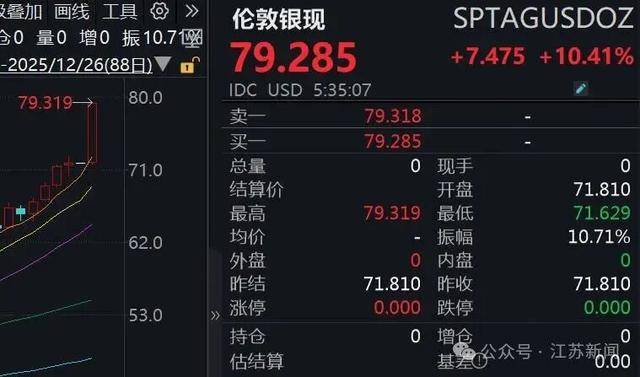
Group 1: Silver and Precious Metals - Spot silver prices reached a new high, surpassing $79 per ounce, with a daily increase of over 10% and a year-to-date increase of over 170% [1][3] - The price of spot gold rose to $4532.505 per ounce, with a daily increase of 1.19% and a weekly increase of 4.41% [2][3] - The price of palladium increased by 15%, driven by strong industrial and investment demand, supply shortages, expectations of continued interest rate cuts in the U.S., a weakening dollar, and escalating geopolitical risks [3] Group 2: Oil Prices - International oil prices fell on the 26th, with light crude oil futures for February 2026 dropping by $1.61 to $56.74 per barrel, a decrease of 2.76% [4] Group 3: U.S. Stock Market - The three major U.S. stock indices closed lower, with the Dow Jones Industrial Average down 0.04% at 48710.97 points, the S&P 500 down 0.03% at 6929.94 points, and the Nasdaq Composite down 0.09% at 23593.1 points [5] - Despite the daily decline, all three indices showed weekly gains, with the Nasdaq up 1.22%, the Dow up 1.2%, and the S&P 500 up 1.4% [5] Group 4: Chinese Stocks - The Nasdaq Golden Dragon China Index rose by 0.71%, with notable gains in Chinese stocks such as Xpeng Motors up over 6%, Dingdong Maicai up over 5%, and NIO up over 4% [7] - Alibaba's stock increased by 1.46% year-to-date, while JD's stock saw a decline of 12.75% [6][7]

Benchmark diesel down yet again, five straight weeks of declines
Yahoo Finance· 2025-12-23 16:31
Core Insights - The benchmark price of diesel has experienced a significant decline, marking the largest drop in a five-week period in two years, with a decrease of 32.4 cents per gallon [1] - The current average retail diesel price is $3.544 per gallon, down from $3.868 prior to this decline [1] - The latest price is the lowest for the benchmark used for most fuel surcharges since June 11, when it was $3.471 [2] Diesel Price Trends - The price of ultra low sulfur diesel (ULSD) on the CME commodity exchange has shown some stabilization after a decline that began on November 18, with a recent settlement at $2.1581 per gallon [2][3] - The ULSD price fluctuated, reaching a low of $2.1219 per gallon before the recent rise [3] Geopolitical Factors - Uncertainty regarding U.S.-Venezuela relations may impact Venezuelan oil output, which is currently estimated at about 1 million barrels per day, significantly lower than the 3.5 million barrels per day prior to 1998 [4] - The market is also affected by uncertainties surrounding Russian oil production, contributing to fluctuations in oil prices despite a slight decline in ULSD [4] Market Dynamics - The ongoing discussions about a potential oil glut have been a primary driver of lower oil prices over the past six weeks, although geopolitical factors can temporarily overshadow supply and demand impacts [5]
汽油价格跌至四年低点,数百万民众开启假日公路出行
Xin Lang Cai Jing· 2025-12-23 12:54
Core Insights - The average price of unleaded gasoline in the U.S. has dropped to its lowest level since 2021, with some regions seeing prices below $3 per gallon [1][3] - Nearly 110 million Americans are expected to choose road travel during the holiday season [1][7] Price Trends - Current fuel prices have decreased by approximately 7% compared to a month ago and have plummeted about 43% from the peak in mid-2022, when prices approached $5 per gallon [6][12] - The drop in gasoline prices coincides with the peak travel season, with over 122 million Americans projected to travel at least 50 miles from home between December 20 and January 1, marking a historical high [7][12] Consumer Behavior - The decline in gasoline prices may alleviate some of the inflationary pressures faced by consumers in other areas during the holiday season [13] - A survey indicates that just over 40% of respondents plan to cut back on holiday spending this year, an increase of 6 percentage points from last year, with 46% attributing this to high prices of various goods [13] Regional Price Disparities - The nationwide drop in gasoline prices masks significant regional price differences, with states like Hawaii and California still exceeding $4 per gallon, while Oklahoma's prices are below $2.30 per gallon [13]

12月18日【油价大跌】原油反弹跌幅持续扩大,下调扩至150元/吨
Sou Hu Cai Jing· 2025-12-18 06:45
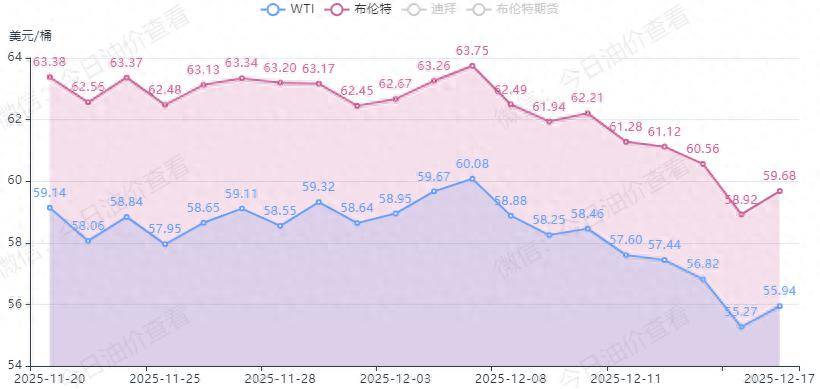
Core Viewpoint - The domestic refined oil price is expected to decrease by 150 yuan/ton, marking the 12th price reduction of the year, with a significant impact on consumer prices [1][3]. Group 1: Price Adjustments - The current pricing cycle has completed 80% of its 10-working-day adjustment period, with only 4 days remaining until the final price adjustment window of 2025 [1]. - The anticipated reduction of 150 yuan/ton translates to a decrease of approximately 0.11-0.13 yuan per liter for gasoline and diesel [1]. - If the reduction is implemented, the national average price for 92-octane gasoline could drop to around 6.7 yuan/liter, with some regions potentially seeing prices near 6.5 yuan/liter, the lowest in recent years [3]. Group 2: International Oil Prices - Despite a recent rebound in international oil prices, the average prices for WTI and Brent crude oil have declined, contributing to the domestic price drop [1]. - As of December 17, WTI crude oil was priced at $55.94 per barrel, and Brent crude at $59.68 per barrel, with respective increases of 1.21% and 1.29% [1]. - The average WTI price for the current cycle is $57.33 per barrel, while Brent's average is $61.03 per barrel, both lower than previous averages, leading to an expanded domestic price reduction [1]. Group 3: Regional Price Variations - As of December 18, the national average prices for 92-octane gasoline, 95-octane gasoline, and 0-diesel are 6.83 yuan/liter, 7.29 yuan/liter, and 6.45 yuan/liter, respectively [3]. - Regional price variations show that in areas like Xinjiang, the price for 92-octane gasoline could approach 6.5 yuan/liter, indicating significant regional disparities [3]. Group 4: Yearly Overview - The overall price reduction for the year is projected to exceed 0.7 yuan/liter, making it the largest annual decline in recent years [3]. - This final adjustment represents the last opportunity for consumers to benefit from lower prices in 2025, encouraging strategic refueling decisions [3].
原油成品油早报-20251217
Yong An Qi Huo· 2025-12-17 02:39
1. Report Industry Investment Rating - No information provided 2. Core View of the Report - This week, oil prices declined, with a rapid weakening of global supply and demand. On - land and on - water inventories increased significantly, and the Dubai monthly spread further weakened. Geopolitically, the US seized a Venezuelan oil tanker, and Russia - Ukraine negotiations continued. There were rumors that Russia had found more ways to export crude oil. The CPC No. 3 berth was expected to resume on the 17th. Global gasoline and diesel cracks declined, US refinery operations recovered to over 94%, and domestic refinery operations fluctuated. The fundamental surplus intensified. If there were no new geopolitical changes, the surplus in the first quarter would be close to that during the pandemic, and short - term monthly spreads and absolute prices should be short - allocated [5] 3. Summary by Related Catalogs 3.1 Price Data - From December 10 - 16, 2025, WTI decreased by $1.55, BRENT decreased by $1.64, and DUBAI decreased by $0.71. Other related products also showed price changes, such as SC decreasing by 6.00, and domestic diesel decreasing by 6.00 [3] 3.2 News - Trump ordered a "full and complete blockade" of all sanctioned tankers entering and leaving Venezuela, which marked an escalation of pressure on Maduro. A sanctioned tanker was seized by the US near the Venezuelan coast last week. The discount of Venezuelan Merey crude oil has widened to $21 per barrel lower than Brent crude oil, compared to $14 - 15 per barrel last week [3][4] 3.3 Inventory - US API crude oil inventory for the week ending December 12 was - 932.2 barrels (expected - 219.7 barrels, previous - 477.9 barrels). Other inventory data for gasoline, refined oil, etc. are also provided for different time intervals [4]
受乌克兰和谈进展乐观情绪影响,油价延续周一跌势
Ge Long Hui A P P· 2025-12-16 10:03
Core Viewpoint - Oil prices continue to decline due to progress in negotiations to end the Russia-Ukraine conflict, with Brent crude falling to $59.94 per barrel and WTI crude to $56.06 per barrel, marking the lowest levels since 2021 [1] Group 1: Price Trends - Brent crude oil decreased by 1% and WTI crude oil decreased by 1.1% [1] - Both benchmark oil prices have dropped 20% year-to-date due to oversupply and weak demand [1] Group 2: Market Analysis - Analysts from Mitsubishi UFJ Financial Group indicate that expectations of oversupply are increasing, suggesting oil prices may continue to decline throughout the year [1] - Factors contributing to oversupply include OPEC+ restoring idle capacity and increased production from other regions [1] - Any potential easing of sanctions on Russia could further exacerbate the downward risks for oil prices [1]
今日油价|12月16日汽柴油预跌115元/吨,6天后调价2025年第12跌中
Sou Hu Cai Jing· 2025-12-16 06:30
Core Viewpoint - Domestic oil prices have experienced a consecutive decline, with gasoline and diesel prices dropping by a cumulative 125 yuan and 120 yuan per ton, respectively, returning to levels seen at the end of October this year [1][3]. Price Changes - The latest price adjustments have brought gasoline prices in Shanghai to 6.81 yuan per liter, marking the lowest level of the year [1]. - The next pricing cycle will begin on December 9, with expectations for further price reductions due to a negative change rate in crude oil [3]. Market Conditions - International oil prices are currently experiencing a weak fluctuation, influenced by global economic concerns and an oversupply expectation due to increased production from the U.S. and OPEC+ [3]. - As of the latest data, WTI crude oil is priced at 56.82 USD per barrel, while Brent crude is at 60.56 USD per barrel, with an average price of 59.75 USD per barrel expected by December 22 [3]. Future Projections - The forecast indicates that gasoline and diesel prices may continue to decline, potentially leading to the 12th price drop of the year by the next adjustment [3]. - The overall decline in oil prices is expected to reach a four-year low, with 92 gasoline prices possibly falling below 6.7 yuan per liter, reducing costs for consumers [3]. Regional Price Overview - A detailed table of gasoline and diesel prices across various regions shows significant variations, with prices for 92 gasoline ranging from 6.68 to 7.96 yuan per liter in different provinces [4].
原油成品油早报-20251216
Yong An Qi Huo· 2025-12-16 01:36
Group 1: Report Industry Investment Rating - No information provided Group 2: Core Viewpoints of the Report - This week, oil prices declined, with a rapid weakening of global supply and demand. There was a significant build - up in on - land and waterborne inventories, and the Dubai monthly spread weakened further. Geopolitically, the US seized a Venezuelan oil tanker, and the Russia - Ukraine negotiations continued. There were rumors that Russia had found more ways to export crude oil. The CPC No. 3 berth is expected to resume on the 17th. Global gasoline and diesel cracks declined, US refinery operations recovered to over 94%, and domestic refinery operations fluctuated. The fundamental surplus has intensified. Without new geopolitical changes, the surplus in the first quarter will be close to that during the pandemic. Short - term monthly spreads and absolute prices should be short - allocated [4] Group 3: Summary by Relevant Catalogs 1. Oil Price and Spread Data - From December 9th to 15th, WTI decreased by $0.62, BRENT by $0.56, and DUBAI by $0.36. SC - BRT increased by $0.39, and SC - WTI increased by $0.45. Domestic gasoline decreased by $80, and domestic diesel decreased by $120 [3] 2. Daily News - The EU announced new sanctions on parties related to Russia's "shadow fleet" on December 15th, adding 5 individuals and 4 entities to the sanctions list. It also added 12 individuals and 2 entities due to Russia's "hybrid threats" [3] - After the US seized a Venezuelan oil tanker, multiple oil tankers turned back, paralyzing Venezuela's oil exports. Over 11 million barrels of crude oil were stranded in Venezuelan waters [3] - As the Russia - Ukraine peace negotiations made progress, US crude oil futures fell by $1 during the day [4] 3. Inventory - For the week ending December 5th, EIA crude oil inventory was - 1.812 million barrels, EIA strategic petroleum reserve inventory was 248,000 barrels, EIA gasoline inventory was 6.397 million barrels, EIA refined oil inventory was 2.502 million barrels, and EIA Oklahoma Cushing crude oil inventory was 308,000 barrels. The EIA refinery equipment utilization rate was 94.5% [4]