市场供应过剩

Search documents
20260204申万期货品种策略日报:原油甲醇-20260204
Shen Yin Wan Guo Qi Huo· 2026-02-04 02:16
1. Report Industry Investment Rating - No information provided 2. Core Viewpoints of the Report - SC crude oil futures rose 1.78% overnight, affected by geopolitical events such as the US shooting down an Iranian drone and an Iranian gunboat approaching a US - flagged tanker, while the sharp increase in Venezuelan crude oil exports to the US increased concerns about oversupply and pressured oil prices [3] - Methanol futures fell 0.31% overnight. The average operating load of domestic coal - to - olefins (methanol) plants decreased slightly. Coastal methanol inventories decreased slightly but were still at a relatively high historical level, and the expected arrival of imported ships in the future was relatively large [3] 3. Summary by Relevant Catalogs Futures Market - **Price and Volume Information**: For SC crude oil, the near - month contract had a previous day closing price of 449.4, a rise of 0.4 (0.09%), with a trading volume of 119,915 and a position of 32,924 (a decrease of 3,276). For WTI, the near - month contract had a previous day closing price of 65.51, a rise of 2.01 (3.17%), with a trading volume of 329,531 and a position of 368,969 (an increase of 4,711). For Brent, the near - month contract had a previous day closing price of 68.74, a rise of 1.04 (1.54%), with a trading volume of 167,809 and a position of 242,672 (a decrease of 63,201) [2] - **Spread Information**: The current value of the spread between SC near - month and SC next - month contracts was - 3.5 yuan/barrel, compared with a previous value of - 1.2 yuan/barrel [2] Spot Market - **International Market**: The current values of OPEC's basket of crude oil price, Brent DTD, Russian ESPD, Oman, Dubai, and Cinta were 64.94, 69.20, 62.14, 65.43, 65.42, and 61.25 respectively, all showing a decline compared to the previous values [2] - **Domestic Market**: The current values of Daqing and Shengli crude oil were 63.38 and 62.21 respectively, showing a decline compared to the previous values. The Chinese gasoline wholesale price index remained at 7,423 yuan/ton, and the Chinese diesel wholesale price index decreased to 6,122 yuan/ton from 6,133 yuan/ton [2] Crude Oil - **Price Movement**: SC crude oil futures rose 1.78% overnight [3] - **Influencing Factors**: Geopolitical events such as the US shooting down an Iranian drone and an Iranian gunboat approaching a US - flagged tanker increased market tension. However, the sharp increase in Venezuelan crude oil exports to the US increased concerns about oversupply and pressured oil prices [3] Methanol - **Price Movement**: Methanol futures fell 0.31% overnight [3] - **Supply - related Information**: The average operating load of domestic coal (methanol) to olefins plants was 80.06%, a decrease of 0.13 percentage points from the previous period. As of January 29, coastal methanol inventories were 143 tons, a decrease of 0.47 tons (0.33%) from January 22, and an increase of 42.43% year - on - year. The estimated arrival volume of imported ships from January 30 to February 15 was 59.3 - 60 tons. The overall operating load of domestic methanol plants was 77.56%, an increase of 0.15 percentage points from the previous period and 0.75 percentage points higher than the same period last year [3]
调查:今年国际油价或维持在每桶60美元关口附近
Xin Lang Cai Jing· 2026-01-30 13:20
Group 1 - The core viewpoint of the article indicates that international oil prices are expected to remain around $60 per barrel this year, as market oversupply expectations offset potential disruptions from geopolitical tensions [1][2] - A survey conducted in January involving 31 economists and analysts predicts that the average price of Brent crude oil will reach $62.02 per barrel by 2026, a slight increase from the previous forecast of $61.27 per barrel in December [2] - As of January 30, Brent crude oil was trading at approximately $70 per barrel, with an expected average price of $68.20 per barrel for 2025 [3] Group 2 - The average price of U.S. crude oil is projected to be $58.72 per barrel in 2026, up from the previous forecast of $58.15 per barrel in December [3] - For 2025, the average price of U.S. crude oil is estimated to be $64.73 per barrel [3]
高盛:白银剧烈震荡将持续,黄金5400美元目标面临上行风险
Ge Long Hui· 2026-01-27 15:52
Group 1 - Goldman Sachs believes that the volatility in silver prices may continue, while emphasizing that its expectation for gold prices to reach $5,400 by the end of the year still faces significant upside risks [1] - The firm has slightly adjusted its forecast for the global aluminum market surplus in 2026 from 1.1 million tons to 800,000 tons, while maintaining its 2027 surplus forecast at 1.6 million tons [1] - Additionally, Goldman Sachs has raised its forecast for aluminum prices in Q4 2026 from $2,350 per ton to $2,500 per ton, while keeping the average price forecast for 2027 unchanged at $2,400 per ton [1]

全球精炼铜市场11月供应过剩为94,000吨
Jin Rong Jie· 2026-01-21 22:40
Group 1 - The International Copper Study Group (ICSG) reports a surplus of 94,000 tons in the global refined copper market for November 2025, an increase from a surplus of 48,000 tons in October 2025 [1] - Cumulative surplus in the global refined copper market for the first eleven months of 2025 reached 206,000 tons, compared to 105,000 tons in the same period last year [1] - Global refined copper production in November was 2.37 million tons, while consumption was 2.28 million tons [1] Group 2 - The International Lead and Zinc Study Group (ILZSG) indicates that the global lead market surplus decreased from 29,200 tons in October to 8,900 tons in November [1] - For the first eleven months of 2025, the global refined zinc market surplus was 74,000 tons, more than double the surplus of 36,000 tons in the same period of 2024 [1]
丙烯市场供应充裕价格难涨
Zhong Guo Hua Gong Bao· 2026-01-21 06:39
Group 1 - The global propylene market is expected to face weak demand, low prices, and high inventory pressures from 2025 to 2026, with a common issue of oversupply affecting various regions [1] - In Europe, propylene imports reached 1.46 million tons from January to September 2025, a 9% increase compared to the same period in 2024, which is expected to weaken local propylene consumption [1] - The price of polymer-grade propylene in Europe dropped significantly to €622.50 per ton by December 23, 2025, down from €781.50 per ton in early July [1] Group 2 - In North America, propylene inventory reached a historical high of 101.8 million barrels in the first week of December 2025, a 15.58% increase from 93.1 million barrels in the same period of 2024 [1] - The average variable profit for the propane dehydrogenation (PDH) industry in the U.S. fell to $122 per ton in December 2025, down from $254 per ton in the first eleven months of the year [2] - Despite market pressures, some companies maintain a positive outlook on propylene production, with a high operating rate of over 90% for two PDH units, although this has contributed to low propylene prices [2] Group 3 - The Asian propylene market is experiencing similar challenges, with prices declining due to weak downstream product profits and low polypropylene demand [2] - A Korean supplier indicated that the Asian propylene market lacks recovery momentum, with supply pressure from propane dehydrogenation units being significant [3] - The current situation suggests that any supply gap would quickly lead to the restart of idled propane dehydrogenation units, limiting the potential for price recovery in the propylene market [3]
油价探底 金铜狂飙 需求端生变 大宗商品价格演绎“冰火两重天”
Zhong Guo Neng Yuan Wang· 2025-12-23 00:06
Group 1: Oil Market Dynamics - The international oil price has dropped significantly due to weak demand and geopolitical factors, with a total decline of approximately 20% this year, reaching its lowest level since February 2021 [2] - The commodity trading giant Trafigura warns of a "super surplus" in the oil market next year due to a combination of supply surge and declining global demand [2] - Analysts predict that the peak of supply surplus will occur in the first quarter of 2026, with expectations of continued inventory growth throughout the year, putting further pressure on oil prices [3] Group 2: Gold Market Trends - International gold prices have surged from $2,650 per ounce at the beginning of the year to over $4,000 per ounce, marking a significant bull market with a year-to-date increase of approximately 60% [4] - Central banks have shown strong demand for gold, with net purchases reaching 254 tons from January to October, providing substantial support for gold prices [4] - The International Clearing Bank (BIS) warns of potential bubble signs in the gold market due to excessive optimism and rising valuations, which could lead to a price correction of 5% to 20% [5] Group 3: Copper Market Outlook - The price of copper is expected to remain robust due to global industrial transformation, particularly in the electric vehicle sector, with a projected demand increase of around 3% in 2026 [7] - Supply constraints, exacerbated by incidents such as the collapse of a copper mine in Chile, have led to reduced production forecasts, supporting copper prices [7] - Goldman Sachs predicts that over 60% of copper demand growth by 2030 will be driven by investments in power infrastructure, indicating strong long-term prospects for copper [8]

受乌克兰和谈进展乐观情绪影响,油价延续周一跌势
Ge Long Hui A P P· 2025-12-16 10:03
Core Viewpoint - Oil prices continue to decline due to progress in negotiations to end the Russia-Ukraine conflict, with Brent crude falling to $59.94 per barrel and WTI crude to $56.06 per barrel, marking the lowest levels since 2021 [1] Group 1: Price Trends - Brent crude oil decreased by 1% and WTI crude oil decreased by 1.1% [1] - Both benchmark oil prices have dropped 20% year-to-date due to oversupply and weak demand [1] Group 2: Market Analysis - Analysts from Mitsubishi UFJ Financial Group indicate that expectations of oversupply are increasing, suggesting oil prices may continue to decline throughout the year [1] - Factors contributing to oversupply include OPEC+ restoring idle capacity and increased production from other regions [1] - Any potential easing of sanctions on Russia could further exacerbate the downward risks for oil prices [1]
油价调整:注意,预计下调70元/吨,油价保持下跌!
Jin Tou Wang· 2025-12-04 03:47
Core Insights - The current oil price adjustment cycle indicates a potential decrease of 70 yuan per ton, translating to a reduction of approximately 0.05-0.06 yuan per liter, suggesting a possible downward trend in oil prices [1] - International oil prices have recently rebounded due to the lack of significant outcomes from US-Russia talks and ongoing attacks by Ukraine on Russian energy facilities [4] Oil Price Trends - As of the latest data, US crude oil prices increased by 0.89% to $59.10 per barrel, while Brent crude rose by 0.66% to $62.74 per barrel [4] - Current projections for domestic oil prices remain unchanged, with the next adjustment scheduled for December 8 at 24:00 [5] Market Supply and Demand - Recent EIA data showed an increase in US crude oil inventories by 574,000 barrels, contrary to market expectations of a decrease of 800,000 barrels, raising concerns about oversupply [4] - Gasoline inventories also rose by 4.518 million barrels, exceeding the expected increase of 1.5 million barrels, further intensifying supply concerns [4] - The US labor market showed signs of weakness, with November ADP employment figures indicating a decrease of 32,000 jobs, the lowest since March 2023, which may contribute to softening demand for oil [4] Regional Price Data - Various regions in China show different oil price levels, with Beijing at 6.89 yuan per liter and Shanghai at 6.85 yuan per liter, among others [6][7]


分析师:铜价在飙升至纪录高位之后涨势可能降温
Wen Hua Cai Jing· 2025-10-31 02:04
Group 1 - Copper prices surpassed historical highs this week, driven by concerns over mine supply and trade developments, but analysts are skeptical about the sustainability of this price surge due to lack of demand recovery [1] - Year-to-date, copper prices have increased by over 27%, aided by a weaker dollar and declining interest rates, making metal prices more affordable for holders of other currencies [1] - ING analysts expect tighter copper market balance by 2026, predicting a shortage, similar to many banks and brokers [1] Group 2 - Glencore reported a decline in copper production for the first nine months of 2025 and lowered its annual production guidance, following competitor Anglo American [1] - The International Copper Study Group (ICSG) forecasts a refined copper market shortage of 150,000 tons next year, with total consumption at 28.7 million tons [1] - Panmure Liberum analysts believe that the main drivers behind recent copper price increases—easing trade tensions and Federal Reserve rate cut expectations—will soon be fully priced in [1][2] Group 3 - Panmure Liberum anticipates a slight surplus of 80,000 tons in the copper market next year, suggesting a potential exit of some investors due to lack of price-driving factors [2] - WisdomTree commodity strategist noted that speculative bets on commodities often cool off after becoming overly heated, as seen in the precious metals market [2] - Goldman Sachs projected that due to market oversupply, copper prices are expected to remain in the range of $10,000 to $11,000 per ton in 2026/2027, although the long-term outlook remains optimistic [2]
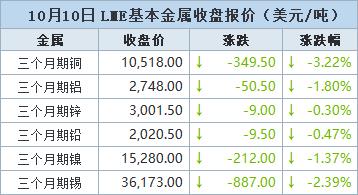
金属全线下跌 期铜下跌,受累于贸易紧张局势升级的担忧【10月10日LME收盘】
Wen Hua Cai Jing· 2025-10-11 00:23
Core Insights - LME copper prices fell due to concerns over escalating global trade tensions, with three-month copper down $349.5 or 3.22%, closing at $10,518.0 per ton [1] - The price had previously approached historical highs, reaching nearly $11,000 [1] Price Movements - Three-month copper: $10,518.00, down $349.50 or 3.22% [2] - Three-month aluminum: $2,748.00, down $50.50 or 1.80% [2] - Three-month zinc: $3,001.50, down $9.00 or 0.30% [2] - Three-month lead: $2,020.50, down $9.50 or 0.47% [2] - Three-month tin: $36,173.00, down $887.00 or 2.39% [2] Supply and Demand Dynamics - Following Freeport's declaration of force majeure at the Grasberg copper mine in Indonesia, there was a surge of investment in the copper market [4] - Chile's state-owned copper company Codelco reported a 25% year-on-year drop in August production due to a fatal collapse [4] - Demand for industrial metals remains weak, limiting price increases, with copper inventories in China rising 15% since late September [5] - The copper premium in Yangshan remained stable at $49 per ton, the lowest since August 19 [5] Future Price Projections - Goldman Sachs forecasts copper prices to remain between $10,000 and $11,000 per ton for the 2026/2027 period due to market oversupply, but maintains a positive long-term outlook [5] - In the nickel market, Goldman Sachs predicts a 6% price drop to $14,500 per ton by December 2026, requiring further profit margin reductions from Indonesian producers to address oversupply [5] - The aluminum market is expected to face oversupply starting mid-2026, with prices projected at $2,350 per ton by Q4 2026, not recovering to current levels until 2030 [5]