
海外并购

Search documents
丽珠集团(000513) - 2025年11月27日投资者关系活动记录表
2025-11-28 01:02
Group 1: R&D Progress and Market Position - The LZM012 project has completed Phase III clinical trials for psoriasis and ankylosing spondylitis, with a formal market application expected next month for psoriasis and in the first half of next year for ankylosing spondylitis [2][3] - LZM012 is the first domestic Phase III study targeting psoriasis with PASI100 as the primary endpoint, showing superior efficacy compared to existing treatments, with fewer administration cycles and lower overall costs [2][3] - The JP-1366 tablet of the P-CAB product has been submitted for market approval, with the injection form entering Phase II clinical trials, capitalizing on the growing P-CAB market projected to reach approximately CNY 1.25 billion in 2024, an 81% year-on-year increase [3][4] Group 2: Strategic Product Development - The company is focusing on the schizophrenia long-acting injection market, with the recently approved aripiprazole microsphere being the first of its kind in China, included in the 2025 guidelines for schizophrenia treatment [4][5] - The company is advancing a new generation KCNQ2/3 activator, NS-041, which is a first-class new drug with unique molecular design, targeting both epilepsy and depression indications [5] - The company has established a comprehensive product pipeline for GnRH-a long-acting release formulations, with the approval of the first microsphere product and plans for further submissions, enhancing treatment options for various conditions [6][7] Group 3: Financial Health and Strategic Acquisitions - The company maintains a robust cash reserve, allowing for dividends, buybacks, daily operations, R&D investments, and potential strategic acquisitions [8][9] - A planned acquisition of a Vietnamese company is underway, marking the first acquisition of a Vietnamese pharmaceutical company by a Chinese enterprise, with ongoing compliance with local regulations [9] - The company aims to focus on strategic partnerships in areas such as digestion, mental health, cardiovascular, metabolic, and autoimmune diseases, targeting projects with patent barriers and commercialization potential [9]
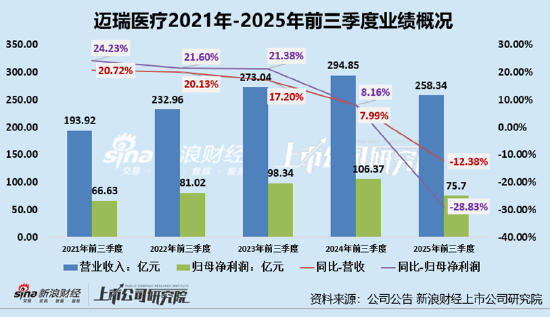
迈瑞医疗A+H: 反腐风暴后国内业务全线收缩 上市后分红超300亿多数流向大股东、现金充足IPO意在海外市场?
Xin Lang Zheng Quan· 2025-11-19 09:19
Core Viewpoint - Mindray Medical has submitted an application for overseas listing on the Hong Kong Stock Exchange, aiming to raise funds for global R&D, expanding its digital healthcare ecosystem, exploring potential acquisitions, and enhancing its global sales network and supply chain capabilities [1][4]. Financial Performance - The company's performance has significantly declined, with a notable drop in revenue and net profit in the first three quarters of 2025. Revenue was 25.834 billion yuan, a year-on-year decrease of 12.38%, while net profit fell to 7.570 billion yuan, down 28.83% [2][4]. - The domestic business has been particularly hard hit, with revenue from mainland China dropping to 8.411 billion yuan in the first half of 2025, a decline of 33.38%, reducing its business share from nearly 60% to about 50% [4][6]. Business Segments - The three core business lines—life information and support, in vitro diagnostics, and medical imaging—have all experienced declines. Life information and support revenue fell by 31.59%, in vitro diagnostics by 16.11%, and medical imaging by 22.51% in the first half of 2025 [6][10]. Market Position and Strategy - Mindray Medical aims to rank among the top 10 global medical device companies by 2030, with a target of increasing overseas revenue to over 70%. As of 2025, it ranked 25th in the global medical device company list, showing a slight improvement from the previous year [10][12]. - The company has a strong cash position, with 17.133 billion yuan in cash and a low debt ratio of 25.3%, indicating a solid financial structure [10][11]. Dividend Policy - Since its IPO in 2018, Mindray has consistently paid dividends, totaling 35.336 billion yuan, with an average payout ratio exceeding 55%. The company has continued to increase its dividend payments into 2025 [7][8].


事关跨境投资!外资高管,最新发声!
中国基金报· 2025-11-14 03:07
【导读】摩根士丹利证券(中国)CEO钱菁称,中国企业跨境投资已迈入高质量发展阶段 中国基金报记者 储是 11月12日至13日,上海证券交易所国际投资者大会拉开帷幕。摩根士丹利证券(中国)有限 公司首席执行官钱菁在并购专场上,就中国企业海外并购的最新趋势及成功要素发表见解。 中国企业海外并购三大趋势凸显 其次,民营企业"出海"拓展国际市场势头强劲。新能源等领域的国内龙头企业,正通过引入 海外主权财富基金或私募股权基金的投资,为其全球业务扩张提供资金支持,加速国际市场 渗透。 第三, 外资聚焦中国优势产业。外资正积极投资于中国的先进制造业与生物医药等优势产 业。 钱菁提到某中国生物医药公司与国际制药巨头达成的独家许可协议,引发国际市场对中国创 新药资产价值的系统性重估;某跨国汽车集团对中国新能源车企的少数股权收购,则实现了 中国新能源整车平台技术的首次对外输出与资本合作。 促成并购的四大核心要素 谈及促成成功并购交易的核心要素,钱菁将其归纳为四点: 第一, 清晰的战略规划是成功的前提,企业需明确并购目标与战略意图。 第二,相通的企业文化同样至关重要,除了常规的业务与财务尽调,还需深入了解目标公司 的企业文化,这直 ...
汇川技术:公司将重点围绕欧洲和新兴市场推进国际化业务落地
Zheng Quan Shi Bao Wang· 2025-11-11 02:46
Core Viewpoint - The company, Huichuan Technology, is focusing on international business expansion, particularly in Europe and emerging markets, to drive growth [1] Group 1: International Expansion Strategy - The company plans to prioritize its international business development in Europe, which hosts many leading equipment manufacturing clients [1] - Southeast Asia, South America, Korea, and the Middle East are identified as regions with significant growth potential, with Southeast Asia and the Middle East showing notable growth in the first half of the year [1] Group 2: M&A Activities - The company is actively seeking suitable acquisition targets, especially in the European market, focusing on companies with brand influence and independent management systems [1] - Mergers and acquisitions are considered a key strategy for rapid expansion into overseas markets [1]

东山精密收购法国GMD集团落地,否认存在“安世半导体并购”风险
Hua Xia Shi Bao· 2025-11-05 11:56
Core Viewpoint - The acquisition of French GMD Group by Dongshan Precision is a strategic move to enhance its presence in the European automotive parts market, despite concerns raised by the recent incident involving Anshi Semiconductor [2][5]. Group 1: Acquisition Details - Dongshan Precision's wholly-owned subsidiary DSBJ PTE.LTD has successfully acquired 100% of GMD Group for approximately €100 million, completing the debt restructuring [2][3]. - The acquisition process began in May 2023, with all preconditions met and relevant documents signed, allowing GMD Group to be included in Dongshan's consolidated financial statements starting November 1, 2025 [2][3]. - GMD Group, established in 1986, is a leading player in the European automotive parts industry, generating annual revenues of €1 billion and employing over 6,600 staff across 46 factories in 12 countries [3][4]. Group 2: Financial Performance - GMD Group reported audited revenues of €983 million and a net loss of €6 million for 2023, with projected revenues of €1.012 billion and a net profit of €3 million for 2024 [4]. Group 3: Strategic Implications - The acquisition aims to implement a dual-driven strategy to increase market share in the automotive parts sector and establish a European industrial footprint, thereby accelerating Dongshan's globalization efforts [4][6]. - The company anticipates leveraging GMD Group's business and influence to expand its global automotive client base, positively impacting its financial health and operational quality [4][8]. Group 4: Risk Management - Dongshan Precision has expressed confidence in avoiding risks similar to those faced by Anshi Semiconductor, citing significant differences between the automotive parts and semiconductor industries [5][6]. - The company has acknowledged potential risks related to cross-border integration and market performance, including differences in management systems and economic fluctuations [6][7].


矿业并购需做到“四个转变”
Zheng Quan Ri Bao· 2025-10-26 16:22
Core Insights - The global mining market is undergoing significant changes, with leading companies like Zijin Mining, Luoyang Molybdenum, Shandong Gold, and Western Mining enhancing their scale and optimizing resource structures through mergers and acquisitions [1] Group 1: Resource Integration - The shift in mining resource integration is moving from "dispersed layout" to "system optimization," with a focus on stabilizing and strengthening supply chains [2] - The demand for key minerals such as copper, lithium, cobalt, and nickel is increasing due to the rise of industries like renewable energy and artificial intelligence, leading to a profound change in global mineral demand structure [2] - The Chinese government has provided clear strategic directions for resource integration, emphasizing the need for effective exploration and project layout to avoid redundant low-level construction [2] Group 2: Value Creation - Mining companies are transitioning from relying on "cyclical profits" to "restructuring industry chain value," seeking more stable and sustainable value creation models [3] - Companies are extending vertically into high-value areas such as semiconductor materials and energy battery materials, aiming for geometric growth in resource value [3] - Horizontal collaboration is increasing, with upstream mining companies forming deep partnerships with downstream application firms to create a new supply-demand relationship characterized by shared risks and benefits [3] Group 3: Development Drivers - The mining industry is moving from "resource dependence" to "technology innovation-driven" development, with technological advancements becoming crucial for enhancing core competitiveness [4] - Innovations in exploration and mining, such as smart mining and efficient ore selection, are unlocking the potential of low-grade and difficult-to-process resources [4] - Companies are focusing on building technological moats to ensure production efficiency and cost control, which is essential for sustainable development [4] Group 4: Overseas Mergers and Acquisitions - The focus of overseas mergers and acquisitions is shifting from "asset acquisition" to "capability output," emphasizing the importance of global operational capabilities and localized value creation [5] - Successful international mining companies integrate their capital, technology, and market advantages with the resource endowments and development needs of host countries [5] - Future competition in the mining sector will hinge on resource integration capabilities, industry chain collaboration, technological innovation, and global operational capabilities [5]
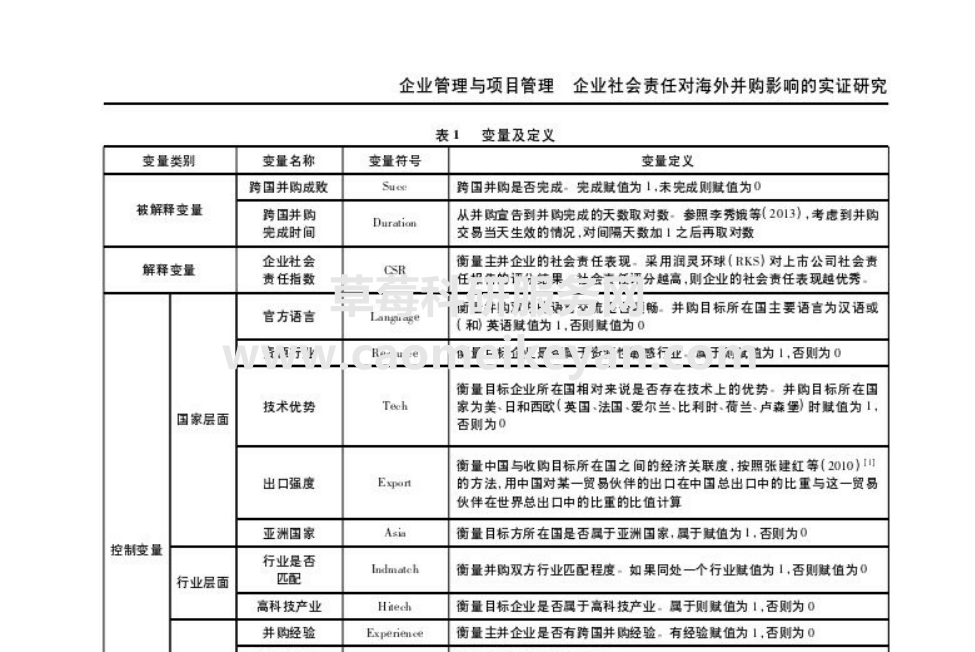
2024-2001年上市公司企业海外并购、跨国并购数据(已测算好)
Sou Hu Cai Jing· 2025-10-23 07:16
Core Insights - The data covers overseas mergers and acquisitions (M&A) of listed companies from 2024 to 2001, focusing on cross-border M&A success rates and completion times [1][2] - A total of over 1,500 samples from 785 companies were analyzed, with various metrics calculated to ensure robustness and accuracy [1][2] - The study references previous research on the impact of corporate social responsibility (CSR) on M&A outcomes, indicating a comprehensive approach to understanding the factors influencing M&A success [1][2] Data Metrics - The success of cross-border M&A is defined as whether the transaction was completed (1 for completed, 0 for not completed) [2] - The duration of M&A is measured by the logarithm of the number of days from announcement to completion [2] - Key variables include CSR performance, official language, technological advantages, export intensity, and industry matching [2] Sample Overview - The dataset includes various metrics such as acquisition ratio, purchase price (in millions), acquisition year, and whether the target company is publicly listed [4] - Specific examples of acquisition prices range from 6,348.51 million to 88,810 million, indicating significant financial commitments [4] - The analysis also considers whether the transactions were cash-based and the experience of the acquiring company in cross-border M&A [4]
迈瑞医疗赴港上市:全球化野心的资本跳板
Sou Hu Cai Jing· 2025-10-17 15:45
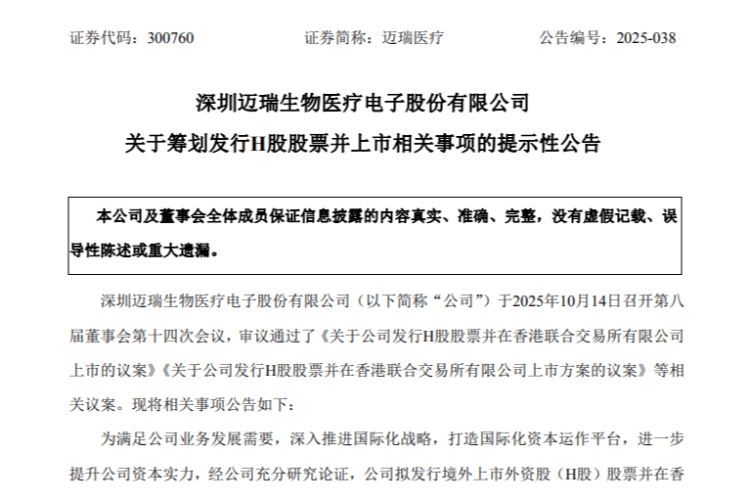
Core Viewpoint - Mindray Medical has initiated its third IPO journey by announcing plans to list in Hong Kong, marking a significant strategic shift from merely seeking financing to establishing a dual capital platform with a strong financial foundation [1][5]. Group 1: Company History and Financial Performance - Mindray Medical has a notable history, having listed on the NYSE in 2006, returned to A-shares in 2018, and now pursuing a Hong Kong listing, reflecting the evolution of China's medical device industry [3]. - Since its A-share listing, Mindray has not engaged in further financing and has maintained a high dividend payout ratio, distributing a total of 33.7 billion yuan, which is 5.7 times its initial fundraising of 5.93 billion yuan [4]. - In the first half of 2025, Mindray reported a revenue of approximately 16.743 billion yuan, a decrease of 18.45% year-on-year, and a net profit of 5.069 billion yuan, down 32.96% year-on-year, marking its first negative growth since listing [6][8]. Group 2: Business Challenges - The company's three main business segments faced significant pressure, with the in-vitro diagnostics segment generating revenue of 6.424 billion yuan, down 16.11%, and the life information and support segment seeing a revenue drop of 31.59% to 5.479 billion yuan [8]. - The decline in revenue is attributed to intensified competition and ongoing healthcare reforms, impacting both the volume and pricing of diagnostic tests [8]. Group 3: Globalization Strategy - Mindray's internationalization began in 2000, evolving from relying on agents to establishing direct subsidiaries in key overseas markets, supported by strategic acquisitions to enhance its technology and market presence [9][10]. - The company aims for overseas revenue to account for over 70% of its total, with current international business revenue at 50%, indicating significant growth potential in global markets [10]. - The Hong Kong listing is seen as a strategic move to create a global capital platform, facilitating overseas acquisitions and business development, particularly in a mature healthcare financing ecosystem [10][11].

迈瑞医疗公告拟赴港上市:国内营收承压,海外营收占比提升
Sou Hu Cai Jing· 2025-10-17 08:21
Core Viewpoint - Mindray Medical, a leading medical device company, has announced plans to issue H-shares and list on the Hong Kong Stock Exchange to enhance its international strategy and capital operations platform, amid declining domestic revenues and growing overseas sales [2][3]. Group 1: Company Performance - Mindray Medical's domestic revenue has significantly declined, with a reported revenue of 16.743 billion yuan in the first half of 2025, a year-on-year decrease of 18.45%, and a net profit of 5.069 billion yuan, down 32.96% [3]. - The decline in domestic performance is attributed to a longer revenue recognition cycle due to competitive pressures, with domestic business revenue dropping over 30% in the first half of 2025 [3]. Group 2: International Expansion - Mindray Medical's overseas revenue reached 16.434 billion yuan in 2024, marking a year-on-year increase of 21.28%, accounting for 44.75% of total revenue, with expectations for further growth in 2025 [4]. - The company's international business saw a 5.39% increase in the first half of 2025, with international revenue expected to constitute approximately 50% of total revenue [4]. Group 3: Mergers and Acquisitions - Mindray Medical has been active in overseas acquisitions, including a 532 million euro purchase of HyTest in 2021 and a 115 million euro acquisition of 75% of DiaSys in 2023, aimed at enhancing core technology and supply chain stability [5]. - The company plans to continue exploring investment and acquisition opportunities to strengthen its competitive position in the medical device industry [5].
盛屯矿业20251016
2025-10-16 15:11
Summary of Shengton Mining Conference Call Company Overview - Shengton Mining focuses on the copper and cobalt sectors, with nearly 60% of sales coming from overseas markets. [2][3] - The company aims to increase copper production capacity to 230,000 tons by 2025, with cobalt benefiting from quota advantages in the Democratic Republic of Congo (DRC) and rising prices of cobalt hydroxide. [2][4] Key Financials and Operations - The cost of cobalt production is approximately 70,000 RMB per ton, while the selling price is close to 400,000 RMB per ton, leading to significant expected sales growth. [2] - Shengton Mining has a cash reserve of over 7 billion RMB, with a debt ratio of about 54%-55%. [2][7] - The company plans to finance its operations through domestic and international bank loans and its own funds. [7][10] Recent Acquisitions - Shengton Mining has acquired a gold mine for a total price of 261 million USD, with an expected annual processing capacity of 3.6 million tons of ore. [2][6] - The gold mine has a surface grade of 2.08 grams per ton and a deeper grade of approximately 2.89-3 grams per ton. [20] Production and Sales Projections - For 2025, copper production is expected to exceed 200,000 tons, up from 175,500 tons in 2024. Cobalt total capacity is projected at 18,000 tons, with a target of 15,000 tons. [12] - The gross margin for copper is around 35%, with self-mined ore margins between 40%-50% and purchased ore margins between 10%-20%. [12] Market Dynamics - The cobalt business in the DRC is significantly advantageous due to the country's control of over 70% of global cobalt reserves. [13] - The price of cobalt hydroxide has risen to nearly 400,000 RMB per ton, while production costs remain low, enhancing profit margins. [8] Strategic Development - Shengton Mining employs a "explore while mining" strategy in the DRC, focusing on resource development without publicly disclosing reserves to protect corporate interests. [14] - The company has a professional geological team of 20-30 members, which is crucial for resource development and acquisitions. [9] Challenges and Risk Management - The company faces challenges related to quota restrictions affecting actual sales, but plans to optimize production and inventory management to mitigate financial impacts. [21][22] - Shengton Mining is also addressing potential illegal mining activities by local residents at the new gold mine site. [20] Future Outlook - The company plans to continue focusing on copper and cobalt while developing its gold business into a relatively independent segment. [5][25] - Shengton Mining aims to solidify its asset base during profitable periods to ensure sustainable growth. [25]
