
疫苗价格战

Search documents
流感「抬头」,疫苗价「雪崩」,行业协会坐不住了
36氪· 2025-11-26 13:39
Core Viewpoint - The article discusses the ongoing price war in China's vaccine industry, driven by changes in supply and demand dynamics, leading to significant price reductions and financial losses for companies [4][15][22]. Group 1: Price War Dynamics - The price of a three-valent flu vaccine has dropped to 5.5 yuan, cheaper than a cup of milk tea, indicating a severe price competition in the vaccine market [5][11]. - The China Vaccine Industry Association has issued an initiative to combat "involution-style" competition, urging members to avoid bidding below cost and threatening penalties for violations [6][8][10]. - The price war has persisted for two years, with the association's initiative being the first formal stance against low-price competition, although it may not resolve the underlying issue of overcapacity [6][10][22]. Group 2: Supply and Demand Changes - The supply side is characterized by homogenization and overcapacity, with many companies entering the vaccine market, leading to intense competition and price wars [16][17]. - Demand is also under pressure, with declining public trust in vaccines and a decrease in vaccination rates, particularly for flu vaccines, which averaged below 4% in China from 2020 to 2023 [17][19]. - The shift in focus from childhood vaccines to adult vaccines due to declining birth rates has intensified competition in the adult vaccine market [17][19]. Group 3: Financial Impact on Companies - The financial repercussions of the price war are evident, with vaccine companies experiencing a 60% drop in revenue and a 113% decline in net profit in the first half of 2025 [19][20]. - Major companies like Zhifei Biological and Wantai Biological have reported significant losses, with Zhifei's revenue down 66.53% and net profit loss of 12.06 billion yuan [20][21]. - Despite some companies showing growth in sales, the overall trend indicates that increased revenue does not equate to increased profit due to drastic price reductions [21][22]. Group 4: Future Outlook and Strategies - Experts suggest that the industry is in a "deep cold moment," requiring a period of consolidation and restructuring that could last five to ten years [23]. - Companies are exploring two main strategies to navigate the competitive landscape: expanding into emerging markets and focusing on differentiated products to meet unmet clinical needs [24].






当带状疱疹疫苗开始“买一送一”
3 6 Ke· 2025-11-26 12:15
Core Insights - The article discusses the competitive landscape of the shingles vaccine market in China, highlighting the unexpected price war initiated by GSK's vaccine, Shingrix, which is being promoted through a "buy one get one free" offer [1][2][4]. Market Dynamics - Shingrix's original price for two doses is 3,260 yuan, but with the promotion, the cost is reduced to 1,652 yuan, effectively a 50% discount [2]. - The vaccine has shown exceptional efficacy, reducing the risk of shingles by 97.2% in individuals aged 50 and above, and offers long-lasting immunity [2][7]. Competitive Landscape - Following GSK's price reduction, domestic competitor, Baike Biological, has also adjusted its pricing strategy, with its vaccine now priced around 1,400 yuan, and further discounts being offered [4]. - The domestic market for shingles vaccines has not met expectations, with Baike Biological reporting a significant drop in sales and revenue due to high return rates and low demand [8]. Consumer Behavior and Market Potential - Despite the high demand for shingles vaccines among the elderly population, the uptake has been low, with only 0.1% vaccination rate among those aged 50 and above in 2021 [9][11]. - The mismatch between the high cost of the vaccine and the financial capability of the target demographic is a significant barrier to market growth [11]. Challenges in Market Expansion - The competitive landscape in China is more fragmented compared to overseas markets, with both imported and domestic vaccines vying for market share, complicating the expansion efforts for Shingrix [11][13]. - There is a lack of awareness and understanding of the vaccine among the target demographic, which hinders its adoption [12][13].
疫苗价格暴跌90%,行业协会坐不住了!
Jin Tou Wang· 2025-11-21 08:29
Core Viewpoint - The Chinese vaccine industry is experiencing a severe price war, leading to significant price drops, with some vaccines falling over 90% in price, prompting the China Vaccine Industry Association to call for an end to the price competition to avoid unsustainable costs [1][3]. Group 1: Price Decline and Industry Impact - The price of common vaccines, such as the flu vaccine, has plummeted to about 1/10 of previous prices, with three-valent vaccines previously priced around 60 yuan now being offered as low as 6.5 yuan [3]. - The HPV vaccine has also seen drastic price reductions, with Watson Bio's two-valent HPV vaccine dropping nearly 90% over three years, resulting in significant profit declines for leading vaccine companies, with net profits falling by 70%-90% last year [3][4]. - In the first three quarters of this year, 10 out of 14 publicly listed vaccine companies in China reported profit declines, with over 70% experiencing this trend, and 5 companies are currently operating at a loss [3]. Group 2: Causes of Price Decline - The decline in birth rates has reduced the market size for vaccines, particularly affecting those targeting infants, while competition among manufacturers has intensified, leading to price cuts due to a lack of product differentiation [4]. - The approval of 59 flu vaccine products has resulted in oversupply, with 40% of flu vaccines going unsold and subsequently wasted last year, forcing companies to sell at a loss [4]. Group 3: Long-term Implications for Public Health - While lower vaccine prices may seem beneficial for consumers, the long-term impact on innovation and quality is concerning, as companies may lack the financial incentive to invest in new vaccine development [6]. - The risk of using cheaper raw materials to maintain low prices could compromise vaccine quality, posing a threat to public health [6]. - The industry must balance price reductions with the need for effective and safe vaccines, as the focus should not solely be on affordability but also on health outcomes [6]. Group 4: Strategies for Industry Recovery - Vaccine companies are increasingly looking to expand into emerging markets in Southeast Asia, Latin America, and Africa, with companies like Wantai Biologics significantly increasing their export volumes [8]. - Chinese vaccine firms are moving beyond simple product exports to include technology licensing and localized production, which helps them navigate trade barriers and integrate into local markets [8]. - Achieving international certifications is crucial for these companies, indicating that their quality management systems meet global standards, which is essential for future growth in the global vaccine market projected to reach $86.2 billion by 2032 [8].

百克生物销售副总辞职,存量竞争下疫苗行业销售高管变动频繁
Xin Lang Cai Jing· 2025-10-27 06:39
Core Viewpoint - The domestic vaccine industry is experiencing significant pressure due to economic downturns, declining birth rates, reduced vaccination willingness, and intensified market competition, leading to frequent executive changes among companies [1][3]. Group 1: Executive Changes - Sun Wanfeng has resigned from his position as employee representative director and vice president of Baike Bio, but will continue as assistant to the chairman [1]. - There are rumors of changes in the management of Kangtai Bio, but the company has confirmed that Vice President Yu Bing remains in his position [1]. - Frequent executive turnover is noted in the domestic vaccine industry, with several companies undergoing leadership changes since late 2024 [3]. Group 2: Financial Performance - In the first half of 2025, only 5 out of 10 listed vaccine companies in A-shares reported revenue growth, with only 3 achieving positive net profit growth [3]. - Baike Bio reported a revenue of 284.9 million yuan with a net loss of 73.57 million yuan, marking a year-on-year revenue decline of 53.93% and a net profit decline of 153.47% [4]. - Kangtai Bio's revenue was 1.392 billion yuan with a net profit of 37.53 million yuan, showing a revenue growth of 15.81% but a significant net profit decline of 77.30% [4]. Group 3: Market Competition - The HPV vaccine market is experiencing aggressive price competition, with prices for the bivalent HPV vaccine dropping below 100 yuan, and the lowest price recorded at 27.5 yuan per dose [5]. - The flu vaccine market is also seeing price reductions, with prices for quadrivalent flu vaccines dropping from 128 yuan to 88 yuan per dose [6]. - The pneumococcal vaccine market is highly competitive, with Pfizer withdrawing from the market due to intense competition from domestic products [6]. Group 4: Growth Opportunities - Despite the challenges, there are structural growth opportunities in the vaccine market, exemplified by Olin Bio's adsorbed tetanus vaccine, which achieved a revenue growth of 35.17% in the first half of 2025 [7].




疫苗降价潮
投资界· 2025-09-16 08:36
Core Viewpoint - The vaccine industry is experiencing a downturn, with significant revenue and profit declines among major companies, attributed to price wars, vaccine hesitancy, and intense competition [4][5][10][20]. Group 1: Industry Performance - In the first half of 2025, the overall vaccine revenue of listed companies in China decreased by 60% year-on-year, and net profit dropped by 113% [5]. - Major vaccine companies like Zhifei Biological and Wantai Biological reported their first half-year losses since going public, with net profits declining by 127% and 155% respectively [5][10]. - Only six out of 17 listed vaccine companies achieved profitability, with the highest profit being 122 million yuan from Chengda Biological [5]. Group 2: Price Wars - The price of flu vaccines has significantly dropped, with some prices reaching as low as 5.5 yuan per dose, leading to a continuous price war in the market [8][9]. - Wantai Biological's revenue from its main product, the bivalent HPV vaccine, fell by 38% to 844 million yuan, marking its first loss since listing [10]. - The price competition has also affected other vaccines, including HPV and shingles vaccines, with prices dropping dramatically in recent years [9][10][11]. Group 3: Vaccine Hesitancy - Vaccine hesitancy has become a significant issue, particularly for non-mandatory vaccines like HPV and flu vaccines, with many individuals expressing doubts about their effectiveness [13][14][15]. - The average flu vaccine coverage in China remains below 4%, significantly lower than in developed countries where it is around 50% [15]. - Factors contributing to vaccine hesitancy include dissatisfaction with COVID-19 vaccine outcomes, misinformation, and a lack of awareness regarding adult vaccinations [15][16]. Group 4: Future Outlook - Experts predict that the current downturn in the vaccine industry may last for five to ten years, with potential consolidation and elimination of weaker companies [20]. - The industry faces challenges in changing public perception and increasing adult vaccination rates, which are crucial for market expansion [20]. - The competition is expected to remain fierce, with many companies struggling to differentiate their products in a saturated market [19][20].


华兰疫苗2025年上半年增收不增利 流感疫苗贡献超40%收入
Mei Ri Jing Ji Xin Wen· 2025-08-28 13:40
Core Viewpoint - Hualan Biological's revenue increased by 68.77% in the first half of 2025, despite a challenging environment for the vaccine industry, primarily driven by significant sales of rabies vaccines and a doubling of flu vaccine revenue [1][2][3]. Revenue Performance - Hualan Biological achieved a revenue of 59.96 million yuan in the first half of 2025, marking a year-on-year growth of 68.77% [1]. - The company's net profit attributable to shareholders was 20.80 million yuan, a decrease of 17.71% compared to the previous year [1]. - The flu vaccine revenue grew by 132.94%, contributing approximately 40% to the total revenue [2][3]. Market Dynamics - The domestic vaccine industry is undergoing a deep adjustment period due to price wars, particularly in the HPV vaccine segment, which has led to significant revenue declines for several companies [2]. - Hualan Biological's proactive sales efforts and increased market promotion have resulted in a notable rise in sales, especially for rabies vaccines [1][3]. Sales and Marketing Strategy - Sales expenses increased by 30.78% to 28.99 million yuan, reflecting the company's efforts to enhance market penetration and awareness [4]. - Hualan Biological's sales network covers over 30 provincial regions and more than 2,500 disease control centers, achieving a coverage rate of over 70% [4]. Future Growth Prospects - The company is focusing on expanding its product pipeline, with ongoing clinical trials for new vaccines, including a freeze-dried Hib vaccine and mRNA vaccines for flu and RSV [5]. - Hualan Biological aims to increase the sales revenue and market share of its rabies vaccine while enhancing public awareness of flu vaccination [5].
中慧生物暴涨背后:中国真的需要319元/针的流感疫苗?
Guan Cha Zhe Wang· 2025-08-15 14:13
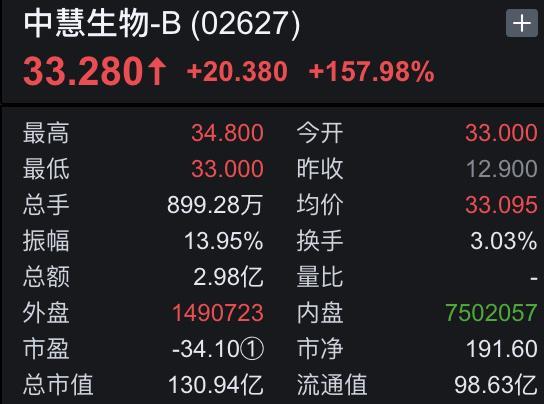
Group 1: Company Overview - Jiangsu Zhonghui Yuantong Biotechnology Co., Ltd. (Zhonghui Bio) successfully listed on the Hong Kong Stock Exchange on August 11, with an initial price of HKD 12.90, surging 164% on the first day to close at HKD 33.28, marking a 158% increase and setting a record for new stock listings in 2025 [1][3] - The company’s market capitalization approached HKD 17.2 billion after two days of trading, with a cumulative increase of over 238% [1] - Zhonghui Bio's core product, the four-valent influenza virus subunit vaccine "Hui Er Kang Xin®," received approval in May 2023 and is positioned as a high-purity alternative to traditional vaccines, boasting a significant technological advantage [1][5] Group 2: Market Dynamics - Despite the initial capital enthusiasm, the influenza vaccine market in China faces challenges, with a vaccination rate stagnating at 3.8%, significantly lower than the U.S. [2][8] - The market is saturated with 26 listed influenza vaccines and 19 in development, leading to intense competition and price wars, which have resulted in significant revenue declines for major players [2][11] - The industry is experiencing a structural dilemma, with high production costs and low vaccination rates creating a challenging environment for companies like Zhonghui Bio [8][12] Group 3: Financial Performance - Zhonghui Bio reported a net loss of CNY 425 million in 2023, with projections of a reduced loss of CNY 259 million in 2024 [12][13] - The company’s revenue is heavily reliant on its single product, which is priced significantly higher than the industry average, leading to challenges in market penetration [12][14] - High research and development expenditures have been a double-edged sword, with R&D costs constituting a substantial portion of total expenses [12][15] Group 4: Future Prospects - Zhonghui Bio is exploring international markets as a strategy to mitigate domestic market pressures, with plans to register in regions like Macau and the Philippines, and to enter markets such as Canada and Singapore [15][16] - The company’s success in international expansion will depend on overcoming patent barriers and adapting to local production requirements [15][16] - The ongoing transition in the vaccine industry from imitation to innovation presents both challenges and opportunities for Zhonghui Bio as it seeks to establish a competitive edge [16]
默沙东要慌了?九价HPV疫苗价格暴降60%!
Xin Lang Cai Jing· 2025-07-08 16:42
Core Viewpoint - WanTai Biologics has officially launched its nine-valent HPV vaccine "Xinkening®9" at a price of 499 yuan per dose, significantly undercutting the imported vaccine price and marking the end of the "high-price era" for HPV vaccines in China [1][6]. Pricing and Market Impact - The imported nine-valent HPV vaccine "Gardasil 9" is priced at approximately 1318 yuan per dose, with a total cost of nearly 4000 yuan for three doses, while "Xinkening®9" costs about 1497 yuan for three doses [1]. - "Xinkening®9" is the only HPV vaccine approved for a two-dose regimen for ages 9-17, reducing the cost for this age group to 998 yuan, thereby enhancing accessibility and compliance [1]. Historical Context and Market Dynamics - Prior to the launch of "Xinkening®9", the nine-valent HPV vaccine market in China was monopolized by Merck's "Gardasil 9," which faced a dramatic shift from high demand and scarcity to excess inventory [2]. - In 2023, the batch issuance of "Gardasil 9" reached 36.55 million doses, a year-on-year increase of 136.16%, making Merck the highest-grossing multinational pharmaceutical company in China that year [2]. Sales Performance and Challenges - Merck's global sales of the HPV vaccine in 2024 were $8.583 billion, a 3% decline year-on-year, primarily due to weak performance in the Chinese market [3]. - To address high inventory levels, Merck announced a suspension of supply to China starting in early 2025, expected to last until at least mid-2025 [3]. Financial Performance of WanTai Biologics - WanTai Biologics reported a 59.25% year-on-year decline in revenue for 2024, totaling 2.245 billion yuan, with a net profit drop of 91.49% to 106 million yuan [3]. - The company faced significant challenges due to a price collapse in its two-valent vaccine, leading to a drastic reduction in government procurement prices [3]. Market Potential and Future Outlook - The potential market for HPV vaccines in China is substantial, with 70%-80% of the 300 million women aged 9-45 yet to be vaccinated [4]. - National Investment Securities predicts that WanTai's nine-valent HPV vaccine could reach a sales peak of 22.8 billion yuan, with projected revenues of 3.17 billion yuan, 11.4 billion yuan, and 28.63 billion yuan for 2025-2027 [4]. Competitive Landscape - Several domestic pharmaceutical companies are in the late clinical stages of developing their own nine-valent HPV vaccines, creating a competitive environment for WanTai [5]. - WanTai has initiated a Phase III clinical trial for a male indication, but competitors like Kanglaite have already started their trials earlier [5]. International Expansion - WanTai aims to become a leading global vaccine supplier by 2030, with plans to have 3 to 5 WHO pre-qualified products [5]. - Competitors are also pursuing international markets, with Kanglaite planning to submit for approval in Indonesia and Ruike Biologics exploring the Middle East [5]. Industry Trends - The World Health Organization has warned that global HPV vaccine supply may exceed demand from 2025 to 2030, potentially leading to a price war and industry reshuffling [5]. - The WHO's recommendation for a single-dose HPV vaccination regimen could further intensify market competition [5].

九价HPV疫苗价格腰斩!国产破局引爆千元降价潮
Xin Lang Zheng Quan· 2025-06-18 09:36
Group 1 - The price of the imported Merck nine-valent HPV vaccine has significantly decreased in several cities, with promotional offers reducing the effective price to around 700 yuan per dose from the original price of 1320 yuan [1][2] - The market for the nine-valent HPV vaccine has shifted dramatically, with the once exclusive Merck vaccine facing competition from domestic manufacturers, leading to a more accessible supply [2][4] - The inventory pressure on Zhifei Biological, the agent for Merck's vaccine, is evident, with a 14.8% year-on-year decline in the batch issuance of the nine-valent vaccine and a staggering 95.49% drop for the four-valent vaccine [3] Group 2 - The approval of the domestic nine-valent HPV vaccine "Xinkening 9" by Wantai Biological has disrupted the market, with a potential price point around 700 yuan, effectively halving the original price of the imported vaccine [4] - Other domestic companies, including Kanglaisheng, Watson Bio, and Shanghai Bowei, are also nearing the launch of their nine-valent HPV vaccines, which is expected to reignite price competition in the market [5] - The anticipated release of more domestic nine-valent vaccines marks the beginning of a trend towards greater affordability and accessibility in the HPV vaccine market [5]
从200元到25元!肺炎疫苗价格“腰斩”背后的行业生死局
Xin Lang Zheng Quan· 2025-05-16 06:16
Core Viewpoint - The drastic price drop of the 23-valent pneumococcal polysaccharide vaccine has severely impacted the profitability of companies in the vaccine industry, leading to an intensified price war and a challenging market environment [1][3][5]. Group 1: Price Drop and Market Impact - The procurement results for the 23-valent pneumococcal vaccine revealed a shocking price of 25 yuan per dose, a nearly 90% decrease from the previous market price of approximately 200 yuan [1]. - This price drop has pushed the industry into a fierce price war, with companies like Beijing Kexing and Yuxi Watson winning bids at significantly lower prices [1][2]. - The trend of price reduction is not new, but the current situation marks a historical low for government procurement projects [1]. Group 2: Government Policies and Vaccination Rates - The vaccination rate for adults, particularly among the elderly in cities like Guangzhou, remains low, with only 14.13% coverage [2]. - To improve vaccination coverage, many local governments have included second-class vaccines in free vaccination programs, further pressuring companies to accept lower prices [2]. - The trend of "volume for price" in government procurement is expected to continue, leading to further price declines in the industry [2]. Group 3: Industry Challenges and Profitability - The vaccine industry is facing collective difficulties, with a projected 34% year-on-year decline in the issuance of 23-valent pneumococcal vaccines in 2024 [3]. - Major companies like Watson Bio and Zhifei Biological are experiencing significant drops in sales, with Watson reporting a 20.21% decrease in overall product sales [3]. - The strategy of "low price for market share" has backfired, as many companies report net profit declines exceeding 30% [3]. Group 4: Policy Changes and Future Outlook - The National Health Commission has indicated plans to dynamically adjust immunization strategies, potentially including necessary vaccines in the national immunization program, which could lead to a recovery in sales but not in prices [4]. - Companies are urged to transform their business models, as reliance on low prices may not sustain long-term competitiveness [4]. - Analysts suggest that companies with scalable production capabilities and innovative pipelines will have a better chance of survival in the evolving market [4]. Group 5: Conclusion on Market Dynamics - The dramatic price reduction from 200 yuan to 25 yuan signifies the end of the "price myth" for pneumococcal vaccines, driven by policy changes and market dynamics [5]. - Companies must find a balance in cost control, technological innovation, and diversified strategies to survive the current market challenges [5]. - The industry must focus on technological upgrades and value reconstruction to escape the "price for volume" dilemma [5].