
精准施策

Search documents
解决急难愁盼不能“撒胡椒面”,要用心用情、精准施策
Ren Min Wang· 2025-11-06 05:30
Core Viewpoint - The article emphasizes the importance of a people-centered approach in addressing public welfare and improving living standards, advocating for precise and targeted measures rather than a broad, superficial approach [1][2]. Group 1: Issues in Current Welfare Approaches - There is a phenomenon of "spreading pepper" in welfare work, which leads to resource waste and fails to address actual problems effectively [2]. - This approach can manifest as average distribution of resources, neglecting differentiated needs, or as a lack of follow-up management, resulting in a disconnect between investment and public satisfaction [2]. Group 2: Importance of Precision in Welfare Work - Precision is crucial for enhancing public welfare, requiring accurate identification of issues and alignment of resources with community needs, akin to targeted medical treatment [3]. - Successful examples include targeted poverty alleviation strategies and tailored urban renewal projects that address specific community needs rather than generic solutions [3]. Group 3: Necessity of Ground-Level Research - To understand true public demands, it is essential for officials to engage directly with communities, conducting thorough research to identify urgent issues and needs [4]. - This involves avoiding one-size-fits-all solutions and focusing on detailed case studies to uncover common problems and underlying patterns [4]. Group 4: Balancing Universal and Targeted Support - Effective welfare strategies must balance universal public services with targeted support for vulnerable groups, ensuring that both general and specific needs are met [5]. - The approach should be gradual and sustainable, focusing on pressing issues while also seeking systemic solutions for broader challenges [5].
解决急难愁盼不能“撒胡椒面”(思想纵横)
Ren Min Ri Bao· 2025-11-05 22:11
Core Viewpoint - The article emphasizes the importance of a people-centered approach in addressing and improving people's livelihoods, advocating for precise and targeted measures rather than a superficial or generalized approach to social welfare [1][2][3]. Group 1: Issues with Current Approaches - The phenomenon of "sprinkling pepper" in social welfare efforts leads to resource waste and fails to address the actual needs of the people, resulting in a lack of satisfaction and potential new conflicts [2][5]. - Current practices often reflect an average distribution of resources, neglecting the differentiated needs of various groups, which can lead to ineffective solutions [2][4]. Group 2: Importance of Precision - Precision is crucial in enhancing people's welfare, requiring a clear identification of issues and a targeted approach to resource allocation, akin to a doctor diagnosing a patient before treatment [3][5]. - Successful examples include targeted poverty alleviation strategies that focus on specific needs and conditions of individuals, avoiding broad and ineffective measures [3][5]. Group 3: Research and Understanding - To implement precise measures, it is essential for officials to engage deeply with communities to understand their true needs, moving beyond superficial assessments [4][5]. - A thorough investigation into the specific challenges faced by different demographics is necessary to inform effective policy decisions and avoid one-size-fits-all solutions [4][5]. Group 4: Balancing Universal and Targeted Support - There is a need to balance universal public services with targeted support for vulnerable groups, ensuring that both general and specific needs are met effectively [5]. - Policies should be adaptable and focused on the most pressing issues, ensuring that resources are allocated efficiently to maximize impact [5].
从十八洞村到“十八栋村”(话说新农村)
Ren Min Ri Bao· 2025-10-30 22:37
Core Insights - The article emphasizes the importance of precise policies in achieving rural revitalization and sustaining poverty alleviation efforts in China [2][4]. Group 1: Rural Revitalization Examples - Xiangxi's Huayuan County's Shibatong Village has transformed from a poverty-stricken area to a thriving community through specialty planting, rural tourism, and local crafts, resulting in significant economic benefits for villagers [1][2]. - Shouning County's Shibadong Village has improved its infrastructure and developed tourism-related facilities, allowing the village to benefit from the tourism economy [1][2]. Group 2: Historical Context and Policy Development - The concept of "precise poverty alleviation" was first introduced in Shibatong Village in 2013, highlighting the effectiveness of targeted strategies in rural development [2][3]. - The article references Xi Jinping's 1988 observations on rural housing conditions, which laid the groundwork for future rural planning and development initiatives [2][3]. Group 3: Resource Utilization and Development Strategies - The article suggests that rural areas should leverage their unique resources and characteristics to create competitive advantages, as seen in the development of bottled water in Shibatong Village and agritourism in Shibadong Village [3][4]. - Successful examples from other regions, such as Qinghai's highland vegetables and Yunnan's flower economy, illustrate the potential for rural areas to thrive by identifying their strengths and integrating into broader market systems [4]. Group 4: Future Directions and Implementation - The article stresses the need for cohesive efforts and a clear vision in implementing rural revitalization strategies, ensuring that the path of rural development continues to expand [4].
2026年国考招录年龄放宽 报名人数创新高
Zhong Guo Qing Nian Bao· 2025-10-24 13:29
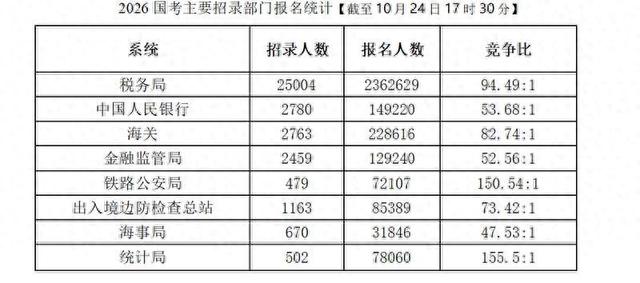
Core Points - The 2026 National Civil Service Examination (国考) has a total recruitment of 38,119 positions, with a record number of 3,515,251 applicants, an increase of nearly 260,000 compared to the previous year, marking a historical high [1][5] - The average competition ratio stands at 92:1, with 3,207,060 applicants passing the recruitment unit's review [1][6] - The age limit for applicants has been relaxed, allowing candidates aged 18 to 38, and for 2026 graduates with master's and doctoral degrees, the limit is extended to 43 [2][3] Recruitment Data - The recruitment numbers and competition ratios for various agencies are as follows: - Tax Bureau: 25,004 positions, 2,362,629 applicants, competition ratio of 94.49:1 - People's Bank of China: 2,780 positions, 149,220 applicants, competition ratio of 53.68:1 - Customs: 2,763 positions, 228,616 applicants, competition ratio of 82.74:1 - Financial Regulatory Bureau: 2,459 positions, 129,240 applicants, competition ratio of 52.56:1 - Railway Public Security Bureau: 479 positions, 72,107 applicants, competition ratio of 150.54:1 [2] Policy Implications - The relaxation of age limits is seen as a response to the delayed retirement policy, suggesting a need for adjustments in recruitment criteria [3][4] - The adjustment reflects a broader trend in various regions, with several local governments already implementing similar age relaxations for public service examinations [4][5] - Experts suggest that this move could create a "demonstration effect" in the job market, encouraging a more inclusive approach to age in recruitment [5] Trends and Observations - The recruitment plan from 2019 to 2025 shows a steady increase in the number of positions, although the growth rate has slowed down, with a slight decrease of about 1,600 positions for 2026 compared to the previous year [5] - The tax system is expected to account for approximately 65.6% of the total recruitment, driven by a wave of retirements and the need for skilled professionals in finance, accounting, and technology [6] - The "public service examination craze" reflects a strategic career adjustment by graduates in response to economic changes, highlighting the stability and social recognition associated with civil service roles [7]

创新长三角地区干部队伍激励机制
Xin Hua Ri Bao· 2025-10-15 23:22
Core Insights - The article emphasizes the importance of a high-quality and professional cadre team for the high-quality development of the Yangtze River Delta region, highlighting innovative incentive policies implemented by Shanghai, Zhejiang, and Anhui to encourage cadre responsibility and action [1] Group 1: Innovative Measures in Cadre Incentives - Shanghai has established a "green channel" for quick processing, breaking through career development bottlenecks for grassroots cadres, and has implemented a "three distinctions" guideline for error correction mechanisms [2] - Zhejiang has created a synchronized mechanism for accountability investigations and error correction assessments, detailing 21 specific error correction scenarios [3] - Anhui has introduced a provincial-level typical case guidance mechanism to explore diverse paths for cadre training and incentives, enhancing the quality and capability of cadres through cross-regional exchanges [3] Group 2: Common Features of Cadre Incentive Systems - The policy framework is systematic, with a three-tiered structure of "provincial guidance + local implementation details + departmental operational methods," ensuring coherence in policy formulation and execution [4] - Incentive methods are diversified, with material incentives reflecting differentiation, political incentives focusing on career development pathways, and honor incentives establishing a comprehensive recognition system [4] - Digital implementation paths are being adopted, with precise quantitative assessments and data-driven decision-making processes being developed across the regions [4] Group 3: Implications for Jiangsu's Cadre Incentives - Jiangsu is encouraged to strengthen institutional innovation and improve its incentive system by refining error correction mechanisms and enhancing grassroots cadre treatment [5] - Emphasis on precise policy measures is suggested, including the establishment of rapid response mechanisms for timely rewards and recognition of outstanding performance [6] - The article advocates for regional collaboration and innovation linkage, promoting cross-regional exchanges and resource sharing to enhance overall cadre team development [6]
经济学家宋清辉:中国楼市政策料延续“稳中求进、精准施策”主基调
Sou Hu Cai Jing· 2025-10-12 05:15
Core Viewpoint - The future of the mainland real estate market is expected to maintain a policy tone of "stability while seeking progress and precise measures" [1][7]. Group 1: Policy Adjustments - Local governments may gain greater autonomy to make micro-adjustments in policies such as purchase restrictions, loan limits, and public housing fund policies, although the "housing is for living, not for speculation" principle in core cities will remain unchanged [1][7]. - There is a suggestion for significant policy adjustments, including the complete removal of housing purchase restrictions and further reductions in transaction taxes and housing loan interest rates to support reasonable demand [4]. Group 2: Infrastructure and Housing Supply - The acceleration of three major projects: affordable housing construction, urban village renovation, and dual-use public infrastructure development is anticipated, serving as a key driver for high-quality housing supply transformation and investment stability [1][7]. - Recommendations include lowering the long-term housing provident fund loan interest rate by 25 basis points and reducing the additional interest rate for second-home loans by approximately 0.2 percentage points in major cities [4]. Group 3: Financial Support and Regulation - Financial regulatory bodies are expected to focus on "precise drip irrigation" in their financial support for real estate companies, with a continued strict curtailment of the trends of financialization and bubble formation in the real estate sector [1][7].

利率不动如山:中国经济的“稳”与“进”
Sou Hu Cai Jing· 2025-09-22 11:39
Core Viewpoint - The decision to maintain the Loan Prime Rate (LPR) at 3% and 3.5% reflects a strategic approach to stabilize the economy while promoting gradual progress, amidst global interest rate fluctuations and inflation uncertainties [4]. Group 1: Monetary Policy - The LPR was kept unchanged as of September 22, indicating a deliberate and targeted monetary policy rather than inaction [4]. - The current environment of low interest rates for corporate and personal housing loans, approximately 3.1%, aims to alleviate financial burdens for businesses and residents [4]. Group 2: Economic Strategy - The rationale behind not further lowering interest rates is to avoid excessive borrowing that could inflate asset bubbles, while also preventing high rates that could suppress consumption and investment [4]. - The focus is on precise measures, utilizing structural tools and targeted relending to direct financial resources towards key areas such as technological innovation and green development [4]. Group 3: Future Outlook - A stable and low interest rate environment is seen as a foundation for accumulating strength in the Chinese economy, preparing for the next phase of high-quality growth [4].

武汉黄陂:“沉浸式驻店”激活商户发展新动能
Zhong Guo Chan Ye Jing Ji Xin Xi Wang· 2025-05-28 08:10
Core Insights - The article discusses the "immersive in-store support" initiative organized by the marketing department of Huangpi District in Wuhan, aimed at enhancing the operational capabilities of local merchants through targeted strategies, scientific inventory management, and spatial optimization [1] Group 1: Targeted Strategies - The marketing team developed tailored solutions for merchants based on actual sales data, such as "breakfast combo promotions" for community convenience stores and "holiday-themed marketing" for specialty shops [2] - Merchants reported significant sales increases, with one store's weekend sales doubling due to the implementation of a "family package" designed by the marketing team [2] Group 2: Scientific Inventory Management - Merchants were guided to establish a scientific inventory management system, which included the "first in, first out" principle for product display and "limited-time promotions" to clear near-expiry items [3] - One store owner noted a 20% increase in inventory turnover speed and an 18% reduction in loss rates due to the new inventory management techniques [3] Group 3: Spatial Optimization - The marketing team restructured store layouts to enhance customer experience, creating dedicated areas for high-frequency items and themed displays to attract customers [4] - Following the redesign, one store experienced a 15% increase in customer return rates and an 8% rise in average transaction value [4] Group 4: Overall Impact - The initiative involved comprehensive support from the marketing team, including store diagnostics, implementation of strategies, and tracking of results, leading to improved efficiency and revenue for retail businesses [4]
高质量发展践悟丨因地制宜 精准施策
Zhong Yang Ji Wei Guo Jia Jian Wei Wang Zhan· 2025-04-01 00:28
Core Insights - The article emphasizes the importance of addressing corruption and misconduct in the community, particularly focusing on issues related to food safety in schools and the management of rural collective assets [2][3][4][5][6][10]. Group 1: Focus Areas of Supervision - The Shandong province is actively working on improving school food safety by urging the education and sports bureau to enhance regulatory mechanisms [2]. - The Guangxi Zhuang Autonomous Region is integrating rural revitalization into political supervision, focusing on grassroots governance and the implementation of agricultural policies [2]. - The 20th Central Commission for Discipline Inspection's fourth plenary session highlights the need for sustained efforts to combat corruption and misconduct affecting people's livelihoods [2]. Group 2: Strategies for Addressing Issues - Local officials are encouraged to utilize various platforms for gathering public feedback and identifying systemic issues in sectors like education, healthcare, and social security [3][4][5]. - The establishment of a "bridge" mechanism for public service projects aims to streamline communication and effectively address community concerns [3][4]. - The implementation of a "five meals" supervision model in school food services aims to uncover and address corruption related to procurement processes [5][6]. Group 3: Mechanisms for Improvement - A focus on data-driven approaches is being adopted to enhance the efficiency of supervision, utilizing data modeling to identify violations quickly [6][7]. - The integration of various supervisory bodies is emphasized to ensure a coordinated response to public grievances and enhance accountability [5][9]. - Continuous improvement of regulatory frameworks is necessary to maintain effective oversight and address emerging issues in public service sectors [10][12]. Group 4: Long-term Goals - The article stresses the need for a persistent and systematic approach to eliminate the conditions that foster corruption, with a focus on accountability and transparency [10][11][13]. - Local governments are encouraged to prioritize the management of public funds and resources, particularly in areas like healthcare and social services, to enhance public trust [8][9][12]. - The establishment of a collaborative framework among various departments is crucial for addressing complex issues and ensuring comprehensive governance [12][13].
