
红海复航

Search documents
集运日报:部分班轮公司报价不及预期,盘面止涨转跌,盘面震荡上行,符合日报预期,已建议全部止盈-20251217
Xin Shi Ji Qi Huo· 2025-12-17 02:23
Report Summary 1. Report Industry Investment Rating No information provided. 2. Core Viewpoints - The tariff issue has a marginal effect, and the current core is the direction of spot freight rates. The main contract has shown a seasonal rebound, and it is recommended to participate with a light position or wait and see [3]. - Due to the possible decline of market optimism and the latest quotes of some liner companies falling short of expectations, the market fluctuates downward. Attention should be paid to tariff policies, the Middle East situation, and spot freight rates [3]. 3. Section Summaries 3.1 SCFIS, NCFI, and Other Indexes - On December 15, the Shanghai Export Container Settlement Freight Index (SCFIS) for the European route was 1510.56 points, up 0.1% from the previous period; the SCFIS for the US - West route was 924.36 points, down 3.8% from the previous period [2]. - On December 12, the Ningbo Export Container Freight Index (NCFI) composite index was 1060.86 points, up 10.23% from the previous period; the NCFI for the European route was 1064.13 points, up 9.98% from the previous period; the NCFI for the US - West route was 1029.8 points, up 17.28% from the previous period [2]. - On December 12, the Shanghai Export Container Freight Index (SCFI) composite index was 1506.461 points, up 108.83 points from the previous period; the SCFI for the European route was 1538 USD/TEU, up 9.86% from the previous period; the SCFI for the US - West route was 1780 USD/FEU, up 14.84% from the previous period [2]. - On December 12, the China Export Container Freight Index (CCFI) composite index was 1118.07 points, up 0.3% from the previous period; the CCFI for the European route was 1470.55 points, up 1.6% from the previous period; the CCFI for the US - West route was 798.95 points, down 2.3% from the previous period [2]. 3.2 Economic Data - The euro - zone's November composite PMI preliminary value was 52.4, slightly lower than the October data of 52.5, remaining above the boom - bust line of 50. The service sector PMI preliminary value was 53.1, higher than the previous value and the expected value, achieving the best monthly performance in a year and a half [2]. - The euro - zone's December Sentix investor confidence index was - 6.2, better than the expected - 7 and the previous value of - 7.4 [2]. - In November, China's manufacturing PMI was 49.2%, up 0.2 percentage points from the previous month, with improved business conditions. In October, the composite PMI output index was 49.7, down 0.3 percentage points from the previous month, falling below the boom - bust line for the first time since 2023 [3]. - The preliminary value of the US November S&P Global services PMI was 55, higher than the expected 54.6 and the previous value of 54.8. The preliminary value of the US November S&P Global composite PMI was 54.8, rising for the second consecutive month, higher than the expected 54.6 and the previous value of 54.6 [3]. 3.3 Market Conditions and Strategies - On December 16, the main contract 2602 closed at 1686.8, down 1.62%, with a trading volume of 27,800 lots and an open interest of 32,500 lots, a decrease of 582 lots from the previous day [3]. - **Short - term strategy**: The main contract rebounds after a pullback, and the fluctuation of far - month contracts slows down. Risk - preferring investors have been advised to go long on the main contract with a light position, and all positions have been advised to take profit. No further position - adding or holding losses is recommended, and stop - losses should be set [4]. - **Arbitrage strategy**: Against the backdrop of international turmoil, each contract maintains a seasonal logic with large fluctuations. It is recommended to wait and see or try with a light position [4]. - **Long - term strategy**: All contracts have been advised to take profit when rising, and wait for the price to stabilize after a pullback before making further decisions [4]. - The daily limit for contracts 2508 - 2606 has been adjusted to 18%, the margin for these contracts has been adjusted to 28%, and the daily opening limit for all contracts 2508 - 2606 is 100 lots [4].
集运日报:部分班轮公司报价不及预期,盘面止涨转跌,盘面震荡上行,符合日报预期,已建议全部止盈。-20251217
Xin Shi Ji Qi Huo· 2025-12-17 01:33
1. Report Industry Investment Rating - Not mentioned in the provided content 2. Core Viewpoints of the Report - The tariff issue has a marginal effect, and the current core is the trend of spot freight rates. The main contract has shown a seasonal rebound, and it is recommended to participate with a light position or wait and see [3] - The market's optimism has diminished, some liner companies' latest quotes are below expectations, and the market fluctuated downward under the game between long and short positions. Attention should be paid to tariff policies, the Middle - East situation, and spot freight rates [3] 3. Summary by Related Catalogs 3.1 Freight Index - On December 15, the Shanghai Export Container Settlement Freight Index (SCFIS) for the European route was 1510.56 points, up 0.1% from the previous period; the SCFIS for the US - West route was 924.36 points, down 3.8% from the previous period [2] - On December 12, the Ningbo Export Container Freight Index (NCFI) (composite index) was 1060.86 points, up 10.23% from the previous period; the NCFI for the European route was 1064.13 points, up 9.98% from the previous period; the NCFI for the US - West route was 1029.8 points, up 17.28% from the previous period [2] - On December 12, the Shanghai Export Container Freight Index (SCFI) announced price was 1506.461 points, up 108.83 points from the previous period; the SCFI European - line price was 1538 USD/TEU, up 9.86% from the previous period; the SCFI US - West route was 1780 USD/FEU, up 14.84% from the previous period [2] - On December 12, the China Export Container Freight Index (CCFI) (composite index) was 1118.07 points, up 0.3% from the previous period; the CCFI for the European route was 1470.55 points, up 1.6% from the previous period; the CCFI for the US - West route was 798.95 points, down 2.3% from the previous period [2] 3.2 Economic Data - The preliminary value of the Eurozone's November composite PMI was 52.4, slightly lower than the October data of 52.5 and remaining above the boom - bust line of 50. The service - sector PMI preliminary value was 53.1, higher than the previous value of 53 and the expected value of 52.8, achieving the best monthly performance in a year and a half [2] - The Eurozone's December Sentix Investor Confidence Index was - 6.2, with an expected value of - 7 and a previous value of - 7.4 [2] - In November, the manufacturing purchasing managers' index (PMI) was 49.2%, up 0.2 percentage points from the previous month, and the business climate improved. In October, the composite PMI output index was 49.7, down 0.3 percentage points from the previous month, and it fell below the boom - bust line for the first time since 2023 [3] - The preliminary value of the US November S&P Global Services PMI was 55, with an expected value of 54.6 and a previous value of 54.8. The preliminary value of the US November S&P Global Composite PMI was 54.8, rising for the second consecutive month, with an expected value of 54.6 and a previous value of 54.6 [3] 3.3 Market Conditions of the Main Contract - On December 16, the main contract 2602 closed at 1686.8, with a decline of 1.62%, a trading volume of 27,800 lots, and an open interest of 32,500 lots, a decrease of 582 lots from the previous day [3] 3.4 Investment Strategies - Short - term strategy: The main contract rebounds after a pullback, and the volatility of far - month contracts slows down. Risk - preferring investors have been advised to try to go long on the main contract with a light position, and all positions have been advised to take profits. It is not recommended to add more positions or hold losing positions, and stop - losses should be set [4] - Arbitrage strategy: Against the backdrop of international geopolitical turmoil, each contract still follows the seasonal logic and has large fluctuations. It is recommended to wait and see or try with a light position [4] - Long - term strategy: Each contract has been advised to take profits when the price rises to a high level, and then judge the subsequent direction after waiting for the price to stabilize after a pullback [4] 3.5 Contract Rules Adjustments - The price limit for contracts from 2508 to 2606 has been adjusted to 18% [4] - The company's margin for contracts from 2508 to 2606 has been adjusted to 28% [4] - The daily opening - position limit for all contracts from 2508 to 2606 is 100 lots [4]
集运日报:现货运价企稳,盘面宽幅震荡,符合日报预期,关注春节前出货行情,运价并无明显波动。-20251212
Xin Shi Ji Qi Huo· 2025-12-12 03:45
Report Summary 1. Report Industry Investment Rating - Not provided in the given content 2. Core Viewpoints - Spot freight rates have stabilized, and the market is filled with optimistic sentiment. Amid the tug - of - war between bulls and bears, the market shows wide - range fluctuations. Future attention should be paid to tariff policies, the Middle East situation, and spot freight rates [1][2] - The issue of Sino - US tariffs has a marginal effect, and the current core lies in the direction of spot freight rates. The main contract has shown a seasonal rebound, and it is recommended to participate with a light position or wait and see [2] 3. Summary by Related Catalogs Freight Index - On December 5, the Shanghai Export Container Settlement Freight Index SCFIS (European route) was 1509.10 points, up 1.7% from the previous period; SCFIS (US West route) was 960.51 points, up 1.2% from the previous period. The Shanghai Export Container Freight Index SCFI announced a price of 1397.63 points, down 5.5 points from the previous period; the SCFI European line price was 1400 USD/TEU, down 0.28% from the previous period [1] - On December 5, the Ningbo Export Container Freight Index NCFI (composite index) was 972.63 points, up 2.77% from the previous period; NCFI (European route) was 1024.64 points, up 7.67% from the previous period. The China Export Container Freight Index CCFI (composite index) was 1121.80 points, down 0.1% from the previous period; CCFI (European route) was 1449.34 points, up 1.1% from the previous period [1] - On December 8, the Ningbo Export Container Freight Index NCFI (US West route) was 881.66 points, down 7.77% from the previous period. The Shanghai Export Container Freight Index SCFI US West route was 1550 USD/FEU, down 5.02% from the previous period. The China Export Container Freight Index CCFI (US West route) was 841.86 points, down 1.1% from the previous period [1] Economic Data - In October, China's manufacturing PMI was 49.0%, down 0.8 percentage points from the previous month, indicating a decline in manufacturing prosperity. The composite PMI output index was 50.0%, down 0.6 percentage points from the previous month, indicating overall stability in the production and operation of Chinese enterprises [2] - The preliminary value of the Eurozone's November composite PMI was 52.4, slightly lower than the October figure of 52.5, remaining above the boom - bust line of 50. The service sector and manufacturing sector showed a divergence, with the preliminary value of the service sector PMI at 53.1, higher than the previous value of 53 and better than the expected value of 52.8, achieving the best monthly performance in a year and a half. The Eurozone's December Sentix investor confidence index was - 6.2, with an expected value of - 7 and a previous value of - 7.4 [1] - The preliminary value of the US October S&P Global services PMI was 55.2 (expected 53.5, previous 54.2), the manufacturing PMI preliminary value was 52.2 (expected 52, previous 52), and the composite PMI preliminary value was 54.8 (expected 53.1, previous 53.9) [2] Trading Strategy - Short - term strategy: The main contract rebounds after a pullback, and the fluctuation of far - month contracts slows down. Risk - takers who had been advised to try long positions with a light position in the main contract are now advised to take all profits, not to add positions, not to hold losing positions, and to set stop - losses. The logic of freight rate trends still returns to traditional seasonality and when shipping routes in the Red Sea will resume. Currently, spot prices have slightly decreased [2] - Arbitrage strategy: Against the backdrop of international turmoil, each contract still follows the seasonal logic with large fluctuations. It is recommended to wait and see temporarily or try with a light position [2] - Long - term strategy: It has been advised to take profits when the contracts reach high points, wait for the price to stabilize after a pullback, and then judge the subsequent situation [2] Contract Information - On December 11, the main contract 2602 closed at 1689.0, up 2.04%, with a trading volume of 18,700 lots and an open interest of 31,600 lots, an increase of 241 lots from the previous day [2] - The price limit for the 2508 - 2606 contracts has been adjusted to 18% [2] - The company's margin for the 2508 - 2606 contracts has been adjusted to 28% [2] - The intraday opening limit for all 2508 - 2606 contracts is 100 lots [2] Geopolitical Events - On December 9 local time, the UN Secretary - General's spokesman expressed "deep shock and serious concern" over the Yemeni Houthi rebels' continued arbitrary detention of a large number of international agency personnel and strongly condemned their practice of handing over UN staff to a special criminal court. He called on the Houthi rebels to withdraw the relevant hand - over decision and immediately release all detained UN, non - governmental organization, and diplomatic personnel [3] - On December 9, Hamas senior official Hussam Badran stated that any discussion about the second - stage cease - fire in Gaza must be based on the negotiation mediators, the US, and all relevant parties pressuring Israel to ensure the full implementation of all terms of the first - stage agreement. He refuted the Israeli military's claim that the "yellow line" is the "new border" in the Gaza Strip, saying that such remarks exposed Israel's non - compliance with the cease - fire agreement. As long as Israel continues to violate the agreement, the second - stage cease - fire in Gaza cannot be launched [3]
集运日报:回撤或已到位主力合约连续反弹已建议轻仓试多关注春节前出货行情运价并无明显波动-20251203
Xin Shi Ji Qi Huo· 2025-12-03 07:00
Report Summary 1. Report Industry Investment Rating - Not provided in the given content 2. Core View of the Report - The retracement may be in place, and the main contract has rebounded continuously. It is recommended to take a small - position long in the main contract and focus on the pre - Spring Festival shipping market. The freight rate has no obvious fluctuation. The tariff issue has a marginal effect, and the current core is the direction of spot freight rates. The main contract has shown a seasonal rebound, and it is suggested to participate with a small position [2][4] - With the interweaving of long and short information such as some liner companies' price increase announcements and the decline of the latest SCFIS index, the contracts rise and fall differently. Attention should be paid to tariff policies, the Middle East situation, and spot freight rates [4] 3. Summary by Related Content 3.1 Freight Index Information - On December 1, the Shanghai Export Container Settlement Freight Index (SCFIS) for the European route was 1483.65 points, down 9.5% from the previous period; the SCFIS for the US - West route was 948.77 points, down 14.4% from the previous period. The Ningbo Export Container Freight Index (NCFI) composite index was 972.63 points, up 2.77% from the previous period; the NCFI for the European route was 1024.64 points, up 7.67% from the previous period; the NCFI for the US - West route was 881.66 points, down 7.77% from the previous period [3] - On November 28, the Shanghai Export Container Freight Index (SCFI) announced price was 1403.13 points, up 9.57 points from the previous period; the SCFI European line price was 1404 USD/TEU, up 2.71% from the previous period; the SCFI US - West route was 1632 USD/FEU, down 0.79% from the previous period. The China Export Container Freight Index (CCFI) composite index was 1121.80 points, down 0.1% from the previous period; the CCFI for the European route was 1449.34 points, up 1.1% from the previous period; the CCFI for the US - West route was 841.86 points, down 1.1% from the previous period [3] 3.2 Economic Data - In October, China's manufacturing PMI was 49.0%, down 0.8 percentage points from the previous month, and the manufacturing prosperity level declined. The composite PMI output index was 50.0%, down 0.6 percentage points from the previous month, indicating that the overall production and operation activities of Chinese enterprises were stable [4] - In the US in October, the S&P Global services PMI preliminary value was 55.2 (expected 53.5, previous value 54.2); the manufacturing PMI preliminary value was 52.2 (expected 52, previous value 52); the composite PMI preliminary value was 54.8 (expected 53.1, previous value 53.9) [4] - In the eurozone in October, the manufacturing PMI preliminary value was 45.9 (expected 45.1, previous value 45); the services PMI preliminary value was 51.2 (expected 51.5, previous value 51.4); the composite PMI preliminary value was 49.7 (expected 49.7, previous value 49.6). The Sentix investor confidence index was expected to be - 8.5, with the previous value of - 9.2 [3] 3.3 Contract Information - On December 2, the main contract 2602 closed at 1534.2, with a gain of 2.16%, a trading volume of 24,700 lots, and an open interest of 36,300 lots, a decrease of 1882 lots from the previous day [4] 3.4 Strategy Suggestions - **Short - term strategy**: For risk - preference investors, it is recommended to take a small - position long in the main contract. When the market dips slightly, do not add more positions, do not hold losses, and set stop - losses [5] - **Arbitrage strategy**: In the context of international situation turmoil, each contract still follows the seasonal logic with large fluctuations. It is recommended to wait and see or try with a small position [5] - **Long - term strategy**: It is recommended to take profits when each contract rises to a high level, wait for the callback to stabilize, and then judge the subsequent direction [5] 3.5 Other Information - Some liner companies have announced price increases for late December, but the latest SCFIS index is declining, with long and short information intertwined, and the contracts rise and fall differently [4] - The Iran - Israel situation: Iran is seeking to restore its military potential and re - arm regional forces to confront Israel, including restoring the military capabilities of the Houthi armed forces and smuggling weapons to the West Bank for attacks on Israel [6] - The daily limit for contracts 2508 - 2606 is adjusted to 18%, the margin of the company for these contracts is adjusted to 28%, and the daily opening limit for all contracts 2508 - 2606 is 100 lots [5]
集运日报:悲观情绪消化,空头止盈离场,主力合约大幅上行,建议观望为主,运价并无明显波动-20251201
Xin Shi Ji Qi Huo· 2025-12-01 05:18
Report Summary 1) Report Industry Investment Rating No information provided. 2) Core Viewpoints of the Report - Pessimistic sentiment has been digested, and short - sellers have taken profits and left the market. The main contract has risen significantly, but the freight rate has no obvious fluctuation. It is recommended to wait and see. The core issue is the direction of spot freight rates, and the main contract has shown a seasonal rebound. It is recommended to participate with a light position or wait and see [1][2]. - Attention should be paid to tariff policies, the Middle - East situation, and spot freight rate conditions [3]. 3) Summary by Related Content Freight Rate Index - On November 28th, the Ningbo Export Container Freight Index (NCFI) (composite index) was 972.63 points, up 2.77% from the previous period; the Shanghai Export Container Settlement Freight Index (SCFIS) (European route) was 1639.37 points, up 20.7% from the previous period; the NCFI (European route) was 1024.64 points, up 7.67% from the previous period; the SCFIS (US West route) was 1107.85 points, down 10.5% from the previous period; the NCFI (US West route) was 881.66 points, down 7.77% from the previous period [1]. - On November 28th, the Shanghai Export Container Freight Index (SCFI) announced price was 1403.13 points, up 9.57 points from the previous period; the China Export Container Freight Index (CCFI) (composite index) was 1121.80 points, down 0.1% from the previous period; the SCFI European route price was 1404 USD/TEU, up 2.71% from the previous period; the CCFI (European route) was 1449.34 points, up 1.1% from the previous period; the SCFI US West route was 1632 USD/FEU, down 0.79% from the previous period; the CCFI (US West route) was 841.86 points, down 1.1% from the previous period [1]. Main Contract Information - On November 28th, the main contract 2602 closed at 1471.9, with a gain of 6.74%, a trading volume of 41,500 lots, and an open interest of 40,100 lots, a decrease of 1089 lots from the previous day [3]. PMI Data - Eurozone's October manufacturing PMI preliminary value was 45.9 (expected 45.1, previous value 45); services PMI preliminary value was 51.2 (expected 51.5, previous value 51.4); composite PMI preliminary value was 49.7 (expected 49.7, previous value 49.6); October Sentix investor confidence index's previous value was - 9.2, forecast value was - 8.5 [2]. - In October, China's manufacturing PMI was 49.0%, down 0.8 percentage points from the previous month, and the manufacturing prosperity level declined. The composite PMI output index was 50.0%, down 0.6 percentage points from the previous month, indicating that the overall production and operation activities of Chinese enterprises were stable [2]. - The preliminary value of the US October S&P Global services PMI was 55.2 (expected 53.5, previous value 54.2); manufacturing PMI preliminary value was 52.2 (expected 52); composite PMI preliminary value was 54.8 (expected 53.1, previous value 53.9) [2]. Strategy Recommendations - Short - term strategy: For risk - preferring investors, it is recommended to lightly test long positions in the EC2602 contract in the 1550 - 1600 range. If the market plunges, do not add positions, do not hold losses, and set stop - losses [4]. - Arbitrage strategy: In the context of international situation turmoil, each contract still follows the seasonal logic with large fluctuations. It is recommended to wait and see or try with a light position [4]. - Long - term strategy: It is recommended to take profits when each contract rises, wait for the callback to stabilize, and then judge the subsequent direction [4]. Other Information - As of November 29th, the Western Land - Sea New Corridor trains have cumulatively sent more than 5 million TEUs of container goods since 2017, reaching 5.003 million TEUs. Among them, the number of TEUs sent this year has exceeded 1.3 million, reaching 1.308 million TEUs, a year - on - year increase of 55.3% [5]. - The daily limit and circuit breaker for contracts 2508 - 2606 have been adjusted to 18% [4]. - The company's margin for contracts 2508 - 2606 has been adjusted to 28% [4]. - The daily opening limit for all contracts 2508 - 2606 is 100 lots [4].
集运日报:悲观情绪略有消化,盘面偏弱震荡,建议观望为主,运价无明显波动-20251128
Xin Shi Ji Qi Huo· 2025-11-28 06:46
Report Summary 1. Investment Rating No investment rating for the industry is provided in the report. 2. Core Viewpoints - Pessimistic sentiment has been slightly digested, with the near - month contracts showing weak and volatile trends, and the far - month contracts having a stronger downward amplitude possibly due to Red Sea resumption information. The focus should be on tariff policies, the Middle East situation, and spot freight rates [2][4]. - The tariff issue has a marginal effect, and the current core is the direction of spot freight rates. The main contract has shown a seasonal rebound, and it is recommended to participate with a light position or wait and see [4]. 3. Specific Summaries 3.1 SCFIS, NCFI and Other Price Indexes - On November 24, the Shanghai Export Container Settlement Freight Index (SCFIS) for the European route was 1639.37 points, up 20.7% from the previous period; the SCFIS for the US - West route was 1107.85 points, down 10.5% from the previous period [3]. - On November 21, the Ningbo Export Container Freight Index (NCFI) (composite index) was 946.44 points, down 5.33% from the previous period; the NCFI for the European route was 951.65 points, down 2.83% from the previous period; the NCFI for the US - West route was 955.93 points, down 9.17% from the previous period [3]. - On November 21, the Shanghai Export Container Freight Index (SCFI) was 1393.56 points, down 57.82 points from the previous period; the SCFI for the European route was 1367 USD/TEU, down 3.53% from the previous period; the SCFI for the US - West route was 1645 USD/FEU, down 9.76% from the previous period [3]. - On November 21, the China Export Container Freight Index (CCFI) (composite index) was 1122.79 points, up 2.6% from the previous period; the CCFI for the European route was 1432.96 points, up 2.1% from the previous period; the CCFI for the US - West route was 850.96 points, up 0.6% from the previous period [3] 3.2 Market Conditions and Contract Information - On November 27, the main contract 2602 closed at 1387.7, with a decline of 0.69%, a trading volume of 25,000 lots, and an open interest of 43,000 lots, a decrease of 1089 lots from the previous day [4]. - The main contract has retraced, and the far - month contracts are relatively strong. Risk - preferring investors are recommended to lightly test long positions in the EC2602 contract in the 1550 - 1600 range. If the market plunges, do not add positions, do not hold losing positions, and set stop - losses [5]. 3.3 Strategies - Short - term strategy: For the main contract retracement and strong far - month contracts, risk - preferring investors can try to go long on the EC2602 contract in the 1550 - 1600 range with a light position. Do not add positions when the market drops sharply, and set stop - losses. For the arbitrage strategy, due to the large fluctuations under the unstable international situation, it is recommended to wait and see or try with a light position [5]. - Long - term strategy: It is recommended to take profits when each contract rises, wait for the callback to stabilize, and then judge the subsequent direction [5]. 3.4 Other Information - In October, the eurozone's manufacturing PMI preliminary value was 45.9, the service PMI preliminary value was 51.2, and the composite PMI preliminary value was 49.7. In the US, the service PMI preliminary value in October was 55.2, the manufacturing PMI preliminary value was 52.2, and the composite PMI preliminary value was 54.8 [3][4]. - In China, the manufacturing PMI in October was 49.0%, down 0.8 percentage points from the previous month, and the composite PMI output index was 50.0%, down 0.6 percentage points from the previous month [3]. - The Sino - US tariff issue is still resolved in the form of an extension in the short term. The logic of the freight rate trend returns to traditional seasonality and the issue of when the Red Sea will resume navigation [4].
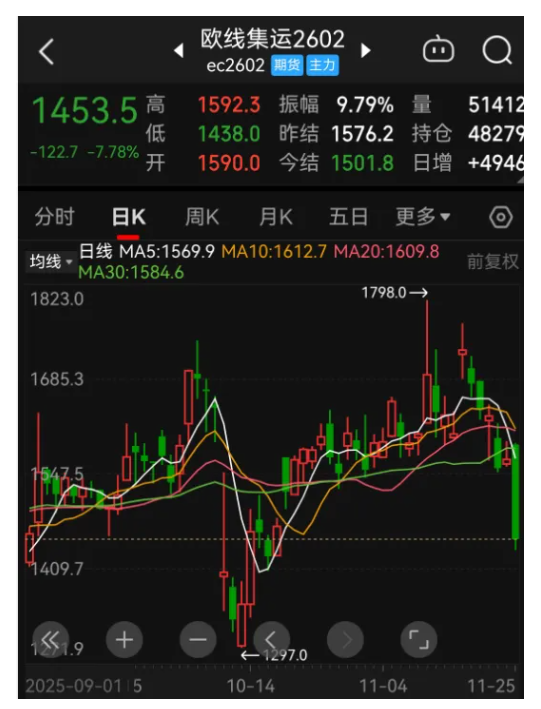
利空突袭,集运指数(欧线)期货近月合约大跌!后市如何应对?
Qi Huo Ri Bao· 2025-11-26 01:08
Core Viewpoint - The container shipping index (European route) futures have significantly declined, with the main contract EC2602 dropping nearly 8% to 1453.5 points, indicating a bearish sentiment in the market due to weak spot market conditions [1][3]. Group 1: Market Conditions - The container shipping market is overshadowed by weak spot market performance, leading several shipping companies to collectively lower their December pricing, with Hapag-Lloyd reducing rates to $2235/FEU, and others following suit [3]. - The current willingness of shipping companies to maintain prices shows divergence, with Maersk's pricing expectations not being strong, contributing to a pessimistic market outlook [3][4]. - The December shipping market may experience a "peak season that is not strong," influenced by the later timing of the 2026 Chinese New Year, which could delay shipping volumes [4]. Group 2: Price Trends and Predictions - Historical trends indicate that the spot market for container shipping saw a continuous decline from early December last year until late February this year, raising concerns about a similar pattern occurring this year [4]. - The current fluctuation in spot freight rates mirrors last year's patterns, with potential price increases being limited despite some improvement in shipping volumes [4]. - The supply of shipping capacity for January is expected to be abundant, with confirmed capacity for the first two weeks reaching 306,000 TEU and 346,000 TEU, respectively, which may lead to aggressive pricing strategies among shipping companies [4]. Group 3: Futures Contracts and Pricing Strategies - The near-term futures contracts are expected to follow the fluctuations in spot market rates, with shipping companies having pricing expectations for the traditional peak season from December to January [5]. - The potential for a price war among shipping companies exists, particularly if they attempt to stockpile goods before the holiday season [4][5]. - The main contract EC2602 is closely linked to the EC2512 contract, with the pricing strategies of shipping companies in late December likely to influence market expectations for January and February [5]. Group 4: Geopolitical Factors - The market is closely monitoring geopolitical developments and the progress of the Red Sea's reopening, which could impact future shipping routes and overall market sentiment [6]. - Recent statements from Maersk regarding the potential resumption of operations in the Suez Canal indicate a cautious optimism, but safety concerns in the region remain a significant risk [6].

利空突袭 集运指数(欧线)期货近月合约大跌!后市如何应对
Qi Huo Ri Bao· 2025-11-26 00:27
Core Viewpoint - The shipping index (European line) futures have significantly declined, with the main contract EC2602 dropping nearly 8% to 1453.5 points, reflecting a weak spot market and a lack of price support from shipping companies [1][2] Group 1: Market Trends - The shipping market is expected to experience a "weak peak season" in December, influenced by a late Chinese New Year in 2026, which may lead to delayed shipments [3] - Shipping companies collectively lowered their December prices, with Hapag-Lloyd reducing rates to $2,235/FEU, and others like CMA CGM and OOCL also cutting prices [1] - The current spot freight rate fluctuations are similar to last year's trends, with peak rates occurring in early December [3] Group 2: Future Outlook - The near-term contract EC2512's performance will depend on the actual pricing strategies of major shipping companies in December, particularly their willingness to raise prices [5] - The supply of shipping capacity for January is robust, with confirmed slot sizes reaching 306,000 TEU and 346,000 TEU for the first two weeks, indicating potential for price competition among shipping companies [3] - The future performance of the long-term contract will be influenced by geopolitical developments and the progress of the Red Sea's reopening, which is currently facing safety challenges [6][7]
昨夜今晨 金价下挫!美调整“对等关税”清单!多次空袭 中东战火又起!集运期货价格承压
Qi Huo Ri Bao· 2025-11-15 01:50
Market Overview - As of November 14, gold prices fell by 2.20% to $4080.04 per ounce, with a weekly increase of 1.98% from $3998.67 to $4245.23 before the decline [1] - COMEX gold futures dropped by 2.70% to $4081.00 per ounce, with a weekly rise of 1.75% [1] - U.S. stock indices showed mixed results, with the Dow Jones down 0.65%, Nasdaq up 0.13%, and S&P 500 down 0.05% [1] - The Nasdaq China Golden Dragon Index fell over 1.6%, with Alibaba down nearly 4% and JD.com and Xpeng Motors down over 4% [1] U.S. Tariff Adjustments - The U.S. government has removed certain agricultural products from the "reciprocal tariff" list as per a new executive order signed by President Trump [3] - The adjustments are based on domestic product demand and capacity assessments, with the updated tariff exemptions effective from November 13, 2025 [3] Geopolitical Tensions - Russian Foreign Ministry spokesperson Zakharova warned NATO against any potential attacks, stating that Russia is prepared to respond with all necessary force [5] - The situation remains tense with ongoing military activities near the Russian border [5] Shipping and Freight Market - The shipping futures market is under pressure due to spot market conditions and the situation in the Red Sea, with near-term freight rates showing weakness [10] - Several shipping companies have lowered their quotes for the second half of November, with Maersk reducing its Week 48 opening price to $2000-$2100 per FEU [11] - The overall sentiment for December pricing remains uncertain, with some companies announcing price increases while others maintain a cautious approach [12][13] - The potential for resuming shipping routes through the Red Sea is increasing, but most companies remain cautious due to ongoing geopolitical tensions [14]
南华期货集运产业周报:高位回调,关注货量与地缘动向-20251109
Nan Hua Qi Huo· 2025-11-09 12:32
Report Investment Rating - No investment rating information is provided in the report. Core Views - The core contradiction in the market this week has shifted from the "expectation of collective price hikes by shipping companies" to the "expectation gap between the conservative pricing of leading shipping companies and the optimistic market sentiment." The conservative pricing strategy of Maersk has weakened the bullish sentiment in the market, and the spot freight rate shows high differentiation, with limited upward momentum [2]. - The short - term market will be dominated by the game between "weak reality" and "stable expectation" due to the weak cargo volume and the strategic differentiation among shipping companies [2]. - The near - term trading logic focuses on the actual implementation of the shipping companies' price - holding actions from November to December, while the long - term trading logic is affected by factors such as 2025's shipping capacity delivery pressure, seasonal factors, and potential resumption of navigation [5][8]. - The market is in a high - level shock and short - term weak state. The main contract EC2512 has encountered significant resistance above 2000 points, and it is expected to oscillate in the range of 1800 - 2050 points with a slightly downward center of gravity [10]. Summary by Directory Chapter 1: Core Factors and Strategy Recommendations 1.1 Core Factors - **Market Core Contradiction**: The core contradiction has shifted, and Maersk's conservative pricing has led to a weakening of bullish sentiment and significant long - position reduction in the main contract 2512. Spot freight rates are highly differentiated, and it is difficult to form a trend - like upward momentum [2]. - **Near - term Trading Logic**: It centers around the actual implementation of the shipping companies' price - holding actions from November to December. The actual effect of the first round of price - holding in December will be the key to the valuation of the 2512 contract. The decrease in the weekly average shipping capacity from East China to European base ports in December may support the price hikes [5]. - **Long - term Trading Expectation**: It is affected by factors such as 2025's shipping capacity delivery pressure, seasonal factors, and potential resumption of navigation. High shipping capacity and other factors limit the upward space of freight rates, and the long - term contracts face multiple suppressing forces [8]. 1.2 Trading - Type Strategy Recommendations - **Market Positioning**: The market is in a high - level shock and short - term weak state. The main contract EC2512 is expected to oscillate in the range of 1800 - 2050 points with a slightly downward center of gravity [10]. - **Arbitrage Strategy**: The spread between near - and far - term contracts reflects the market's pessimistic expectation of the long - term fundamentals. Attention can be paid to the arbitrage opportunities brought by spread fluctuations, but operations need to be cautious due to the uncertainty of the Red Sea resumption of navigation [11]. 1.3 Industrial Customer Operation Recommendations - **Risk Management Strategies**: For companies with excessive shipping capacity or poor booking volume, they can short the container shipping index futures to lock in profits; for those worried about rising freight rates, they can buy the container shipping index futures to determine the booking cost in advance [13]. 1.4 Basic Data Overview - **Comprehensive Freight Rate Index**: The FBX comprehensive route index increased by 16.22% week - on - week, while the CICFI, SCFI, NCFI, and SCFIS European route index decreased, and the SCFIS US - West route index increased by 14.43%. The SCFI European, US - West, and US - East route freight rates all decreased [14]. Chapter 2: This Week's Important Information - **Positive Information**: Shipping companies are determined to hold prices and continue to announce price hikes until December; there are positive signs in shipping capacity regulation; the year - end seasonal peak season provides marginal support for freight rates [29]. - **Negative Information**: There are signs of easing in the geopolitical situation, increasing the expectation of Red Sea route resumption; the spot index has turned from rising to falling; macro and trade data are weak [30]. Chapter 3: Disk Interpretation - **Unilateral Trend and Capital Movement**: The main contract EC2512 had a volatile "roller - coaster" trend this week. It reached a new high this year but then declined due to the increased expectation of Red Sea resumption and the decline of the spot index. The trading volume and open interest increased, indicating intensified divergence between bulls and bears [31]. - **Basis Structure**: The basis (spot - futures) contango structure is still deep. The current high premium of futures means that the spot needs to rise more strongly to support the futures price, otherwise, the futures price may return to the spot price [36]. - **Calendar Spread Structure**: The spread between near - and far - term contracts maintains a B structure but fluctuates. The far - term contracts are more sensitive to negative factors, reflecting the market's concern about the medium - and long - term fundamentals [40]. Chapter 4: Profit Analysis - In the first half of 2025, major shipping companies such as COSCO SHIPPING Holdings, Maersk, and CMA CGM had relatively good profit and revenue performance, while some companies like ONE and Yang Ming Marine Transport saw a significant reduction in profits compared to the same period last year. Most shipping companies are still profitable [43]. - For the second half of the year, shipping companies believe that the uncertainty has increased, and they will operate more cautiously, which may affect the freight rate trend from the supply and cost sides [43].
