
美国劳动力市场

Search documents
高盛前瞻美国1月非农:新增就业人数或仅为4.5万 劳动力市场正逐步降温
Zhi Tong Cai Jing· 2026-02-11 06:41
Group 1 - The core viewpoint of the article is that Goldman Sachs anticipates a weaker than expected non-farm payroll growth for January, projecting an increase of 45,000 jobs, which is below the market expectation of 70,000 and lower than the average growth of slightly above 50,000 in the previous two months [1] - The unemployment rate is expected to remain steady at 4.4%, with an anticipated month-over-month increase in average hourly earnings of 0.35% [1] - Several factors are expected to drag down the official employment data, including an update to the "birth-death" model by the U.S. Bureau of Labor Statistics, which Goldman estimates could reduce overall non-farm employment growth by 30,000 to 50,000 jobs [1] Group 2 - Alternative or "big data" employment indicators tracked by Goldman show that hiring momentum remains weak, with an average increase of about 40,000 jobs for the month [1] - Public sector employment is expected to remain flat, providing little support to overall job growth, while labor demand indicators have shown signs of softening [1] - The Conference Board's labor differential index has significantly declined in January, reaching its lowest level since early 2021, indicating a weakening perception of job availability [1] Group 3 - On a positive note, Goldman points out that several offsetting factors may limit downside risks, such as a decrease in initial jobless claims and a reduction in the number of companies reporting layoffs [2] - Seasonal factors that typically lead to significant job losses at the beginning of the year are expected to adjust over time, reducing the extent of seasonal drag [2] - Employment in the retail and construction sectors is projected to rebound, following weaker holiday hiring and disruptions caused by weather in December [2]
1月非农今晚公布!真正的“深水炸弹”:百万级就业数据或被抹去
Jin Shi Shu Ju· 2026-02-11 03:07
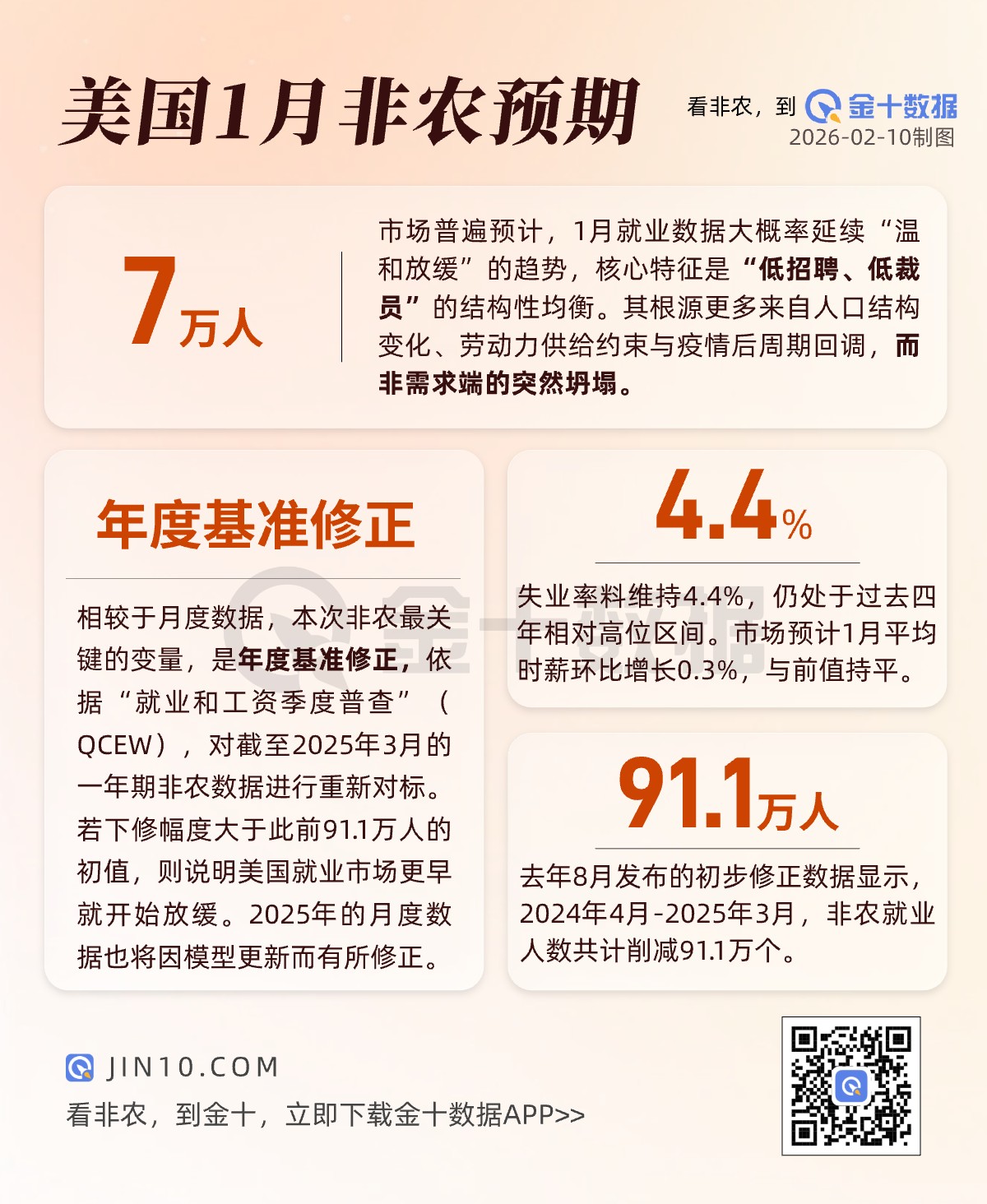
Group 1 - The January non-farm employment report, delayed due to the U.S. government shutdown, is expected to reveal a moderate slowdown in job growth, with an anticipated addition of approximately 70,000 jobs, slightly above December's 50,000 [1] - The core characteristic of the current U.S. labor market is a structural balance of "low hiring, low layoffs," indicating that while there are no large-scale layoffs, the pace of job creation has significantly slowed [6] - The upcoming report will include an annual benchmark revision, which could potentially revise employment data down by as much as 910,000, marking a historical record, although some analysts expect the final adjustment to be around 720,000 [7] Group 2 - Discrepancies within the Federal Reserve regarding the interpretation of revised employment data have emerged, with some officials suggesting that job growth may have been overestimated, while others argue that the economy remains resilient enough to maintain current interest rates [8] - The labor market is experiencing a return to normalcy rather than a sudden collapse in demand, driven by demographic changes and labor supply constraints, rather than a drastic drop in demand [9] - The healthcare sector remains one of the few areas still expanding, but its sustainability will be crucial for assessing the stability of employment structures [6]

非农报告发布在即 亚币集体转入盘整
Sou Hu Cai Jing· 2026-02-11 00:55
Group 1 - The core viewpoint of the article suggests that the Asian currencies are stabilizing against the US dollar ahead of the US non-farm payroll report, with expectations of weaker employment numbers putting pressure on the dollar [1] - CBA's Carol Kong anticipates that the trend of non-farm employment numbers falling below expectations will continue, which may lead to further weakening of the dollar [1] - The report indicates that a softening labor market in the US, combined with easing inflation pressures, could encourage the Federal Reserve to lower interest rates two more times this year [1]
重磅发声!美联储突发大消息!
天天基金网· 2026-02-09 01:05
Core Viewpoint - The Federal Reserve may need to implement one or two more rate cuts to address the weakness in the U.S. labor market, as indicated by San Francisco Fed President Mary Daly [2][3][5]. Group 1: Labor Market Concerns - The current situation for American workers is challenging, with rising prices eroding wage income and a scarcity of new job opportunities [4]. - Daly expressed greater concern about the labor market compared to inflation, noting an increase in parents reporting difficulties for their children in finding jobs, particularly among recent college graduates [7]. - There is a risk of increased layoffs if companies find that expected demand does not materialize, although Daly does not foresee a significant rise in inflation due to stable inflation expectations [6][7]. Group 2: Economic Data and Predictions - Key macroeconomic data, including the January non-farm payrolls and core Consumer Price Index (CPI), will be released soon, which will provide important insights into the Fed's policy direction [8]. - Analysts expect the January non-farm payroll growth to be between 60,000 and 80,000; a figure below this range could heighten expectations for rate cuts [8]. - The January core CPI is anticipated to show a year-on-year increase of 2.6%, with the overall CPI expected to decrease from 2.7% to 2.5% [9]. Group 3: Market Expectations - The market has fully priced in a 25 basis point rate cut by the Fed in July, with probabilities for rate cuts in March and April also being assessed [10]. - As of the latest data, the probability of a 25 basis point cut by March stands at 23.2%, while the likelihood of maintaining the current rate is 76.8% [10].

美联储降息筹码再加重?JOLTS数据大爆冷,黄金又要飞了?
Sou Hu Cai Jing· 2026-02-06 06:09
Core Viewpoint - The market's perception of the U.S. economy is shifting as labor data, particularly the December JOLTS report, indicates a cooling labor market, prompting a reassessment of economic conditions and potential Federal Reserve policy changes [1][2]. Group 1: JOLTS Data Interpretation - The December JOLTS report revealed job vacancies dropped to 6.542 million, significantly below expectations and marking a five-year low [3]. - The previous month's data was notably revised down, suggesting a sustained decline in labor demand rather than a temporary fluctuation [5]. - By the end of 2024, job vacancies are projected to be around 7.5 million, reflecting a decrease of nearly 1 million positions from the previous year [5]. Group 2: Labor Market Dynamics - The decline in job vacancies indicates a cautious approach from businesses regarding expansion, aligning with a slower economic pace [6]. - Despite the drop in vacancies, other indicators such as hiring rates and voluntary resignations show a slight increase, suggesting that the labor market is stabilizing rather than collapsing [6]. - The current labor market is transitioning from an "overheated" state to a more balanced condition, rather than experiencing rapid deterioration [6][7]. Group 3: Impact on Federal Reserve Policy and Gold - The JOLTS data's significant shortfall suggests a reduction in wage pressures, which could influence the Federal Reserve's interest rate decisions [9]. - As the market anticipates a potential shift towards rate cuts, lower real interest rate expectations may support gold prices, making interest rate expectations a critical variable for gold investors [9]. - The JOLTS report's declining response rate raises concerns about its accuracy, and recent government disruptions have affected data release schedules, potentially amplifying market reactions [9]. Group 4: Long-term Investment Strategies for Gold - The ongoing decline in job vacancies indicates a reduction in economic "tension," suggesting that businesses are less eager to expand, which may slow economic momentum [12]. - While this does not guarantee immediate increases in gold prices, it enhances gold's hedging value in asset allocation, particularly as interest rate cycles may shift [13]. - Investors are encouraged to focus on understanding macroeconomic trends rather than making impulsive decisions based on single data points, as changes in macro logic often precede price movements [13].
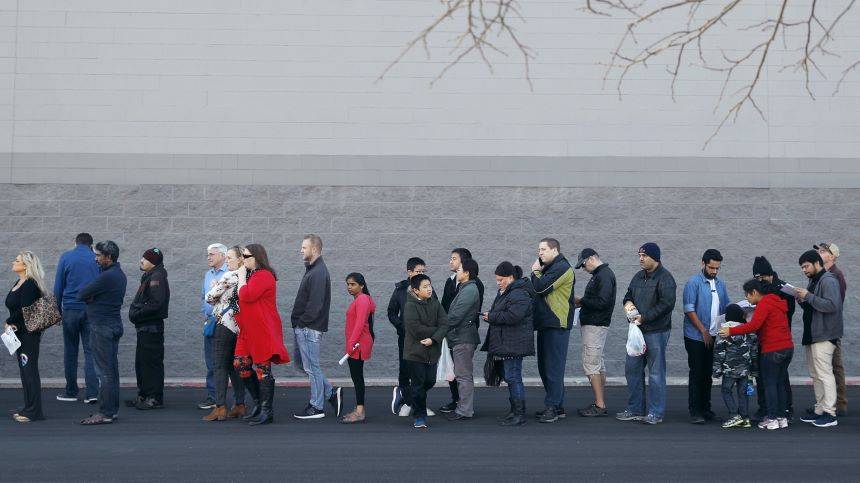
U.S. Economy Shed Nearly 1 Million Job Openings Last Year
WSJ· 2026-02-05 15:41
Core Insights - The number of open jobs in the U.S. economy decreased to just over 6.5 million in December from approximately 7.5 million at the end of 2024, indicating a slowdown in demand for workers in a fluctuating labor market [1] Job Market Analysis - The decline in job openings reflects an uneven labor market, suggesting that certain sectors may be experiencing more significant challenges in hiring compared to others [1]

摩根大通:2026年,就业市场开局不利
财富FORTUNE· 2026-02-02 13:05
Group 1 - The core viewpoint of the article is that the U.S. job market is expected to start weakly in early 2026 but may gradually recover in the second half of the year due to stabilizing tariff policies and tax cuts from the Trump administration [2][3]. - Morgan Stanley predicts that the unemployment rate will rise to 4.5% in early 2026, with the latest labor report indicating it has already reached 4.6%, the highest in nearly four years [3]. - The article highlights that the U.S. GDP is projected to grow by 1.8% in 2026, while inflation is expected to remain high at 2.7%, with a one-third probability of the economy entering a recession [4]. Group 2 - Artificial intelligence is identified as a key variable affecting the job market, with significant investments in AI technology not yet translating into job growth, leading to a slowdown in hiring in certain sectors [5]. - Despite the potential for AI to enhance productivity over time, there are warnings from experts about the risk of job displacement as AI technology advances [5]. - The article suggests that the combination of tax cuts, stable tariff policies, and potential interest rate cuts by the Federal Reserve could attract capital back to the U.S., creating strategic opportunities for Chinese companies amid labor shortages in the U.S. [6].


美国初请失业金人数小幅回升 劳动力市场维持“低流动”稳态
Xin Hua Cai Jing· 2026-01-30 00:55
Group 1 - The initial jobless claims for the week ending January 24 were reported at 209,000, slightly above the market expectation of 205,000 but lower than the revised previous value of 210,000 [1] - The continuing jobless claims stood at 1.827 million, significantly below the market expectation of 1.86 million and the revised previous value of 1.865 million [1] - The four-week moving average of initial jobless claims was 206,250, revised up from 201,500 to 204,000, indicating a stable labor market within the range of 200,000 to 210,000 [1] Group 2 - The Federal Open Market Committee (FOMC) decided to maintain the benchmark interest rate, with Chairman Powell noting signs of stabilization in the unemployment rate and a lack of significant changes in hiring activity, job vacancies, and wage growth [1] - The market is closely watching the non-farm payroll report scheduled for release on February 6, with expectations of a slight increase in new non-farm jobs from 50,000 in December to 70,000 in January, while the unemployment rate is expected to remain at 4.4% [1] - There is uncertainty regarding the timely release of the non-farm employment report due to potential government shutdowns if a new funding bill is not passed by January 31 [2]
US jobless claims dip to 209,000 as labour market stays resilient despite layoffs
Invezz· 2026-01-29 15:19
Core Viewpoint - US applications for unemployment benefits have declined, indicating a resilient labor market despite corporate layoffs and economic uncertainty [1] Labor Market Data - Initial claims for jobless aid decreased by 1,000 to 209,000 for the week ended January 24 [1]

瑞银美国首席经济学家:预计美联储下半年降息两次
Sou Hu Cai Jing· 2026-01-29 11:09
Core Viewpoint - The U.S. inflation and labor market may present conflicting signals, posing challenges for the Federal Reserve and its monetary policy [1] Group 1: Labor Market and Monetary Policy - The primary policy driver for the Federal Reserve this year will be the labor market, with the unemployment rate expected to remain around 4.5% by the end of the year [1] - This level of labor market weakness is sufficient to support two interest rate cuts by the Federal Reserve this year [1] - Regardless of who the new Federal Reserve Chair is, there will be a gradual push towards lower interest rates, even if immediate cuts are not implemented [1] Group 2: Inflation Outlook - The transmission effect of tariffs has delayed the overall decline of inflation in the U.S., with inflation expected to remain high in the first half of the year [1] - However, inflation is anticipated to decrease by 2027 [1] Group 3: Stock Market Outlook - The outlook for the U.S. stock market remains relatively optimistic, with expectations of good performance throughout the year [1]