
规模化

Search documents
常年外调蔬菜超千万吨 广西打造优质蔬菜生产基地
Jing Ji Ri Bao· 2025-12-21 22:52
Core Insights - Guangxi has been actively promoting the "vegetable basket" project to stabilize production and enhance quality, establishing itself as a major production base for autumn and winter vegetables in China [1][2] Group 1: Production and Scale - Guangxi's vegetable planting area reached 19.51 million acres by the end of September, a year-on-year increase of 2.4% [1] - The total vegetable output was 33.58 million tons, reflecting a 4.0% year-on-year growth [1] - The area for facility vegetables (including small arch sheds) is projected to reach 840,000 acres by 2024, marking a 17.49% increase [1] Group 2: Product Diversity and Regional Development - Guangxi has developed four major vegetable production belts: Beibu Gulf, Xianggui Corridor, Xijiang River Basin, and Youjiang River Basin, creating a diverse production structure [1] - The annual output of leafy vegetables exceeds 10 million tons, with other categories like cabbage, root vegetables, melons, and nightshades each exceeding 5 million tons [1] Group 3: Quality and Branding - Guangxi has 238 green and geographical indication agricultural products, with a pesticide residue monitoring compliance rate of over 98% [2] - By 2025, a total of 79 "Gui" branded agricultural products are expected to be recognized, with a total brand value exceeding 60 billion yuan [2] Group 4: Logistics and Marketing - Guangxi has established 20 cold chain logistics centers, with a cold storage capacity of approximately 11 million cubic meters and a storage capability of around 2.2 million tons [2] - The region has built marketing networks by establishing exhibition centers in major cities and organizing numerous supply and demand matching events annually [2]
媒体+联动全国“牛人”,让世界爱上潮汕牛肉火锅!
Nan Fang Nong Cun Bao· 2025-12-20 12:01
Core Insights - The event "Media+ First Chaozhou Beef Hotpot Culture Festival" aims to promote the Chaozhou beef hotpot culture and enhance the beef industry in Guangdong, showcasing the integration of local culinary traditions with modern consumption trends [4][5][139] - The festival serves as a platform for industry collaboration, connecting breeding, sales, and culinary culture to drive economic value from regional cultural IP [11][13][131] Industry Overview - The Chaozhou beef hotpot industry has an annual output value of nearly 50 billion yuan, indicating its strong market appeal and consumer demand [28] - The Guangdong beef industry faces a significant supply-demand gap, with over 500,000 tons of beef consumed annually but a self-sufficiency rate of only 6% [39][40] Event Highlights - The unveiling of the "Yue Mu You Pin" regional public brand marks a milestone in the industry's upgrade, aiming to enhance quality and trust [6][71] - Over 300 industry participants attended the event, fostering cooperation and promoting industry standards [15][16] Market Dynamics - The event highlighted the collaboration between northern beef production areas and the high-demand market in the Greater Bay Area, addressing the "high demand and low supply" issue [39][46] - Various regions, including Inner Mongolia and Ningxia, showcased their unique beef products, enhancing the diversity of offerings in the market [49][60] Technological and Standardization Efforts - The industry is focusing on standardization and technological empowerment to address structural issues and improve efficiency [78][80] - Innovations in breeding and processing are being emphasized to enhance product quality and meet consumer expectations [96][100] Media and Brand Integration - The "Media+" approach has effectively bridged the gap between production and consumption, facilitating better market access for quality beef products [116][120] - The festival utilized both online and offline strategies to promote the Chaozhou beef hotpot, enhancing its cultural significance and market presence [123][125]


2025年中国塑料软包装行业发展现状及趋势
Sou Hu Cai Jing· 2025-11-23 20:41
Industry Overview - The plastic flexible packaging industry in China utilizes resins such as PP, PE, and PVC to produce various films like BOPP and BOPET, widely used in food, pharmaceuticals, and clothing sectors [1][2] - Products are typically composed of a base layer, functional layer, and heat-seal layer, with varying performance requirements based on end-use applications [1] Current Industry Status - From 2020 to 2025, plastic film prices are expected to rise initially and then decline, with an overall downward trend by 2025; BOPA prices are the highest [2][20] - Profit margins have been shrinking over the past five years, with an anticipated overall negative margin in 2024 and 2025, particularly for BOPA [2][25] - The industry is concentrated in East, South, and North China, with Jiangsu, Zhejiang, and Guangdong as core production areas; new production lines in Central and Southwest China are filling gaps [2][31] Future Development Directions - The industry is expected to see six major trends: increased scale, accelerated integration of the supply chain, focus on differentiated development, elimination of less efficient production facilities, emphasis on park-based development, and active exploration of overseas markets [3] Market Forecast - Supply and demand will dominate the market in Q4 2025 and 2026, with macro policies and demand being significant influencing factors; international crude oil prices may decline, leading to seasonal fluctuations in plastic film prices [4]

小马智行完成“美股+港股”双重上市,打造Robotaxi高价值可持续模式
Di Yi Cai Jing· 2025-11-17 04:28
Core Insights - The automatic driving taxi market is entering a new era with companies like Pony.ai and WeRide going public in Hong Kong, focusing on commercialization and scalability as key investment themes [1][5]. Business Model Divergence - There is a split in the business model choices among autonomous driving companies for Robotaxi, with some opting for a project-based (B2B) model while Pony.ai is pursuing a scalable operation model (B2C) to provide ongoing transportation services and achieve economies of scale [4][9]. - Pony.ai's CEO emphasizes that the company aims to focus on service provision rather than vehicle sales, with plans to expand its fleet and operations in various markets [4][5]. Operational Strategy - Pony.ai is transitioning to an "operation-centric" phase, having received recognition from long-term capital institutions for its focus on fleet scale and operational capabilities [5][14]. - The company has achieved 24/7 operational service in cities like Guangzhou and Shenzhen, with testing in Beijing [10]. Economic Model and Growth - The breakeven point for Robotaxi operations in major cities is identified at a fleet size of 1,000 vehicles, beyond which the cost per vehicle decreases and gross margins improve [13]. - The company reported a significant revenue increase of 75.9% year-on-year for Q2 2025, driven by cost reductions and scale effects [15]. Market Position and Future Outlook - Pony.ai is the first autonomous driving company to obtain permits for fully driverless Robotaxi services in major Chinese cities, indicating a strong market position [9][14]. - The company plans to scale its fleet to 50,000 vehicles by 2028-2029, with expectations of positive cash flow as it moves past the scalability inflection point [15]. Industry Evolution - The industry is shifting from a technology-driven phase to one focused on operational and scale-driven models, with sustainable and profitable service delivery becoming the core competitive advantage [16].
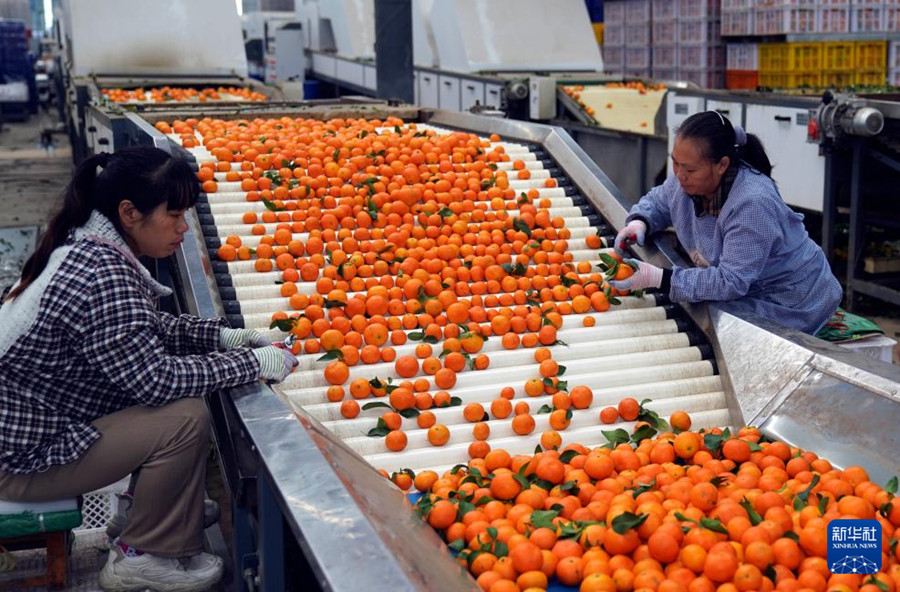
云南华宁:柑橘产业助增收
Xin Hua Wang· 2025-10-28 05:58
Core Insights - Yunnan Province's Huaining County has developed the citrus industry by establishing citrus industrial parks, promoting green, large-scale, and branded development [2] - The industrial park employs a "company + collective economic organization (professional cooperative) + farmers" model, which helps increase farmers' income [2]
超快光热工艺0.02秒产生3000℃高温 能快速合成高性能催化剂
Ke Ji Ri Bao· 2025-10-22 23:46
Core Insights - A research team from the Korea Advanced Institute of Science and Technology has developed a direct-contact photothermal annealing platform that can achieve temperatures up to 3000℃ in just 0.02 seconds, significantly enhancing the efficiency of hydrogen production and reducing energy consumption by five times compared to traditional methods [1][2] Group 1: Technology and Innovation - The new photothermal process utilizes a strong photothermal effect to convert inert nanodiamond precursors into highly conductive and catalytically active "carbon nano-onions" [1] - "Carbon nano-onions" consist of multiple concentric graphite shells, offering high conductivity, large surface area, and excellent chemical stability, making them ideal catalyst supports [1] - The technology allows for the simultaneous synthesis of "carbon nano-onions" and the functionalization of single-atom catalysts, preventing atom aggregation during the rapid cooling process [1] Group 2: Applications and Performance - The research team has successfully prepared eight types of high-density single-atom catalysts, including platinum, cobalt, and nickel [2] - The hydrogen evolution efficiency of the platinum-carbon nano-onion catalyst is six times greater than that of traditional catalysts, while significantly reducing the amount of precious metals used [2] - This technology demonstrates substantial potential for large-scale and sustainable hydrogen production applications [2]
国内人均乳制品消费量仅世界平均1/3!乳业振兴受益个股有哪些?
Ge Long Hui· 2025-10-02 12:20
Core Insights - The Chinese dairy industry has significant growth potential due to low per capita consumption compared to global averages and developed countries [3][4] - The government is increasing support for the dairy sector, with substantial financial allocations aimed at expanding production and improving quality [1][2] Industry Development - The Ministry of Agriculture and Rural Affairs reported a 5.2% year-on-year increase in fresh milk production and an 8.8% increase in dairy product output for the first three quarters of the year [1] - The average milk yield per cow increased by 400 kg to 7.8 tons, with large-scale farms achieving quality levels comparable to developed countries [1] - The revenue from large-scale dairy farming has rebounded to approximately 3,000 yuan per cow annually [1] Consumption Trends - Liquid milk sales grew by 7.1% year-on-year last year, while domestic infant formula sales surged from 14.5% to 21% [1] - The current consumption structure shows a predominance of liquid milk over dry dairy products, contrasting with developed countries where the ratio is approximately 7:3 [2][4] - Per capita dairy consumption in China is only one-third of the world average, half of that of developing countries, and one-seventh of developed dairy nations, indicating substantial room for growth [2][3] Challenges in Production - The competitiveness of domestic dairy farming is hindered by higher production costs, with feed prices approximately 60% above international averages [2][5] - The average scale of dairy farms is small, with many farms operating below optimal efficiency, leading to higher costs and reduced pricing power [5][6] Future Industry Direction - The focus on "scale" and "cost reduction" in dairy farming is expected to enhance industry concentration and profitability for leading companies [6] - The government aims to address production and consumption issues through a collaborative approach involving government guidance and enterprise participation [2] Investment Opportunities - Modern Dairy (01117.HK) is identified as a leading raw milk producer, with a significant portion of its revenue derived from milk sales [7] - China Shengmu (01432.HK) is noted for its organic milk production and has expanded into raw milk processing [8] - Major players like Mengniu (02319.HK) and Yili (600887.SH) are diversifying into new product categories beyond liquid milk, positioning themselves for future growth [9][10]




国内产业链的一体化、规模化、集约化提升带来的比较优势基本确立,石化ETF(159731)受益于政策发展
Mei Ri Jing Ji Xin Wen· 2025-09-26 11:08
Core Viewpoint - The A-share market indices opened lower but turned positive, with the China Securities Petrochemical Industry Index rebounding, indicating a potential recovery in the petrochemical sector [1] Group 1: Market Performance - The China Securities Petrochemical Industry Index rose approximately 0.4%, with leading stocks including Wanhua Chemical, Yara International, Rongsheng Petrochemical, and Yangnong Chemical [1] - The Petrochemical ETF (159731) followed the upward trend of the index [1] Group 2: Industry Outlook - Tianfeng Securities believes that the integration, scaling, and intensification of domestic industrial chains have established comparative advantages in the medium to long term [1] - The economic development in ASEAN and Africa may lead to a rapid increase in demand for chemicals, while traditional refining centers in the US, EU, Japan, and South Korea are gradually exiting or pausing expansion in the petrochemical industry [1] - Domestic consumption appears to have emerged from a low point, with factors driving chemical product demand and export growth expected to remain strong despite short-term tariff disturbances [1] Group 3: Sector Composition - According to the Shenwan secondary industry classification, the top three sectors in the China Securities Petrochemical Industry Index are refining and trading (27.12%), chemical products (23.87%), and agricultural chemicals (19.75%) [1] - These sectors are expected to benefit significantly from policies aimed at reducing competition, restructuring, and eliminating outdated production capacity [1]
告别人工智能泡沫,准备迎接崩盘
阿尔法工场研究院· 2025-08-22 00:00
Core Viewpoint - The release of GPT-5 by OpenAI has been disappointing, revealing that it is harder to use and performs worse than its predecessors, leading to skepticism about the AI industry's promises [2][3][6] Group 1: AI Industry Performance - AI companies are currently propping up the U.S. economy, but this situation resembles a bubble, with significant investments made without any AI lab achieving profitability [4][6] - The hype surrounding AI is reminiscent of the dot-com bubble, where companies falsely claimed to be "internet companies" to boost stock prices [4][6] - Nvidia, a key chip manufacturer for AI research, is compared to Intel in the 1990s, as it plays a leading role in supporting the current stock market rally [5] Group 2: Public Perception and Expectations - The disappointing launch of GPT-5 has led to a realization of the extent to which the AI industry relies on hype, with users expressing frustration over the model's performance [7][8] - Despite the setbacks, the hype machine continues to operate, with organizations predicting significant AI advancements by 2027, which may be overly optimistic [9][10] - The belief in "scaling up" AI technology to achieve breakthroughs is challenged by GPT-5's performance, raising concerns about the massive capital investments required for data and processing capabilities [10] Group 3: Economic Implications - If AI's promises turn out to be illusory, investors may face significant losses, as the current situation mirrors past market bubbles [6][10] - Predictions of AI leading to substantial productivity gains have not materialized, with some economists forecasting minimal growth contributions from AI in the coming decade [13] - The marketing of AI as a transformative technology is critiqued, emphasizing that it is more of a buzzword than a scientific or engineering term, which could mislead investors and the public [13]

长青股份上半年净利润为4227.78万元 同比增长117.75%
Zheng Quan Shi Bao Wang· 2025-08-10 11:02
Group 1 - Company achieved operating revenue of 2.083 billion yuan in the first half of the year, a year-on-year increase of 7.28% [1] - Net profit attributable to shareholders reached 42.28 million yuan, representing a year-on-year growth of 117.75% [1] - Company focuses on the research, production, and sales of high-efficiency, low-toxicity, and low-residue pesticide raw materials and formulations [1] Group 2 - The international market for pesticides has rebounded, leading to a 19.61% year-on-year increase in export sales, totaling 1.087 billion yuan in the first half of 2025 [1] - Company is actively optimizing product structure and accelerating overseas market registration to capture orders [1] - Company emphasizes cost reduction and efficiency improvement through process optimization, technological transformation, and management upgrades [1] Group 3 - China is the world's largest pesticide exporter, with a well-established industry system including research, production, and sales [2] - Industry trends indicate that scale and intensification are essential for pesticide companies to grow stronger [2] - Company benefits from a dual-engine growth model, with stable and rapidly developing raw material business supporting the formulation business [2]
