负电价

Search documents
极端寒潮冲击美国电力系统,芝加哥电价为何跌入负值?
Guo Ji Jin Rong Bao· 2026-01-27 04:17
Core Insights - The severe winter storm has put significant pressure on the U.S. power system, leading to increased heating demand and soaring electricity prices in many areas, while some regions, particularly in the Midwest, have experienced rare negative electricity prices [1][4]. Group 1: Impact of Winter Storm - The winter storm has affected approximately two-thirds of the eastern U.S., causing over 580,000 households and businesses to lose power due to downed trees and ice on power lines [1]. - The storm's extreme cold is expected to persist throughout the week, raising safety risks associated with power outages [1]. Group 2: Electricity Price Surge - The benchmark hub price in the PJM region surged to $638.73 per megawatt-hour during peak hours, marking a 542% increase and the highest level in 12 years [2]. - In New York City, the day-ahead price rose by 28% to an average of $679.13, setting a new record since 2005, with some areas exceeding $800 [2]. Group 3: Regional Power Management - The Midcontinent Independent System Operator (MISO) announced a conservative operational approach until January 29 to ensure reliable power supply for approximately 45 million people from the Great Lakes to the Gulf Coast [3]. Group 4: Negative Pricing in Chicago - In stark contrast to the price surges in the East, the Chicago electricity market experienced negative pricing, with real-time prices dropping to -$227.93 per megawatt-hour, indicating that some generators had to pay to offload electricity [4]. Group 5: Supply Constraints - The extreme cold has increased heating demand in the Midwest, but the negative pricing is attributed to full capacity on cross-regional transmission lines, limiting power exports to higher-priced markets [7]. - U.S. energy officials have requested grid operators to activate backup power sources, including data centers, to alleviate local supply constraints, but the situation is unlikely to change in the short term due to the near-maximum operation of high-voltage transmission lines [7].

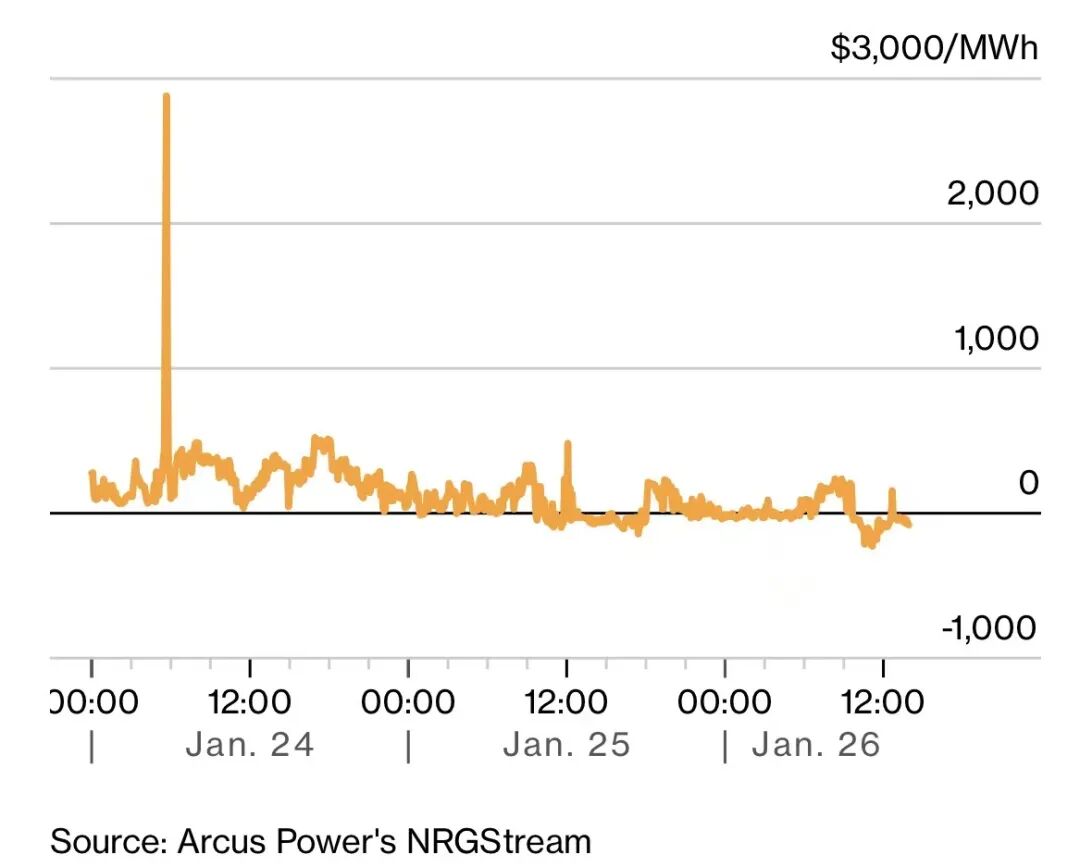
芝加哥出现负电价
财联社· 2026-01-27 00:30
Group 1 - The core point of the article highlights that despite a surge in electricity demand due to stormy weather, electricity prices in the Chicago area have fallen into negative territory due to the saturation of high-voltage transmission lines [1] - On Monday at 10:10 AM local time, real-time electricity prices in the ComEd utility service area dropped to -$227.93 per megawatt-hour, contrasting with an average price above $50 on Sunday [1] - The extreme cold weather sweeping through the northern Midwest has increased the electricity demand for heating, but when long-distance transmission lines reach their capacity limits, excess electricity supply accumulates [1]

20余省份机制电价揭晓! 上海比山东高约85%,浙江比辽宁高约31%……
Mei Ri Jing Ji Xin Wen· 2026-01-12 04:12
Core Viewpoint - The introduction of the mechanism electricity price system, effective from May 31, 2025, is leading to significant changes in the investment landscape for renewable energy projects, particularly in the photovoltaic (PV) sector, as companies adjust their strategies in response to new pricing structures and market dynamics [1][14]. Group 1: Mechanism Electricity Price Changes - The mechanism electricity price for new renewable energy projects will be determined through competitive bidding, replacing the previous guaranteed purchase system [1][4]. - The price differences for renewable energy projects across various provinces are substantial, with solar prices ranging from 0.1500 yuan/kWh in Xinjiang to 0.4155 yuan/kWh in Shanghai, indicating a disparity of over 84.67% [3][5]. - The mechanism electricity price for existing projects varies between 0.26 yuan/kWh and 0.45 yuan/kWh, with higher prices in economically developed provinces [4][5]. Group 2: Impact on Investment Strategies - Companies are becoming more cautious in their investment decisions, particularly in the PV sector, as they await the implementation of provincial guidelines and assess profitability [14][15]. - The return on investment period for existing projects has extended from 6.5 years to 8 years due to lower electricity sales revenue, prompting some developers to shift focus to EPC (Engineering, Procurement, and Construction) services [1][14]. - The competitive bidding process is leading to lower mechanism electricity prices, as companies often submit lower bids to secure participation, which can further depress prices [13][14]. Group 3: Regional Pricing Dynamics - The pricing of renewable energy projects reflects regional resource endowments and demand, with high-demand areas like Shanghai setting higher prices to encourage local green energy development [6][7]. - In regions with abundant renewable resources but limited consumption capacity, such as Gansu, the mechanism electricity prices are significantly lower due to oversupply in the market [6][7]. - The disparity in pricing is also influenced by local policies and the competitive landscape among renewable energy companies [6][7]. Group 4: Future Market Dynamics - The transition to a market-driven pricing mechanism is expected to increase competition in the electricity market, potentially leading to lower overall electricity prices for consumers [22]. - The implementation of the mechanism electricity price may exacerbate the occurrence of negative electricity prices during periods of oversupply, as companies may adopt aggressive pricing strategies to ensure their electricity is sold [23][24]. - Long-term, the new pricing mechanism aims to promote efficient resource allocation and rational market behavior, which could alleviate negative pricing phenomena [24][25].
双碳研究 | 电网瓶颈加剧:欧洲2024年弃电逾10太瓦时
Sou Hu Cai Jing· 2026-01-11 14:13
Core Insights - The issue of renewable energy curtailment in Europe is worsening, with over 10 terawatt-hours (TWh) of electricity expected to be curtailed in 2024, and projections indicate that by 2030, the curtailment in the UK, Spain, and Italy alone could approach 22 TWh [4][5] - The European renewable energy market has seen over 150% growth in installed capacity over the past decade, and to support this expansion, an estimated investment of approximately €1.5 trillion will be required by 2050 [4] - The development risks remain a key constraint on the growth of renewable energy in Europe, with over 1,000 gigawatts (GW) of renewable projects currently awaiting grid connection approval [5] Investment Needs - By 2030, Europe will require around €600 billion in new investments to meet climate goals and replace aging fossil fuel power generation facilities [6] - Power Purchase Agreements (PPAs) are expected to remain the primary market entry path for renewable energy projects, although their attractiveness varies significantly across different countries and technologies [6] Market Mechanisms - Two-sided Contracts for Difference (CfDs) will continue to be the main support mechanism in most European markets, with 162 GW of renewable capacity planned for procurement through auctions by 2030 [7] - Recent auction challenges in offshore wind sectors in Germany, the Netherlands, and Denmark have raised concerns about investor confidence due to supply chain pressures and political uncertainties [7] Price Pressures - The increasing frequency of negative electricity prices poses a systemic risk, with many markets expected to exceed 2024 levels of negative pricing hours by 2025 [8] - The expectation is that negative price pressures may ease after 2035 as electricity demand rises and the flexibility of the power system improves [8] Policy and Regulatory Framework - The European Grids Package is seen as a step in the right direction to accelerate approval processes and unlock stalled projects, which is crucial for realizing the potential of the upcoming investment wave in renewable energy [8]

太阳能发电激增,欧洲迎来史上“负电价”最严重一年!
Hua Er Jie Jian Wen· 2026-01-05 13:22
Core Insights - The European electricity market is experiencing unprecedented "negative pricing" due to a surge in renewable energy output overwhelming grid capacity, highlighting structural imbalances in supply and demand as well as lagging infrastructure [1] Group 1: Market Dynamics - In 2025, Germany recorded 573 hours of negative pricing, a significant increase of 25% from the previous year, while Spain, which first experienced negative pricing in 2024, saw its negative pricing periods double in 2025 [1] - The rapid growth of renewable energy generation is colliding with stagnant electricity demand and ongoing grid bottlenecks, leading to a situation where excess power cannot be absorbed by demand [1][2] Group 2: Infrastructure Challenges - The expansion of renewable energy is outpacing the necessary upgrades to the electricity grid and the construction of battery storage facilities, resulting in a mismatch that hampers the grid's ability to respond to variable weather conditions [2] - The reliance on fossil fuels for backup support during periods of low renewable output contributes to extreme market volatility, characterized by frequent negative pricing during oversupply and sharp price spikes during shortages [2] Group 3: Trading Opportunities - The normalization of negative pricing, while pressuring renewable energy developers' revenues, is creating new profit opportunities for traders who are increasingly betting on battery storage [3] - Traders are adopting strategies to buy electricity when prices fall below zero and sell during scarcity, capitalizing on the price volatility driven by weather-dependent renewable energy supply [3] Group 4: Future Outlook - Market expectations indicate that the current imbalance is unlikely to be resolved in the short term, with price differentials potentially persisting into 2026 [4] - Efforts to promote further renewable energy development will face the reality of slowly recovering electricity demand, which may lead to increased use of natural gas and coal to meet additional load requirements, complicating market pricing mechanisms [4]

可再生能源产出激增席卷欧洲电网 2025年负电价频率创历史新高
智通财经网· 2026-01-05 09:04
Group 1 - The core issue is the increasing frequency of negative electricity prices in Europe due to a surge in renewable energy production, which is outpacing demand and grid capacity [1][4][6] - Germany recorded 573 hours of negative electricity prices in 2025, a 25% increase from the previous year, while Spain has seen its frequency of negative prices double since first experiencing them in 2024 [1][4] - The expansion of renewable energy capacity is expected to continue leading to negative pricing patterns through 2026, as the growth of grid infrastructure and energy storage lags behind new generation facilities [4][6][8] Group 2 - The increase in negative pricing is reshaping the European electricity market, squeezing revenues for renewable energy developers while creating new opportunities for trading firms to profit from price volatility [4][6] - The reliance on fossil fuels remains significant for backup support during periods of renewable energy output fluctuations, leading to potential price spikes when demand exceeds supply [6][8] - Efforts to develop more renewable energy face challenges from slow recovery in electricity demand and the increasing role of natural gas and coal in meeting additional load in certain markets [6]

欧洲绿电采购遭遇“凛冬”,PPA交易量暴跌六成为哪般?
Zhong Guo Neng Yuan Wang· 2025-11-29 08:05
Core Insights - The European Power Purchase Agreement (PPA) market is experiencing an unprecedented downturn after years of rapid expansion, with a more than 60% year-on-year decline in the number of agreements signed and a 40% reduction in contract capacity compared to the previous year [1][2] - The PPA mechanism, once a key financing and consumption channel for renewable energy projects in Europe, is now facing challenges due to price volatility, tightened financing, and regulatory uncertainties [1][2] - The decline in PPA activity poses significant challenges to Europe's decarbonization goals, energy security, and industrial competitiveness, with structural issues such as frequent negative electricity prices and prolonged approval processes undermining market confidence [1][4] Market Trends - Approximately 60 GW of renewable energy capacity in Europe is currently traded through PPAs, with solar energy accounting for about 25 GW and an annual trading volume of 130 TWh, equivalent to nearly a quarter of Germany's annual electricity consumption [2] - The number of PPA agreements has sharply decreased from 230 last year to around 115, reflecting a decline of over 50% [2] - Despite the downturn, there are still many undisclosed or privately negotiated small to medium-sized agreements in the market, indicating that the overall trend of contraction is significant but not fully captured in official statistics [2] Structural Challenges - The PPA market's downturn is not a short-term fluctuation but a manifestation of deep structural contradictions, including delays in grid construction, slow project approvals, and frequent occurrences of negative electricity prices [4] - The progress of grid construction is lagging significantly behind the actual demand for renewable energy development, with hundreds of GW of new wind and solar projects stalled due to delays in grid access [4] - The complexity and lengthy approval processes at the EU member state level hinder project timelines, with 26 member states yet to fully implement regulations aimed at expediting approvals [4] Industry Impact - The contraction of the PPA market has a cascading effect on the energy transition chain in Europe, forcing high-energy-consuming industries like steel, cement, and chemicals to reassess their energy strategies [5] - The slowdown in renewable energy investment is also impacting related logistics and equipment manufacturing sectors, leading to a decline in demand [5] Policy Responses - The European Investment Bank has launched a €500 million PPA guarantee program, and the European Commission has proposed a tripartite risk-sharing mechanism to address the challenges faced by the PPA market [6] - However, the speed of policy implementation has not kept pace with industry needs, highlighting a gap between regulatory responses and market demands [6] Evolving PPA Models - The PPA market is transitioning from a single fixed model to a more hybrid and flexible approach, as traditional fixed-price agreements struggle to adapt to a high-volatility and uncertain market environment [7] - New mechanisms such as demand-side response, energy storage participation, and cross-period matching are being integrated into PPA designs to enhance market adaptability [7] - Companies are increasingly seeking to implement precise matching of generation and consumption, with some contracts requiring suppliers to meet a 95% reliability standard to ensure stable operations [8]
专访中国能源研究会首席专家黄少中:可通过技术手段和机制创新 让“负电价”红利惠及老百姓
Mei Ri Jing Ji Xin Wen· 2025-11-19 17:04
Core Viewpoint - The recent publication of the "Suggestions on Formulating the 15th Five-Year Plan for National Economic and Social Development" emphasizes the need for high-quality development of clean energy, including the peak consumption of coal and oil, and the promotion of new energy storage solutions [1] Group 1: Coal and Oil Peak Consumption - China's coal consumption has decreased from 68.5% in 2000 to 53.2% in 2024, while oil consumption has dropped from 22% to 18.2%, but both still account for 71.4% of total energy consumption [2] - Achieving peak consumption for coal and oil by 2030 is challenging but feasible, with ongoing policy efforts showing gradual effectiveness [2] - The coal power sector is expected to reach its peak consumption before the coal sector overall, due to the reduction in coal use in industries like steel and cement [4] Group 2: Energy Transmission and Pricing Mechanism - The external transmission of electricity is deemed crucial for large-scale renewable energy consumption, especially in regions like Northwest China [5] - The establishment of a scientific and reasonable pricing mechanism for electricity transmission is essential, as current pricing often leads to disputes and inefficiencies [7] - Government intervention is necessary to enhance transmission capacity and coordinate interests among different stakeholders [9] Group 3: Renewable Energy Investment and Market Dynamics - As of September 2023, China's renewable energy capacity reached nearly 22 billion kilowatts, with a target of 36 billion kilowatts by 2035, necessitating an annual increase of 1.9 to 2 billion kilowatts [10] - The current low on-grid electricity prices are affecting investment enthusiasm in the renewable sector, particularly in solar energy [10][11] - The relationship between promoting investment and achieving targets is manageable, with expectations that the 2035 goal will be met or exceeded [12] Group 4: New Energy Storage Development - The new energy storage sector is experiencing rapid growth but faces challenges such as low-price competition and economic viability [15] - Recent policy changes have ended mandatory energy storage requirements for new renewable projects, leading to an oversupply in the market [16] - The government is working on reforms to improve market mechanisms for energy storage, including integrating it into capacity pricing systems [17]

如何让负电价红利传导到居民?专访中国能源研究会首席专家黄少中:在维持居民电价基本稳定的前提下 通过技术手段和机制创新实现负电价红利的间接传导
Mei Ri Jing Ji Xin Wen· 2025-11-17 15:33
Core Viewpoint - The recent guidelines from the Central Committee emphasize the need for coordinated local consumption and external delivery of clean energy, aiming for high-quality development in the energy sector, while addressing the challenges of achieving peak coal and oil consumption by 2030 [1][2]. Group 1: Coal and Oil Peak Consumption - China's coal consumption has decreased from 68.5% in 2000 to 53.2% in 2024, while oil consumption has dropped from 22% to 18.2%, yet both still account for 71.4% of total energy consumption, indicating a challenge in reaching peak consumption targets [2][5]. - The coal industry is expected to peak before coal power, as coal power's peak is delayed due to its role in ensuring energy security and the reduction in coal consumption from other sectors like steel and cement [6][5]. Group 2: Energy Delivery and Storage - The primary solution for large-scale renewable energy consumption in the northwest regions is external delivery, as local consumption capacity is limited due to economic constraints and insufficient grid flexibility [7][8]. - The construction of external delivery channels faces challenges such as high costs and complex approval processes, which can lead to underutilization of built channels [9][10]. Group 3: Renewable Energy Investment - As of September, China's renewable energy capacity reached nearly 220 million kilowatts, with wind and solar power exceeding 170 million kilowatts, necessitating an annual addition of 19 to 20 million kilowatts to meet the 2035 targets [13][15]. - The recent market price decline for renewable energy has led to a cautious investment stance among power generation companies, particularly in the solar sector, due to the adjustments in pricing mechanisms [16][17]. Group 4: Addressing Negative Pricing - The frequent occurrence of negative pricing in the electricity market is attributed to supply-demand imbalances, and simply adjusting long-term trading ratios will not resolve this issue [18][19]. - To ensure that the benefits of negative pricing reach consumers, innovative mechanisms are needed, such as developing virtual power plants that aggregate consumer loads to respond to market conditions [20][21]. Group 5: New Energy Storage Development - The new energy storage sector is experiencing rapid growth but faces challenges such as low price competition and economic viability, leading to widespread operational difficulties [22][23]. - The government is working on reforms to allow energy storage to participate as an independent market entity, which includes integrating storage into capacity pricing mechanisms to ensure stable revenue streams [24].

让“负电价”发挥“正能量”
中国能源报· 2025-11-17 01:35
Core Viewpoint - The phenomenon of "negative electricity prices" is becoming more frequent in China's electricity market, driven by the rapid development of intermittent renewable energy sources and the improved operation of provincial spot markets. This indicates a potential oversupply of electricity, necessitating further optimization of the power system's adjustment capabilities [2][10][13]. Group 1: Occurrence of Negative Prices - In January, Zhejiang's electricity spot market reported a minimum price of -0.2 yuan/kWh, marking the first occurrence of "negative prices" in the region. In May, Shandong experienced negative price periods with a low of -0.08 yuan/kWh, and in September, Sichuan saw the first full-day negative price at -0.05 yuan/kWh [2][5]. - The increasing frequency of "negative prices" serves as a "signal light" for the electricity market, encouraging deep adjustments in power generation and investments in energy storage and other new entities [2][10]. Group 2: Implications for Power Plants - Power plants may report negative prices to enhance competitiveness during periods of oversupply, allowing them to sell electricity even at a loss. Renewable energy companies can still benefit from environmental credits, making it viable to sell at negative prices within acceptable ranges [5][6]. - Traditional coal-fired power plants face high startup costs and may choose to report negative prices to avoid shutting down, thus balancing their operational costs against potential future high-price periods [6][12]. Group 3: Market Dynamics and Policy Changes - The gradual relaxation of electricity price floors across various regions is contributing to the rise of negative prices. For instance, Shandong set a lower limit of -80 yuan/MWh, while Zhejiang proposed a range of -200 yuan/MWh for future market operations [11][12]. - The emergence of negative prices reflects significant changes in the supply-demand relationship within the electricity system, highlighting the scarcity of adjustable power resources [12][13]. Group 4: Future Trends and Recommendations - The frequency of negative prices is expected to increase in the short term, but with the deployment of flexible resources like energy storage, the occurrence may stabilize in the long run [13][14]. - To effectively manage negative prices, it is recommended to enhance market mechanisms, allowing for predictable and manageable fluctuations rather than completely eliminating them. This includes optimizing resource allocation and improving inter-provincial electricity trading [13][14][15].